Review: Wumbers by Amy Krouse Rosenthal

wumbers

Wumbers by Amy Krouse Rosenthal, illustrated by Tom Lichtenheld

I love puzzle games and this book is like reading a puzzle game.  The concept is to mix numbers and words to form something entirely new.  The book cre8tes a gr8 way to interact with children, who will happily call out the answers.  My 11-year-old happily curled up with me and helped decipher the puzzles on each page.  The book is made up of a series of different situations rather than a flowing storyline, which makes the puzzles all the more enjoyable.  As the book progresses, the wumbers do get more difficult to figure out, resulting in plenty of groans of appreciation as we read the book.

This would make a 1derful writing exercise for students to a10mpt, since it’s a lot more difficult than it first appears.  It’s not a book to share with a large group, but rather one to cozily figure out together with one or two children.  Lichtenheld’s illustrations are great fun, adding context to the puzzles and a lightness too. 

Perfect for children who enjoy word puzzles or as a jumping off point for a fun writing exercise, this book is sure to el8 young readers.  Appropriate for ages 6-8.

Reviewed from copy received from Chronicle Books.

Review: Laugh with the Moon by Shana Burg

laugh with the moon

Laugh with the Moon by Shana Burg

After her mother dies, Clare’s father takes her to Malawi where he had worked as a young doctor.  Clare is determined to never speak to her father again.  She has lost not just her mother, but her best friend and the potential for her first boyfriend at school.  Now she is stuck in Africa where there is little hot water, mosquito netting over the bed, and monkeys screaming outside.  As Clare starts to relax into life in Africa, she begins to make incredible friends at her new school.  Memory, a girl from the local village, quickly becomes her closest friend.  Memory too has lost her mother, though the girls don’t speak of their losses together.  Memory makes sure that Clare has things that she can eat, explains the school day to her, and even warns her of the bully in class.  As Clare faces her new school with its new language, visiting chickens, and scurrying insects, her relationship with her father starts to get better.  Clare still has big issues to face, including teaching English, putting together a play, and another large loss in her life.

Burg truly brings Malawi to life with its strong culture, the stark differences between America and Africa, and the warmth of the people.  Her writing is an invitation to explore Africa.  She celebrates both the differences in cultures and the universal aspects of life, filling the book with details that paint a full picture. 

Clare is a complex character, grieving from the loss of her mother, at first she seems remote and difficult to relate to.  Happily, she soon grows past that, becoming a vivacious personality with opinions and skills.  Her art forms a connection between her and other people who may not speak the same language, but it is her open personality that does the rest. 

The book would make a good choice for reading aloud in a classroom setting since it explores so many themes and topics.  There is plenty to discuss from death and grieving to dealing with living in another part of the world.  The glorious cover will get this moving from the shelf into young hands directly too.  Appropriate for ages 9-12.

Reviewed from copy received from Delacorte Press.

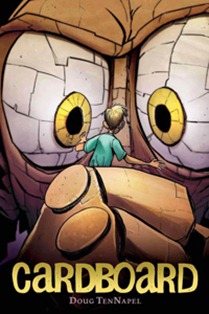
Review: Cardboard by Doug TenNapel

cardboard

Cardboard by Doug TenNapel

What’s the worst birthday present ever?  It just might be the cardboard box that Cam’s father had to give him.  Cam’s dad can’t find work, his mother is dead, and his family is falling apart.  But Cam is still optimistic about the fun the two of them can have together building things from cardboard.  Little does he know that the cardboard things they create are about to come to life!  There are rules that come with the magical cardboard.  Gather all of the scraps that are unused and return them to the man who gave Cam’s dad the cardboard.  Unfortunately, the local bully finds out that Cam has something worth taking away and starts to create an army of cardboard monsters.  What will it take for Cam and his dad to fix the misuse of magical cardboard?

TenNapel’s graphic novel is pure maniacal genius.  He takes a universal thing like playing with cardboard and makes it first pure magic and then dark and sinister.  He also carries the story to the extreme, refusing to back away and take an easier approach.  It makes for a riveting graphic novel that will have plenty of kid-appeal.  My only quibble is that the side story of the father’s romantic interest in the neighbor lady does not add to the story.

Because I am reviewing an advanced copy of the book, I don’t have it in the full color throughout.  The pages I do have are a mix of sandy tan, zips of red, deep purples with plenty of shadows in black.  He plays with angles and points of view, creating an entire world of cardboard before he is finished. 

This is a darker comic for kids, something that children will appreciate and gobble up.  Appropriate for ages 9-12.

Reviewed from ARC received from Scholastic.

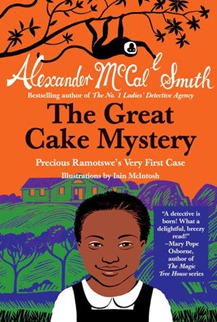
Review: The Great Cake Mystery by Alexander McCall Smith

great cake mystery

The Great Cake Mystery by Alexander McCall Smith, illustrations by Iain McIntosh

The author of The No. 1 Ladies’ Detective Agency series has written his first children’s book.  This one too stars Precious Ramotswe and is the story of her very first mystery as a child in Botswana.  When her father tells her a favorite story about when a lion got into their village, he notices that she has several characteristics of a detective: she asks a lot of questions and she can tell when people are telling the truth.  So when food starts disappearing at Precious’ school, she gets involved in solving the mystery.  She is shocked when one of her friends accuses another boy of being the thief because he has sticky fingers, literally.  It makes her even more determined to figure out exactly who is stealing the food. 

Told in very simple prose, sometimes a bit too simple, this story has a certain charm about it.  The book begins in a rather stilted way thanks to the wording, but quickly moves on to a more natural cadence that works much better.  I am pleased to see a mystery set in Africa with a young female protagonist who manages to solve the mystery without any adult help.  Smith captures the differences between societies as well as the special setting of Botswana.

McIntosh’s illustrations are block prints done in a limited color palette of red, black and gray.  They have a quality about them that speaks to the setting clearly.  They have a delicate and yet unfinished quality that is very appealing.

This book for young readers has plenty of mystery, detective work and an appealing heroine.  Appropriate for ages 6-9.

Reviewed from library copy.

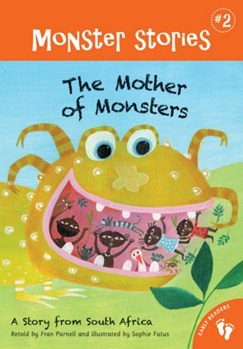
Review: The Mother of Monsters by Fran Parnell

mother of monsters

The Mother of Monsters: A Story from South Africa by Fran Parnell, illustrated by Sophie Fatus

This second in a series of monster tales features a story from South Africa retold for young readers.  It is the story of Ntombi, the mischievous and brave daughter of the chief, who is determined to see the dangerous Ilulange River with her own eyes.  Her father allows her the trip to the river as long as she takes the other girls along with her.  When they finally reached the legendary river, the girls are disappointed.  Instead of danger, they have found a river that looks perfect for swimming.  Leaving their clothes on the bank, the girls splash in the water.  Then they discover that their clothes are missing.  It could have been the Mother of Monsters who took them!  One-by-one the girls pled with the monster to return their things, and the monster does.  But Ntombi is not willing to beg for her clothing, so the monster swallows her whole.  But that is not the end of the story!  You must read this book to find out how Ntombi survives the Mother of Monsters.

Parnell has broken the story into chapters, making it all the more pleasant for beginning readers who can take the story a bite at a time.  The chapters are short and filled with action.  The star of the book, Ntombi, is both brave and foolish, often at the same time.  Throughout the story, she learns about humility but also about love.  The book is clearly from another culture, which makes it all the more interesting to read.

Filled with bright colors, the paintings by Fatus have an intriguing folk quality to them.  The scenes of the girls without clothing are handled with skillfully placed leaves, hands and flowers.  The illustrations have humor to them, which makes the book very playful, something that is welcome with a monster devouring people.

A welcome addition to folktales, this is a story I had never heard before and really enjoyed.  Appropriate for ages 6-8.

Reviewed from copy received from Barefoot Books.

Review: Rachel Carson and Her Book That Changed the World by Laurie Lawlor

rachel carson and her book

Rachel Carson and Her Book That Changed the World by Laurie Lawlor, illustrated by Laura Beingessner

This is a biographical picture book about the environmentalist Rachel Carson.  The book covers her childhood, which she spent outside in her family’s woods, orchards and fields.  Her mother loved nature and passed her passion on to her daughter.  Though times were tough and her father struggled to make enough money to support the family, Rachel was able to attend Pennsylvania College for Women in Pittsburgh.  It was during this time that she started to be concerned about the environment. Rachel decided to become a biologist and received her Master’s Degree, becoming one of the few female biologists.  After some time jobless due to the Great Depression, her two skills of science and writing came together in a job for the Bureau of Fisheries writing radio scripts about sea life.  After World War II, Rachel became alarmed at the chemicals being sprayed everywhere.  Though she had been diagnosed with breast cancer, she continued work on Silent Spring which caused such a reaction that new laws were created to protect the environment.  This book tells the story of a woman who was smart, scientifically gifted, and passionate about the natural world she loved so much. 

Lawlor pays real homage to Rachel Carson here.  It is the story of her entire life, from the early days of connecting with nature through her years of study to the final, vital book she wrote.  Hers is an inspirational story of what can be done by someone who is smart and passionate about a subject.  It is also a great story about a woman who defied the conventions and followed her dreams.  Lawlor makes Carson both intensely human but also heroic.

The illustrations are done in a simple style with ink and watercolor.  They celebrate the natural world around Carson with plenty of the greens of the woods and the blues of the waters.  And in each, Carson is observing and making notes.  It’s a glimpse of a woman who is a scientist first and foremost.

This is a celebration of a groundbreaking book by a groundbreaking woman.  Appropriate for ages 5-8. 

Reviewed from library copy.

Review: A Path of Stars by Anne Sibley O’Brien

path of stars

A Path of Stars by Anne Sibley O’Brien

Dara has a close relationship with her grandmother, Lok Yeay, who tells her stories about life in Cambodia when she and her brother were growing up.  She remembers Cambodia as a place of beauty, filled with moon and star light.  Lok Yeay also shared her darker memories of the soldiers coming and hiding in the jungle until they could make their way to Thailand.  But when the phone call came and Lok Yeay found out that her brother had died, she stopped telling stories.  In fact, she stopped getting out of bed entirely and stopped eating.  The entire family was worried.  Dara went to the garden and picked a rose and a ripe tomato.  Then she put them on a tray along with a photograph of Lok Yeay’s brother and went into the darkness of her grandmother’s room.  They shared the tomato and prayed for her brother, and Dara shared a story of the future and going back to visit Cambodia.

Commissioned by the Maine Humanities Council, this book reflects the story of a family that survived the Killing Fields in Cambodia and came to Maine afterwards.  According to her author’s note, O’Brien did extensive research not only about Cambodia’s history but also about its culture and environment.  As a reader, it is clear that she took Cambodia into her heart and showed its beauty.  O’Brien focuses on the intergenerational relationships in the family, demonstrating the importance of the grandparent in the Cambodian culture.  Additionally, the book is about war, families torn apart, and grieving. 

The art in the book is done in oil paints and oil crayon.  It has a wonderful jewel-tone and great depth and richness.  The illustrations focus on the family relationship, none of them showing the atrocities of war at all. 

This is a strong picture book that looks at the Cambodian Americans and the violent history that they fled from.  Appropriate for ages 7-9.

Reviewed from copy received from Charlesbridge.

Review: Ocean Sunlight by Molly Bang

ocean sunlight

Ocean Sunlight: How Tiny Plants Feed the Seas by Molly Bang and Penny Chisholm

Following her Living Sunlight book, this continues the story of how the sun makes life on earth possible.  Here, the focus is on the ocean and the role that sunlight plays even in the darkest depths of the sea.  The story starts with photosynthesis and food chains on dry land, then moves to the water.  Bang asks where the green plants in the ocean are except for the seaweed.  Then she shows the tiny phytoplankton that make up the plants of the sea.  The food chain is shown and the book then turns to the darkness of the deep and how the food chain works even in blackness.  It is beautiful science. 

Bang successfully combines poetry and science in this enticing picture book. Her tone is inviting, inquisitive and filled with wonder at the amazing things that happen due to our sun.  The book is written from the point of view of the sun itself and how its energy reaches everywhere on earth.  It is a celebration of the sun and of the oceans themselves too.

Chisholm’s art ranges from the glow of the yellow sun to the black deep of the ocean.  Everywhere, even in the darkness, you can see the energy of the sun.  When the phytoplankton are displayed, Chisholm shows them up close in all of their wonderful detail.  Then the energy of the sun dances above the waves in yellow dots.  The entire book sings with energy and light.

This book is a tribute to science and nature.  It’s a readable and very understandable look at the complex systems that make our lives possible.  Appropriate for ages 5-8.

Reviewed from library copy.

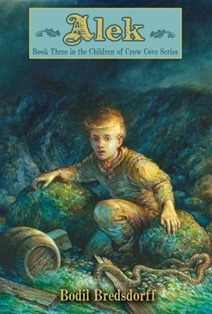
Review: Alek by Bodil Bredsdorff

alek

Alek by Bodil Bredsdorff

This final book in The Children of Crow Cove series has Doup as the main character.  Doup came to Crow Cove as a child with the Crow-Girl.  He has lived there all of his life but misses his older brother Ravnar who has moved away.  Doup reclaims his birthname of Alek and heads off with his father to town to find Ravnar.  They discover his empty home that is dirty and dank. Ravnar only appears when his boat is in harbor, otherwise he is out fishing for a living.  Alek’s father leaves him with Ravnar and returns to Crow Cove.  But one night, Alek witnesses a shipwreck on the beach where the sailors were tricked into beaching the boat.  He then sees a man murdered and discovers a young girl hiding away from the beach.  Alek takes the girl home with him, though she doesn’t speak his language.  Young Alek has to figure out what happened and then what to do about it.

I’ve adored this series for some time.  The writing is so natural and easy.  It is steeped in its seaside setting and filled with small details that bring their world to life.  This final book has plenty of action to move the story along, but it still remains a book about everyday life and creating a family out of the people who are with you.  From the small details of hunting and farming to information on meals and shopping, this book like the others in the series is a small book filled with the largeness of a life well led.

Definitely start with the first in the series.  As the series moves forward, the characters grow and age, offering a look at the results of their decisions in earlier books.  The strength of these books are in the complex characters, the fine details and the glory of the natural setting.

This is a fittingly strong final volume in a delight of a series.  Appropriate for ages 10-12.

Reviewed from copy received from Farrar Straus Giroux.