Review: The Cats in the Doll Shop by Yona Zeldis McDonough

cats in the doll shop

The Cats in the Doll Shop by Yona Zeldis McDonough, illustrated by Heather Maione

I was a big fan of The Doll Shop Downstairs when it came out in 2009.  Here in the sequel, Anna is two years older at  age 11.  She and her family still live above the doll shop, but their work has changed from that of a doll hospital to building their own dolls.  Anna finds a pregnant cat behind their house and wants to adopt it, but her father insists that they do not need a cat inside.   So Anna and her sisters give the cat food.  Anna is also looking forward to the arrival of her cousin from Russia, who is coming to live with them.  Anna wants to be best friends with her cousin, but Tania arrives and is very shy and has odd traits.  Anna has to figure out how to invite not only a new cousin into her family but maybe some cats too.

Once again, McDonough has captured the lives of a Jewish family at the turn of the century with great detail that brings the time period to life.  It is also a captivating picture of a loving family with three sisters who do not get along all the time.  The writing is simple and honest, creating a world of safety but also exploring more serious issues too.

In both lines of the story, the issue of acceptance and finding one’s place is a focus.  There are the cats who are wild outdoors, cold and even injured.  That parallels very clearly with the storyline of Tania, the cousin from Russia, who is also an outsider, stand-offish and needs nurturing to blossom. 

A great pick for any fan of the first book, these are books that read like classics.  Appropriate for ages 7-10, this book is also gentle enough to work for advanced younger readers looking for appropriate books to read. 

Reviewed from copy received from Viking.
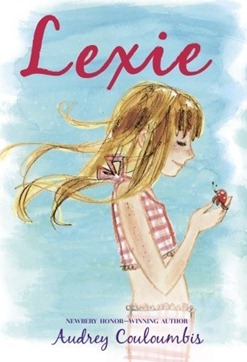
Review: Lexie by Audrey Couloumbis

lexie

Lexie by Audrey Couloumbis

The shore has always been one of ten-year-old Lexie’s favorite places in the world.  She would spend the summer there with her parents, playing on the beach, finding treasures in the sand, and reading picture books.  Now though, her parents are divorced.  So her mother isn’t going to be going to the shore at all.  Lexie is spending a week there with just her dad.  Or so she thinks!  On the way there, her father announces that his new girlfriend will be joining them, and her two sons too.  Lexie is pushed out of her usual bedroom into one that is as tiny as a closet.  Teenage Ben is also not enthusiastic about being stuck together.  Little Harris is messy and doesn’t even want to head outside at first.  As the two families try to live together, Lexie discovers that connections can be created over the smallest things and that there is still room for everyone even if the house is a lot more crowded.

This is a book that takes a moment in time, a week at the shore, and creates a world out of it.  Couloumbis writes with a voice that celebrates the small things, yet doesn’t wander.  The characters are real, each written with an honesty that is surprising.  The adults have faults, make mistakes.  The young people are struggling with this new situation, facing it with various emotions that all read as true.

Lexie is child who can see past her love for her father and see him through the others’ eyes.  At the same time though, she has to spend time with the others to understand them as deeply.  It all works well as the reader is also learning about these characters.  When truths are revealed is a crux of the story.  Throughout the book, honesty is explored.  Lexie struggles with trying to be kind and then finding herself in situations where it may have been better all along to tell the truth.  The situation with the adults mirrors this as well.

This is a radiant read that explores deep issues of divroce and truth while never losing the sunshine of the shore.  It would make an intriguing pairing with Junonia by Kevin Henkes which is for a similar age and also is set on the beach. Appropriate for ages 8-11.

Reviewed from copy received from Random House.

Also reviewed by:

Review: Benjamin Bear in Fuzzy Thinking by Philippe Coudray

benjamin bear in fuzzy thinking

Benjamin Bear in Fuzzy Thinking by Philippe Coudray

This is another winner from Toon Books.  Their graphic novel line up for elementary aged children manages to be funny, smart and perfectly age appropriate.  Originally published in France, this graphic novel has a certain elegance and style.  Each comic in the book ranges from three to six panels, telling small stories in a quick, simple way.  The humor ranges from a quiet contemplative joke about friendship to a physical slap-stick style.  Coudray has woven those styles together so the book moves from one level to another seamlessly, creating a dynamic and surprising reading effect. 

Coudray’s humor is multi-faceted and great fun to read.  The book moves from one sort of humor to another with great ease.  The illustrations are colorful but in a more sophisticated palette than many children’s books.  A lot of the humor is physical, so the illustrations convey much of it.  Even in the broadest of slapstick, there is a feel of style that makes it a unique read.

The book is laugh-out-loud funny and also great fun to share aloud with children.  This is a graphic novel that belongs in all public libraries, because it is a great hook for reluctant readers.  Appropriate for ages 5-9.

Reviewed from library copy.

Also reviewed by Pink Me.

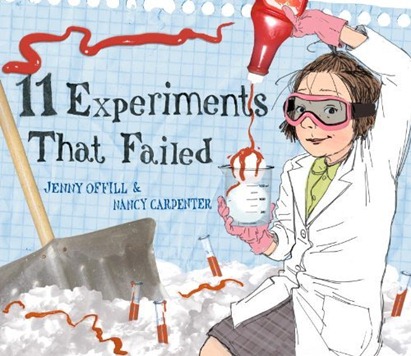
Review: 11 Experiments That Failed by Jenny Offill

11 experiments that failed

11 Experiments That Failed by Jenny Offill and Nancy Carpenter

A series of experiments take place in this book, each one funnier than the next.  They attempt to answer questions like: Can a kid make it through the winter eating only snow and ketchup?  Do dogs like to be covered in glitter?  Will a piece of bologna fly like a Frisbee?  The only way to find out is for the protagonist to test it scientifically.  That means trying to eat only ketchup and snow and observing the results.  Sprinkling her dog with glitter to see what happens.  Testing flight capabilities of bologna in the lunchroom of school.  All of the experiments have a question, a hypothesis, instructions, and results.  Budding scientists are sure to find plenty to laugh along with in this book, along with new ideas for experiments of their own.

This very funny book and also great fun to share.  The book design plays a big role in the fun.  Since the results are after a page turn, we enjoyed guessing what the results of the experiments would be.  Each experiment is unique, silly and entirely engaging.  The other winning part of the book is that this is a girl doing science, wearing her pink goggles and gloves, and her lab coat. 

The illustrations add to appeal.  The collage illustrations mix photographs and drawing.  They are quirky, colorful and glorious.

Get this one in the hands of science teachers who are teaching the scientific process.  Young scientists will also love it as well as any kid who enjoys silliness in their books.  But beware of flying bologna!  Appropriate for ages 5-8.

Reviewed from copy received from Schwartz & Wade Books.

Also reviewed by Pink Me and Young Readers.

Review: Saint Louis Armstrong Beach by Brenda Woods

saint-louis-armstrong-beach

Saint Louis Armstrong Beach by Brenda Woods

Saint loves playing the clarinet.  He plays it for tourists in New Orleans to earn money for a new clarinet and for his future at Julliard.  Life isn’t all easy though, he has taken to a stray dog that his father will not allow him to adopt and his best friend has outgrown him, now spending her time partying with the cooler, older kids.  As Hurricane Katrina approaches, Saint and his family are not that concerned since it is expected to miss New Orleans, as the days progress, the tension builds and the warnings increase.  Though Saint’s family tries to send him to safety, things don’t go as planned and Saint is trapped by the weather and the flood waters.

Woods has written a book that captures the power of music in a young man’s life nicely, bridging the days before the storm, the time during the storm, and the time afterwards together with song.  The bulk of this book is the period before the storm hits, showing the loving family that Saint comes from, his close-knit neighborhood, friends, crushes, and his love of a dog.  While I know that this had a large part in establishing reader relationships with Saint, it is lengthy and could have been made more focused.  In particular, his friendship with Money is talked about at length, but the book never returns to her after the storm. 

The period during the storm is dramatic, with Woods leaving the drama of the storm to stand on its own.  More time could have been spent here with the reader, truly exploring the emotions and complexity of survival.  The same is true of the time after the storm, where only a few chapters are left for the aftermath.  My hope is that there is a sequel that will let us better understand the effect of the storm on Saint and his family, neighbors and friends.

There were also portions of the book that were too neat and tidy.  One such instance was when Shadow, the dog, brings Saint’s parents to him after the storm.  It was just too convenient and should have been foreshadowed more clearly to work better.

In the end, I have mixed feelings about this book.  A sequel may very well fix a lot of the dangling story lines, which would go a long way.  Saint is a strong male character and this is a book that children will find shows a close-up perspective on the storm.  Appropriate for ages 9-12.

Reviewed from ARC received from Penguin.

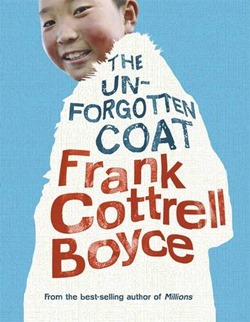
Review: The Unforgotten Coat by Frank Cottrell Boyce

unforgotten coat

The Unforgotten Coat by Frank Cottrell Boyce

Frank Cottrell Boyce has done it again, creating a book that surprises, amazes, and twists.  This is the story of what happens when two Mongolian boys join a class in England.  They appear out of nowhere, suddenly there in school.  The two brothers refuse to be separated, so the younger boy, Nergui, stays in his older brother’s class.  The two wear large coats and fur hats.  They immediately capture the imagination of Julie, one of their classmates, who is thrilled to be selected as their “Good Guide.”  She wonders where they live, trying for days to follow them home, but they elude her.  Chingis, the older boy, has photographs of Mongolia that he shares with everyone.  The entire class learns more about Mongolia than they had ever known.  But everything is not as it seems, and Julie discovers the truth too late to be of any help in the end.

The book is short, under 100 pages, with most of it being told in a flashback by an adult Julie.  The design of the book adds much to the story, with lined pages that resemble a notebook and Polaroid photographs that capture Mongolia and England, perhaps a mix of both.  The photographs in particular are cleverly done, hiding the truth and then revealing with equal success.

This is a powerful story that seems easy.  It reads as a simple story about two unusual children joining a classroom, and then twists and turns.  It speaks to community and acceptance throughout, showing a class that is eager and willing to embrace the new children, much to my delight.  Then the story takes on a more serious subject, about immigration, fear and deportation.  There is no didactic message here that is too heavy handed, instead it is kept serious but not message driven. 

The book also dances along an edge of imagination and reality where children who pay close attention will realize that even in the end there are questions about what has happened and what truly was.  This dance strengthens the novel even more, making it a powerful choice for discussion.

Highly recommended, this book may just be his best, and that is definitely saying something.  The short length, powerful subject and complex storyline all combine to make a package that is approachable for young readers, discussable by classes, and pure delight to experience.  Appropriate for ages 9-12.

Reviewed from library copy.

Also reviewed by:

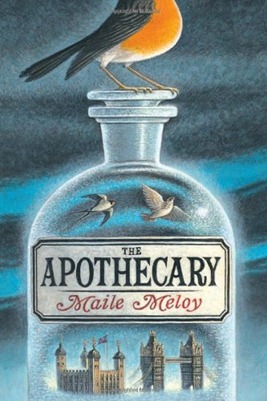
Review: The Apothecary by Maile Meloy

apothecary

The Apothecary by Maile Meloy

Janie and her parents have just fled California and headed to Cold War London.  There she meets Benjamin, a boy who stands up for himself.  As the two of them attempt to follow Soviet spies around London, they discover a real plot, a dangerous one.  When Benjamin’s father disappears as they hide in the cellar below, Benjamin and Janie must try to use an ancient book of potions and spells to try to find him.  But first they have to keep the book and themselves out of the hands of the enemies who are trying to find them.  It’s not that easy when you don’t know who to trust or what to believe in anymore.

When I opened this book, it was like tumbling into a world that felt like home to me, but at the same time surprised and delighted me too.  Meloy’s writing has a solid feel to it, hearkening back in tone to classic children’s books of adventure.  At the same time, she has created a wondrous world to explore, one that she brings to life with strong characters, memorable settings, and a lot of magic. 

The two protagonists are winning characters, filled with both whimsy and charm.  They are characters that readers will relate to instantly.  Their sudden friendship and mutual attraction is written in a way that makes sense.  Both characters are brave, inventive, and creative.  They are just whom one would want to take a grant adventure with. 

The ARC I read of the book only had a few of the illustrations in it, but those that I have seen are beautiful.  The design of the book plays with light and dark and so do the images, many of them capturing moments of action and importance in the story. 

A dazzling fantasy novel, this book also has a strong sense of period and setting that can be missing in magical books.  Appropriate for ages 10-13.

Reviewed from ARC received from Penguin Young Readers Group.

Also reviewed by:

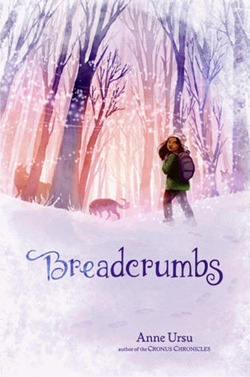
Review: Breadcrumbs by Anne Ursu

breadcrumbs

Breadcrumbs by Anne Ursu

Hazel and Jack have been best friends for almost their entire lives.   They share a love of Harry Potter, Narnia, and comics.  But now Jack spends a lot of time with his friends who are also boys.  He still does special things with Hazel, but it seems like less and less.  Then one day, something horrible happened and Jack stopped being friends with Hazel.  He was rude and mean.  Soon after that, Jack disappeared.  His parents weren’t worried.  They insisted he had been sent to care for an elderly aunt, but Hazel felt that something was really wrong.  When Tyler, a boy Jack was friends with, told her that he had seen a strange woman take Jack into the woods, Hazel set out to find Jack and bring him back.  But even her love of books can’t prepare Hazel for the twisted world she finds in the woods and the hazards she will have to face to find her best friend.

Ursu writes with a tone of wonder and discovery.  She puts things in ways that they have not been said before, creating new ways of expressing emotion and attachment.  She takes her time, building a way of seeing the world that is quirky and compelling at the same time.  Here is a paragraph from page 44 which shows the care with which she has created her world:

There were some days, ever since the summer, when the whole feel of Jack seemed to change.  Like suddenly, instead of being made of baseball and castles and superheroes and Jack-ness, he was made of something scratchy and thick.  Hazel could tell, because he had been her best friend for four years, and you can tell when your best friend is suddenly made of something else.  And all she could do was try to remind him what he was really made of.

The two main characters are exceptional.  Jack is a boy dealing with a mother fighting severe depression, someone who has already been lost to the emptiness and cold.  Hazel is a girl who never sees her father any more, who has a mother who wants her to make new friends beyond Jack, and who loves her friend beyond bravery. 

Everything in this book just works.  The background of the two protagonists clicks into what they do in reaction to the magic that enters their world.  Jack embraces the cold and emptiness.  Hazel has been abandoned by her father and will not abandon her best friend.  It is all simply cohesive.

This is a magical, amazing, lovely read that will appeal most to readers who also love Narnia and The Snow Queen.  Appropriate for ages 9-12.

Reviewed from ARC received from Walden Pond Press.

Also reviewed by:

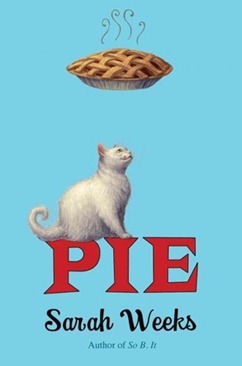
Review: Pie by Sarah Weeks

pie

Pie by Sarah Weeks

When Alice’s Aunt Polly dies, the entire community of Ipswitch feels the loss.  Polly, the Pie Queen, left behind quite a void, one that had been filled by her pie shop and her incredible gift for baking pies.  Every resident had a favorite and with her death, they knew they would never taste them again.  But for Alice it is much worse, she has lost one of her dearest friends as well as the shop where she spent much of her time.  Her Aunt Polly left the recipe for her award-winning pie crust to Lardo, her ornery cat, and she left Lardo to Alice.  No one is really sure how someone can leave a recipe to a cat.  As the days pass, strange things start happening, but only Alice seems to notice.  She knows there is someone out there trying to get their hands on the recipe.  With her new friend, Charlie, Alice is determined to solve the mystery.

Weeks has written a book as light as meringue but that has plenty of depth as well.  The story is great fun to read.  It has the tang of a mystery combined with the sweetness of pie.   The pie recipes shared at the beginning of each chapter will have you drooling and determined to see if you could maybe be the next Blueberry Award winner.

Notice how that rhymes with Newbery Award winner?  Weeks has a lot of fun with her brief description of how the Blueberry Award is announced.  It closely resembles the Newbery Award process and had me giggling.  It’s a great insider joke to have in a children’s book.

Alice is a strong character, struggling with the loss of her aunt.  She is determined, creative and imaginative, singing little songs to herself all the time.   These are the things her aunt supported in her, but that her own mother doesn’t understand.  The family dynamic is an important piece of the entire book and is written with great honesty.

A delicious, fun read, this book of pie and mystery is a treat whether read with alamode or alone.  It’s an ideal book for classroom sharing as well, after all who doesn’t like pie?  Appropriate for ages 9-12.

Reviewed from ARC received from Scholastic Press.

Also reviewed by: