Review: Cardboard by Doug TenNapel

cardboard

Cardboard by Doug TenNapel

What’s the worst birthday present ever?  It just might be the cardboard box that Cam’s father had to give him.  Cam’s dad can’t find work, his mother is dead, and his family is falling apart.  But Cam is still optimistic about the fun the two of them can have together building things from cardboard.  Little does he know that the cardboard things they create are about to come to life!  There are rules that come with the magical cardboard.  Gather all of the scraps that are unused and return them to the man who gave Cam’s dad the cardboard.  Unfortunately, the local bully finds out that Cam has something worth taking away and starts to create an army of cardboard monsters.  What will it take for Cam and his dad to fix the misuse of magical cardboard?

TenNapel’s graphic novel is pure maniacal genius.  He takes a universal thing like playing with cardboard and makes it first pure magic and then dark and sinister.  He also carries the story to the extreme, refusing to back away and take an easier approach.  It makes for a riveting graphic novel that will have plenty of kid-appeal.  My only quibble is that the side story of the father’s romantic interest in the neighbor lady does not add to the story.

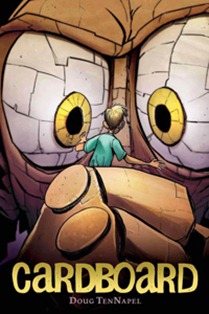
Because I am reviewing an advanced copy of the book, I don’t have it in the full color throughout.  The pages I do have are a mix of sandy tan, zips of red, deep purples with plenty of shadows in black.  He plays with angles and points of view, creating an entire world of cardboard before he is finished. 

This is a darker comic for kids, something that children will appreciate and gobble up.  Appropriate for ages 9-12.

Reviewed from ARC received from Scholastic.
Review: Take What You Can Carry by Kevin C. Pyle

take what you can carry

Take What You Can Carry by Kevin C. Pyle

This graphic novel explores connections between generations and across races, in an innovative way.  It is the story of two teenage boys.  One is a Japanese American who is sent to the internment camps during World War II.  His part of the story shows the displacement of his family, the loss of their rights, and the realities of the camps.  In alternating chapters, we also get the modern story of a teenage boy who moves to a new community and gets in with the wrong group of boys.  Soon he is robbing stores and eventually ends up in real trouble.  The man whose store he robs was the Japanese teen, who also resorted to stealing in the camps. 

At first, readers are not sure how the two stories will ever come together into one, or if they ever will.  They seem so remote and separate from one another.  Then when they do, there is a great satisfaction is realizing why the modern boy is given a chance to remedy what he has done.  It is a story that deals with two very personal stories, but that also has a more universal message about displacement, theft and redemption.  Both of the teen boys find ways to make things right in their lives, to accept their conditions, to rise above. 

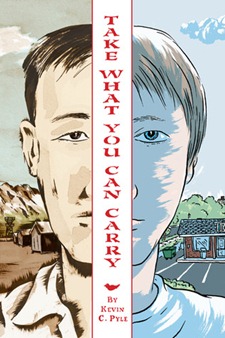
Pyle’s two stories are shown in different color palettes as you can see from the cover.  The sepia tones work well for the historical story, also emphasizing the wasteland of the internment camps.  The blues of the modern story give it a cool feeling that suits a story where a boy is not making the right choices and where his world is devoid of warmth. 

This intriguing graphic novel is a compelling read that will show young readers not only about history but also about themselves and their own choices.  Appropriate for ages 12-14.

Reviewed from copy received from Henry Holt.

Review: The Year of the Beasts by Cecil Castellucci

year of the beasts

The Year of the Beasts by Cecil Castellucci and Nate Powell

Told in chapters that alternate Castellucci’s writing with Powell’s graphics, this is the story of two sisters.  When the summer carnival comes to town, Tessa, her younger sister Lulu and her best friend Celina get to go to the carnival without their parents for the first time.  After meeting up with a group of boys they know, the three girls and the boys head to the sideshow tent with its darkness and opportunities.  But Tessa’s plans don’t quite work out, and the boy she has a crush on, Charlie, ends up entering the tent with Lulu instead.  Tessa is left to go in with Jasper, a boy who is known as a strange loner.  When they exit, Tess has rebuffed Jasper’s attempts to kiss her, but something has obviously happened between Charlie and Lulu that has sealed them together as a couple.  Now Tessa has to deal with her jealousies and their dark results.

Castellucci’s prose is lush and wild.  The emotions in the book sizzle, coming right off the page.  On page 97, there is a great example of this:

If there were such a thing as a dark cloud over someone’s head, Tessa had one.  It was a stormy little thing.  With hail and lightning and thunder.  And no silver lining.

She explores the feelings of confusing lust and potential love, the ability for those same feelings to alienate and discourage, and the intensity of sisterhood.  The book is character-driven with Tessa at its center in all of her confusion, desperation to not be jealous, and constantly feeling as if she is second best.  There are no easy answers here, nothing is let go of easily, and emotions twist and turn.  It is a beautiful storm of a book.

Then you have the other chapters done in graphic novel format that show Tessa as Medusa with her nest of snake hair.  The graphic portion moves along in advance of the text portion, foreshadowing things that are yet to come.  Medusa finds that her school is also filled with other monsters, her best friend is a mermaid, and Charlie is a centaur.  She has turned her parents to stone with her gaze and now must live with the consequences of that unless she is able to reawaken as a human again. 

The pairing of these two makes this book even more original and powerful.  It also makes the book much more welcoming for reluctant readers or those who have discovered Castellucci through her graphic novels. 

An emotional ride of a teen novel done with beauty and power, this book has an innate appeal thanks to its graphic novel portion and the dynamic writing.  Appropriate for ages 13-16.

Reviewed from copy received from Roaring Brook Press.

Review: Giants Beware by Jorge Aguirre

giants beware

Giants Beware! by Jorge Aguirre, illustrated by Rafael Rosado

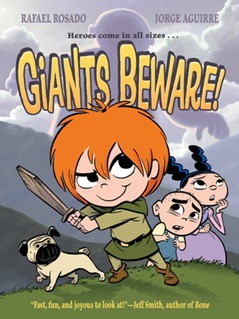
Claudette lives in a town protected by a huge wall to keep the giant out.  Years earlier, the town had been terrorized by The Baby-Feet Eating Giant who still figures into most of the stories to keep the children in town in line.  Claudette though knows that she is brave enough to slay any giant, so she sets out with her wooden sword to kill the giant.  She brings along her friend Marie who desperately wants to be a princess and her younger brother Gaston who is a disappointment to their father who wants him to be more brave.  Gaston on the other hand wants to be a chef.  The three children head out on their quest that will take them through the Forest of Death, across the Mad River, and up to the Giant’s Peak.  Unfortunately, their parents are following them to bring them back home before their adventure is really complete!  Can Claudette kill the giant before being dragged back to safety?

How I love a book that turns gender stereotypes on their head.  In Claudette, a spunky girl who is brave and ferocious, the author does just that.  Claudette is wild, heroic and along the way learns a lot about being a better friend and sibling.  Told with plenty of humor, the storyline is tight,  and the world building is amazing.

Rosado’s illustrations shout with color and energy.  This full-color graphic novel gets a lot of its appeal from the strength of the illustrations, their clarity and the skill with which the story is depicted. 

Highly recommended for all library collections, this is a graphic novel that has broad appeal.  Here’s hoping there are more monsters to slay in upcoming episodes of this feisty red-headed heroine!  Appropriate for ages 9-12.

Reviewed from copy received from First Second.

Review: Nursery Rhyme Comics

nursery rhyme comics

Nursery Rhyme Comics

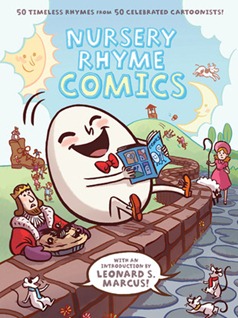
Take 50 classic nursery rhymes and put them in the hands of 50 of the top cartoonists of the day, and you get a nursery rhyme book that will delight all ages!  As you turn the pages, the styles change too.   While the text stays true to the nursery rhyme, comic asides and comments merrily twist the meaning at times.  There are also plenty of modern twists on the old tales, like There Was an Old Woman Who Lived in a Shoe is a the owner of a daycare who also happens have a rock and roll band.  This is a book that embraces the humor, quirkiness and outright strangeness of nursery rhymes and takes them to another level.

When I first opened the book, I thought I might list my favorite rhymes and illustrations, but then I realized turning the pages that the real impact of this book is because there are so many diverse rhymes and illustration styles.  I tip my hat to the skill of Chris Duffy in matching illustrators to the ideal nursery rhymes.  This is really what makes the book sing.  I also appreciate the creative freedom given to the artists, making the result all the more intense and beautiful.

Highly recommended, this would be a great way to get nursery rhymes in the hands of older children who may have missed out on them when they were younger.  It’s also a delight if you know the rhymes already.  Appropriate for ages 6-10.

Reviewed from library copy.

Review: Zig and Wikki in the Cow by Nadja Spiegelman

zig and wikki in the cow

Zig and Wikki in the Cow by Nadja Spiegelman and Trade Loeffler

This is the second Zig and Wikki book, featuring two little aliens who find their way to Earth.  In this book, the two friends lose their spaceship when they return Zig’s pet fly its native habitat.  On the way, the two discover that flies eat poop, that dung beetles use it as well, and that cows have multiple stomachs.  It’s all a matter of learning things up close and personal, right down to being swallowed by a cow.  This humorous mashup of scientific fact, alien appeal, and comic format makes for an engaging read for young readers.

It is really the blend that works so well here.  The writing is light and funny, combined with scientific facts that are highlighted with photographs.  Readers learn about food cycles, ecology and habitats without even realizing it.  Add in the humorous poop factor and the graphic novel format, and this is one appealing package.

A graphic novel series that is a lot of fun and also informational, this second book is a winner, winner, cow dinner.  Appropriate for ages 7-9.

Reviewed from copy received from Candlewick Press.

Review: Chopsticks by Jessica Anthony

chopsticks

Chopsticks by Jessica Anthony, illustrated by Rodrigo Corral

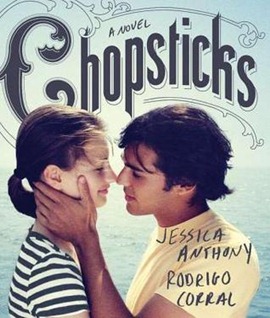
Told only in photographs, this book is the story of Glory, a piano prodigy.  After her mother dies, Glory’s music continues to soar, leading her to play sold out programs at places like Carnegie Hall.  Her father is a large force behind her success, driving her forward with his high expectations for her future in music.  Then Glory meets Frank, a neighbor, and falls in love.  As her connection with Frank grows and she immerses herself in his art, things begin to change.  Soon the young prodigy becomes obsessed with the song “Chopsticks” and is unable to play anything else.  Now it is up to the reader to piece together the truth of Glory’s life as the frightening picture comes together into something entirely different than it first appeared.

I was unable to put down this book and devoured it in a single sitting.  The intriguing use of full-page photographs alone and then the wild twists of the story make it compulsively readable.  Anthony’s story reads like a movie, in pictures.  The building tension of the story, the budding romance, and then the truth that hits like a cold wave of ice water, all combine to form a riveting read. 

The photographs work to add to the story.   They use intriguing angles, photos of documents, different amounts of light and dark, different focus amounts, and play with a combination of home photographs and professional feel.  You never know what you will see on the next page. 

I immediately thought of reluctant readers, especially those interested in art or music as a perfect audience for this book.   It will appeal to many teen readers.  There is one caution for librarians to be aware of and that is that there are some female nudes in the book.  This moves it from being a book for younger teens into one for a slightly older audience, so I’d say the book is appropriate for ages 16-18.

Reviewed from copy received from Razorbill.

Review: Explorer: The Mystery Boxes by Kazu Kibuishi

mystery boxes

Explorer: The Mystery Boxes by Kazu Kibuishi

Released March 1, 2012.

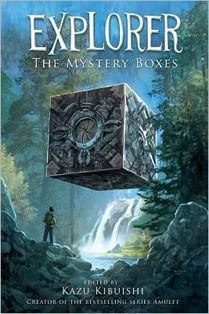
Kibuishi is the author of the Amulet series of graphic novels as well as the anthologist for Flight.  Here he has created an anthology for children that has seven short stories in graphic format that focus on a single subject: opening a mystery box.  The seven stories all take very different approaches to the focal subject, some of them approaching with humor, others with drama.  The differences deepen when the drawing style is factored in, some creating almost real images and others looking more like mainstream cartoons.  They all add up together to a whole that works well, the entire book rather like a mystery box since you never know what story is coming after the next turn of the page.

Kibuishi’s skill in anthologies is apparent here, weaving the seven individual stories together into a flow that works well.  Many of the stories focus on the boxes showing the characters more depth to their world than they ever knew existed.  There are dolls that come to life, spiritual worlds in modern suburbia, magicians searching for magical objects, war, aliens and treasure too.  Just like textual short stories, these are focused stories that get to the point and end up surprising and delighting thanks in part to their brevity.

This is a great addition to library collections and will offer glimpses of rich worlds to graphic novel fans.  Appropriate for ages 9-12.

Reviewed from ARC received from Amulet Books.

Review: Friends with Boys by Faith Erin Hicks

friends with boys

Friends with Boys by Faith Erin Hicks

Released February 28, 2012.

Maggie McKay has been homeschooled her entire life by her mother, who has left the family.  Now she has to start regular high school, just like her three older brothers have.  Maggie has never had any friends who were girls, happily being friends with just her brothers.  As Maggie starts high school, she discovers the boredom, the cliques, and the first tentative steps at real friendship, even one with a girl!  Add into the mix a tragic ghostly mystery complete with a female ghost who follows Maggie around, and you have an interesting mix of graphic novel, paranormal, and high school reality.

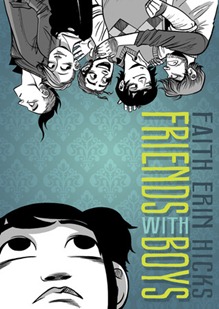
Hicks has created a very engaging graphic novel here with her mix of genres.  Her characters are fully-formed, with all of the major characters displaying real depth.  The relationships between siblings is a large part of the storylines in the novel.   I also appreciated a story about a homeschooled teen who may be hesitant to enter high school but is not specifically troubled by her previous schooling.

The graphic format is well-used here.  The images are regularly used to tell more of the story than the characters’ speech bubbles do.   Done in black and white, the use of shadow and light is very effective.  The story takes several surprising twists, which makes it all the more readable.

A graphic novel about a girl who is not particularly girly is just the right book to have in library collections.   Appropriate for ages 13-15.

Reviewed from copy received from First Second.