A Voice Named Aretha by Katheryn Russell-Brown

A Voice Named Aretha by Katheryn Russell-Brown

A Voice Named Aretha by Katheryn Russell-Brown, illustrated by Laura Freeman (9781681198507)

Explore the life of one of the greatest singers of all time in this picture book biography of Aretha Franklin. Aretha grew up in a family filled with music and talking. She was a shy little girl, but even from a young age had an incredible singing voice. Her parents left one another when she was a child, and she lived with her father. She adored her time with her mother until her mother died when Aretha was 10. She used music to express her feelings, moving to New York City at age 18. It was the turbulent 1960s where clubs and venues were still segregated for the most part. Aretha made sure to not ever be tricked out of being paid as well as paying attention to venues where everyone was allowed. She was popular but all of her albums flopped until she made some of her most iconic songs and became the Queen of Soul.

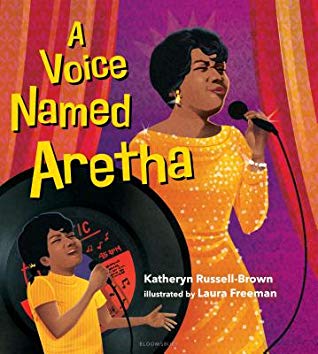
Told in a warm and welcoming tone of someone sharing the life story of a beloved family member, this picture book biography captures the way so many people feel about Aretha Franklin and her joyous impact in their lives through her music. The text is accessible and shares the hardships of Franklin’s life and career, displaying her resilience in the face of disappointment as well as her savviness about business and civil rights. The digital art in the book is full of bright and deep colors that pop on the white backgrounds.

A grand picture book biography for the Queen of Soul. Appropriate for ages 6-9.

Reviewed from ARC provided by Bloomsbury.

The Secret Garden of George Washington Carver by Gene Barretta

The Secret Garden of George Washington Carver by Gene Barretta

The Secret Garden of George Washington Carver by Gene Barretta, illustrated by Frank Morrison (9780062430151)

George Washington Carver grew up to be a famous botanist and inventor. In 1921, he spoke before Congress, talking about how the humble peanut could be used to make so many different products. This famous man’s connection with plants and the earth came from an early age in the form of his own secret garden. Born into slavery in 1864, he was kidnapped as an infant along with his mother. His mother was never found, but George was brought back to slavery. George and his brother grew up on the farm, even after slavery was abolished. Every day, George headed to the woods and the garden he was growing there. He learned all about plants without being mocked or teased, soon helping people in the area with their sick plants. He grew up, got an education, and became an Agriculture professor at Tuskegee Institute He also traveled the United States working directly with farmers to answer their questions and improve their farms. 

Barretta’s picture book biography of this famous African-American scientist and genius is fascinating and filled with moments of wonder. The frightening kidnapping in his infancy, his start as a slave and then working on a farm for his previous owners, and his incandescent mind finding a way forward to learn and grow all add up to a remarkable life. The text is engagingly written for a compelling read. 

Morrison’s art is phenomenal. The browns of the days of manual labor on the farm contrast with the bright greens, growing shoots, and tall trees of George’s secret garden. The two parts of his life could not appear more different. 

A fascinating look at a remarkable man. Appropriate for ages 6-9.

Reviewed from library copy.

Mother Jones and Her Army of Mill Children by Jonah Winter

Mother Jones and Her Army of Mill Children by Jonah Winter

Mother Jones and Her Army of Mill Children by Jonah Winter, illustrated by Nancy Carpenter (9780449812914)

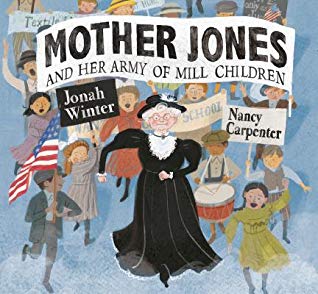
Mother Jones is mad. She is furious at the treatment of children who work in the mills for a paltry 2 cents an hour to help keep their families from ruin. She saw the issue first hand and called the newspapers. But the newspapers are owned by wealthy men who were friends with the owners of the mills. So Mother Jones came up with a plan to create a protest march from Philadelphia to New York City. The march started on July 7, 1903. They got a lot of media attention, and Mother Jones changed her plan and decided to march to Washington, D.C. Mother Jones presented her arguments in every town and then the children put on a play. It took them fourteen days to reach New York City and six more to reach D.C. They didn’t get to see the President, but the march did its job anyway and laws changed to forbid child labor in the United States. 

Winter tells the complex story of Mother Jones and her fight to stop child labor in the United States. By focusing on the march itself, the picture book stays sharp and fast paced. He uses quotes from Mother Jones in the text as well as on the endpapers which really capture the spirit of Mother Jones and her willingness to fight for others. 

The illustrations center on Mother Jones in her black and white outfit standing out against a pastel world that is almost foggy in its softness. This works very well for this subject, showing the impact of a person willing to make sacrifices and stand up to demand change.

A dynamic look at the unique historical figure of Mother Jones and her continued impact on our world. Appropriate for ages 6-9.

Reviewed from e-galley provided by Schwartz & Wade.

Wanted! Criminals of the Animal Kingdom by Heather Tekavec

Wanted Criminals of the Animal Kingdom by Heather Tekavec

Wanted! Criminals of the Animal Kingdom by Heather Tekavec, illustrated by Susan Batori (9781525300240)

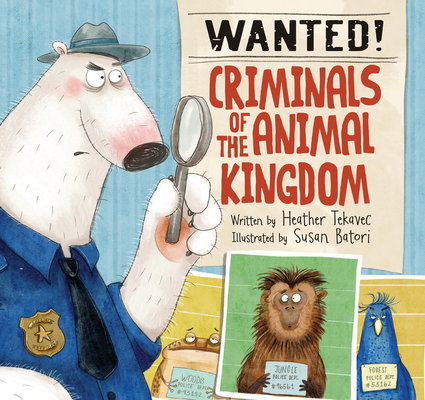
Take a look at the thirteen most wanted creatures in the animal kingdom. Their crimes are all unique to them and their names indicate what they have done. There is Big Bad Mama, Bubbles, Queenie the Meanie, and the Backyard Burglar. Each animal has its own rap sheet, complete with what they are wanted for, their aliases, distinguishing features, life span, sightings, witnesses and even previous arrests and gang affiliations. The various crimes are things like faking their own death for a frog, assault for spitting llamas, and traffic violations for crabs who cross the road in a huge crowd.

Done with a broad sense of humor, the book also offers factual information within the laughter. The criminal activity part of their rap sheet offers a paragraph about the animal and its problematic behavior. Some of the animals may be familiar to children but others will be a delight to discover. The art works seamlessly with the text to create a full rap sheet with loose paperclips, file folders, photographs and much more.

Humor combines with science and police records to create a funny and dynamic animal picture book. Appropriate for ages 6-9.

Reviewed from e-galley provided by Kids Can Press.

Portrait in Poems by Evie Robillard

Portrait in Poems The Storied Life of Gertrude Stein & Alice B. Toklas by Evie Robillard

Portrait in Poems: The Storied Life of Gertrude Stein & Alice B. Toklas by Evie Robillard, illustrated by Rachel Katstaller (9781525300561)

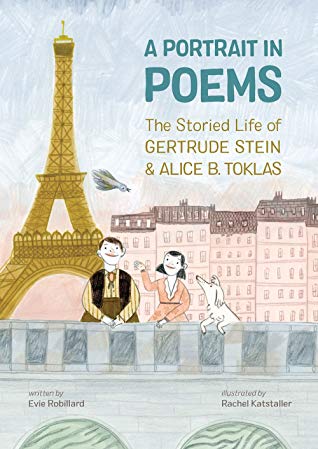
Enter the marvelous world of Gertrude Stein and her partner Alice B. Toklas in France in the middle of the 20th century. Stein created an art gallery in her home after moving to Paris with her brother. They purchased from many incredible artists of the time, including Picasso. In fact, Picasso was so taken with Stein that he had her sit for a portrait which he then gave to her as a gift. Saturday evenings, they opened their home so that others could see the art. Stein was both a writer and a genius, working on capturing her world in words for both adults and children. Stein and Toklas purchased a dog they called Basket, that was featured in Stein’s work, including the “autobiography” she wrote about Alice. 

Robillard captures the essence of the life that Stein and Toklas created together, one of acceptance and adoration for one another. Her author’s note speaks to the complexity of their life in World War II France as well as their relationships with those who conspired with the Germans, which likely allowed them to keep their collection of masterpieces safe during the invasion. These elements are not referred to in the body of the book, instead focusing on the art collection, the world they built for themselves, and Stein’s writing and ideas.

Fitting nicely with the clever writing, the illustrations are playful and jovial with a great quirkiness as well. The images depict Gertrude and Alice together, their garden, their home and Basket as well in a color palette that feels timely and modern. 

A lovely picture book biography that celebrates an iconic lesbian couple in history. Appropriate for ages 6-9.

Reviewed from e-galley provided by Kids Can Press.

Honeybee: The Busy Life of Apis Mellifera by Candace Fleming

Honeybee The Busy Life of Apis Mellifera by Candace Fleming

Honeybee: The Busy Life of Apis Mellifera by Candace Fleming, illustrated by Eric Rohmann (9780823442850)

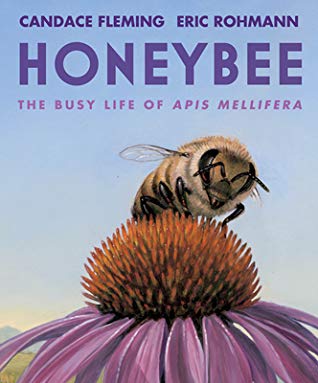
On a summer morning, a new bee hatches in a hive. She is Apis mellifera and must rest before she can do anything. She eats and grows stronger, her color changes from gray to a yellow orange. Though she is destined to fly eventually, first she must do many other jobs for her hive. She tends to the larvae, checking on them and feeding them with liquid from her glands. After eight days, she changes jobs and starts tending to the queen bee. At 12 days old, she heads to another job and starts building honeycomb then fills it with the nectar the other bees bring in. Her next job is to guard the hive from predators and other bees from different hives. Then finally, on her 25th day, it is time for her to fly. And does she ever fly! She flies for over 500 miles total and visits over 30,000 flowers! 

Frankly, I have never understood honeybees better than I do now after finishing this nonfiction picture book. Fleming writes in such an engaging way, inviting readers to wonder when Apis will actually get to fly for the first time. The various changes to Apis’ body as well as the variety of duties she has in the hive are very interesting and make the species all the more fascinating. 

Rohmann’s illustrations bring readers right into the hive, seeing it from a bee’s point of view. His rich illustrations are filled with honey gold and bright summer skies that beckon to readers, inviting them to lean in even closer.

A great science and nature book, there’s plenty of buzz about this one! Appropriate for ages 4-8.

Reviewed from library copy.

Bear Goes Sugaring by Maxwell Eaton III

Bear Goes Sugaring by Maxwell Eaton III

Bear Goes Sugaring by Maxwell Eaton III (9780823444489)

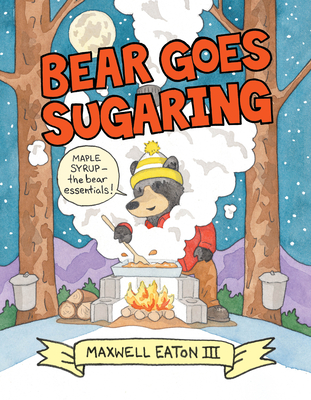
Join Bear as she goes through the process of making maple syrup. Joined by her friends, Fox and Squirrel, who are desperate for pancakes, Bear begins by getting her tools ready. Both Squirrel and Fox don’t really help much, offering a lot of side comments and once knocking a hole in one of the buckets. That hole though gives Bear a chance to show readers that all sorts of containers can be used to catch the sap as it drips from the trees. Readers will learn about the type of maple used for syrup making, about the tools used, and then the process of boiling down the sap into maple syrup. Bear does this outside with an open fire and a lot of patience. The end result is sweet, particularly for the impatient pair who have joined Bear throughout the book.

Eaton excels at making nonfiction subjects jovial and great fun. His use of Squirrel and Fox to offer comical asides makes the book great fun to read. Bear herself is knowledgeable and unflappable as she reacts patiently to her friends and buckets with new holes. The information shared here is fascinating and delivered in a way that allows readers to really understand things like why sugar maples are the best for syrup and how many gallons of sap it takes to make a gallon of maple syrup (40!) 

The illustrations are bold and colorful, inviting readers into the woods with Bear and showing in detail what the steps are to making maple syrup. Squirrel and Fox peek out from various places on the page, offering their opinions on what is happening. 

Funny and factual, this picture book is not syrupy at all. Appropriate for ages 4-6.

Reviewed from library copy.

Astronauts: Women on the Final Frontier by Jim Ottaviani

Astronauts Women on the Final Frontier by Jim Ottaviani

Astronauts: Women on the Final Frontier by Jim Ottaviani, illustrated by Maris Wicks (9781626728776)

The team who brought us the Primates graphic novel continue their focus on women in science. This time they tell the story of Mary Cleave and how women were finally able to enter NASA has astronauts. It is the story of hard work and dedication, of insistence on being heard and knowing when to push. It is a story of proving the worth of women, undergoing a battery of tests and still being told no. The tale is a compelling one, a story of politics and science, of women’s right to be seen as valid scientists, engineers and pilots.

There are so many heroines on these pages! Women who changed the course of NASA along the way. Valentina Tereshkova, the first woman in space, is also shown as the space race intensified between the United States and the Soviet Union. Throughout, Cleave narrates the history for the reader, as she floats in space herself, testimony to the progress that would eventually be made. Just as with any fight for equal rights, this one took a lot of time and a lot of women to enact. It is a story worth exploring.

The graphic novel format works particularly well with this subject as the story plays out almost as a documentary across the pages. Wicks makes each woman recognizable on the page as an individual, eventual side-by-side illustrated version and actual photograph show how deeply she connected the images to the actual women.

A stellar look at gender in space and science that is inspiring. Appropriate for ages 9-12.

Reviewed from copy provided by First Second.

On Wings of Words by Jennifer Berne

On Wings of Words by Jennifer Berne

On Wings of Words: The Extraordinary Life of Emily Dickinson by Jennifer Berne, illustrated by Becca Stadtlander (9781452142975)

Emily Dickinson grew up in a small New England town. As a little girl, she explored the fields and gardens around her home, discovering new words and ways of thinking about the world around her. Her feelings were deeper than most people’s with higher joys and lower sadness. Her thoughts here also deeper, including her love for so much around her. She found sorrows and looked for solutions in school and church, but refused to put her faith in things she could not see. She had her own brand of hope, one that led her to her own truth too. That truth came to life in her poems, not shared with anyone, just with herself. They allowed her to express her feelings and the way she looked at the world, puzzle through things, and ask questions that could not be readily answered. Those same words now inspire so many readers to do the same, find their own voice, look at the world from their own lens: just as Emily did.

Berne writes her prose with a thoughtfulness that allows her to intersperse many of Dickinson’s own words in the text. Dickinson’s poems fly on the page, lifting it up in the way only she can. Berne then serves as her foundational story, offering clarity about Dickinson’s life and then pairing those with poems. It’s a delightful way to introduce young readers to poetry and to Emily Dickinson herself. 

The illustrations have a lot of historically accurate elements like the Dickinson home and surroundings. Still, my favorite illustrations are the ones where Emily’s imagination soars along with the illustrations which become whimsical and wild. 

A grand look at a great poet’s life and work. Appropriate for ages 6-9.

Reviewed from copy provided by Chronicle Books.