Honeybee: The Busy Life of Apis Mellifera by Candace Fleming

Honeybee The Busy Life of Apis Mellifera by Candace Fleming

Honeybee: The Busy Life of Apis Mellifera by Candace Fleming, illustrated by Eric Rohmann (9780823442850)

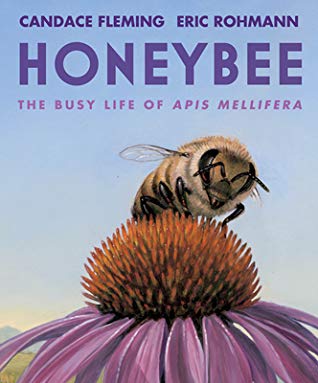
On a summer morning, a new bee hatches in a hive. She is Apis mellifera and must rest before she can do anything. She eats and grows stronger, her color changes from gray to a yellow orange. Though she is destined to fly eventually, first she must do many other jobs for her hive. She tends to the larvae, checking on them and feeding them with liquid from her glands. After eight days, she changes jobs and starts tending to the queen bee. At 12 days old, she heads to another job and starts building honeycomb then fills it with the nectar the other bees bring in. Her next job is to guard the hive from predators and other bees from different hives. Then finally, on her 25th day, it is time for her to fly. And does she ever fly! She flies for over 500 miles total and visits over 30,000 flowers! 

Frankly, I have never understood honeybees better than I do now after finishing this nonfiction picture book. Fleming writes in such an engaging way, inviting readers to wonder when Apis will actually get to fly for the first time. The various changes to Apis’ body as well as the variety of duties she has in the hive are very interesting and make the species all the more fascinating. 

Rohmann’s illustrations bring readers right into the hive, seeing it from a bee’s point of view. His rich illustrations are filled with honey gold and bright summer skies that beckon to readers, inviting them to lean in even closer.

A great science and nature book, there’s plenty of buzz about this one! Appropriate for ages 4-8.

Reviewed from library copy.

Bear Goes Sugaring by Maxwell Eaton III

Bear Goes Sugaring by Maxwell Eaton III

Bear Goes Sugaring by Maxwell Eaton III (9780823444489)

Join Bear as she goes through the process of making maple syrup. Joined by her friends, Fox and Squirrel, who are desperate for pancakes, Bear begins by getting her tools ready. Both Squirrel and Fox don’t really help much, offering a lot of side comments and once knocking a hole in one of the buckets. That hole though gives Bear a chance to show readers that all sorts of containers can be used to catch the sap as it drips from the trees. Readers will learn about the type of maple used for syrup making, about the tools used, and then the process of boiling down the sap into maple syrup. Bear does this outside with an open fire and a lot of patience. The end result is sweet, particularly for the impatient pair who have joined Bear throughout the book.

Eaton excels at making nonfiction subjects jovial and great fun. His use of Squirrel and Fox to offer comical asides makes the book great fun to read. Bear herself is knowledgeable and unflappable as she reacts patiently to her friends and buckets with new holes. The information shared here is fascinating and delivered in a way that allows readers to really understand things like why sugar maples are the best for syrup and how many gallons of sap it takes to make a gallon of maple syrup (40!) 

The illustrations are bold and colorful, inviting readers into the woods with Bear and showing in detail what the steps are to making maple syrup. Squirrel and Fox peek out from various places on the page, offering their opinions on what is happening. 

Funny and factual, this picture book is not syrupy at all. Appropriate for ages 4-6.

Reviewed from library copy.

Astronauts: Women on the Final Frontier by Jim Ottaviani

Astronauts Women on the Final Frontier by Jim Ottaviani

Astronauts: Women on the Final Frontier by Jim Ottaviani, illustrated by Maris Wicks (9781626728776)

The team who brought us the Primates graphic novel continue their focus on women in science. This time they tell the story of Mary Cleave and how women were finally able to enter NASA has astronauts. It is the story of hard work and dedication, of insistence on being heard and knowing when to push. It is a story of proving the worth of women, undergoing a battery of tests and still being told no. The tale is a compelling one, a story of politics and science, of women’s right to be seen as valid scientists, engineers and pilots.

There are so many heroines on these pages! Women who changed the course of NASA along the way. Valentina Tereshkova, the first woman in space, is also shown as the space race intensified between the United States and the Soviet Union. Throughout, Cleave narrates the history for the reader, as she floats in space herself, testimony to the progress that would eventually be made. Just as with any fight for equal rights, this one took a lot of time and a lot of women to enact. It is a story worth exploring.

The graphic novel format works particularly well with this subject as the story plays out almost as a documentary across the pages. Wicks makes each woman recognizable on the page as an individual, eventual side-by-side illustrated version and actual photograph show how deeply she connected the images to the actual women.

A stellar look at gender in space and science that is inspiring. Appropriate for ages 9-12.

Reviewed from copy provided by First Second.

On Wings of Words by Jennifer Berne

On Wings of Words by Jennifer Berne

On Wings of Words: The Extraordinary Life of Emily Dickinson by Jennifer Berne, illustrated by Becca Stadtlander (9781452142975)

Emily Dickinson grew up in a small New England town. As a little girl, she explored the fields and gardens around her home, discovering new words and ways of thinking about the world around her. Her feelings were deeper than most people’s with higher joys and lower sadness. Her thoughts here also deeper, including her love for so much around her. She found sorrows and looked for solutions in school and church, but refused to put her faith in things she could not see. She had her own brand of hope, one that led her to her own truth too. That truth came to life in her poems, not shared with anyone, just with herself. They allowed her to express her feelings and the way she looked at the world, puzzle through things, and ask questions that could not be readily answered. Those same words now inspire so many readers to do the same, find their own voice, look at the world from their own lens: just as Emily did.

Berne writes her prose with a thoughtfulness that allows her to intersperse many of Dickinson’s own words in the text. Dickinson’s poems fly on the page, lifting it up in the way only she can. Berne then serves as her foundational story, offering clarity about Dickinson’s life and then pairing those with poems. It’s a delightful way to introduce young readers to poetry and to Emily Dickinson herself. 

The illustrations have a lot of historically accurate elements like the Dickinson home and surroundings. Still, my favorite illustrations are the ones where Emily’s imagination soars along with the illustrations which become whimsical and wild. 

A grand look at a great poet’s life and work. Appropriate for ages 6-9.

Reviewed from copy provided by Chronicle Books.

Lizzie Demands a Seat: Elizabeth Jennings Fights for Streetcar Rights by Beth Anderson

Lizzie Demands a Seat Elizabeth Jennings Fights for Streetcar Rights by Beth Anderson

Lizzie Demands a Seat: Elizabeth Jennings Fights for Streetcar Rights by Beth Anderson, illustrated by E. B. Lewis (9781629799391)

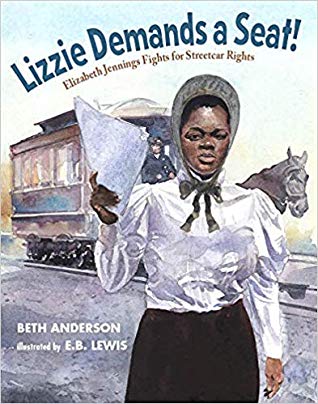
In 1854, Lizzie Jennings boarded a streetcar in New York City. In that time, there was segregation on public transportation which was a custom not a law. Certain cars were marked for “colored people” and others were for white people who could allow people of color to ride, or not. So Lizzie didn’t know if she would be allowed to ride the car she boarded. No passengers disputed her right to ride, but the conductor did. He forced her off the car and when she argued and boarded again, the police were called. Lizzie was educated as a teacher and her family had fought for their civil rights, so she decided to fight back in court and sued the streetcar company. She even had a white passenger who offered to be a witness to the way she was treated that day. In the end, Jennings won a landmark case for civil rights in public transportation. It didn’t fix every streetcar in New York right away, but led to other people fighting for their rights to ride too. 

Anderson takes one of the first legal victories against segregation and creates a dynamic look at a critical moment in our national history. This little-known event, particularly compared to Rosa Parks, helps set the stage for the civil rights movement that followed. Lizzie also breaks stereotypes of African Americans on her time period with her level of education and wealth. 

The illustrations are done in watercolor with amazing backgrounds that illuminate the scenes with their inspiring colors. Lizzie and her battle are surrounded by swirls of peach, lavenders, pinks and blues with her at the center, calm and composed. 

A stirring picture book that captures early civil rights efforts. Appropriate for ages 6-9.

Reviewed from library copy.

Review: A Ride to Remember by Sharon Langley

A Ride to Remember by Sharon Langley

A Ride to Remember by Sharon Langley and Amy Nathan, illustrated by Floyd Cooper (9781419736858)

Back in the 1960’s, African-Americans were not allowed to enter the Gwynn Oak Amusement Park in Baltimore. They were not allowed to sit on the grass, share treats or ride on the carousel. As the world around them began to change and become less segregated, Gwynn Oak continued its policies. They became the center of protests where hundreds were arrested. A mother and child who were African American and light skinned covertly entered the park and were allowed to enjoy themselves for hours. They shared their story with the press. As the pressure built, the park’s owners agreed to allow everyone into the park and to drop any charges from the protests. The first day the park was open was August 28, 1963. That day, a little girl named Sharon Langley, was the first African-American to ride the carousel with her father holding onto her. A photo of the ride made the papers as did the other major news story of the day, when Martin Luther King, Jr. made his iconic “I Have a Dream” speech. The carousel was moved to Washington, D. C. where Sharon took a ride on the fiftieth anniversary of her first ride in Baltimore.

The authors make a point of framing the tumultuous 1960’s for young readers. They have a child ask questions about why African-Americans were not allowed to enter the park. This is such an important moment in the book, giving modern children a lens into the inherent societal racism of the time, racism that is not erased in our modern society either, of course. They then turn to the protests about the park, showing the bravery of the people who protested, who went to jail, and who insisted on staying overnight to make a point. The body of the book does a great job offering historical perspective as well as details about the protests and efforts to desegregate the park. More information is also shared in the final pages, including more details of the events in the book, a bibliography and a timeline.

Cooper’s art is done with a lush softness to the lines. He used oil erasure on illustration board to capture an almost sepia-toned historical feel. The faces he shows of the people involved are tremendously moving, showing that this was about people insisting on change.

In a single story, children will deeply understand what the civil rights struggle was about. Appropriate for ages 5-9.

Reviewed from copy provided by Abrams.

Review: Cezanne’s Parrot by Amy Guglielmo

Cezanne’s Parrot by Amy Guglielmo

Cezanne’s Parrot by Amy Guglielmo, illustrated by Brett Helquist (9780525515081)

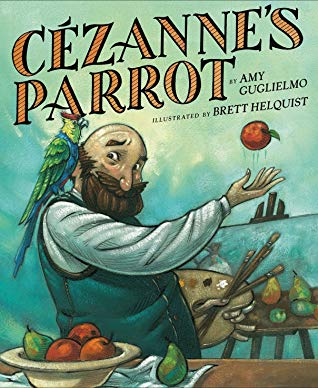
Cezanne was a French painter who longed to be told that he’s a great artist, so he tried to train his parrot to say that to him. Cezanne’s focus on ordinary events and people as well as his unique style of thick paint and heavy lines did not speak to the professors at the famous Academie des Beaux-Arts where he longed to study. Monet advised Cezanne to head into the French countryside for inspiration. But Monet painted quickly and Cezanne painted very slowly, sometimes taking over 100 visits to a site before his painting was complete. He continued to submit his art for consideration by the Academie, but continued to be rebuffed. The Impressionists emerged as a group that broke the rules of art, but Cezanne didn’t fit in, even with them. He continued to paint the way that only he could, eventually becoming a huge success. 

Cezanne’s continued disappointments in gaining attention for his art flavor this picture book biography with rejection and sorrow. They also give readers a chance to see someone who never gave up even as people mocked him. This incredible resilience is also captured in the humor of teaching his parrot to compliment him, something that finally happens in the picture book towards the end. 

Helquist’s illustrations are saturated with color, rich and vibrant. He reproduces several of Cezanne’s masterpieces on the page while the majority of the illustrations are filled with images of Cezanne’s hard work, using speech bubbles and humor when appropriate.

A look at one of the greatest painters of all time and what it took to be a success. Appropriate for ages 6-9.

Reviewed from e-galley provided by G. P. Putnam’s Sons.

Review: Dictionary for a Better World by Irene Latham and Charles Waters

Dictionary for a Better World by Irene Latham and Charles Waters

Dictionary for a Better World: Poems, Quotes and Anecdotes from A to Z by Irene Latham and Charles Waters, illustrated by Mehrdokht Amini (9781541578937)

The authors that created Can I Touch Your Hair, a collection of poems about race, return with a dictionary that selects powerful words to think about as we work on making our world better. The dictionary includes words like empathy, acceptance, compassion, humility, respect and tenacity. Nicely, no effort is made to include the entire alphabet, rather words were selected for their ability to make an impact. Along with each word, there is a poem written by one of the authors and then also a piece of prose that speaks to their own interaction with the concept and how it has impacted their life. Other elements include a quotation with each word and also a way for the reader to try it out in their own life. 

The tone here is encouraging and positive without underplaying the incredible amount of work needed to be done to make progress on social issues. The focus is on individual responsibility for each of the concepts and taking personal action to make change happen. In their personal stories, the authors make it alright to make mistakes, take responsibility and continue to move forward. The combination of all of the elements for each concept is very powerful, offering a book that can either be read cover-to-cover or that one can dive into a single concept and explore.

The art by Amini uses a variety of media from photographs to cut paper to pressed leaves to paintings. Each turn of the page takes readers into a new concept visually as well, changing from dark colors to vivid green to cool blues and using different formats. 

A unique dictionary that asks us all to do our part in changing our world. Appropriate for ages 9-12.

Reviewed from e-galley provided by Carolrhoda Books.

Review: Our House Is on Fire: Greta Thunberg’s Call to Save the Planet by Jeanette Winter

Our House Is on Fire Greta Thunberg’s Call to Save the Planet by Jeanette Winter

Our House Is on Fire: Greta Thunberg’s Call to Save the Planet by Jeanette Winter (9781534467781)

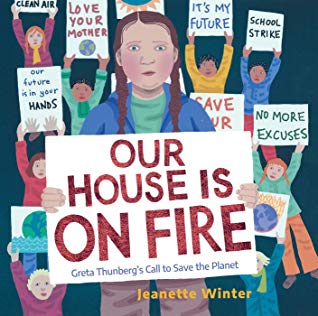
Greta was a quiet girl living in Stockholm until she learned about climate change. Once she heard a little bit about it at school, she started reading and watching films to learn even more. Greta soon realized that the world was in serious danger of fires, floods, droughts and catastrophic environmental change. She was sad and depressed for a long time, then she decided to go on strike from her school to protest the lack of action on climate. She protested outside the Parliament building every Friday, at first alone and then with other students. Soon children around the world were joining the protests. The quiet girl from Stockholm has become one of the leading young voices for climate change in the world.

Winter makes this book not only about Greta but also about climate change itself. As Greta finds her passion for working on climate, readers learn alongside her about the dangers that climate change brings to the world. As with all of her nonfiction picture book, Winter distills the story of Greta into something digestible by small children. Her pages are full of illustrations with words that explain but never become narrative or overwhelming. Her illustrations are bold and fresh, depicting climate disasters in images on the wall, the dangers to wildlife in Greta’s thoughts, and also the resilience and determination it took for Greta to continue to protest when no one seemed to be listening.

A timely and strong biography about one of the most important people working in climate today. Appropriate for ages 4-6.

Reviewed from copy provided by Simon & Schuster.