Review: Carlos Santana: Sound of the Heart, Song of the World by Gary Golio

Carlos Santana Sound of the Heart, Song of the World by Gary Golio

Carlos Santana: Sound of the Heart, Song of the World by Gary Golio (9781627795128)

Carlos Santana was born into a musical family with a father who was a popular mariachi performer. Carlos started learning to read music at age five and to play the violin at age six. But his father is often gone, playing musical gigs around Mexico. His father sends money home to the family, and eventually Carlos’ mother decides to head to America with the children. Carlos earns money playing music for the tourists, but his heart isn’t in it. It isn’t until he hears American blues music for the first time that he discovers his own kind of music. Carlos tries to play with his father’s band but it does not go well. Eventually, his father realizes that his son needs a new instrument, one that goes with his own blend of Latin and blues.

Golio tells a story of Santana’s childhood, focusing on the impact that music had throughout his early days but also the importance of finding his own musical voice that is entirely unique. The relationship between father and son is a critical one in this picture book biography, resonating throughout Santana’s childhood. Golio tells a complex story and yet keeps it straightforward for a young audience.

The illustrations are done in mixed media of torn paper, acrylics and printed inks. They are layered and deep, the colors swirling on the page. The faces of the various family members and Santana are particularly arresting. The art has a great vibrancy and a feel of freedom around it.

A great pick for libraries looking for quality biographies of musicians. Appropriate for ages 6-9.

Reviewed from copy provided by Henry Holt & Co.
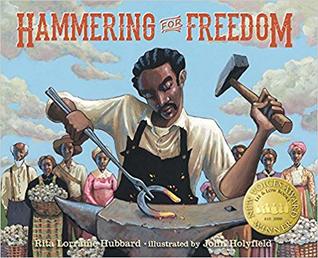


Review: Hammering for Freedom by Rita Lorraine Hubbard

Hammering for Freedom by Rita Lorraine Hubbard

Hammering for Freedom by Rita Lorraine Hubbard, illustrated by John Holyfield (9781600609695)

Born into slavery in 1810, Bill Lewis grew up on a plantation in Tennessee. There, he was taught to be a blacksmith and soon earned so much money that his owner, Colonel Lewis, allowed him to keep some money for himself. Bill worked for years saving his coins, determined to purchase freedom for himself and his family. Eventually he asked Colonel Lewis if he could rent himself out. The Colonel agreed and charged Bill $350 a year for his limited freedom. Bill purchased a blacksmith shop in Chattanooga and became the first African-American blacksmith in the city. He worked long hours and eventually paid for his wife’s freedom, ensuring that all future children would be born free. He then purchased his own freedom and that of his one son born into slavery. But Bill Lewis was not done yet and keep on working hard until he freed every member of his family, including his siblings and mother.

The determination and tenacity of Bill Lewis is indescribable. In a society designed to hold him down, he managed to find a way forward to freedom. Hubbard makes sure that readers understand how unusual this arrangement was and how gifted Lewis was as a blacksmith. The text keeps the story of Lewis’ life focused and well paced. It is a very readable biography.

The illustrations are rich and luminous. The sharing of emotions and holding emotions back play visibly on the page, demonstrating how much had to be hidden and not disclosed in order to purchase freedom. It also shows in a very clear way how limited that freedom was.

A great addition to nonfiction picture book shelves. Appropriate for ages 6-9.

Reviewed from e-galley provided by Lee & Low Books.

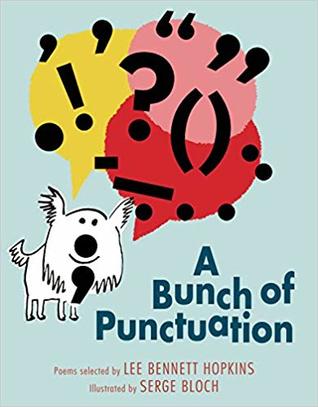
Review: A Bunch of Punctuation selected by Lee Bennett Hopkins

A Bunch of Punctuation selected by Lee Bennett Hopkins

A Bunch of Punctuation selected by Lee Bennett Hopkins, illustrated by Serge Bloch (9781590789940)

This poetry anthology celebrates the various forms of punctuation. It begins with a poem that looks at the range of different punctuation and then moves on to poems about specific types of punctuation. The exclamation point is a superhero in a poem with lots of sounds and naturally, exclamations. The dash gives one a bit of pause. The hyphen creates new combinations. The period is a traffic officer demanding a full stop. The popular apostrophe works hard to show possession and create contractions. One after another, these forms of punctuation are given their own voice and uses it to explain what they do with humor.

Anytime you pick up an anthology by Hopkins, you know you are in for a treat. He has a knack for creating poetry books for children that have child-friendly poetry but also have an arc that gets pages turning. Here the punctuation poems follow one after another in a way that displays their full range and results in a journey rather than a simple series of poetry.

The illustrations by Bloch use punctuation to create bodies for the various characters. He also uses words to create them too. They have the loose feel of doodles, which creates a look at that adds to the friendliness of the book.

Another winner of an anthology from Hopkins. This one will be useful in the classroom and will be enjoyed as a full anthology by readers. Appropriate for ages 6-9.

Reviewed from library copy.


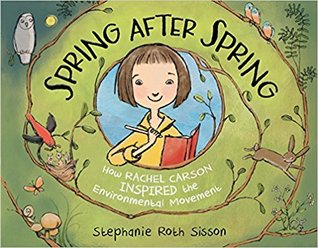
Review: Spring After Spring by Stephanie Roth Sisson

Spring After Spring by Stephanie Roth Sisson

Spring After Spring: How Rachel Carson Inspired the Environmental Movement by Stephanie Roth Sisson (9781626728196)

This nonfiction picture book begins in much the same way that Rachel’s childhood days started: birdsong, insects, forest exploration and insects. Rachel loved to look at the world from the big view and then to kneel down and look very closely at nature. She loved spring days best, returning home after dark to supper and her big family. As the seasons turned, Rachel watched and documented them all, growing bigger herself. She headed off to college to become a writer, until she discovered the microscopic world which led her to science. She worked as a scientist, diving under the sea and then writing books about it. Soon though, she realized that things were changing and species were disappearing. This led to her most important book, Silent Spring, which cautioned about the impact of chemicals on the ecosystem.

Sisson encapsulates Carson’s life in a very approachable way. The first part of the book focuses on Carson’s childhood love of nature and being outside. The text focuses on what Carson sees and experiences. As the book moves to her adult life, the text is about bravery and taking on the unknown. It then moves to her realization of what is happening in nature and her tenacity in figuring out what is going on. Throughout, this is the picture of a girl and woman who loves nature, thinks deeply and writes beautifully enough to change the opinions of a nation.

The illustrations are simple and lovely. They show all of the sounds of nature when Carson is a young child. Those same rich experiences are shown with the ghostly figures of animals that have disappeared due to chemicals. There is no mistaking the warmth of Carson’s home and family and then the strength that it took for her to stand strong in the face of people’s doubts.

A great picture book biography about an amazing woman, this is a timely read. Appropriate for ages 4-6.

Reviewed from copy provided by Roaring Brook Press.


Review: Pass Go and Collect $200 by Tanya Lee Stone

Pass Go and Collect 200 by Tanya Lee Stone

Pass Go and Collect $200: The Real Story of How Monopoly Was Invented by Tanya Lee Stone, illustrated by Steven Salerno (9781627791687)

Explore the story of how the popular board game Monopoly was invented in this nonfiction picture book. Lizzie Magie was a talented woman, someone who was very concerned with fairness in the late 1800s. During that time, wealthy people bought up property in cities and charged high rents for them. Maggie invented the Landlord’s Game, an early version of what would become Monopoly, with two ways to play. One was buying up and owning lots of land and the other was working together and demonstrating how fairness worked better. The game was complicated but popular with different versions being created across the country. When Charles Darrow, a man down on his luck during the Great Depression, was introduced to the game, he worked to improve it. Then he started selling it rather than sharing it the way it had been done. Soon Parker Brothers was interested in selling it. But what of Lizzie?

Stone tells the poignant story of a woman with a real concern for society and the way it was headed. She created a complex game, shared it with others and was taken advantage of by the system that she was working against. Paid a nominal fee to give up her claim to the game, Darrow went on to become a millionaire in contrast. Make sure to read the author’s note at the end that shows how this book was originally about Darrow until Lizzie’s story emerged.

The illustrations have a wonderful vintage quality to them, suiting the period of setting of the book. It is very interesting to see close ups of the different boards of the Landlord’s Game and eventually the very familiar Monopoly board. Even those who don’t enjoy Monopoly, like me, will be fascinated by the complex tale behind the game.

A very intriguing tale that is a mix of women’s rights, ingenuity and economics. Appropriate for ages 8-12.

Reviewed from library copy.

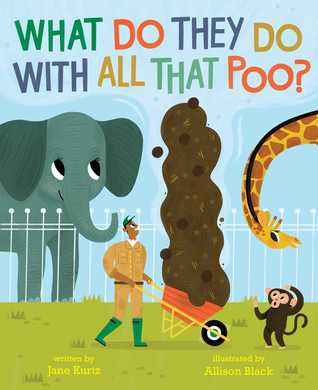
Review: What Do They Do with All That Poo? By Jane Kurtz

What Do They Do with All That Poo By Jane Kurtz

What Do They Do with All That Poo? By Jane Kurtz, illustrated by Allison Black (9781481479868)

Anyone working with children and books knows that the rather naughty subjects of poop, peeing and farting are some of the most popular. In this book, science is mixed in as well, showing what zoos do with all of the animal poop they have. First the book explains what poo is, then moves into showing different types of animal poop like giraffe, panda, hippo and elephant. The book then goes on to explain that most of the poop heads to landfills after being loaded into trucks. Some poop goes to labs for scientists to examine. Some is made into compost for gardens. And interestingly, sometimes paper is made from elephant poo!

Kurtz explains in a matter-of-fact way the various animals and how they poo and then handle their poop. The hippo splattering its poop around is gross but interesting, something that basically sums up this book. Kurtz doesn’t shy away from the grosser parts, but also keeps her focus on facts and science in the book. The illustrations are bright and friendly, despite all of the poop on the pages. Animals are shown in their zoo habitats and then their poop is also shown with them.

An interesting and scientific look at poos in zoos. Appropriate for ages 3-6.

Reviewed from copy provided by Beach Lane Books.


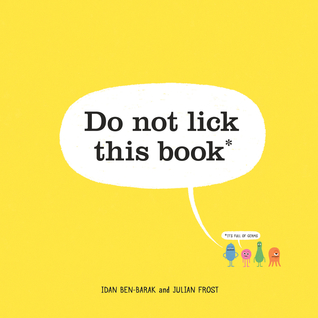
Review: Do Not Lick This Book by Idan Ben-Barak

Do Not Lick This Book by Idan Ben-Barak

Do Not Lick This Book by Idan Ben-Barak and Julian Frost (9781250175366)

Min is a microbe that lives in this book. Readers get to look at the page closer and closer, until with a micron microscope they can see the individual strands that make up the paper. Resting there, very bored indeed, is Min. The readers pick up Min on their finger and then move her to their teeth. The next page shows the surface of a tooth very, very close up with the microbes creating cavities. Min moves on, but one of the tooth microbes comes along too. This pattern continues to the reader’s shirt and then finally their belly button, each place close up and full of microbes.

Shown in such a playful way, children will enjoy the lesson on microbes without realizing they are learning science. The interactive piece of the book is also a pleasure, though it will limit using the book with a very small group or one child at a time. There are more microbial facts at the end of the book to enjoy. The illustrations are a delightful mix of images from an electron microscope and cute little microbes that are different colors and shapes from one another.

A smart choice for libraries looking for great STEM reads. Appropriate for ages 4-7.

Reviewed from copy provided by Roaring Brook Press.

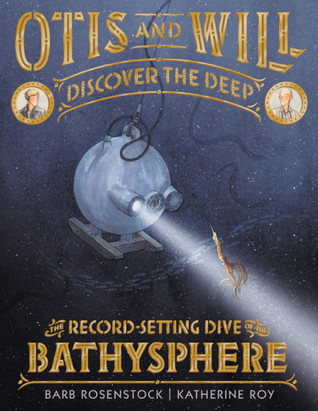
Review: Otis and Will Discover the Deep by Barb Rosenstock

Otis and Will Discover the Deep by Barb Rosenstock

Otis and Will Discover the Deep: The Record Setting Dive of the Bathysphere by Barb Rosenstock, illustrated by Katherine Roy (9780316393829)

Otis loved the ocean since he was a boy. He experimented with different ways to dive lower and lover in the water. Will didn’t discover the ocean until later in life, spending time in the woods, trekking the world and climbing volcanoes. Otis heard that Will wanted to dive deep into the ocean and with his background in machines knew that Will would need a very special submersible to survive. Otis reached out to Will again and again until Will agreed to see him. Otis built the machine and Will planned the expedition. The two tall men managed to squeeze inside the small space and then down they went into the deep. Lower and lower they went, creaking and remembering to breathe. They reached 800 feet and then returned to the surface, smiling.

Rosenstock has created a wonderful text for this book that captures the importance of teamwork and connecting with others who have a similar passion but different skills. The differences between the two men are highlighted and then it is even more powerful when the two come together and work on a common goal. I particularly enjoy Will supporting Otis as they descend into the depths. That same support of remembering to breathe is very effectively used to create drama as the depth increases, since readers too  may be holding their breath. The art by Roy is exceptional, adding to the drama of the tale by showing the Bathysphere as isolated, suspending in the dark water. The two men and the contortions they go through to fit and work together in the small space are also charmingly captured in the illustrations.

A winner of a science read. Appropriate for ages 7-9.

Reviewed from library copy.

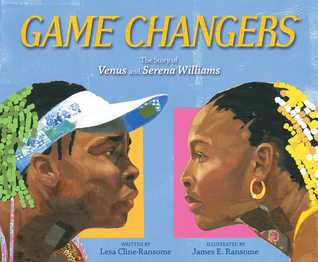
Review: Game Changers by Lesa Cline-Ransome

Game Changers The Story of Venus and Serena Williams by Lesa Cline-Ransome

Game Changers: The Story of Venus and Serena Williams by Lesa Cline-Ransome, illustrated by James E. Ransome (9781481476843)

The childhood of Venus and Serena is told in this picture book biography. As the youngest of the Williams children, they started playing tennis alongside their older sisters. Then they became the two who continued on. Growing up in Compton made their practices more challenging, including sometimes having to stay down when guns were fired in the neighborhood. The two remained dedicated to their sport, quickly climbing the ranks and becoming ranked players. Trained from a young age to ignore the taunts from the crowd, the two of them became two of the best players of all time, both in doubles and singles. There has been drama when the two sisters had to play one another in tournaments and still they showed a joy in one another’s accomplishments even when they were the loser.

A look at two girls who shared their father’s dreams for them, putting in the hard work, showing resilience and silencing critics. The book focuses on Venus and Serena themselves and also on the way that they have supported one another through wins and losses, staying close and being true sisters. The illustrations are exceptional works of collage that have strong colors and graphic elements that pop on the page. Small touches add interesting details, like the girls’ socks being made from paper with words and lines.

Beautiful, strong and inspiring, this look at two modern legends is a pleasure. Appropriate for ages 6-9.

Reviewed from copy provided by Simon & Schuster.