Review: Counting on Katherine by Helaine Becker

Counting on Katherine How Katherine Johnson Saved Apollo 13 by Helaine Becker

Counting on Katherine: How Katherine Johnson Saved Apollo 13 by Helaine Becker, illustrated by Dow Phumiruk (9781250137524)

Katherine loved counting and math as a young girl. She was a brilliant student who skipped three grades. However, there was no high school in her town that accepted black students. So her father worked day and night to afford to move them to a town where Katherine could attend high school. She became an elementary school teacher, because there were no jobs for research mathematicians who were women. Katherine did not give up her dream, eventually becoming a mathematician working for NASA. She worked on the Mercury missions and the Apollo missions, doing the math that allowed the Apollo 13 astronauts to return safely.

Filled with the determination and resilience it took for Johnson to become a NASA mathematician, this picture book shows the barriers that were and are in place for scientists and mathematicians who are women and people of color. Make sure to check out the note at the end that provides even more information on this incredible mathematician. The art in the book is incredibly appealing with mathematics adding complexity to the simple style.

A picture book biography that soars to great heights. Appropriate for ages 5-8.

Reviewed from library copy.

Review: Nothing Stopped Sophie by Cheryl Bardoe

Nothing Stopped Sophie The Story of Unshakable Mathematician Sophie Germain by Cheryl Bardoe

Nothing Stopped Sophie: The Story of Unshakable Mathematician Sophie Germain by Cheryl Bardoe, illustrated by Barbara McClintock (9780316278201)

Sophie loved math from the time she was a small girl. Her parents had to take away her candles and her warm dresses to keep her in bed at night and not at work at her desk. But nothing stopped her, not even the French Revolution when she  was growing up. There were no opportunities for Sophie to study in a university, so she did her homework by mail using a male name. Her work was extraordinary, but when her identity was discovered no mathematicians would return her letters, though she became very popular at dinner parties due to her reputation. In her thirties, Sophie discovered a mathematical problem that would become her focus for many years. A challenge was set to figure out the mathematics behind vibrations and the patterns they made. Years later, Sophie was the only one to submit a solution which she then worked to perfect for additional years. This time though, she worked under her own name.

Bardoe has written a lovely biography of a fascinating woman who demonstrated that women are just as good at mathematics as men are. Her math has a blend of science and math with its focus on vibrations, making it all the more complex. The book shows again and again the resilience and determination that it took for Sophie to succeed. The writing is accessible and celebratory in tone. McClintock’s illustrations incorporate collage in a subtle but profound way. She also uses numbers and formulas in the art itself, creating scenes from a scaffold of digits and action from vibration patterns.

A great picture book biography about an inspiring woman. Appropriate for ages 7-9.

Reviewed from library copy.

The Horse’s Haiku by Michael J. Rosen

The Horse_s Haiku by Michael J. Rosen

The Horse’s Haiku by Michael J. Rosen, illustrated by Stan Fellows (9780763689162)

This book of haiku poetry focuses solely on horses and their daily lives. Starting with their time in the field as young foals, the poems include dust baths, rainwater pools, and dappled shade. Moving into the barn, readers get to see humans interacting with horses, feeding them apples, and going on a ride together. The next chapter of poems has an even greater focus on riding, galloping and jumping.

The poems capture the beauty and grace of horses, the unique relationships they have with the people who care for them, and the joy of running fast. Each haiku is a separate moment in time, showing the importance of slowing down, of seeing each moment as unique and in sharing them to create a universal joy of horses.

The illustrations are done in watercolor that dapples the page, creating sunlight and shadow, hoofprints and breezes in the grass. They have a wonderful sense of freedom about them that mirrors the celebratory tone of the haiku, inviting readers to feel movement on the page.

A stellar book of focused haiku. Appropriate for ages 6-9. (Reviewed from library copy.)

Review: For Every One by Jason Reynolds

For Every One by Jason Reynolds

For Every One by Jason Reynolds (9781481486248)

This book is a single poem, one that is a clarion call for young creatives to continue their work. Originally performed at the unveiling of the Martin Luther King Jr. Memorial and then again as a tribute to Walter Dean Myers, this poem is striking and powerful. There is no claim here that Reynolds has the answer to make money at your dream, to be successful at your dream, but there is a demand that you continue to dream and create as a young person. That it is important for you and for the world.

Reynolds shares personal set backs as a young adult, showing how hard it can be to stay on course when your work is not being noticed. Still, he continued and he asks that everyone continue to speak, to share, to be out there and demand to be heard and seen. It is a book about perseverance and resilience, a poem about life, hard knocks and getting up and continuing onward.

This one belongs in every library and every creative writing and art room. It is inspiring and beautiful. Appropriate for ages 13-18.

Reviewed from copy provided by Atheneum.

3 All-Natural Nonfiction Books

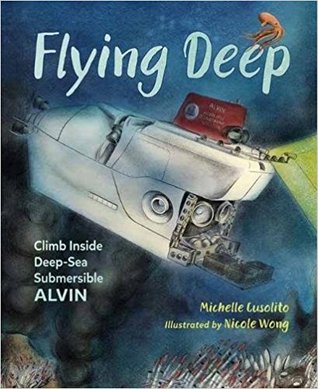
Flying Deep by Michelle Cusolito

Flying Deep: Climb Inside Deep-Sea Submersible ALVIN by Michelle Cusolito, illustrated by Nicole Wong (9781580898119)

Alvin is a deep-sea submersible that seats just three people. In this picture book, readers take a journey with Alvin’s crew down into the sea to collect specimens, survey the site and look for life. Light dims and temperatures drop as Alvin descends. At nearly two miles down, they reach the seafloor. There are small crabs, glassy rocks and vent chimneys. Pompeii worms sway in the current and clams nestle in the rocks. There are other surprises too! Soon the specimens are stored and it’s time to slowly ascend to the surface once more.

There is a gorgeous natural drama to this nonfiction picture book that simply shows what scientists encounter as they explore the depths of the sea. Refreshingly, there is no artificial accidents or incidents used, just the depth itself and the sights to be seen. The book contains information about Alvin, a glossary of terms and a list of organisms with information on each. The illustrations are dramatic and use the play of darkness, beams of light and the different light at various depths very effectively.

Immensely readable, this would make a grand nonfiction addition to a story time. Appropriate for ages 5-7. (Reviewed from library copy.)

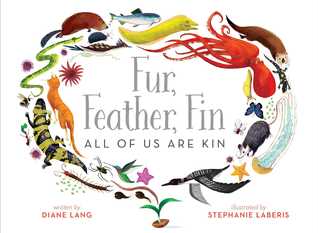
Fur, Feather, Fin All of Us Are Kin by Diane Lang

Fur, Feather, Fin – All of Us Are Kin by Diane Lang, illustrated by Stephanie Laberis (9781481447096)

Exploring the classes of animals, this nonfiction picture book is written in rhyming text. The book looks at mammals, birds, amphibians, reptiles, arthropods, fish, water dwellers, and detritivores. Each class of animal is explained, including their unique attributes and how they are similar to other animals as well. The focus is on the web of creatures around the world, celebrating the varied nature of life.

The book is filled with facts, including a section at the back that offers even deeper information on each class of animal. Far more than just basic types of animals are explored here and young readers will learn new terms for animals like worms, crabs and insects. This very readable book is accompanied by illustrations that show how different these creatures are, from those under the sea to creatures who mature through various stages to those that fly.

An approachable book that offers lots of information in a very flexible and light way. Appropriate for ages 5-7. (Reviewed from copy provided by Beach Lane Books.)

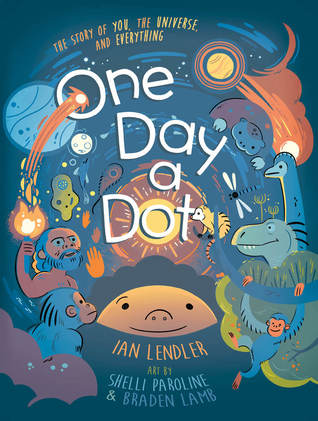
One Day a Dot by Ian Lendler

One Day a Dot by Ian Lendler, illustrated by Shelli Paroline and Braden Lamb (9781626722446)

This book is a dynamic mix of graphic novel, nonfiction and picture book. It’s the story of the Big Bang and how earth came to be and how life started here. From the initial explosion, the book quickly moves to life on earth, using comic panels to great effect to show various lifeform stages. Dinosaurs emerge and life flourishes until the meteor strike. Still, some life survives and mammals and evolution lead to humans. The book has many answers but still ends with the ultimate question of where that first dot came from.

A great look at the science of the Big Bang and evolution for small children, this is a cleverly designed book. The book remains firmly nonfiction, nicely describing what is happening in short texts. The book also offers a timeline at the end that shows the Big Bang through current day. The illustrations have a gentle whimsy to them that makes the book inviting. A bright color palette of yellows, greens and oranges adds to the dynamic subject. A winner of a read. Appropriate for ages 4-8. (Reviewed from ARC provided by First Second.)

Review: Drawn from Nature by Helen Ahpornsiri

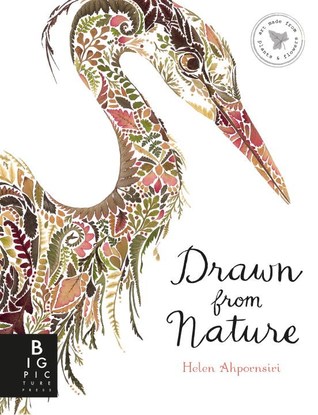
Drawn from Nature by Helen Ahpornsiri

Drawn from Nature by Helen Ahpornsiri (9780763698980)

Explore the changing seasons through this exceptional book. With text that focuses on the various aspects of each season, this book invites you to look more closely at nature and the small events that take place. There is nest building in the spring, caterpillars turning into butterflies, and blossoms emerging. In the summer, swallows fly, the meadow grows, crickets chirp, bees buzz, green leaves emerge. The autumn arrives with leaves turning color, berries and nuts, geese flying south. In the winter, hibernation starts and branches turn bare.

The text of this book is filled with facts yet at the same time offer a sense of wonder at what is happening at nature around us. These small glimpses of nature form a larger image of the natural world for young readers.

As good as the text is though, it is nothing compared to the illustrations of this book. Uniquely designed out of pressed flowers and leaves, they are mesmerizing and achingly lovely. The larger animals are spectacular in their delicate beauty and so are the smaller animals and plants. Throughout there is a grace of line and delight. An organic look at nature in all of its beauty. Appropriate for ages 6-9. (Reviewed from library copy.)

3 New Picture Books Bringing History to Life

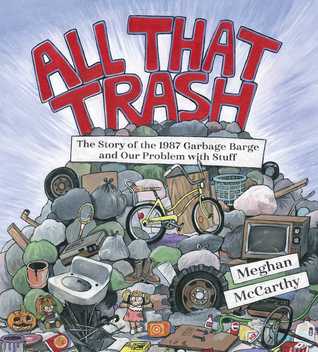
All That Trash The Story of the 1987 Garbage Barge and Our Problem with Stuff by Meghan McCarthy

All That Trash: The Story of the 1987 Garbage Barge and Our Problem with Stuff by Meghan McCarthy (9781481477529)

In 1987, when a New York landfill was almost out of room, Lowell Harrelson decided to take the trash and move it far away using a barge. His plan was to use the garbage to create methane gas that would be turned into electricity in North Carolina. But the garbage barge never made it to North Carolina, when the state got a court order to stop the barge. The barge was also not welcome in Alabama or Louisiana. It eventually made its way into the Gulf of Mexico and tried to enter Mexico, but that country refused it entry as well. Eventually, the barge returned to waters near New York, prepared to return the garbage to where it had come from. But even that was not simple. Finally, after five months at sea and traveling over 6,000 miles, the garbage was incinerated on order by a judge.

McCarthy nicely plays up two aspects of the story of the garbage barge, the ludicrous nature of the barge being stuck at sea for months and the environmental impact of the trash that humans create. She uses a light tone and light touch in her writing, making it accessible for children who will not have heard of the barge before. She also offers more details at the end of the book, explaining how the crew survived on the barge for so long and offering facts about the barge. She also has recycling facts, garbage facts, and information on ocean garbage in particular. A bibliography is also attached.

Part of the light tone of the book are the illustrations which feature McCarthy’s signature bug-eyed characters. She incorporates speech bubbles and larger images to effectively break up the text into readable chunks.

A funny and amazing true story of the garbage barge that captured the attention of everyone in 1987. Appropriate for ages 6-9. (Reviewed from copy provided by Simon & Schuster.)
Grandma Gatewood Hikes the Appalachian Trail by Jennifer Thermes

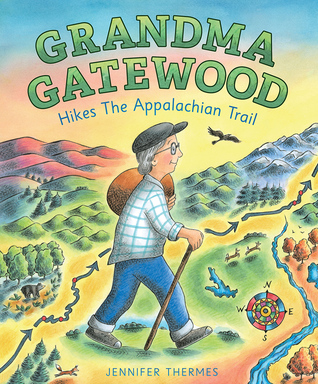
Grandma Gatewood Hikes the Appalachian Trail by Jennifer Thermes (9781419728396)

At the age of 67, Emma Gatewood became the first woman to hike all 2160 miles of the Appalachian Trail alone. She was also the first person to complete the trail three times. In this picture book, readers follow her along on her historic trek. With accompanying maps, the journey is filled with nature, rocks and streams. There are encounters with bears, plenty of rain, and many pairs of ruined shoes.

The book takes a warm look at her accomplishments, showing exactly why she was drawn to walk the trail, the beauty she found there and the peace she discovered along the way. The illustrations are playful and bright, focusing on the landscape and the journey often with Gatewood a small figure amongst nature and other times showing her right at the center. A wonderful book about an inspiring figure who journeyed through life in her own unique way. Appropriate for ages 5-9. (Reviewed from copy provided by Abrams.)
Let the Children March by Monica Clark-Robinson

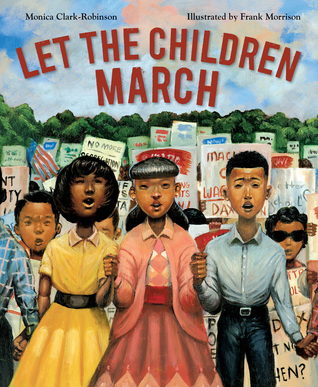
Let the Children March by Monica Clark-Robinson, illustrated by Frank Morrison (9780544704527)

Told from the point of view of a child participating in the Birmingham Children’s Crusade in 1963, this picture book uses verse to take children back in history. Starting with Dr. Martin Luther King speaking to their congregation, the book shows why it was necessary for children to march, since adults would lose their jobs. The picture book shows how frightened the children were to march but also how very brave they were to overcome those fears and continue. As children were jailed for their actions, the protests continued. When the rest of America saw children being knocked down by fire hoses, even the President took notice and soon change came and children brought that change!

This is a powerful look at the importance of standing up and protesting when things are wrong in our society. While it is about an event in the Civil Rights struggle, it resonates with today’s marches for Black Lives Matter and other causes such as immigration rights. The importance of the Children’s Crusade is explored in the afterword as well. The verse of the book has a quiet but firm tone, telling the tale and letting the courage of the children stand. The illustrations focus both on the crowd of children but also on the faces of individuals and their willingness to stand strong and march together.

An important read about a protest that must never be forgotten. Appropriate for ages 6-9. (Reviewed from library copy.)

Review: Life Inside My Mind

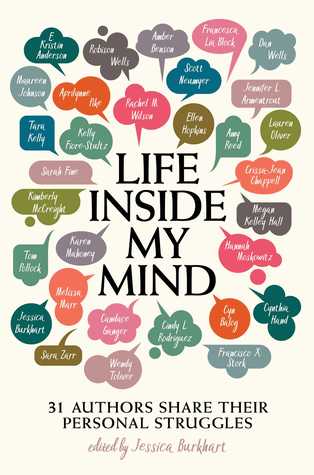
Life Inside My Mind

Life Inside My Mind: 31 Authors Share Their Personal Struggles edited by Jessica Burkhart (9781481494649)

This nonfiction book for teens is a brutally honest look at mental illness and how over thirty well-known authors of young adult books have faced their own struggles. It is a book of short personal tales of how mental illness entered their lives, took them over, turned them upside down. It is a book always though about hope, about tools that work sometimes but not always, drugs that help but may not work for everyone, thought processes that offer glimpses of freedom beyond the illness.

This book is profoundly important for teens. It is a book that took such bravery to write. Almost every story has some taut hesitation in it, to reveal something this private. Each one is a testament to the author’s strength, whether they see it themselves or not. Taken together though is when this book really sings. It is a chorus of voices that say strongly that you can survive. You can thrive. We can do this.

Reading this book is an exercise in opening your heart. It belongs in every public library serving teens. It will save lives. Period. Appropriate for ages 13-18.

Reviewed from copy provided by Simon & Schuster.

3 New Picture Books about Nature

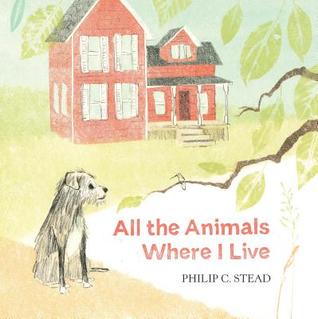
All the Animals Where I Live by Philip C. Stead

All the Animals Where I Live by Philip C. Stead (9781626726567)

Stead has created another picture book that invites you into his everyday world. Filled with stories of a bear chased off my an elderly woman and a teddy bear that Stead has had his entire life, stories of maple-syrup scented blankets, a dog named Wednesday, loud cranes, a falling turtle, and much more.

There is a beautiful simplicity to the book, one that slows the reader down to look out their own windows and think about the animals that live near them. The illustrations are simple too, washed with colors that suit the season and time of day, they move from yellows to blues to the oranges of autumn and to the ethereal greens of winter. A quiet and marvelous picture book. Appropriate for ages 4-6. (Reviewed from copy provided by Roaring Brook Press.)

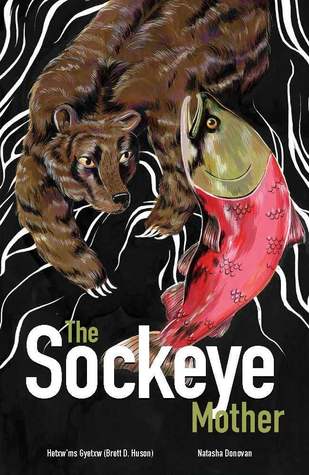
The Sockeye Mother by Hetxw_ms Gyetxw

The Sockeye Mother by Hetxw’ms Gyetxw (Brett David Huson), illustrated by Natasha Donovan (9781553791395)

This picture book combines biology with a storytelling feel to create a very special tale. It is the story of sockeye salmon. From their time as a small fry just losing their yolk sac through to adult sockeye returning to their birthplace to spawn before they die. The picture book is also about the Gitxsan people of the Pacific Northwest and their connection to the river and the salmon. The book looks at the various stages of the live of the salmon and offers scientific information about them, the bears, environmental impact of humans, and much more.

The book is deep and lovely, the tone unique and lush. Seasons are captured in words but also in the senses. The scent of pine and cedar, the replacing of old snow with new snow, the run of water in the river, all fill this book with elements of the Pacific Northwest. The illustrations are large and mostly focused on the river and the salmon. Even the smoke from a fire flows across the dark sky like the river flows on other pages. A picture book written and illustrated to honor the Xsan river and the animals and humans who depend on it. Appropriate for ages 4-7. (Reviewed from library copy.)
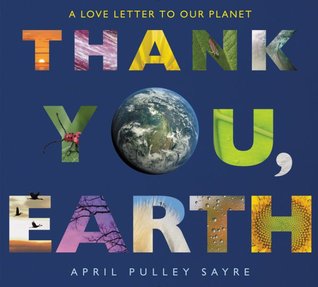
Thank You, Earth by April Pulley Sayre

Thank You, Earth by April Pulley Sayre (9780062697349)

Sayre provides a love letter to the Earth in this picture book. With a reverential tone and gentle rhymes, the book swoops the reader up on a photographic journey around Earth with all of its wonders. Thank yous go out for mountains, water, air and trees. Then the book moves to smaller things like patterns, sounds, seasons and plants. The book once again widens to look at the beauty of the sky and the amazement of lifetimes.

Embracing and filled with just the right tone of enthusiasm, this picture book is celebratory and filled with big thoughts that children will find mesmerizing. The photographic illustrations are varied and filled with color, mists, water, stone and more. A diverse look at life on earth and our privilege to be here. Appropriate for ages 3-5. (Reviewed from library copy.)