Review: Trombone Shorty by Troy Andrews

Trombone Shorty by Troy Andrews

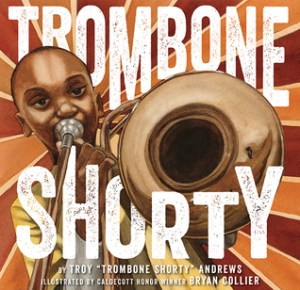
Trombone Shorty by Troy Andrews, illustrated by Bryan Collier

This autobiographical picture book is about a young boy growing up in the Tremé neighborhood in New Orleans where music was a simple part of everyday life and was always in the air. Tony particularly loved the music and energy of Mardi Gras where he could see brass bands play every day. Troy first played an imaginary instrument and then found a broken trombone that didn’t sound perfect but at least it was something he could play. Troy started to teach himself to play the trombone, an instrument that was almost as tall as he was, which is how he got the nickname of Trombone Shorty. He even slept with his horn in his hands. When Troy gains the attention of Bo Diddley for his playing in the crowd at his concert, Trombone Shorty knows it’s time to form his own band. And he still has his own band today!

Andrews is a Grammy-nominated trombone player and runs the Trombone Shorty Foundation committed to preserving the musical heritage of New Orleans. Andrews writes like a master on these pages which read like music is in the air between them too, just like the air in New Orleans. He shows children how an inspiration to play an instrument can become a lifelong calling. He also shows exactly how music empowers people in a place, gives them strength, creates a united culture, and unifies them. It’s a narrative about the power of music.

Collier’s illustrations are strong and dynamic. He creates motion on the page with his collage illustrations with patterns and textures that weave together. His paintings are a zingy mix of softly rendered closeups filled with detail and personality and then images of people farther away that are rougher but add even more energy to the art.

An inspiring picture book filled with music and vivaciousness, this autobiography celebrates New Orleans and the music in its veins and in one boy specifically. Appropriate for ages 7-10.

Reviewed from copy received from Abrams.

Review: High Tide for Horseshoe Crabs by Lisa Kahn Schnell

High Tide for Horseshoe Crabs by Lisa Kahn Schnell

High Tide for Horseshoe Crabs by Lisa Kahn Schnell, illustrated by Alan Marks (InfoSoup)

The annual spawning of the horseshoe crabs serves as a way to speak about the life cycle of this fascinating creature. As the crabs come to the shore, they ride the high tide to get far enough up on the beach for their eggs to be safest. Following the crabs are the shorebirds who are looking for a feast. Humans are coming too, scientists who study both the crabs and the birds. The horseshoe crabs begin laying their eggs, their bodies piled high at the edge of the shore, all trying to reach the sand to deposit their eggs. The scientists tag the crabs, allowing them a better way to study how these creatures live and where they travel. The eggs that survive the birds feasting start to grow and the adult crabs return to the sea. A few weeks later, the baby crabs hatch and make their way down the sand to the sea too.

Schnell has created a book that celebrates the horseshoe crabs and highlights not only their life cycle but their impact on the larger habitat as well. Tying the human scientific element into the book as well informs young readers that there are interesting natural studies happening all around them. The final pages of the book offer many additional details on the horseshoe crab and how they function in the food system. Readers will also find more resources on the crabs including websites and books to explore.

Marks’ illustrations are beautiful and functional. He shows the wonder of life under the water as well as the gorgeous moonlit night that the crabs come to shore. The mix of underwater, sea and sky create a palette of blue that celebrates life.

A strong nonfiction picture book that highlights a fascinating and unique creature. Appropriate for ages 5-7.

Reviewed from library copy.

Review: Mesmerized by Mara Rockliff

Mesmerized by Mara Rockliff

Mesmerized: How Ben Franklin Solved a Mystery that Baffled All of France by Mara Rockliff, illustrated by Iacopo Bruno (InfoSoup)

When Benjamin Franklin went to France to ask them for their help in gaining freedom for the American colonies, he discovered that they were fascinated by science. Particularly, they were abuzz about Dr. Mesmer, a man who staged shows and used an unseen force that he claimed was similar to electricity to cure people of their health issues and control their thoughts. Even Marie Antoinette was taken with Dr. Mesmer and in awe of his powers. The King of France asked Ben Franklin to explore what the force was. So Franklin started the very first blind test, literally, by blindfolding people and experimenting to see if they could tell if Dr. Mesmer was using the force or not. In the end, several things were discovered like the placebo effect and the amazing power of the human mind itself.

Rockliff writes a rollicking book where science is what everyone wants to know more about but also where science is in its infancy. This look at a specific moment in history is dynamic and great fun, particularly due to the personalities involved and also the fact that it demonstrated scientific ideas that are still in use today. Rockliff relishes the fun of the entire story along with the reader, allowing this story to carry forward on its own wild pace which will delight teachers looking for a book on science that is fun to share aloud.

Bruno’s illustrations add to that wild feel with their fancy flounces when talking of Dr. Mesmer and the straight-forward but period touches when Franklin takes the page. There are full color double-page spreads mixed with other pages with more white space. The illustrations have a broad sense of humor that ties in well with the text.

A fabulous nonfiction book that is sure to surprise and enthrall history and science buffs. Appropriate for ages 6-9.

Reviewed from library copy.

Review: Elvis by Bonnie Christensen

Elvis by Bonnie Christensen

Elvis: The Story of the Rock and Roll King by Bonnie Christensen (InfoSoup)

This picture book biography offers a glimpse into the journey of Elvis Presley from poverty to becoming a rock and roll legend. The book begins in segregated Mississippi with the birth of Elvis in 1935. Elvis’ father went to jail and even after he returned to the family, they lived a hard life of poverty. But through it all flowed music from their Sundays in church to listening to the radio at home. Elvis was shy and quiet, but he could sing and at age 10 he entered his first contest and then at 11 got his first guitar. His family moved to Memphis when he was 13 and Elvis found a new kind of music. He graduated from high school and eventually worked up the courage to enter a recording studio and offer his singing services. After a disastrous first session, Elvis was filled with nerves and picked up a guitar, singing That’s All Right. It got onto the radio and suddenly everyone wanted to hear more!

Christensen makes sure that readers understand that Elvis came from a difficult background, one where there was no money and no opportunities. His shyness was another thing that Elvis had to overcome, turning his shaking on stage into his signature moves. Christensen also keeps it clear that this was a different time, a time when these sorts of music did not mix together and that Elvis was uniquely situated to be the one who created the new sound. In all, this is a testament to the power of dreams and talent.

Christensen’s illustrations gleam with hope and the future even as Elvis is being moved to yet another house and another school. She makes sure that the light shines on the little boy and that readers see that there are possibilities to come.

A strong introduction to Elvis, make sure to play some of his music when reading it to children so that they can feel that beat too. Appropriate for ages 6-9.

Reviewed from library copy.

Review: Over the Hills and Far Away by Elizabeth Hammill

Over the Hills and Far Away by Elizabeth Hammill

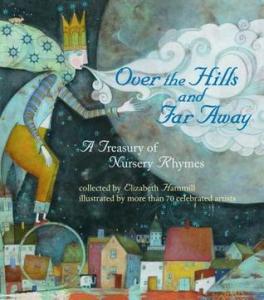
Over the Hills and Far Away: A Treasury of Nursery Rhymes by Elizabeth Hammill and various illustrators (InfoSoup)

Nursery rhyme treasuries have to be something special to gain attention and this one certainly is. In this treasury, nursery rhymes from around the world nestle together into one full and playful view of the world and children. There are rhymes from England and the United States, and then there are wonderful additions from Africa, China, South America, France and other areas. Adding to the variety are the illustrations from some of the greatest children’s book illustrators working today, including popular favorites like Lucy Cousins, Shirley Hughes, Jon Klassen, Jerry Pinkney and Shaun Tan.

Opening this book invites the youngest readers into a journey of the imagination and the joy of rhymes from around the world. Anchored by familiar favorites for western readers, the book branches merrily out into less familiar rhymes. Rhymes carefully chosen to become new favorites and ones that reflect the places and regions they come from clearly.

The illustrations are gorgeous and varied. It makes each turn of the page thrilling and filled with wonder. Each one is unique and marvelous, a great example of that master illustrator’s work.

Add this nursery rhyme treasury to your library collection to add an important amount of diversity to your shelves. Appropriate for ages 1-4.

Reviewed from library copy.

Review: Water Is Water by Miranda Paul

Water Is Water by Miranda Paul

Water Is Water: A Book about the Water Cycle by Miranda Paul, illustrated by Jason Chin (InfoSoup)

A poetic look at the various stages of water in the water cycle, this book moves logically from one to the next as water evaporates, condenses and changes. Seen through the lives of two siblings, the book begins with pages where the children are down near the lake and then rain drives them back home. Once home, they get a glass of water then water is boiled for a cup of cocoa out on the porch. Clouds come out in the evening, lit by the setting sun. Then autumn arrives with its foggy school mornings. Rain falls down as the school bus reaches school and then there are puddles to jump in at recess. Winter arrives with ice and snow and then spring returns with more puddles and mud. Apples are picked and turned into cider that the children drink up.

Shown through seasonal changes and a very personal view, this water cycle book makes everything very tangible and real. At the end of the book children can learn more about evaporation, condensation and precipitation which are tied directly to the forms of water that they experienced in the bulk of the book and the story. Keeping the focus on the ways that children themselves experience the water cycle makes this book particularly accessible.

The illustrations by Chin are done in watercolor and gouache. They are filled with nature and beauty from the wonder of the sky in evening to the bright colors of the fall leaves to the brisk cool colors of winter. The illustrations capture the beauty of weather and forms of water in a vivid way.

A dynamic and personal book about what can be an abstract theory, this book on the water cycle is exactly the sort of science book that will inspire additional investigation in the world and science. Appropriate for ages 4-6.

Reviewed from copy received from Roaring Brook Press.

Review: Mad Scientist Academy: The Dinosaur Disaster by Matthew McElligott

Mad Scientist Academy The Dinosaur Disaster by Matthew McElligott

Mad Scientist Academy: The Dinosaur Disaster by Matthew McElligott (InfoSoup)

Released July 7, 2015.

In this graphic novel for elementary-aged children, facts about dinosaurs mingle with a great adventure. A new class of young monsters are enrolled at the Mad Scientist Academy. On their first day of school, they meet Dr. Cosmic, a teacher at the academy who has managed to lose the school pet, Oscar, a dinosaur. The children are sent to find Oscar and set off on an adventure through the various exhibits that Dr. Cosmic has been working on. The focus of the exhibits is dinosaurs and there are mechanical dinosaurs throughout who are set to be tame. Unfortunately, their setting is accidentally set to live mode and all of the dinosaurs start acting as if they are real. It is up to the students to figure out how to escape the rampaging T-Rex and find Oscar too.

McElligott has a great feel for pacing and humor in this graphic novel. There are small touches of humor throughout the book, from one students stinky lunch to the out-of-control exhibits that have too much lava and are a bit too effective in showing meteors. The book is thoughtfully designed too with each monster character having characteristics that come into play in the story line. The lizard boy uses his long tongue to reach something, the insect girl uses her wings to remove smoke from the room, and much  more. The insertion of the dinosaur information is done in a light way and includes plenty of illustrations to keep the information accessible and fun.

The art is very effective throughout the book. The characters are diverse enough to be recognizable even in images where they are smaller. Double-page spreads of the full exhibit show the largeness of both the exhibit and the dinosaurs too. Dramatic moments are nicely captured and the timing of funny events is done very effectively.

Get this into the hands of children growing out of Magic School Bus books. The mix of graphic novel, information and fantasy elements will find lots of young fans. Appropriate for ages 6-9.

Reviewed from digital galley received from Crown Books for Young Readers and Edelweiss.

Review: The Amazing Age of John Roy Lynch by Chris Barton

Amazing Age of John Roy Lynch by Chris Barton

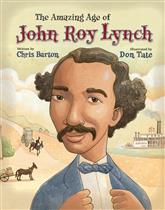
The Amazing Age of John Roy Lynch by Chris Barton, illustrated by Don Tate (InfoSoup)

John Roy Lynch grew up as a slave in Mississippi, the son of an overseer who tried to free his children from slavery. Unfortunately, his untimely death led to them continuing to be enslaved until the Emancipation Proclamation. Lynch found a job, his first paying job, on a steamer ship and worked his way up. At age 17, John Roy went to work for a photographer whose studio was right across from a school. Listening in on the classes and attending night school, John Roy was able to learn to write eloquent letters. He also started being active in politics, buying land, and speaking out. He was appointed Justice of the Peace at age 21. Soon he was elected as the Mississippi Speaker of the House and then in 1872, he became the first African-American US Congressman. Throughout, John Roy Lynch spoke to the needs of the people he represented and the importance of civil rights for all.

Barton provides just enough information for children to understand the time period and the implications of the Emancipation Proclamation. This look at the Reconstruction Period offers a view of an important time in American history, one that is often overlooked in children’s books. The amazing fortitude and resilience of John Roy Lynch keeps this book moving as his own life progresses forward in unexpected ways. Clearly it is his intelligence and gift for communication that carries Lynch forward into a very different life than others around him. More information on Lynch is offered in the final pages of the book with a complete timelines and bibliography.

The illustrations by Tate are done with a light touch, creating a book that depicts darker subjects at time but also infusing the book with a sense of hope and wonder. This makes a book covering such a heavy topic as well as such an important part of history much more appealing and approachable.

An important book focused on an important figure in a dynamic time in American history, this picture book biography will inform new audiences about the potential for both progress and defeat during the Restoration. Appropriate for ages 7-10.

Reviewed from copy received from Eerdmans Books for Young Readers.

Review: Beastly Verse by JooHee Yoon

Beastly Verse by Joohee Yoon

Beastly Verse by JooHee Yoon (InfoSoup)

Children are introduced to a collection of poetry from well-known poets as well as anonymous and lesser known ones in this picture book. Each poem focuses on an animal and the collection includes William Blake’s The Tiger among others. The animals are varied and make for page turning that is exciting and interesting, since you never know if the next animal will be a pig or a hummingbird. The poems are cleverly selected for child appeal and yet many of them aren’t specifically children’s poetry, allowing children to stretch a bit and learn more about poetry and their own reactions to it.

Yoon has selected primarily European and western poets in this book. I do long for more diverse poets and poetry to be included and yet one can’t fault the high quality of the selections here and the astute awareness of children and what they are interested in and drawn to. The result is a clever book that children will enjoy and learn from.

The illustrations here are the star and what will have children and adults alike picking up the volume. The colors are beyond bright, zinging on the page and creating worlds. There are jungle scenes that drip with deep greens and echo with lushness. There are domestic scenes that have a zany energy to them that is echoed in the poetry too. Yoon is skillful and playful in her art, creating a unique look and feel in this poetry book that is sure to appeal.

A dynamic look will get readers opening the book where they will discover plenty of poetry to love. Appropriate for ages 7-10.

Reviewed from copy received from Enchanted Lion Books.