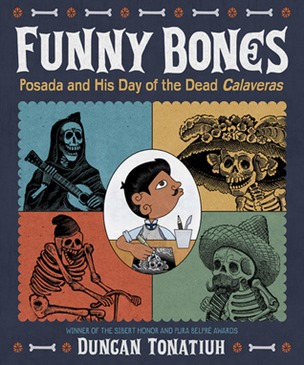
Review: Funny Bones by Duncan Tonatiuh

Funny Bones by Duncan Tonatiuh

Funny Bones: Posada and His Day of the Dead Calaveras by Duncan Tonatiuh (InfoSoup)

Award-winning author and illustrator, Tonatiuh brilliantly tells the story of Jose Guadalupe Posada. Called Lupe by his family, he showed artistic promise early in life. At age 18, he went to work in a print shop where he learned lithography and engraving. Lupe starting doing drawings for the small local paper, including political cartoons. Lupe eventually opened his own print shop and starting to create illustrations for books and pamphlets. After his shop was ruined in a flood, he moved with his family to Mexico City where he opened a new shop. Lupe began creating broadsides and that is where he started creating his calaveras or skeletons. Some have specific meanings while others are unknown, many of them make political commentary on Mexican society. Lupe was soon recognized for these prints more than any of the rest of his work. Posada continues to be known for these images thanks to other Mexican artists like Diego Rivera who investigated who had drawn the etchings.

Tonatiuh does a great job of telling the story of the full life of Posada while focusing on making it accessible to children and also making it a compelling tale. Readers will recognize some of the images in the book, creating a firm connection between the artist and the images. The story of Posada’s life is a mix of tragedy and accomplishment, rather like the images he created. The Author’s Note at the end of the book adds details to the story of Posada and his art.

Tonatiuh’s art is as unique and marvelous as ever. He uses his stylized characters, usually shown in profile. They have a wonderful folk-art feel to them and work very nicely with Posada’s own skeletons. His illustrations are a rich mix of collage and line drawings, mixing textures and colors very effectively.

A great book to share for Dia de Muertos or Day of the Dead, this will be a welcome addition to all public library collections, but particularly those serving Hispanic populations. Appropriate for ages 5-8.

Reviewed from library copy.
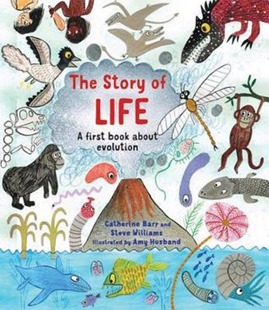
Review: The Story of Life by Catherine Barr

The Story of Life by Catherine Barr

The Story of Life: a First Book about Evolution by Catherine Barr and Steve Williams, illustrated by Amy Husband (InfoSoup)

Starting before there was life on earth, this nonfiction picture book takes readers on a journey from 4.5 billion years ago to today. Volcanoes and black ocean water with some areas that were warm from underwater volcanoes created the tiny bits that formed the basis of life. Cells started growing, some using sunlight, water and oxygen that changed the very earth itself. Over millions of years, cells developed into different forms of life and became the first animals. The seas became full of life and animals and plants started to expand to the land. Then an unknown disaster hit and most of the life on earth was destroyed. It became cold and dark, giving a chance for huge dinosaurs to emerge and take over. Millions of years passed again and insects and mammals appeared. A meteor hit the world though, and then it was time for the mammals to survive. Humans evolved from those mammals and spread across the world, bringing us to the present day.

This basic look at evolution offers a sense of the length of time that it has taken to get us from basic cells to humans today. On each two-page spread there is information on how long ago this scene was taking place. The text on the page has lots of information on the changes happening, the progress towards new life, and also the series of disasters that has caused sudden death on the planet. This is a fascinating look at evolution that is appropriate for even preschool children to begin to understand the science that created life on earth.

The illustrations by Husband are playful and fun. They add a lighthearted touch to the serious scientific information. At the same time, they are have scientific labels for important objects and ideas that let children better understand the progress of evolution that they are learning about.

A strong picture book that explores evolution and will inspire children to learn even more about prehistoric times. Appropriate for ages 4-7.

Reviewed from copy received from Frances Lincoln Children’s Books.

Review: Out of the Woods by Rebecca Bond

Out of the Woods by Rebecca Bond

Out of the Woods: A True Story of an Unforgettable Event by Rebecca Bond (InfoSoup)

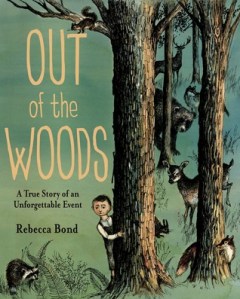
Inspired by a true story, this picture book tells of the author’s grandfather’s life in Ontario, Canada in 1914. Antonio lived with his family in a hotel run by his mother. He spent his time with the hotel workers since there were no children around. He helped the cooks, the maids, and watched as others hauled wood and repaired buildings. The hotel had three stories with a space to feed crowds of people, individual rooms for travelers and then a large open dormitory space for others. He loved spending time in the forest around the hotel too. Then one year when Antonio was almost five, it was dry as could be. When smoke was spotted in the distance, everyone knew they were in real trouble. All of the people fled the building and stood in the lake watching the fire come closer. Then something amazing happened and the animals too left the forest and entered the water, standing near the humans and close to one another, predator and prey alike. When the fire ended, the hotel was still standing and the animals returned to the burned forest, but Antonio never forgot what he witnessed that day.

Bond captures the time period, allowing readers to really explore the hotel that Antonio lived in, showing us all of the floors and the hard-working men that the hotel served. The text offers details such as describing Antonio’s room as a place that was off the kitchen and had once been a pantry. Even small things are noted like the travel bags men carried and the fact that they sometimes had guns along too. Through these details, the entire hotel comes alive on the page.

The illustrations in the book also add to the details from the long distance view of the hotel on the lake to the finely drawn images showing the interior. Small details are captured in sepia tones and fine ink lines, allowing us to get a glimpse into the past and a way of life. The same details continue even as the fire rages and the animals come into the water. Realistic and lovely, the animals’ body language shows how wary they are and yet how desperate too.

A true story brought to life through details and wonder. Appropriate for ages 4-6.

Reviewed from copy received from Farrar, Straus and Giroux.

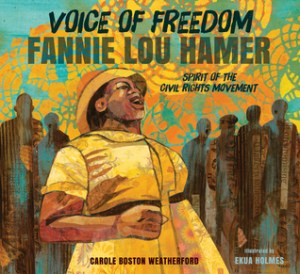
Review: Voice of Freedom: Fannie Lou Hamer by Carole Bostone Weatherford

Voice of Freedom Fannie Lou Hamer by Carole Bostone Weatherford

Voice of Freedom: Fannie Lou Hamer:The Spirit of the Civil Rights Movement by Carole Bostone Weatherford, illustrated by Ekua Holmes (InfoSoup)

This biographical picture book is written in verse, singing the life of Fannie Lou Hamer, a woman who was at the heart of the civil rights movement. The book begins with Hamer’s childhood in Mississippi as the youngest of twenty children in a sharecropper family. She grew up working in the cotton fields, seeing it for the slavery that it was. School was only held for four months a year, because the children needed to work in the fields in order for their family to survive. Even in the early part of the 1900s, Hamer was taught that black was beautiful and that she was special. She stayed in the south rather than moving north like her siblings, taking care of her mother and getting married. The in the 1960s, voter registration became an issue and Hamer found herself standing up to the system despite the violence and the threats. She joined the movement for voter rights and starting to use her singing voice to bring people together. Soon she was seen as a leader in the movement, running for office, and speaking out for those who did not have a voice. She is an inspiration for today’s Black Lives Matter movement and youth activism in general.

Weatherford’s writing is gorgeous and the verse she uses to tell Hamer’s story is very effective. She is able to directly talk about racism and violence in her poems, never dancing away from the toughest of subjects. Each poem reads as a call to action, a reason to stand up and make sure civil rights are not being abridged. Even the poem where Hamer is beaten by police and other prisoners rings with strength and power. This is a biography of a woman who was immensely determined and strong. She stood up to the system, risked her own life for change, and used her own skills for the sake of the cause.

Alongside the powerful poetry are equally impressive illustrations. The collage art by Holmes is a mix of paper art and paintings. The illustrations are deep colored and tell the story of oppression and then accomplishment. There are illustrations that take the bright colors of Africa and the 1970s and make the pages blaze while others are dark and somber as violence and death cloud the pages.

Important and powerful, this nonfiction picture book shares the story of a woman vital to the civil rights movement. Appropriate for ages 7-10.

Reviewed from library copy.

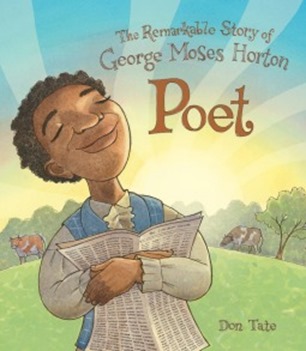
Review: Poet by Don Tate

Poet by Don Tate

Poet: The Remarkable Story of George Moses Horton by Don Tate

Released September 1, 2015.

George’s family were slaves in North Carolina. Though he loved words, George was not allowed to learn to read. But he listened when the white children did their ABCs and then got himself an old spelling book along with a book from his mother and taught himself how to read. He read everything that he could find, but loved poems most of all. He spent his workdays composing poems in his head, though he didn’t know how to write them down. Soon after, his family was split apart and he was sent to live on another farm. He worked in the fields and was sent to Chapel Hill to sell fruit and vegetables to the students. While there, he started to share his poetry aloud. The students loved his words and helped him by giving him more books to read and paying him to write poems for them. He was also taught to write his poems down and soon had his writing published in newspapers. George could then negotiate with his master to pay him for his time away from the farm where he could write. As George created the best life he could while still living a slave, the country was changing and a war for freedom was about to be fought. It was a war that would free George finally and allow him to continue writing but this time a free man.

Tate captures the life and times of this remarkable man with a tone of wonder at times. What Horton managed to do in his lifetime under slavery is amazing and a sign of the quality of the words he wielded so well. As readers watch Horton grow up and then fight for his freedom in his own way, with words, they will be devastated when he continues to be a slave despite his best efforts. Even the work of others on his behalf could not get him free.

Tate’s illustrations are exceptional. One can see the yearning for education on Horton’s face as he watches the white children learn to read. Tate also makes sure that Horton’s image shines on the page. He is regularly lit from outside lights of candles and the sun, creating a light around him. The illustrations also show North Carolina in the mid-1800s and Chapel Hill in particular. Tate also incorporates some of Horton’s poems into the illustrations, allowing them to flow past visually.

This is a choice nonfiction picture book that shows the strength of one man, his intelligence and the power of his words. Appropriate for ages 6-8.

Reviewed from digital galley received from Peachtree Publishers and Netgalley.

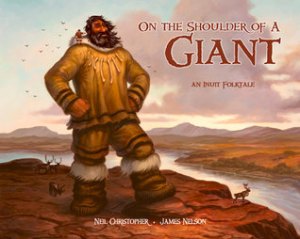
Review: On the Shoulder of a Giant by Neil Christopher

On the Shoulder of a Giant by Neil Christopher

On the Shoulder of a Giant by Neil Christopher, illustrated by James Nelson (InfoSoup)

Based on a traditional Inuit folktale, this picture book shows what happens when a massive giant takes an interest in a small human. Inukpak was big even for a giant. When he walked across the land, he could easily step over rivers and wade the deepest lakes. He could cross the Arctic on foot in only a few days, fishing for whales along the coasts. Then one day he met a hunter, whom he mistook for a little child. Before the hunter knew what has happening, Inukpak had adoped him as a son and placed him on his shoulder. In just a few steps, they were so far from the hunter’s home that he didn’t know how to return. As Inukpak got them dinner in the form of a huge whale, he almost drowned the hunter just from the huge waves that splashed as he walked in the water. When a polar bear attacks the hunter, Inukpak just laughs and tosses it away. In time, the two became good friends, the giant and the hunter.

The stage is set very nicely for this story with an introduction that explains what stories the book is based on and how the author came to know so much about Arctic folklore. The pages after the story expand the topic of Arctic giants even further with explanations of different kinds of giants. The storyline is not as linear as European tales, allowing readers to get a sense of the giant and a different rhythm of storytelling at the same time. The huge and kind giant is full of appeal thanks to his huge sense of humor and the merry way he approaches life in the Arctic.

Nelson’s illustrations are playful and jolly as well. They show the various areas of the Arctic from the seashore to the more inland areas. The size difference between the giant and the human is kept fairly consistent throughout the book, This giant is much larger than most and that adds to the appeal as well. The natural landscapes of the book are thoughtfully done as are the various animals. The lifelike depictions of these elements make the giant all the more believable.

One huge giant and one little man create a great story together and one that can nicely be shared aloud. Appropriate for ages 5-8.

Reviewed from library copy.
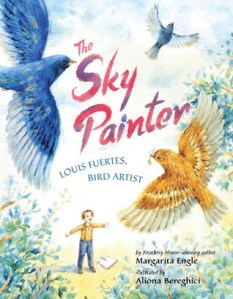
Review: The Sky Painter by Margarita Engle

Sky Painter by Margarita Engle

The Sky Painter: Louis Fuertes, Bird Artist by Margarita Engle, illustrated by Aliona Bereghici (InfoSoup)

Told in verse, this nonfiction picture book celebrates the life and work of Louis Fuertes. As a child, Louis loved watching birds and caring for them if they were injured. Even in his youth he started drawing and painting birds, despite the fact that his father wanted him to be an engineer. He kept drawing and painting in college, and learned to paint quickly and capture birds in action. At the time, the practice was to hunt the birds and then paint the dead bodies posed. Fuertes instead watched birds in life and painted them. Soon he was traveling the world to see different birds and paint them for museums, books and scientific record. Fuertes painted murals at the Natural History Museum and had a series of collectible cards with his paintings of birds on them. He helped make bird watching one of the most popular sports in the world by reinventing the way artists approached painting wildlife.

Engle speaks as Fuertes in her poems, giving him a voice to describe his own life and his own art. The book swirls like birds wings, moving from one colorful part of the world to another, delighting in the diversity of bird life everywhere. The format is rather like Fuertes’ work itself. She captures Fuertes in his real life, speaking as himself, traveling around the world, and then settling down to be the Bird Man in his old age. He is in his natural habitat throughout. Engle also captures the power of art and the importance of following the natural gifts you have.

The illustrations by Bereghici are bright with color and filled with birds. She labels each one, so that readers can learn about the different types of birds along the way. The book is filled with different habitats, even showing Fuertes underwater attempting to learn more about ducks so that he doesn’t have to shoot them. The illustrations of the birds are serious and detailed while there is often a playfulness to Fuertes’ image on the page.

A beautiful celebration of an artist who forever changed the way that birds and wildlife are painted. Appropriate for ages 7-9.

Reviewed from library copy.

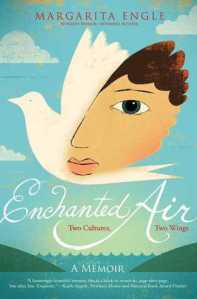
Review: Enchanted Air by Margarita Engle

Enchanted Air by Margarita Engle

Enchanted Air: Two Cultures, Two Wings by Margarita Engle (InfoSoup)

Released August 4, 2015.

In this verse memoir, Engle tells the story of her childhood during the Cold War. With half of her family coming from Cuba and a grandmother who still lived there, Engle had a strong connection to Cuba. It was there that as a child she found herself, connected to the island culture and lifestyle, ran wild in nature, and discovered a quieter life. It contrasted with her life in Los Angeles, filled with bustle and crowded with people. Through both of these distinct worlds, she has a constant, her love of books and words. As the Bay of Pigs escalates, Engle fears for her island family and has to deal with the increased hatred of Cuba and Cubans in America. Cut off from family with the Cuban embargo, Engle can do little to help and again turns to her words to express herself.

Engle is one of the best verse novelists working today. While all of her previous books are splendid, this one is personal in a new way, one that offers up her heart. She shows her love of Cuba so vividly and so profoundly that her connection there runs through the entire novel. At the same time, she also shares the loneliness of a girl who likes books and words and who struggles to make friends at times. Add to that the political turmoil that has continued for decades and you have a book that could have been a tragedy but instead rises beyond that and straight into hope.

As always, Engle’s verse is exceptional. She captures emotions with a clarity in her verse that makes it immensely compelling to read. There are poems that show a pig being slaughtered on the farm in Cuba that makes it sound both brutal and delicious, the perfect mix of tempting and revolting. There are poems that capture the night sounds of Cuba and the longing for a horse of her own. They show the beauty of milking cows, the strength of a hard-working hand, the joy of connecting with a horse as you ride it. It all melts together into a picture of Cuba that is both personal and universal.

Give this to children who loved Brown Girl Dreaming for another verse memoir that is sure to inspire young readers to see the world in a more diverse and brilliant way. Appropriate for ages 9-12.

Reviewed from digital galley received from Atheneum Books for Young Readers and Edelweiss.

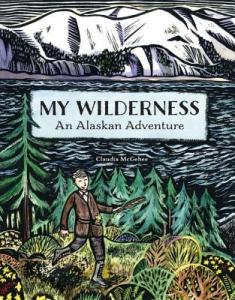
Review: My Wilderness by Claudia McGehee

My Wilderness by Claudia McGehee

My Wilderness: An Alaskan Adventure by Claudia McGehee

This nonfiction picture book tells the story of Rocky and his father, painter Rockwell Kent, who spent a winter in 1918-1919 on Fox Island, just off the coast of Alaska. Rocky was nine years old at the time. He and his father repaired an old shed and turned it into their cabin. While his father spent time painting, Rocky drew a bit and explored the island a lot. He saw wildlife in the woods, collected shells and stones and the beach. Evenings were spent in the cabin, eating dinner and sharing stories. When the winter came, days filled with different activities like taking snow baths, making snow houses. They took trips to a larger island in their dory, rowing when the weather was good. They faced one large storm when returning home, barely making it to land. All too soon, their time in the wilderness was done. It was a time that Rocky always felt was the best in his life.

McGehee takes readers along on an epic journey to Alaska. The mountains are huge, the water freezing, the woods thick and the animals are everywhere. Told from the point of view of Rocky, the book allows young readers to see Alaska through his eyes and marvel along with him at the wonder of nature. As he walks the woods and explores the shore, he dreams that there may be monsters or pirates around, but looking again he always sees something that fits into the natural scene. The days are filled with exploration and evenings spent together, one gets the sense that there was more than enough adventure to fill their days.

The illustrations are done on scratchboard giving the feel almost of woodcut prints on the page. The result is a very organic feel with thick lines and an interplay of bright colors and deep black. The more natural feel works very well with this Alaskan subject matter, creating an old fashioned feel that enhances the book as well. McGehee captures nature with an ease that makes one want to enter the deep green woods alongside Rocky.

Explore the Alaskan wilderness in all of its wonder in this historical picture book. Appropriate for ages 5-7.

Reviewed from library copy.