Review: Eye to Eye by Steve Jenkins

eye to eye

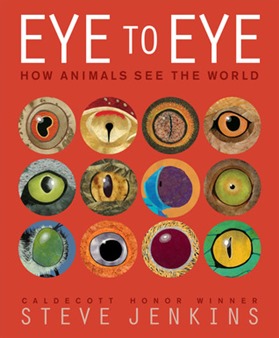
Eye to Eye: How Animals See the World by Steve Jenkins

Explore different types of animal eyes in this gorgeous nonfiction picture book by the amazing Steve Jenkins.  In this book, Jenkins not only talks about the different kinds of animals eyes, explaining them in just the right amount of detail, but also looks at specific animals and their unique eyes.  Jenkins shares lots of facts, carefully chosen to be fascinating and fun.  One never knows what will be found on the next page and whether it will be looking right at you.

Jenkins makes sure that children will learn about evolution in this picture book.  His emphasis throughout is on the evolution from simple light-sensitive eyespots to the complex camera eyes of humans and hawks.  As always, his information is well-chosen and interesting.  It is accompanied by large-format images that are paired with smaller images that show the animals entire body.  This is science information at its best.

The eyes have it!  This is a book that belongs in all public libraries.  Appropriate for ages 6-9.

Reviewed from library copy.
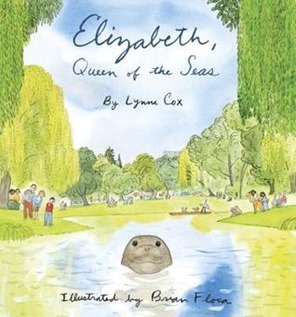
Review: Elizabeth, Queen of the Seas by Lynne Cox

elizabeth queen of the seas

Elizabeth, Queen of the Seas by Lynne Cox, illustrated by Brian Floca

This is the true story of Elizabeth, an elephant seal, who decided she wanted to live in the warm waters of the Avon River near the city of Christchurch in New Zealand.  People are happy to have Elizabeth in the river, often spending time watching her swim.  Then Elizabeth decides that her favorite place to sun is the middle of a two-lane road.  It is flat and warm and perfect, except for the dangers of the cars to both Elizabeth and the people.  So Elizabeth is towed out to sea, to live with the other elephant seals.  But Elizabeth returns.  She is removed to the sea over and over again, each time taking her farther away from Christchurch.  But she still finds her way back to those warm river waters. 

Cox, a famous long-distance, open-water swimmer, has written her first children’s book here.  One would never know that it is her first.  She writes with a grace and simplicity that make her book entirely readable but also poetic too.  She incorporates imagery that will help children understand Elizabeth better: “Moving up the soft shore like a giant inchworm.”  She also uses descriptive language to draw contrasts between the waters in the river and those in the cold sea. 

Floca, winner of the 2014 Caldecott Medal, uses his fine-line drawings to show the merry spirit of Elizabeth both when she is in the warm river waters and upon her amazing returns after being towed away.  Floca’s illustrations of Elizabeth on the warm road and her surprise but lack of alarm when the cars approach are beautifully done. 

A winning story that tells the story of one unique elephant seal and the town that she decided was her home.  Appropriate for ages 5-7.

Reviewed from copy received from Random House Children’s Books.

Review: Galapagos George by Jean Craighead George

galapagos george

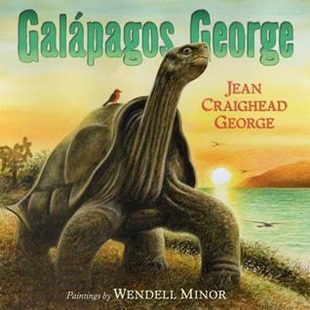
Galapagos George by Jean Craighead George, illustrated by Wendell Minor

A story of evolution and extinction, this picture book explores the incredible life of the famous Lonesome George a tortoise who was the last of his kind.  The book begins by explaining how a million years ago a tortoise was driven from South America and carried to the island of San Cristobal near the equator.  There she laid eggs, used her long neck to reach food, and passed on her genetics.  Thousands of years later, all of the turtles looked different with long necks and shells that curved back to give their necks more room.  When humans discovered the Galapagos Islands, they quickly decimated the turtle population which dwindled down to only a few thousand from the hundreds of thousands that had lived there.  A hundred years later, the giant tortoise population had reduced even further, so that one lone turtle remained.  He was moved to the Charles Darwin Research Station and protected but no other turtle of the species was ever found.

George creates a vivid story of the power of evolution in our world and the effects of humans on animal species.  She steadily shows how weather forces and natural disasters impact animals as well, moving them from place to place and changing their habitats.  As the animals change slowly, George keeps the text clear and factual, making for a book that moves quickly and is filled with fascinating scientific information.

Minor’s illustrations are lush and lovely.  They are filled with the light of sun, bursting on the horizon in tropical colors.  He also shows the barren landscape of the Galapagos clearly and the frank regard of a tortoise looking right at the reader.  There is a sense of loneliness for much of the book both when the book is about the first tortoise and then later when there is one left.  That connection between the two lone turtles is made clearly in the illustrations.

Fascinating, distressing and yet ultimately hopeful, this nonfiction picture book will work well in science classrooms as well as library collections.  Appropriate for ages 6-9.

Reviewed from copy received from HarperCollins.

Review: Separate Is Never Equal by Duncan Tonatiuh

separate is never equal

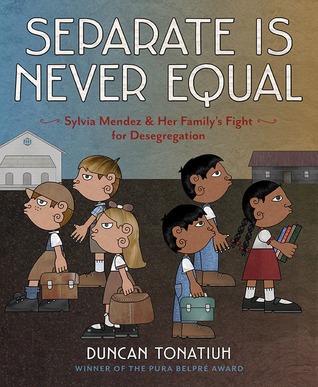
Separate Is Never Equal: Sylvia Mendez & Her Family’s Fight for Desegregation by Duncan Tonatiuh

Explore an early battle for desegregation of the California public schools in this picture book.  In a court battle that took place seven years before Brown v. Board of Education, Sylvia Mendez and her family fought the system.  Having been placed in a Mexican school rather than a “whites only” one due to her Mexican and Puerto Rican heritage, Sylvia and her family realized that she was being given a second-class education because the facilities and teachers were much better in the white school.  After appealing the school placement, the full extent of the racism of the system was revealed as the school proceeded to inform Sylvia who spoke perfect English that the other school would help her learn English better.  Sylvia’s parents took the battle to court and also organized the Hispanic community to find other students who were being clearly discriminated against.  This is a book where people took on a fight for what was right and managed to get things changed. 

Tonatiuh emphasizes the small and poor vs. large government and wealth throughout this book.  He makes sure that young readers understand the extent of the racism against Hispanics and the reality of the policies that they were living under.  The issue is complex, but he keeps it clear and concise, offering a solid view of the courage that it took for the Mendez family to fight the system and also making it clear why they were able to fight back when others could not.

Tonatiuh’s stylized illustrations pay homage as always to folk art.  His characters have glossy hair in different colors that are cut-outs of photographs.  The same is true of the fabric of clothes and other objects.  This is paired with a flat paint and clear black outlines making a combination that is modern and ageless. 

An important addition to the civil rights history of the United States, this nonfiction picture book tells a story of courage and determination.  Appropriate for ages 6-9.

Reviewed from copy received from Abrams.

Review: Plant a Pocket of Prairie by Phyllis Root

plant a pocket of prairie

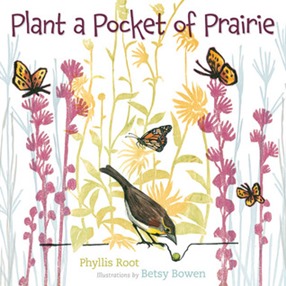
Plant a Pocket of Prairie by Phyllis Root, illustrated by Betsy Bowen

Prairies used to cover vast swaths of the United States, but are almost entirely gone now.  In this nonfiction picture book, young readers are invited to create their own small prairies at home.  Root offers ideas for what native prairie plants should be planted first and then ties each plant to a type of wildlife that will arrive along with the plants.  Butterfly weed invites monarchs to your yard.  Asters and rough blazing star bring even more butterflies.  Toads, birds, mice, bumblebees, and more may appear in your little garden.  And who knows, if lots of people plant a little prairie, eventually we may have prairies back across the nation.

Root has written this book in poetry that rhymes at times and others not.  There are rhymes at the ends of lines, then internal rhymes within a line, and other times it is the rhythm and flow of the words themselves that create the structure.  It has a strong organic feel to it, the names of the plants flowing into those of the animals they will bring to your yard.  The book ends with information on all of the plants, animals and insects mentioned in the book as well as further information on the state of prairies in the United States and where you can go to see a prairie.

The illustrations by Bowen are light and free.  They focus on the plants and animals, showing them clearly.  Along the way, one bird moves from page to page, planting seeds that grow into the garden and building her own nest in the new habitat.  There is a sense of the garden expanding and building as the book continues, yet that light feel continues throughout. 

A song of the prairie, this book will inspire young gardeners to try native plants and is a great addition to curriculums in schools doing their own garden programs.  Appropriate for ages 5-8.

Reviewed from digital galley received from University of Minnesota Press and NetGalley.

Review: Mama Built a Little Nest by Jennifer Ward

mama built a little nest

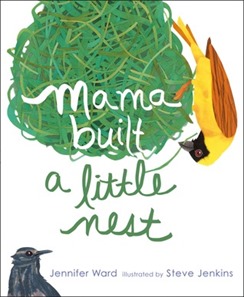
Mama Built a Little Nest by Jennifer Ward, illustrated by Steve Jenkins

Told in rhyme, this book explores the many different ways that birds create nests for their eggs and babies.  The jaunty rhyme is accompanied by informational text on each species and their habitats and nest building style.  Bird species range from penguins to falcons to flamingos.  There are also more unusual birds like weaverbirds as shown on the cover of the book. 

Ward’s rhyme works well here, offering a playful feel to a book filled with scientific information.  She has also selected a great mix of species with familiar birds mixed in with more exotic ones.  Each has its own unusual way of creating a nest, making this a book where turning the page is part of the adventure.

As always, Jenkins’ cut paper art is spectacular.  He manages to create so much life with textured paper and different colors.  From the subtle colors of a cactus plant to the feathers on an owl’s wing, this art is lovely and makes this book very special.

Intelligently and beautifully presented, this nonfiction picture book will entice young readers to learn even more about birds.  Appropriate for ages 5-8.

Reviewed from copy received from Beach Lane Books.

The Fly and The Worm by Elise Gravel

fly worm

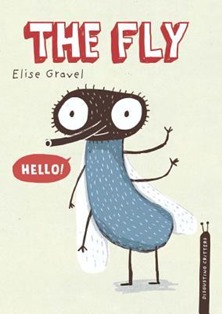
The Fly by Elise Gravel

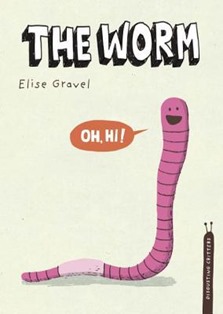
The Worm by Elise Gravel

The first and second books in the new Disgusting Critters series of nonfiction picture books, these books take a humorous look at the biology of a specific creature.  The first book deals with flies, specifically the common house fly.  Inside are all sorts of interesting facts like the fly being covered in hair and information on eggs and maggots.  More disgusting aspects are played up, which should appeal to young children, like the diet of flies and how germ filled they are and why.  The second book is about worms and focuses on their unique anatomy, such as having no eyes and no limbs.  There is also a focus on habitat, diet and reproduction.  Throughout both books, humorous asides are offered, making this one of the most playful informational book series around.

Gravel combines both humor and facts in her book.  She keeps the two clearly defined, with the animals themselves making comments that add the funniness to the books.  The facts are presented in large fonts and the design of the book makes the facts clear and well defined.  These books are designed for maximum child appeal and will work well in curriculums or just picked up by a browser in the library.

The art in the books, as you can see by the covers, is cartoonish and cute.  The entire effect is a merry romp alongside these intriguing animals.  I know some people believe that books about science for children should be purely factual, but Gravel’s titles show how well humor and touch of anthropomorphism can work with informational titles.

Information served with plenty of laughs, these science titles will be appreciated by children and teachers.  Appropriate for ages 5-8.

Reviewed from library copies.

Review: Thomas Jefferson by Maira Kalman

thomas jefferson

Thomas Jefferson: Life, Liberty and the Pursuit of Everything by Maira Kalman

The author of Looking at Lincoln takes on Thomas Jefferson in her newest picture book biography.  The focus in this biography is on the wide range of Jefferson’s interests and how he truly was a Renaissance man.  Monticello, the house Jefferson designed and built, serves as a fine background to his interests since the home itself was ever changing and also housed many of his interests as well.  The book looks at fascinating small details like the design of Jefferson’s bed, the extensive vegetable gardens, and his hours spent practicing music.  After fully exploring Jefferson personally, the book turns to the Declaration of Independence and Jefferson becoming the third President of the United States.  Then the book also explores the fact that Jefferson had slaves and fathered children with one of them, Sally Henning.  This is a complex and thorough look at a man who was brilliant in so many ways but troubled as well.

Kalman writes biographies with her own opinions right on the page.  So when she addresses the slave issue, she speaks of “our hearts are broken” and then speaks to how tragic it is that Jefferson’s children who could pass as white had to hide who they really were.  This adds a personality to the book, making it far richer than simple facts would.  It will assure young readers that it is good for them to have opinions about history and to express them too.

As always, it is Kalman’s art that sets this book apart.  Her illustrations range from more serious portraits of the historical figures to eye-popping bright colors in the vegetable gardens where paths are pink next to the bright green of the grass.  It is all entirely rich and joyful.

Another dynamic and unique biography from Kalman, this book belongs in every public library serving children.  Appropriate for ages 7-10.

Reviewed from copy received from Nancy Paulsen Books.

Review: The Scraps Book by Lois Ehlert

scraps

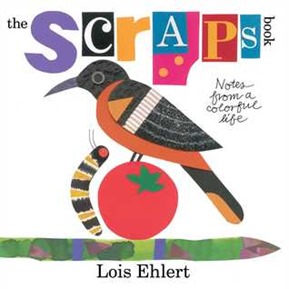
The Scraps Book: Notes from a Colorful Life by Lois Ehlert

This nonfiction picture book allows readers a glimpse into Ehlert’s creative process as well as her personal history.  The book begins with a very young Ehlert and how she was raised by parents who enjoyed making things with their hands.  She even had her own art space in the house.  After art school, she worked on her own art in the evenings and in an art studio by day.  She wasn’t creating books right away, but when she started she found inspiration right in her own life.  At this point, the book focuses on Ehlert’s previous work and the process she uses to create her beloved books.  This is a colorful and delightful visit to an artist’s studio.

Ehlert approaches this biographical book just as she does her fictional picture books.  The pages are scattered with scraps, cut out objects, designs from her previous work, and photographs from her past.  The result is a book that shines with her own personal style and energy.  This could be no one else’s studio and no one else’s art.  Ehlert invites young readers not only to explore her own history and approach to art, but also to seek out their own and create things themselves. 

Bright, beautifully messy, and wonderfully creative, this book will be inspiring to young artists and authors.  Appropriate for ages 6-8.

Reviewed from copy received from Beach Lane.