Review: I Am the World by Charles R. Smith, Jr.

i am the world

I Am the World by Charles R. Smith, Jr.

In this book that combines verse and photography, children from around the world are celebrated.  The images and verse both speak to the wide diversity of people and cultures that make up our world.  At the same time, the universal aspects of children from all cultures are celebrated too, including their strength and spirit.  The combination of a simple and powerful poem and dynamic photographs make for a book that is just as vibrant as its subjects.

Smith is a Coretta Scott King Award winner and his photographs here speak to his skill.  He captures children mid-motion and often in full smile.  His photos are combined with a poem that is simple but also strong, offering subtle rhyme and incorporating enough culture-specific words that a glossary is offered at the end. 

Beautiful, warm and inclusive, this title is a celebration of children across the globe.  Appropriate for ages 6-8.

Reviewed from copy received from Atheneum Books for Young Readers.

Review: The Boy Who Loved Math by Deborah Heiligman

boy who loved math

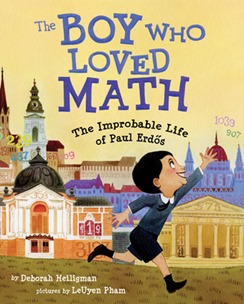
The Boy Who Loved Math: The Improbable Life of Paul Erdos by Deborah Heiligman, illustrated by LeUyen Pham

Paul Erdos grew up loving math from a very young age.  Growing up in Budapest, Hungary, Paul loved to think about numbers.  Unfortunately, he didn’t love school with all of its rules, so he was homeschooled by Fraulein, his nanny, until he went to high school.  Paul grew famous for his math but he still could not take care of himself and do his own laundry, cook his meals or even butter his own bread.  So when at age 21 he was invited to go to England to work on his math, he was worried about whether he could do it.  It turned out that buttering bread was not that difficult and that he would follow his own sort of lifestyle that ignored the rules.  So he traveled and did math around the world, staying with fellow mathematicians and relying on them to take care of him and his laundry and his meals.  He was the furthest thing from a stereotypical solitary mathematician to the point that people now have an “Erdos number” that shows how closely they worked with the amazing mathematician Paul Erdos.

This is such a wonderful biography.  It is a breath of fresh air in so many ways.  First, it plays against the stereotype of introverted and shy mathematicians working in solitude on formulas and instead shows Erdos as a vivacious man who didn’t just work with others, but depended on them.  Second, it shows mathematics as ever changing and new, something that is enticing and exciting.  Heiligman uses a light tone throughout as well as an obvious respect for Erdos’ brilliance and accomplishments. 

The illustrations share the same playful feel of the text.  Done in bold colors and dynamic motion, they have a humor that is welcome as well.  The look on Erdos’ face as he tries to butter his own bread for the first time is priceless and wonderful.  Children will be amazed that such a bright man would struggle with basic tasks.

A pleasure to read, this is an unusual biography that will make a welcome addition to nonfiction shelves.  Appropriate for ages 6-9.

Reviewed from library copy.

Review: When Stravinsky Met Nijinski by Lauren Stringer

when stravinsky met nijinsky

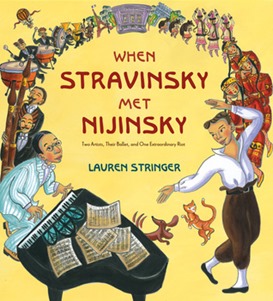
When Stravinsky Met Nijinsky: Two Artists, Their Ballet and One Extraordinary Riot by Lauren Stringer

This is the story of how two Russian artists collaborated to create a revolutionary new ballet, The Rite of Spring.  When the two artists met one another, each of them started to change.  Stravinsky’s music changed and Nijinsky’s dance changed.  They inspired one another to try something entirely new and created a ballet based on Russian folk dances and folk songs.  Even at rehearsal, some of the musicians walked out, but enough stayed so that the show could go on.  When the ballet was first performed, the crowd was split.  Some people loved the new music and dancing, others were shocked and hated it.  The crowd took to the streets to continue to express their anger and appreciation.  This is a great picture book biography that captures the magic of creativity that results when two masters collaborate on something brave and new.

Stringer’s writing takes a complicated story and distills it to the most important points.  Young readers will quickly understand that the two men brought new ideas out of one another, finding each other inspiring.  Her art also speaks to the collaboration of these two men, using flowing lines and deep yet soft colors.  She inserts elements from the art of the time, referencing movements like cubism in both her text and art.  The end of the book has photographs of the two artists and dancers in the ballet.  It also has a longer look at their collaboration. 

A great choice for art and music classes, I’d recommend listening to The Rite of Spring with the group too.  Appropriate for ages 6-8.

Reviewed from library copy.

Review: Becoming Babe Ruth by Matt Tavares

becoming babe ruth

Becoming Babe Ruth by Matt Tavares

This biographical picture book takes a look at Babe Ruth’s formative years.  It is the story of a small boy named George Herman Ruth who gets into lots of trouble, so much that his father puts him into Saint Mary’s Industrial School for Boys.  There he has to follow the rules and work hard.  Happily, there is also baseball and George gets to play it almost every day.  Best of all, there is Brother Matthias who serves as an inspiration and mentor for George’s baseball game and life.  As George gets better and better, he is finally whisked into the world of major league baseball, but he never forgot the school and the man who got him there. 

Tavares writes in such an engaging way that the pages fly by.  The sudden sternness of the school is told in short, abrupt sentences that enforce the martial feel of the establishment.  That contrasts directly with the long sentences that talk about the beauty of baseball.  Readers can almost feel themselves taking a big gulp of freedom on those pages. 

The joy Tavares feels about his subject is also palpable.  From eating ice cream with the boys from the school, to tipping his hat to them as he walks on the field, to the pleasure of hitting a ball, all are captured with a fondness and pleasure in the paintings that are the illustrations in the book. 

This is a baseball biography that children will find accessible and fascinating.  Play ball!  Appropriate for ages 6-9.

Reviewed from library copy.

Review: Brush of the Gods by Lenore Look

brush of the gods

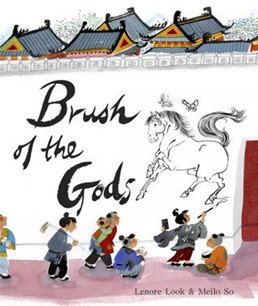
Brush of the Gods by Lenore Look and Meilo So

This is a picture book biography of Wu Daozi from the T’ang Dynasty, who is considered China’s greatest painter.  As a child, Daozi is taught calligraphy, but his brush does not want to just create Chinese characters.  Instead, he creates the first stroke and then turns it into an animal like a fish or a horse.  Daozi began to paint on walls, painting so fast that his sleeves opened like wings, gaining him the nickname of Flying Sleeves.  He painted every day and people began to leave coins for him that he donated to feed the poor.  As time passed, his skills grew even greater until the creatures he drew and painted became alive and left the flat surface of the walls.  He was then commissioned to paint an entire wall for the emperor, a project that took him many years.  In the end though, he created an entire world on a wall, one that you could almost walk right into.

Beautifully told and illustrated, this picture book biography takes a playful tone right from the beginning.  The sense that Daozi was not in control of his own gift makes for a wonderful insight into the drive and talent of artists and the way their talents can control them.  It is also a tribute to the skills gained by doing what you love and practicing a tremendous amount.  Daozi’s work and its lifelike quality is captured through a magical transformation to life in the story, making this feel much more like folklore than a biography.

Look’s text will work best for elementary-aged children, as she tells the story of hard work and talent combined into something spectacular.  They will also be more likely to understand the juxtaposition of biography and magical realism that is in the book.  Her writing is clear and lingers in all of the right moments and moves quickly when those moments are right too.  So’s illustrations are a tribute to Chinese art.  Done with clear brushstrokes, they also have fine details and small touches that make them shine.

This is a very impressive biography of an incredible artist that few children will be aware of before reading this book, making it perfect to share with children in art classes.  Appropriate for ages 6-8.

Reviewed from digital galley received from Random House via Edelweiss.

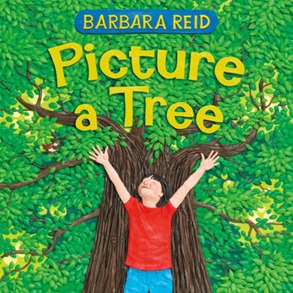
Review: Picture a Tree by Barbara Reid

picture a tree

Picture a Tree by Barbara Reid

How do you picture a tree?  Do you see a drawing on the sky?  A tunnel?  An ocean?  A sun umbrella to stop on your hot walk home?  What do you see?  These are just some of the ideas that Reid puts forward in her picture book that pays homage to trees and their ever-changing beauty.  Starting with the spring and moving through all of the seasons, this book will have you looking into the trees around you and noticing them even more.

Reid’s text here is simple but very effective.  She gets you dreaming of your own answers and also seeing trees from all angles and all seasons.  The true focus here though is her art.  Done entirely in Plasticine clay, they have a wonderful three-dimensional quality to them and are anything but simple.  In fact, the detail is amazing and will keep readers gazing long after they complete the words on the page.

An awesome addition to any Arbor Day, Earth Day, tree-related or seasonal story time or unit, this book should inspire all of us to wonder about trees.  Appropriate for ages 4-6.

Reviewed from library copy.

You can also see the trailer for the book for a glimpse of Reid’s art and words:

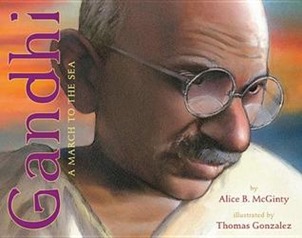
Review: Gandhi by Alice B. McGinty

gandhi

Gandhi: A March to the Sea by Alice B. McGinty, illustrated by Thomas Gonzalez

This nonfiction picture book focuses on Gandhi’s 24-day March to the Sea in 1930.  Joined by over 70 others, this was a nonviolent protest of British rule of India and the taxes they had levied on salt.  Told in verse, this picture book explores how the march united the different faiths and castes of India into a common cause.  The book and journey ends with Gandhi scooping salt from the sea, inspiring many others to do the same.  Many were imprisoned for their actions, but they proved too numerous for the prison system and had to be released.  This is a profound and impressive look at a nonviolent action that was noticed around the world and still serves as inspiration today.

McGinty’s verse is free and flowing.  She nicely integrates imagery that is moving and speaks volumes about the situation.  Just one line from when Gandhi reaches the sea: “white salt dusting dark sand.”  McGinty also weaves in the way that Gandhi inspired others to spin their own thread rather than relying on British cloth, how he prayed together with all faiths, truly how he created a single community out of so many different ones.

The illustrations by Gonzalez are exquisite.  His paintings capture the stones on the path, the crowds that gathered, and finally Gandhi by the sea, alone and strong.  All of the images show a man of strength of conviction and a spirit that was unfailing.  They are stunningly evocative of the man and his mission.

This is a top-notch picture book that truly conveys the difference one man can make in the world being nonviolent.  Appropriate for ages 6-9.

Reviewed from library copy.

Review: Primates by Jim Ottaviani

primates

Primates: The Fearless Science of Jane Goodall, Dian Fossey, and Birute Galdikas by Jim Ottaviani and Maris Wicks

Released June 11, 2013.

Explore three of the greatest primatologists of the 20th century in this graphic novel.  The book begins with the story of Jane Goodall and how she was recruited by the famous anthropologist Lous Leakey to research chimpanzees.  It shows how she first learned to quietly watch the chimpanzees and be accepted by them as well as her own personal life as she lived in the jungle.  When Dian Fossey is then recruited by Leakey, the story turns to her life and her very different personality as she researched gorillas using similar techniques to Goodall.  The last woman recruited was Galdikas and she studied orangutans and had her own adventures as her research progressed.  Told with humor but also immense respect, the stories of these three pioneering women show the importance of female scientists and the unique paths you can take to reaching your dreams.

Ottaviani writes in the voices of the three women, beautifully capturing their individuality through their words.  The three are profoundly unique yet also amazingly similar in their bravery, dedication and resilience.  I particularly enjoyed the scenes where the three of them were together and the ending which demonstrated how different they were from one another.  It takes a lot of skill to write three women’s voices with such clarity that they are distinct and special.

The art by Wicks has a wonderful simplicity and also a playfulness that makes the book welcoming and light hearted.  This is nonfiction that reluctant readers and young biologists alike will enjoy.  The graphic format is compelling and given the nature of the research makes the entire experience more tangible for young readers.

A great graphic novel, this is a stellar pick for school libraries and public libraries that will have children learning about scientific history without even realizing it!  Appropriate for ages 9-12.

Reviewed from copy received from First Second.

Review: Stripes of All Types by Susan Stockdale

stripes of all types

Stripes of All Types by Susan Stockdale

Visit this gallery of animals who bear stripes of all sorts.  There are animals that live in the ocean, ones that slither in grass, large cats, amphibians, insects, mammals and more.  Drawn in crisp illustrations that show the stripe detail as well as pieces of their habitat.  The book reads quickly, carried forward by the rhyming text.  Children looking for more information on the intriguing animals can turn to the back of the book. 

Thanks to the rollicking rhyme and the short sentences in the body of the book, even toddlers will enjoy this nonfiction book.  Older children will enjoy talking about the different animals and reading more details. 

Entertaining and informative, this is a very flexible title that a wide range of ages will find interesting.  Appropriate for ages 3-6.

Reviewed from copy received from Peachtree Publishers.