Review: Gandhi by Alice B. McGinty

gandhi

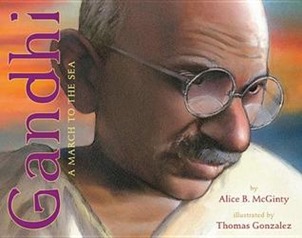
Gandhi: A March to the Sea by Alice B. McGinty, illustrated by Thomas Gonzalez

This nonfiction picture book focuses on Gandhi’s 24-day March to the Sea in 1930.  Joined by over 70 others, this was a nonviolent protest of British rule of India and the taxes they had levied on salt.  Told in verse, this picture book explores how the march united the different faiths and castes of India into a common cause.  The book and journey ends with Gandhi scooping salt from the sea, inspiring many others to do the same.  Many were imprisoned for their actions, but they proved too numerous for the prison system and had to be released.  This is a profound and impressive look at a nonviolent action that was noticed around the world and still serves as inspiration today.

McGinty’s verse is free and flowing.  She nicely integrates imagery that is moving and speaks volumes about the situation.  Just one line from when Gandhi reaches the sea: “white salt dusting dark sand.”  McGinty also weaves in the way that Gandhi inspired others to spin their own thread rather than relying on British cloth, how he prayed together with all faiths, truly how he created a single community out of so many different ones.

The illustrations by Gonzalez are exquisite.  His paintings capture the stones on the path, the crowds that gathered, and finally Gandhi by the sea, alone and strong.  All of the images show a man of strength of conviction and a spirit that was unfailing.  They are stunningly evocative of the man and his mission.

This is a top-notch picture book that truly conveys the difference one man can make in the world being nonviolent.  Appropriate for ages 6-9.

Reviewed from library copy.

Review: Primates by Jim Ottaviani

primates

Primates: The Fearless Science of Jane Goodall, Dian Fossey, and Birute Galdikas by Jim Ottaviani and Maris Wicks

Released June 11, 2013.

Explore three of the greatest primatologists of the 20th century in this graphic novel.  The book begins with the story of Jane Goodall and how she was recruited by the famous anthropologist Lous Leakey to research chimpanzees.  It shows how she first learned to quietly watch the chimpanzees and be accepted by them as well as her own personal life as she lived in the jungle.  When Dian Fossey is then recruited by Leakey, the story turns to her life and her very different personality as she researched gorillas using similar techniques to Goodall.  The last woman recruited was Galdikas and she studied orangutans and had her own adventures as her research progressed.  Told with humor but also immense respect, the stories of these three pioneering women show the importance of female scientists and the unique paths you can take to reaching your dreams.

Ottaviani writes in the voices of the three women, beautifully capturing their individuality through their words.  The three are profoundly unique yet also amazingly similar in their bravery, dedication and resilience.  I particularly enjoyed the scenes where the three of them were together and the ending which demonstrated how different they were from one another.  It takes a lot of skill to write three women’s voices with such clarity that they are distinct and special.

The art by Wicks has a wonderful simplicity and also a playfulness that makes the book welcoming and light hearted.  This is nonfiction that reluctant readers and young biologists alike will enjoy.  The graphic format is compelling and given the nature of the research makes the entire experience more tangible for young readers.

A great graphic novel, this is a stellar pick for school libraries and public libraries that will have children learning about scientific history without even realizing it!  Appropriate for ages 9-12.

Reviewed from copy received from First Second.

Review: Stripes of All Types by Susan Stockdale

stripes of all types

Stripes of All Types by Susan Stockdale

Visit this gallery of animals who bear stripes of all sorts.  There are animals that live in the ocean, ones that slither in grass, large cats, amphibians, insects, mammals and more.  Drawn in crisp illustrations that show the stripe detail as well as pieces of their habitat.  The book reads quickly, carried forward by the rhyming text.  Children looking for more information on the intriguing animals can turn to the back of the book. 

Thanks to the rollicking rhyme and the short sentences in the body of the book, even toddlers will enjoy this nonfiction book.  Older children will enjoy talking about the different animals and reading more details. 

Entertaining and informative, this is a very flexible title that a wide range of ages will find interesting.  Appropriate for ages 3-6.

Reviewed from copy received from Peachtree Publishers.

Review: On a Beam of Light by Jennifer Berne

on a beam of light

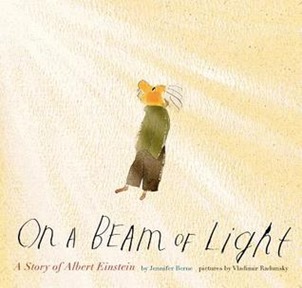
On a Beam of Light: A Story of Albert Einstein by Jennifer Berne, illustrated by Vladimir Radunsky

The author of Manfish: A Story of Jacques Cousteau (my review) returns with this picture book biography of Einstein.  It follows the story of Einstein from birth through his series of amazing discoveries about the universe.  The book begins with pages where Einstein as a small child does not speak until he is inspired to ask questions thanks to a compass which is given to him.  Einstein is also inspired by picturing his bicycle riding on beams of light, racing through space.  So he began to study science and numbers and after graduating from college wanted to be a teacher.  Instead, he found a job working in a government office where he had extra time to think.  That time to think turned into incredible discoveries about science and the nature of the universe until scientists and professors were seeking Einstein out to come and work with them.  The end of the book celebrates Einstein’s eccentricities as well as the discoveries that he made.  This is an inspiring look at a scientist who broke all the rules and decoded the universe.

Berne’s writing truly celebrates this amazing thinker.  The pacing is brisk, but the tone allows readers to linger and think if they wish to.  When she focuses on his odder behaviors, they are seen through a lens of what they meant for his genius rather than just being peculiar.  And who wouldn’t want to not wear socks and have ice cream too! 

Radunsky’s illustrations are done on textured paper that adds a soft yellow glow to the entire book, something wonderful to have in a book that speaks about rays of light.  His drawings are rough and have a wonderful sense of playfulness. 

A great read about a great man, this picture book biography should be welcomed by young scientists as well as in science classrooms.  Appropriate for ages 6-9.

Reviewed from library copy.

Review: Look Up! by Robert Burleigh

look up

LookUp! Henrietta Leavitt, Pioneering Woman Astronomer by Robert Burleigh, illustrated by Raul Colon

Henrietta had loved the stars ever since she was a little girl and spent hours gazing at them.  When she studied astronomy, she was one of the only women in her class.  After graduating, she worked at an observatory though she almost never got to look through the telescope.  Instead the women were there to do the calculations, to work and not think.  But Henrietta continued to study and to think, she was especially interested in a group of stars that seemed to dim and glow.  She discovered some new blinking stars that no one had ever found before.  As she studied, she found a pattern in the dimming and brightening of these stars: the blink time allowed her to measure the true brightness of any blinking star in the sky.  Her discovery led to a deeper understanding of the vastness of the universe and her life demonstrated that women are thinkers and scientists.

Burleigh’s writing is almost poetic here.  He speaks of the connection Henrietta felt to the stars: “Sometimes she felt the stars were trying to speak, to tell her what they knew.”  He writes with deep amazement at the vastness of the universe and also speaks of Leavitt’s discoveries in thrilled tones, giving her credit for the hard work and patience it took to find the patterns in the stars.  The book ends with several pages that outline her discoveries, names of other female astronomers, and also have a glossary and bibliography. 

Colon’s illustrations are simply gorgeous.  Done in watercolors and pencil, the illustrations are luminous, glowing with the light of the stars and with the light of the heroine herself.  Textured with swirling lines, the illustrations have a great depth to them as well.

This picture book biography invites children to follow their own passions and get involved in science as well.  Appropriate for ages 6-9.

Reviewed from library copy.
Review: The Beatles Were Fab by Kathleen Krull

beatles were fab

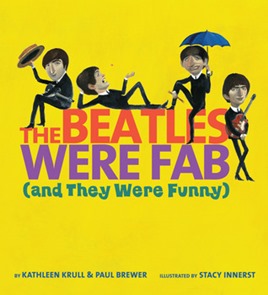
The Beatles Were Fab (And They Were Funny) by Kathleen Krull and Paul Brewer, illustrated by Stacy Innerst

This is a picture book biography of The Beatles that captures their humor and the way that they used it in their music and lifestyle.  The book begins with the formation of the band and the fun they had naming themselves.  The book talks about their use of silliness and jokes to keep their spirits up as they struggled to make it, looking for a record deal.  When success came, it came quickly and with success came fame and fans.  Then there was the Beatlesmania craze that swept the United States, nothing like it had been seen before or since.  Krull includes some small details like American fans throwing jellybeans on stage because the band said they liked jellybabies, but jellybabies are soft where jellybeans are certainly not.  She then has a section on each Beatle and some of the interesting responses they gave during interviews.  This is a merry and fast-moving look at one of the greatest bands of all time.

Krull injects her nonfiction work with humor and zest.  She tells specific stories that offer insight into the Beatles nature.  It is a treat to hear their own words but it is also wonderful to read about moments in history that are revealing about their character.  Krull and Brewer skillfully end the book before drug use became an issue for the band.  Instead they focus on the early Beatles and their humor rather than the complexity of the later Beatles music and attitudes.

Innerst’s illustrations are just as humorous and playful as the stories that Krull and Brewer tell.  The characters have a feel of bobble-heads and a strong modern vibe.  He she uses bright colors that match the energy of the text.  I have to say, I am particularly partial to Ringo’s nose in the illustrations.

This strong picture book biography is not made for research, but instead fans of the Beatles can share part of their story with children and everyone is sure to end up humming some of the songs.  Appropriate for ages 6-9.

Reviewed from library copy.

Review: A Place for Turtles by Melissa Stewart

Layout 1

A Place for Turtles by Melissa Stewart, illustrated by Higgins Bond

Another strong title in the A Place for… series, this book introduces children to turtles and the role that people play in keeping them safe and their habitats viable.  Each page shows a different species of turtle in their specific habitat with the main part of the page explaining an overarching theme.  The inset on each page talks about scientific facts about the turtles, often including ways that humans have helped turtles survive.  The combination makes for an engaging way to present the information, giving readers the sense of digging deeper into the more specific information.  The emphasis here is on being a good steward of the environment and the way that humans can ensure the continued survival of turtles.

Stewart writes with an engaging tone, inviting young readers to explore the subject.  The insets on the pages are filled with dramatic examples, facts and scientific information.  Yet they never feel heavy thanks to the fine selection of intriguing information provided.  Bond’s illustrations reveal the lives of turtles, from the sea turtles escaping fishing nets to the lethal beauty of purple loosestrife.  He captures the beauty of both the habitat and the creatures.

A fine choice for library nonfiction collections, this is a great introduction to turtles and an inspiring call to action for children.  Appropriate for ages 6-9.

Reviewed from copy received from Peachtree Publishers.

Review: The Eagles Are Back by Jean Craighead George

eagles are back

The Eagles Are Back by Jean Craighead George, illustrated by Wendell Minor

The third book in this pair’s new nature series, this is the story of how people worked together to save the bald eagle from possible extinction.  Told through the eyes of a young boy, this is also the story of how children can make a real difference in their world.  When the boy climbs to a bald eagle nest, he sees that the eggs in the nest are broken.  Only 450 pairs of bald eagles still survived in the wild because of the impact of the pesticide DDT making the eagles’ eggs soft and fragile.  The boy meets with a ranger who has a healthy eagle egg for the empty nest.  The boy agrees to keep an eye on the pair and see whether they accept the egg.  The boy kept watch and saw the eagles adopt the egg, but he also helped by catching fish for the eagles to catch in midair.  Readers and the boy get to see the eaglet grow and take her first flight.  This is a celebration of how humans can turn things around and help the environment, no matter how young they are.

George writes with plenty of details that really explain the seriousness of the situation that DDT caused.  Writing with a child as the main character sends a powerful message to today’s children and the impact that they too can have on issues that are important to them.  It is also a clear invitation to enter the wild and explore.  George specializes in writing about nature and the environment and always reveals the beauty and wonder of the wilderness.

Minor’s art echoes that beauty and wonder.  In gouache and watercolor, he creates images that are soft and inviting.  They are also lit from within, giving them the glowing feel of real nature and sunlight on leafy canopies. 

Celebrate the return of the eagles with this book, but also make sure that your library collection has the first two about wolves and buffalo.  Appropriate for ages 6-9.

Reviewed from copy received from Dial Books for Young Readers.

Review: Follow Follow by Marilyn Singer

follow follow

Follow Follow by Marilyn Singer, illustrated by Josee Masse

This is the second book of reverso poems by Singer, following her amazing Mirror Mirror.  In a form she invented, Singer tells the stories of fairy tales using a poem and then reversing the lines and changing the punctuation to tell the other side of the story.  The result are brain teasing poems that illuminate the darkness inherent in the tales themselves.  This group of poems includes stories that may not be familiar to readers, so the index of stories at the end of the book will be welcome.

As with her first book, some of the reversos work better than others.  Here my favorites are The Little Mermaid, Thumbelina, and The Tortoise and the Hare.  All of the poems have a wonderful cleverness and wit to them, making them all infinitely readable and a great deal of fun.  This is a celebration of poetry, fairy tales and word play all wrapped into one delight.

Masse’s illustrations are done on wood, giving them a wonderful texture that is reminiscent of tapestries and medieval images.  Her use of jewel tones evokes that period even more.  All of the images are also double-sided, showing both sides of the poem in one united image.

Perfect for fans of fairy tales, this clever and delicious book will have them seeking out the unfamiliar tales to read them in full.  Appropriate for ages 7-9.

Reviewed from copy received from Dial Books.