Review: Stardines by Jack Prelutsky

stardines

Stardines: Swim High across the Sky and Other Poems by Jack Prelutsky, illustrated by Carin Berger

This poetry book takes the wit of Prelutsky and combines it with equally amazing illustrations.  Prelutsky tells of unusual creatures in his poems here.  He writes of creatures who are a mix of animal and inanimate objects.  For example, there are the Slobsters who are very messy lobsters who love being crude and dirty.  There are Plandas who are pandas that sit around and make elaborate plans but never do anything.  Tattlesnakes are snakes who are nosy and always tattling on others.  This menagerie of incredible creatures will be enjoyed by children who love puns and humor.

Prelutsky excels at creating poetry that both of interest to children but will also make them stretch their vocabulary a bit.  He throws in words like “slovenly,” “pretension” and even “lachrymose.”  Thanks to his rhythm and rhymes, these words slide by almost effortlessly and usually the definition can be figured out in the context.  He also has woven puns and humor into all of the poems, nicely creating creatures that speak more to the human condition than to the animal. 

It is Berger’s art that really makes this book an incredible read.  Thanks to her dioramas that show the creatures in collages and boxes, the book is a true exploration of the intriguing.  She has deftly incorporated pins and labels that make the illustrations look like lab specimens, but without hampering all of the action in the images by pinning down the animals themselves. 

Thrilling illustrations and superb children’s poetry create a poetry book that is wild, funny and a delight to read.  Appropriate for ages 7-10.

Reviewed from copy received from Greenwillow Books.
Review: A Little Book of Sloth by Lucy Cooke

little book of sloth

A Little Book of Sloth by Lucy Cooke

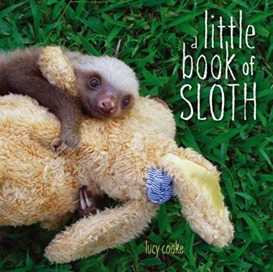
Welcome to the world of the Avarios Sloth Sanctuary in Costa Rica, the world’s only sloth orphanage.  Here you will meet the residents like the queen of the sanctuary, Buttercup, who started the entire thing.  Now over 20 years old, she is the oldest sloth living in captivity.  She was soon joined at the sanctuary by many others.  There are tiny baby twins and others who are so small they have to  have clothes made for them out of socks to keep them warm.  There are injured sloths who give incredible hugs.  The book describes the different kinds of sloths, how they live such chill lives, and the remarkable ways they survive in the wild moving that slowly.  This is a book that will enchant you with the fuzzy warmth of sloths.

Cooke writes in a frank and direct way, describing the sanctuary and its residents with plenty of humor.  After all, there is lots of to laugh at in a poo pole all on its own, add in confused little sloths and you have pure stinky magic.  She also makes sure that readers understand how special the sanctuary and these animals are.  It is a book of appreciation with a tone of wonder at times.

The illustrations are photographs of the sloths and their lives in the sanctuary.  You get to meet all sorts of personalities and ages throughout the book and their stories are told quickly but effectively.  The images help a lot, showing the place rather than having lengthy explanations slow things down. 

A great addition to library collections, this book has a great charm about it just like the sloths themselves.  Warm and welcoming, this book is all about being more chill.  Appropriate for ages 5-9.

Reviewed from copy received from Margaret K. McElderry Books.

Review: The World Is Waiting for You by Barbara Kerley

world is waiting for you

The World Is Waiting for You by Barbara Kerley

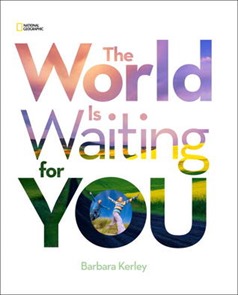
Another visually gorgeous book from National Geographic, this book ties together what kids do at a young age with what they can become as an adult.  The book invites children to get out into the world and explore.  After all, if you love getting wet, you could become a diver.  Love digging in the mud?  You could be an archeologist.  Love looking at the stars?  Climbing trees?  Digging into deep holes in the ground?  All of these and more are skillfully tied to careers in a book that is less about getting children to buckle down and more about getting them to open up and fly.

Kerley’s prose reads like a poem, each line designed as an invitation to be themselves and get into things that they love.  Even better, those same thrilling things are tied to life as an adult, offering options for turning their passions into careers.  Yet this book does not dwell there, instead it is a cornucopia of ideas, one after another meant to inspire thought and dreaming than to instruct on specific jobs.

As always in National Geographic books, the illustrations are crisp and colorful photographs.  Here readers will see children out in nature, interacting and loving it.  The images are from around the world and are filled with joy and motion.  At the end of the book, details on each image are given.

Bright, colorful and filled with inspiration, this is a career book that children will find thrilling.  Appropriate for ages 4-8.

Reviewed from library copy.

Review: When I Was Eight by Christy Jordan-Fenton

when i was eight

When I Was Eight by Christy Jordan-Fenton and Margaret Pokiak-Fenton, illustrated by Gabrielle Grimard

This is a lovely new picture book version of Fatty Legs that will share Olemaun’s story with younger readers than the original chapter book.  It follows Olemaun from her time with her nomadic family through her attending the “outsider’s school.”  There her hair is chopped short and her warm parka is replaced with thin and scratchy clothing.  Her name is even changed to Margaret.  Margaret wants most to learn to read, but the school is much more interested in getting the children to work hard rather than teaching them.  Margaret has a difficult relationship with one nun in particular who makes a point of humiliating her regularly.  In the end though, Margaret does learn to read all on her own.

This is a story that works really well as a picture book.  I really enjoyed both Fatty Legs and A Stranger at Home that were chapter books, but this younger version simplifies the story and keeps its quiet power.  As with the earlier books, I remain in awe at the strength that it took for Margaret to survive in the school and also the courage it takes to keep on telling her story.

Grimard’s illustrations echo the beauty of the Arctic but also capture the dullness and darkness of the school.  The nun character radiates scorn and anger on every page she appears in.  Margaret is shown usually isolated, but also as radiant in her resiliency.

A powerful look at residential schools on Native populations, this picture book version belongs in most libraries.  Appropriate for ages 6-9.

Reviewed from digital galley received from Netgalley and Annick Press.

Review: Wild Boy by Mary Losure

wild boy

Wild Boy: The Real Life of the Savage of Aveyron by Mary Losure, illustrated by Timothy Basil Ering

Losure’s latest is another compelling true story this time focusing on the boy found in the woods in southern France in 1789.  The boy was not a tiny child, but rather a young boy who had obviously been surviving on his own for some time, his body covered in scars.  Quickly, the boy was taken for study and observation, his life curtailed and limited because he always attempted to run away.  There was very little attempt to actually reach him until he was sent to the Institute for Deaf-Mutes where he was put into the care of Dr. Itard.  Itard decided to make the boy, who he named Victor, happy before trying to teach him to speak.  So Victor joined the family of the housekeeper and quickly became attached to them.  But civilizing a wild boy is not simple, as this book shows with historical details, engaging humor, and a narrative that shows an immense empathy for this wild child.

Losure, author of The Fairy Ring, has once again taken a complicated situation and made it understandable for young readers.  Young readers will immediately relate more closely with the intriguing Victor.  Through his eyes and Losure’s exquisite writing, readers understand his ties to nature (Page 72):

But when rain pattered on the roof and everyone else went inside, the wild boy often crept out into the garden, to the tiny, formal reflecting pond that sat among the flower beds.  He would circle the pond several times, then sit by its edge and rock himself back and forth as the rain dimpled the surface of the pond.  He’d gaze into the water, toss in a handful of dead leaves, and watch them drift.

The digital galley I read did not have the completed art available, so I cannot comment on the illustrations.  Throughout the book, Losure makes the Wild Boy come to life as a very unique and resilient boy.  The story is told during his time, through the eyes of those who knew him best, using reports written at the time.  Only in her Author’s Note does Losure speculate on whether Victor was autistic.  There she also notes the importance of Victor on educational attitudes like Montessori.

An engaging, wrenching read that brings history to life in the form on one amazing person.  Appropriate for ages 9-12. 

Reviewed from digital galley received from Netgalley and Candlewick Press.

Review: A Splash of Red by Jen Bryant

splash of red

A Splash of Red: The Life and Art of Horace Pippin by Jen Bryant, illustrated by Melissa Sweet

Born in 1888, Horace Pippin loved to draw from the time he was a small child.  He would draw on scrap paper using charcoal, he would draw for his friends, and he would even draw on his spelling tests though his teacher did not appreciate that.  As he grew, he had to quit school in 8th grade.  He worked hard with his hands in different ways, but continued to draw and paint.  Then Horace went to war and was wounded in his right arm.  Now he could no longer draw, or so he thought.  He started trying again with a poker and using his other hand to steady himself.  As he grew stronger, he drew more and more.  Eventually, he gained the attention of people like N. C. Wyeth, who helped put together his first art show.  Pippin’s life that was filled with hardships and obstacles serves as inspiration for young artists.

Bryant and Sweet  collaborated before with Caldecott Honor results.  This picture book biography of an important but lesser known African-American artist shows the power of art in one’s life and how it is impossible to stop seeing and communicating the world through art once you begin.  Bryant writes with a solidity that is lovely.  Incorporating Pippin’s own words from letters, she captures the life of this artist and how he came to be recognized for his work.

Sweet too weaves Pippin’s words into her art.  Her use of collage truly builds Pippin’s world before readers’ eyes.  My favorite image in the book is Pippin as a young boy sitting and drawing on piles of papers.  It captures the intensity with which he created art even at such a young age.  This intensity continues through his story to after he is wounded and the determination that is apparent in just his hands. 

Another very successful collaboration of these two masters, this biographical picture book should serve as its own splash of red on every library’s shelves.  Appropriate for ages 6-9.

Reviewed from copy received from Random House Children’s Books.

Review: When Thunder Comes by J. Patrick Lewis

when thunder comes

When Thunder Comes: Poems for Civil Rights Leaders by J. Patrick Lewis, illustrated by Jim Burke, R. Gregory Christie, Tonya Engel, John Parra, and Meilo So

These poems celebrate heroes who have fought for civil rights.  Each poem focuses on one person, tells their story in imagery and strength.  Seventeen men and women are on the pages here, people from around the world and from the American Civil Rights Movement.  These are heroes who fought for justice and for equality.  Their stories and these poems are filled with courage, vision and a sense of doing what is right.  They will serve as inspiration for future generations who will have their own civil rights struggles to face.

Lewis has created poems that are both art but also informational.  He offers critical details in understanding what these heroes have been through and what they have accomplished.  At the same time, he reaches the heart of the person through his poetry too, showing the humanity about them as well.

The art in this book of poems was done by five illustrators.  The images range from the bright colors of Chinatown to the darkness of murder in Mississippi.  In every image though, readers see a leader who radiates courage.  The different art styles come together to form a tapestry of that courage.

Strong and powerful, this book of poetry deserves to be shared widely and these names known and understood.  Appropriate for ages 8-12.

Reviewed from copy received from Chronicle Books.

Review: Miss Moore Thought Otherwise by Jan Pinborough

miss moore thought otherwise

Miss Moore Thought Otherwise by Jan Pinborough, illustrated by Debbie Atwell

Annie Carroll Moore grew up in Limerick, Maine in a time when girls were not encouraged to be opinionated but she had her own ideas.  Children in that time were also not allowed in libraries, especially not girls, because reading was not seen as important.  Annie had always loved stories and books and though she thought at one time of being a lawyer like her father, she decided to become a librarian.  She studied in New York City, living alone even though others thought it was dangerous.  Miss Moore became a children’s librarian at the Pratt Free Library, with a room designed just for children.  She had new ideas, of course, like letting children take books home and removing the large “SILENCE” signs from the libraries.  As her new ideas took hold, Miss Moore changed library service for children into what we love today.

Pinborough clearly admires Miss Moore and her gumption and willingness to approach problems with new ideas.  Miss Moore’s life work is detailed here but we also get to see to her personal life and the tragedies that marred it.  Perhaps my favorite piece is the ending, where Miss Moore retires in her own special way, on her own terms.  Don’t miss the author’s note with more information about Miss Moore as well as a couple of photographs of the woman herself.

The illustrations by Atwell have the rustic feel of folk art.  It is colorful, vibrant and lends the entire work a playfulness that is entirely appropriate to the subject. 

A celebration of one woman who changed the face of library service to children around the world, this book will be welcomed by librarians and children alike.  Appropriate for ages 6-8.

Reviewed from library copy.

Review: Snow School by Sandra Markle

snow school

Snow School by Sandra Markle, illustrated by Alan Marks

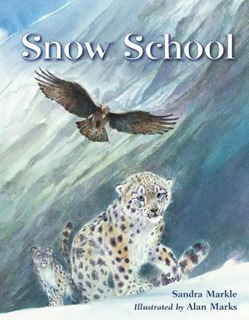
High in the mountains of Pakistan, two week-old snow leopard cubs snooze in a den waiting for their mother to return.  It’s May and the pair are only a week old.  When the male cub goes outside, he is attacked by a golden eagle and only saved by his mother rescuing him.  As the cubs grow, the practice pouncing one another and then start to eat directly from the game their mother kills.  Their mother teaches them skills they must have to survive in the harsh climate.  They learn to mark their territory, to silently hunt, to be quick, to guard their food, to find shelter when snow comes, and when to retreat.  It is a story of how small cubs grow into strong hunters and how these great and beautiful cats manage to survive in their mountainous and cold habitat.

Markle is the author of over 200 books for children.  In this one she takes on one of the most elusive creatures on earth and shows the strong family bonds and the huge amount of learning these young cats must accomplish to live.  She writes her nonfiction in verse, making it more easily read.  Nicely, as the mother is teaching her cubs, Markle makes sure readers understand the lesson by repeating it neatly at the end of the stanza. 

Marks’ illustrations capture the snow leopards and their beauty and grace.  There are moments of such daring leaps and heart pounding danger that Marks captures with flawless accuracy.  His use of soft watercolors adds to the mystique of these cats and also captures the speed and motion as they hunt. 

Beautiful illustrations and strong text result in a book that will teach children much about the snow leopards and their lives.  Appropriate for ages 7-9.

Reviewed from copy received from Charlesbridge.