Review: A Rock Is Lively by Dianna Hutts Aston

rock is lively

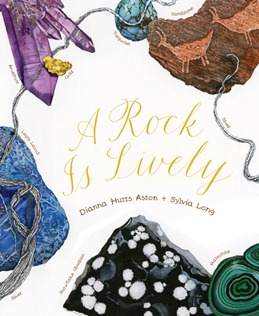
A Rock Is Lively by Dianna Hutts Aston, illustrated by Sylvia Long

Another stellar collaboration by the team that created An Egg Is Quiet, A Seed Is Sleepy, and A Butterfly Is Patient, this nonfiction picture book focuses on rocks and minerals.  The book begins with rock melted as magma beneath the earth.  It talks about what makes up rocks and how old they are, as well as the rocks that we find in space.  Rocks as tools and weapons are explored, mixed in with the amazing rock interiors that surprise and delight. The different types of rocks finish off the factual piece of the book, but the bright and beautiful illustrations continue all the way to the final lapis lazuli endpages. 

Aston manages to write nonfiction as if each sentence is filled with delight.  Her enthusiasm for the subjects she writes about is evident in her writing, inviting young readers to get just as interested as she is.  The art carries that same enthusiasm in its bright colors and details.  Done in watercolor, the colors are surprisingly deep and lush. 

If you have the first three books from these amazing collaborators, this is a must-buy.  It should be on the shelves of any school or public library, sure to get young people exploring a new subject.  Appropriate for ages 7-9.

Reviewed from copy received from Chronicle Books.

Review: Island: A Story of the Galapagos by Jason Chin

island

Island: A Story of the Galapagos by Jason Chin

Follow the birth of a group of islands to the present day in this book that beautifully documents the wonders of the Galapagos.  Opening with the drama of a volcanic eruption six million years ago, the book shows how plants and animals arrive at a new island in the ocean.  As time goes by, the island turns from barren rock to a place of lush green.  Specific attention is paid to the evolution of creatures and plants that are found only on these islands.  Young readers will fully understand why finch beaks grew larger, seagulls got larger eyes, and tortoise shells changed shape.  The book ends with Darwin arriving on the shores of one of the islands.  This book is a celebration of these islands and the wonders of nature.

Chin’s book offers information that is solid and fascinating packaged with illustrations that capture the details of what is being explained.  It makes for a book that is bright and energized and that is clearly nonfiction as well.  The story of the birth and life of an island makes for a magnificent tale that readers are sure to respond to.

In his art, Chin brings the reader up close to what is happening on the island.  We get to look between the mangrove roots at sharks, watch pelicans feast on fish in the lagoons, and see land iguanas float on logs to reach the island.  Even better, as I mentioned earlier, the process of evolution is detailed so that readers can see the gradual but necessary changes that occurred.

This is one incredible nonfiction book that teachers, parents and students will enjoy looking through and learning from.  Appropriate for ages 6-8.

Reviewed from library copy.

Review: Colorful Dreamer by Marjorie Blain Parker

colorful dreamer

Colorful Dreamer: The Story of Artist Henri Matisse by Marjorie Blain Parker, illustrated by Holly Berry

Matisse grew up in a French town that was industrial and gray.  Despite this, he dreamed in bright colors.  He was a boy who did not do well in school, at music, or really at much of anything except dreaming.  Matisse decided to study law in Paris, but he discovered that being a law clerk was very dull, copying legal documents word for word by hand.  Due to the stress, Matisse ended up in a hospital bed for months.  It was there that he started painting to pass the time.  Now he had found exactly what he was good at.  It wasn’t easy, there were times he lacked food and money, but he worked very hard at his art.  Years later, Matisse found himself sick and in bed again in his old age.  He could no longer stand at an easel, so he turned to making cut-out collages, and those pieces turned out to be some of his most celebrated creations.

Parker vividly tells the story of a boy who grew up as a very unlikely artist.  From his colorless surroundings to the fact that he had never discovered his artistic gift, it is amazing that Matisse became what he was.  I appreciate particularly her celebration of the creative and the imaginative.  She also makes sure though that young readers know how much work it took for Matisse to reach success and that it did not come instantaneously.  It’s a book that speaks to everyone having a gift, but also the hard work it takes to achieve it.

Berry’s art plays black-and-white against brilliant color.  The gray world of Matisse’s youth is shown in intricate pencil illustrations, but pales against the radiant color of his dreams and his art.  As the pages turn, Matisse’s world becomes the same colors as the art he creates, demonstrating that he has finally found his place in the world as a whole.

Beautifully illustrated and written as an inspiration to young people looking for their own special place in the world, this is a very special look at a famous artist.  Appropriate for ages 5-8.

Reviewed from copy received from Dial Books.

Review: Life-Size Farm by Teruyuki Komiya

life size farm

Life-Size Farm by Teruyuki Komiya

This fourth in the “Life-Size” book series takes on farm animals in glorious full-size photographs.  Just like the others in the series, there are panels that offer more detailed information, including the animals name, age, and scientific name.  There are details about physical characteristics that are explained further as well as a list of facts.  All of these are presented in bright colors and with a playful feel.  But it is the photographs in their large size and with the clarity and detail that they offer that will have children taking this book home and lingering over it.

Several of the pages unfold to show even larger images of animals.  The huge furry alpaca and the enormous cow will generate lots of interest.  What is most amazing here is that the size of all of the animals is surprising and fun.  Even better, the quality of the photographs is always high and offer lots of small details to pay attention to.

A great pick for library shelves, though the size is large enough to make them not fit on shelves easily!  This is an excellent addition to a popular nonfiction series for children.  Appropriate for ages 5-9.

Reviewed from copy received from Seven Footer Kids.

Review: Helen’s Big World by Doreen Rappaport

helens big world

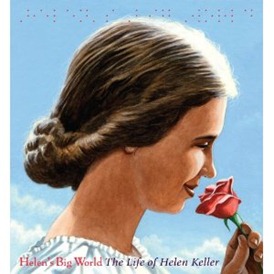
Helen’s Big World: The Life of Helen Keller by Doreen Rappaport, illustrated by Matt Tavares

This picture book biography of Helen Keller celebrates both the accomplishments of Helen Keller in overcoming her world of darkness and silence and those of her teacher Annie Sullivan.  The book begins with Helen as a small baby, before she had an unknown illness at 19 months that took her sight and hearing away.  It then moves through her attempts to continue to communicate, the frustration that caused her tantrums, and the slow progression of learning that led to the seminal moment at the water pump that connected the letters in her hand to the outside world.  Readers will see how Helen learned to write, read in Braille, and put her hands on people’s faces to feel their lips move so she could understand their speech.  The book continues to show how Helen Keller spoke up for social injustices that she felt were wrong.  This is a testament to what a brilliant mind and a great teacher can create.

Rappaport has somehow condensed the complicated story of Keller’s life into a very readable picture book that has a brisk pace and invites readers to find out more about this remarkable woman.  Throughout the book, Keller’s own words are used to illustrate points in the story.  Shown in their own font that is colorful and set apart from the rest of the text in size too, her words shine.

Tavares’ illustrations reveal the marvel of Helen Keller’s learning and education.  There is a light to the images once the learning begins that contrasts with the darkness of her earlier life.  Throughout Keller is shown experiencing the senses she does have, from the scent of a rose to the feel of the breeze on her face. 

An inspirational figure, Helen Keller continues to be a beacon for overcoming obstacles and using one’s mind.  This book is a beautiful tribute to her.  Appropriate for ages 8-11.

Reviewed from library copy.

Review: Hands around the Library by Susan L. Roth

hands around the library

Hands around the Library: Protecting Egypt’s Treasured Books by Susan L. Roth and Karen Leggett Abouraya

Told from the point of view of one of the protesters in modern Egypt, this is the true story of how the Alexandria Library was saved during the protests.  As the crowd moved toward the library, which was built on the same ground as the ancient Library of Alexandria, the library director came outside and spoke to them.  He pointed out that the library had no gates to lock and no way to protect the large doors made of glass.  It was up to the people to save the treasures inside.  The crowd pressed on and the shouting grew louder.  But then one young man ran up the steps of the library and joined hands with the library director.  Then more and more people  joined hands, a living barrier protecting the library. 

The writing here tells the story clearly and concisely.  There is fear of the mob mentality woven into the story, a trepidation at what could happen with that many passionate and angry people in a large group.  The energy of that mob and that mood carries the book forward.  That moment of decision by the crowd hangs jewel-like in the book, the one person who does the right thing first and then those who follow.  It’s a book and a story that pivots in a moment of bravery. 

Roth’s collages capture the press of the crowd and its passion, but also the fact that these are regular people who were creating change.  The illustrations have a flatness to them that works well much of the time.  It is particularly effective when hands are joined in a chain. 

A powerful look at the importance of libraries and the bravery of a few, this book is also a reminder that we are witnessing history being made.  Appropriate for ages 5-7.

Reviewed from copy received from Dial Books.

Review: The Fantastic Jungles of Henri Rousseau by Michelle Markel

fantastic jungles

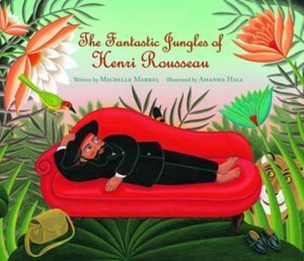
The Fantastic Jungles of Henri Rousseau by Michelle Markel, illustrated by Amanda Hall

This striking picture book is a biography of the artist, Henri Rousseau.  It tells the story of this man as he started to do art at forty years old. Rousseau dreamt of being an artist because he saw so much beauty and color everywhere. He couldn’t afford lessons, so he read many books to learn techniques and structure.  At age 41, Rousseau entered an art exhibition for the first time.  The art experts said mean things about his art, but Rousseau kept painting.  Inspired by the World’s Fair in Paris, he began to draw jungles.  Rousseau kept entering exhibitions and kept getting rude things written about his art.  He kept on painting, eventually getting accepted by the younger artists in Paris, like Pablo Picasso.  By the end of his life, no one was laughing or scorning his art.  Rousseau had not just proven himself to the critics, but to the entire world.

Markel has chosen to write this book in the present tense and also to call Rousseau by his first name throughout.  Both of these make the book feel welcoming and immediate.  The prose here is never dense and at times is almost playful as Rousseau (or Henri) starts to discover his talent and inspirations.  It is like you are discovering things alongside Rousseau.

Hall’s art pays beautiful homage to Rousseau’s own work.  Reading her Illustrator’s Note, one finds that she has changed her medium for this book, using watercolor and acrylics to achieve Rousseau’s characteristic look and feel.  She also used some of his original work as direct inspiration, adding his breaking of scale and perspective rules as well.

This is a superb picture book biography of an artist who came late to finding his passion in life.  Both his life and work are inspirations for children and adults to dream big and ignore the critics.  Appropriate for ages 6-9.

Reviewed from copy received from Eerdmans Books for Young Readers.

Review: Martin de Porres: The Rose in the Desert by Gary D. Schmidt

martin de porres

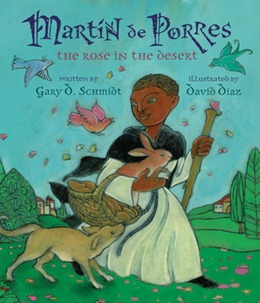
Martin de Porres: The Rose in the Desert by Gary D. Schmidt, illustrated by David Diaz

Martin de Porres was born to a former slave and a Spanish nobleman in Lima, Peru.  He lived in severe poverty in the barrios until his father took him back to Ecuador with him.  As Martin grew older, he returned to Lima and started learning to tend to the ill.  His healing power revealed itself while he was there.  Thanked for his healing, he was given the seeds of a lemon tree as a gift.  After planting the seeds, a tree grew overnight and had ripe fruit.  Word began to spread about this amazing boy.  Still, his mixed race prohibited him from becoming a priest, so he joined the Dominican Order as a servant.  He continued to heal others, eventually proving his ability and worth and becoming a priest after all.  Other stories of miracles surrounded him and he was finally canonized as a saint.  Through vivid writing and rich illustrations, the story of the childhood of this saint is told.

Schmidt’s writing warmly celebrates the wonders and miracles of Martin de Porres.  It is a story that starts with a boy who is the poorest of the poor, rejected by the priesthood and eventually ends with sainthood and life led in service to others.  In a world divided just as much between rich and poor, this story will resonate with modern young readers.

Diaz’s illustrations are filled with colors that are saturated and deep.  The deep hues of Martin de Porres’ skin are celebrated in the pages here.  Other parts of the illustrations have a feel of stained glass with sun pouring through.  The images are beautiful and celebratory.

A shining example of a picture book biography of a saint, this book will speak to modern readers as well as celebrate an amazing person.  Appropriate for ages 7-9.

Reviewed from library copy.

Review: Minette’s Feast by Susanna Reich

minettes feast

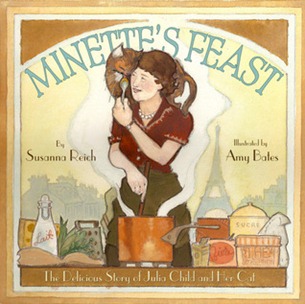
Minette’s Feast: The Delicious Story of Julia Child and Her Cat by Susanna Reich, illustrated by Amy Bates

Minette was most likely the luckiest cat in the world, since she was owned by Julia Child.  Adopted by Julia Child and her husband during their time in Paris, she was just as discerning about her food as her owner was.  She spurned canned food, eating only fresh mice and bird.  Julia would bring home marvelous fish heads just for Minette and also give her leftovers from her cooking.  Still, Minette preferred her own hunted food.  Julia began to cook more and more, taking classes as Le Cordon Bleu.  Minette honed her own hunting skills at the same time, practicing on her toys.  It would take something very special to lure Minette away from the mice.  But then again, her owner was Julia Child who was certainly up to that challenge.

Taking on a famous cook and personality through her finicky cat is a wonderful approach.  We get to see a younger Julia Child, figuring out how to cook French food in her own small kitchen.  We are there to see her arrive in Paris, find her footing in the culture, and then through her learning process until her cooking inspires even her cat to turn away from mice.  It’s a genuine way to approach the subject that has a real child-appeal.

Bates’ illustrations are done in pencil and watercolor.  There is a seriousness and also a playfulness in her illustrations that remind me of Julia herself.  The lanky woman is shown at her full height throughout the book as she is celebrated in both image and text.  Minette appears early in the book, long before Julia adopts her.  It’s a nice touch for sharp-eyed children.

A warm and energetic glimpse of Julia Child that celebrates her on the year of her 100th birthday.  Simply delicious!  Appropriate for ages 6-8.

Reviewed from copy received from Abrams.