Review: The Price of Freedom by Dennis Brindell Fradin

price of freedom

The Price of Freedom: How One Town Stood Up to Slavery by Dennis Brindell Fradin and Judith Bloom Fradin, illustrated by Eric Velasquez

In 1856, John Price and two other slaves escaped to Ohio and freedom.  But the Fugitive Slave Act of 1850 was in effect and even free states were required to allow slave owners to capture escaped slaves anywhere in the United States.  John and his friend Frank spent the winter in Oberlin, Ohio, a hub of Underground Railroad activity.  They decided to stay and not travel to the safety of Canada.  So when a group of slave catchers came to Oberlin specifically hunting for John and Frank, the residents of the city had no legal grounds to help the two men.  When John was captured though, the city rose up against the slave catchers, forcing a showdown that would be one of the defining moments in fueling the Civil War.

Filled with informational facts, this book reads more like a fictional story thanks to its inherent drama.  It begins with John Price’s escape across the ice on stolen horses, continues through the Underground Railroad but the most amazing part is the final showdown, where your heart almost stops with the bravery and daring the Rescuers demonstrate. Fradin offers just the right mix of information and heroism.

Velasquez’s illustrations add to the dramatic feel of the narrative with their deep rich colors, drawn guns and historical details.  There are so many gorgeous night images filled with danger but also with hope.

This is a nonfiction picture book that is sure to inform children about an aspect of slavery that they will not have heard of as well as a tale of what a group of brave citizens can do.  Appropriate for ages 7-9.

Reviewed from library copy.

Review: Who Says Women Can’t Be Doctors? by Tanya Lee Stone

who says women cant be doctors

Who Says Women Can’t Be Doctors?: The Story of Elizabeth Blackwell by Tanya Lee Stone, illustrated by Marjorie Priceman

Back in the 1830s, there were no women doctors, only men could have that career.  But also growing up in the 1830s was a young girl who would end up changing that.  Elizabeth Blackwell was not particularly well behaved: she was always exploring, working to toughen herself up, and even carried her brother over her head until he backed down.  Elizabeth had not dreamed of becoming a doctor, but she was inspired when an friend mentioned how much nicer it would have been to be examined by a woman.  When Elizabeth started talking about her new dream, people mocked her and told her it was impossible.  She applied to school after school, until finally the 29th school she applied for said yes!  But Elizabeth would have to face additional challenges in school and beyond as well.  This is the story of a woman who would not take no for an answer and the way that she changed the face of medicine along the way.

Stone has written a very engaging biography of Blackwell.  Much of the story is spent on her childhood and the challenges she faced getting into medical school.  I love the image of a spunky young girl who just wants to explore and demonstrates determination from a very young age.  She is an inspiring figure for youth, someone who discovered her dream and stood by it despite the many obstacles in her way and the mockery she endured.  Stone’s author’s note continues Blackwell’s story and offers a photograph of the real Dr. Blackwell.

Priceman’s illustrations done in gouache and India ink are filled with bright colors.  They bring the past to life, showing the energy of the young Elizabeth Blackwell and incorporating the vistas and buildings of the 1800s.  While they are bright and vibrant, they also serve to make sure that readers are cognizant of the period in which the book takes place.

Blackwell is a real-life heroine that young readers should be aware of.  This bright and welcoming new biography for younger readers is a welcome addition to library collections.  Appropriate for ages 6-9.

Reviewed from copy received from Henry Holt and Co.

Review: Etched in Clay by Andrea Cheng

etched in clay

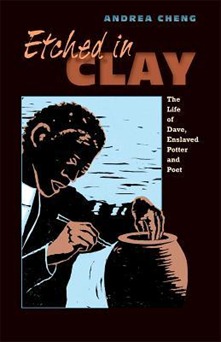
Etched in Clay: The Life of Dave, Enslaved Potter and Poet by Andrea Cheng

Told in virtuoso verse, this is the true story of the life of Dave, an enslaved potter who lived in the years before and after Emancipation.  Dave was an artist, most likely making over a thousand pieces of pottery in his lifetime of work of which only 170 survive today.  He inscribed some of his pieces with either his own name, his master’s name and also poetry that he wrote, brief verses that offer a glimpse into his world.  The amount of bravery that small act took is monumental, since Dave faced potential death because he was demonstrating his ability to read and write in a time when it was forbidden for slaves in South Carolina to do so.  Dave serves both as an example of the injustice and brutality of slavery and also as a remarkable example of the artistry and strength of human beings. 

Cheng tells Dave’s story in very short poems.  They are not all in Dave’s voice, sometimes instead being in the voice of his owners, his wife, or his children.  Cheng does not soften the harshness of slavery, offering poems that speak directly to the separation of families through selling them apart and the brutality of the punishments inflicted.  I would not call it unflinching, because one can sense Cheng flinching alongside the reader as she captures the moment but also makes it completely human and important. 

Cheng also did the woodcuts that accompany the poetry.  They are a harmonious combination with the subject matter thanks to their rough edges and hand-hewn feel.  Done only in black and white, they share the same powerful message as the poems.

This powerful book informs middle grade readers about a man who could have been one of the many lost faces of slavery but who through art and bravery had a voice.  Appropriate for ages 12-15.

Reviewed from digital galley received from Lee & Low Books.

Review: Nelson Mandela by Kadir Nelson

nelson mandela

Nelson Mandela by Kadir Nelson

In a way that only Kadir Nelson could capture, this book tells the story of Nelson Mandela’s life, imprisonment and how he became the inspiration he is.  This is a very humanizing tale of Mendela, showing his childhood before his father’s death and then his move across South Africa to study under a powerful chief.   Mandela attended school and then got involved in fighting apartheid.  The book follows him as he is jailed the first time and as he rises to be a threat to those in power and goes into hiding.  Mandela returned to South Africa to continue the fight and is then jailed again, doing heavy labor.  After being in prison for over 27 years, Mandela was freed.  His passion for righting the wrongs of apartheid and speaking for equality of all people shines from every page.

Nelson tells the story of Mandela in verse that is factual but also compelling.  He captures the long time spent in prison in a way that children will be able to understand.  Cold meals, thin blankets and beating rocks into dust.  It shows the futility and the harshness with such clarity.  Nelson’s verse also has a great sense of awe for this man and what he has accomplished, that too makes it a very special, honest book.

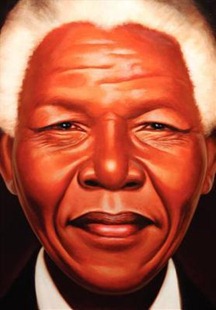
As always, Nelson’s images are simply wondrous.  Here they seem to shine from within whenever Mandela is part of the image.  As you can see from the cover illustration, there is all of the human inside his art; it radiates from his work.  Shown with detail, interesting perspectives, and ending with a sense of celebration, Nelson’s art is a standout.

This is the story of Nelson Mandela captured fully in a picture book that celebrates all of his accomplishments and what he stands for as a human being.  Beautiful.  Appropriate for ages 6-9.

Reviewed from copy received from Katherine Tegen Books.

Review: Brave Girl: Clara and the Shirtwaist Makers’ Strike of 1909 by Michelle Markel

brave girl

Brave Girl: Clara and the Shirtwaist Makers’ Strike of 1909 by Michelle Markel, illustrated by Melissa Sweet

Clara Lemlich and her family came to America planning to find jobs, but no one will hire her father.  The factories did want girls like Clara though, and so she started working in the garment industry.  She worked from dusk to dawn in rows with other young girls, sewing as fast as she could.  If they were late at all, they lost half a day’s wages.  If they pricked their fingers and bled on the cloth they were fined, if it happened again they were fired.  The doors were locked, there was no fresh air, and the girls were inspected when they left to make sure they weren’t stealing anything.  But Clara would not be held down, she went to the library and learned English, teaching the other factory girls on their lunch break.  Then Clara learned about unions and strikes, though some thought the girls were not tough enough to strike.  So began her transformation into a union leader, through beatings and hunger, these girls and Clara are the people we have to thank for fair hours and pay. 

Markel tells the story with a strong heart and a certain thrill.  Readers get to see a quiet girl get off of the boat and steadily transform through self-education and pure tenacity into an amazing person who had strength and energy enough for several people.  Markel manages to tell the story of the times without dedicating much of her brief story to background.  Instead she uses the situation at the mill to speak on their own.  She ends the book with more information about the garment industry, giving facts and figures about how many girls were working there and the abuses they suffered.

Sweet’s illustrations are a treat.  Her paintings are turned into collage with the addition of various textiles and trims.  On one page the buildings of New York are painted and then enriched by trimmings, stitches and swatches of material.  On another the painting is smaller and then framed by material.  Clara herself is often wearing a look of determination on her face, usually with a fist clenched as if ready to do battle at any time. 

This is a wonderful picture book biography about a heroine that children can related directly to, since she is so young.  It is also a very timely read with labor under such pressure right now.  Appropriate for ages 6-9.

Reviewed from library copy.

Review: Peace by Wendy Anderson Halperin

peace

Peace by Wendy Anderson Halperin

A simple poem is at the heart of this picture book about peace.  Each line of the poem forms the basis of a page of the book and is also accompanied by other quotes about peace that bring a wonderful depth to the entire read.  As one reads, it almost becomes a chant about peace, a reverberation of the power of peace, and when one finishes that peace lingers for a long time.  When I finished the book, I immediately wanted to do two things:  start all over again and also research some of the quotes and people I had never heard of before.  There are quotes from all of the big names like the Dalai Lama and Martin Luther King, Jr.  but wonderfully, there are also quotes from others whose messages are just as powerful.

Halperin’s illustrations are detailed and wonderful.  The images are bright and speak directly to the sorts of peace being discussed.  In those images and in the surrounding quotes, children will see ways that they can personally work for peace on small and large levels.  There is a delicacy to the illustrations that works so well with the subject matter.  They are inclusive, warm and joyful.

As I was reading, I noticed a quote from Peace Pilgrim, a woman I was lucky enough to meet when she was alive.  My family hosted her for a night and she spoke at a small park in rural Wisconsin on the shore of a lake.  It was that sort of person being included in this book that meant so very much to me.  I also think about others searching for the new people they have found in this book and discovering her. 

A lovely and powerful book about peace, this belongs in every library.  Appropriate for ages 7-10.

Reviewed from copy received from Atheneum Books for Young Readers.

Review: Frog Song by Brenda Z. Guiberson

frog song

Frog Song by Brenda Z. Guiberson, illustrated by Gennady Spirin

This is one breathtaking nonfiction book about frogs.  The book takes a look at various fascinating species from around the world, explaining what makes that species so special.  Delving deeper than skin deep, the strawberry poison dart frog from the cover is celebrated for the unique way she lays her eggs:  five at a time and then when the tadpoles emerge she carries each of them to their own pool of water up in the trees.  Each turn of the page brings another strange and amazing frog with its own unique approach to life.  This is a celebration of frogs that is sure to enthrall any young biologist.

Guiberson has carefully selected frogs that are incredible and unique.  Her writing is filled with frog noises, motion, and even the sounds that whipping a gooey mass of eggs into a ball of bubbles would make.  This adds a certain zing to the writing, making it great fun to read aloud.  You must have your ribbit on to pull this one off.

Spirin’s illustrations are simply amazing.  Filled with more all the great details you would get from a photograph, they are superbly realistic.  Turning the pages shows the breadth of frog life on our planet.  The vitality and also the fragility of these animals is highlighted in her art.

Beautiful, intriguing and great fun to read, this book is an impressive testament to the importance of frogs in our ecosystems.  Appropriate for ages 7-10.

Reviewed from copy received from Henry Holt and Company.

Review: Henry and the Cannons by Don Brown

henry and the cannons

Henry and the Cannons: An Extraordinary True Story of the American Revolution by Don Brown

The trend for great children’s historical biographies in picture book format continue this year.  This picture book tells the story of Henry Knox.   It is the winter of 1775 and the Americans need cannons to take back Boston from the British.  Knox takes the challenge of moving 59 cannons over 225 miles across Massachusetts in the dead of winter.  It took boats, oxen and plenty of determination and innovation to get those cannons across the state.  The journey and amazing achievement is told here in a way that will entice children to learn more stories about the American Revolution.

Brown’s writing is solid throughout the book.  He carefully sets the scene, clearly explaining how unbalanced the war was with Revolutionaries vs. the world’s best soldiers.  Add to that the power of cannons, and there was clearly no hope for victory.  After that the book turns more towards adventure and peril, making for a read that must be finished.  From the impossible mission to each and every mishap, readers will be rooting for Knox.

The illustrations serve to underline the stark winter and the heaviness of the cannons.  Men and oxen strain to move the 120,000 pounds of cannon.  Snow flies, the boats seem more like twigs next to the metal, and the crossing of an iced-over river brings drama and danger. 

Strong and noteworthy, this picture book nonfiction title has history and also plenty of action and adventure.  Appropriate for ages 7-10.

Reviewed from copy received from Roaring Brook Press.

Review: From the Good Mountain by James Rumford

from the good mountain

From the Good Mountain: How Gutenberg Changed the World by James Rumford

A mysterious object appeared in Germany in the 15th Century.  “It was made of rags and bones, soot and seeds. It wore a dark brown coat and was filled with gold.  It took lead and tin, strong oak, and a mountain to make it.”  To find out the answer to this clever riddle that appears on the first page of this book, readers will visit the 15th century and meet Johannes Gutenberg, who has invented a way to print books with movable type.  The riddle is not left at the first page, but is the center of the entire book.  Each piece of the printing press is explored from the very elements it is made from to the final culmination in a printed document.  Each page is also illustrated like an illuminated manuscript. 

Come visit the world of Gutenberg in this picture book biography that takes a very unique and intriguing approach to its subject matter.  This is much more a biography of the press itself than Gutenberg the man.  It is about the ingenuity and foresight it took to see such a construct in raw materials.  Readers are sure to learn much about the process of printing and what materials were used to create books.

Rumford’s art is just as wonderful as his writing.  The illuminated manuscript feel of the book is captured in its use of golds that seem to shine on the page like gold leaf.  He also uses the deep blues and other rich hues to create a feel of timeless beauty.

This is an intriguing read that will appeal to students who enjoy puzzles and riddles.  It is a book that unwraps and explains in a clever, engaging way.  Appropriate for ages 7-9.

Reviewed from library copy.