Review: Barnum’s Bones by Tracey Fern

barnums bones

Barnum’s Bones: How Barnum Brown Discovered the Most Famous Dinosaur in the World by Tracey Fern, illustrated by Boris Kulikov

Barnum Brown was fascinated with fossils from the time he was a toddler following behind his father’s plow.  His collection got so large, it outgrew his bedroom and he was forced to move out to the laundry house with his finds.  In college, Barnum got to go on digs in the summers of 1894 and 1895 in South Dakota and Wyoming.  Barnum got a reputation for being a great bone hunter, collecting more than 1400 pounds of bones!  The American Museum of Natural History in New York City didn’t have a dinosaur on display, so they hired Barnum to do fossil digs for the museum.  Barnum continued to prove he could find bones, but he never found a new species, even though others were discovering them.  All that changed when he found a huge bone, discovering the first T. Rex.

This book is science and hard work made fascinating and cool.  I appreciated the fact that this is not just a book about Barnum’s great find, but also all of the determination and time that it took to make that find.  Readers travel along with Barnum through the heat and mosquitoes to find bones.  The amazing hauls that he made before finding T. Rex are mind-boggling.  The persona of Barnum is an interesting one too.  His dandy clothes, wearing a fur coat and nice shoes on digs makes for an even more fascinating scientist. 

Kulikov’s illustrations use glowing outlines of the dinosaurs being discussed to show readers the form of the dinosaur.  What could have been a frustrating part of the book becomes all the more intriguing and inviting.  His illustrations are playful, contrasting dusty old-fashioned colors with the bolder colors of the night sky and burning campfires. 

This is a book that will inspire children to search for their own fossils, whether they are as big as a T. Rex or not.  Appropriate for ages 7-9.

Reviewed from library copy.
Review: It Jes’ Happened by Don Tate

it jes happened

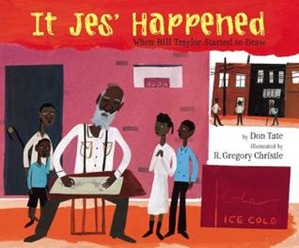
It Jes’ Happened: When Bill Traylor Started to Draw by Don Tate, illustrated by R. Gregory Christie

This picture book is a beautiful tribute to a legendary folk artist.  Bill Traylor grew up a slave in Alabama.  Born in 1854, he worked in the fields as a child.  When the slaves were freed at the end of the Civil War, his family stayed on working as sharecroppers on the same land they worked as slaves.  As things happened to him throughout his life, from hunger to parties, Bill Traylor remembered it all.  When he finally left the farm and headed to the big city of Montgomery, it was those memories that he drew and painted.  At age 85, he started drawing and kept on.  He got attention for it too, eventually getting a gallery show in 1940.  Bill Traylor showed his life and his heart through his simple yet powerful art.

Tate does not shy away from truly embracing Traylor in this picture book.  The book has more words than many picture books, but they are necessary to truly recreate both the memories of Bill Traylor and the amazing transformation to artist that happened so late in his life.  The writing is solid and smooth, building a full life before your eyes.

Christie’s art hearkens back to that of Traylor’s in its rough simplicity.  It speaks to the deep colors and the power of plain paint and strong lines.  There is also a wonderful dynamic quality to the art that offers motion and storytelling.

A lovely look at the life of a folk artist, this book is a great example of a picture book biography.  Appropriate for ages 6-9.

Reviewed from library copy.

Review: Monet Paints a Day by Julie Danneberg

monet paints a day

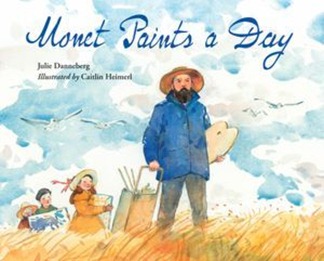
Monet Paints a Day by Julie Danneberg, illustrated by Caitlin Heimerl

Told in the first person by Monet, this book explores his painting process when he was on holiday in Etretat, France.  Children waited for him when he leaves his hotel, wanting to help carry his canvasses to the seaside.  When they reached the strip of sand at the bottom of the cliffs, the canvasses were placed against the cliff.  Monet was unique in painting right in the middle of the landscape rather than sketching and then finishing the painting in his studio.  Because of his unique approach, he had many canvasses in process at the same time.  On this day, he got so involved in painting that he didn’t realize how quickly the tide was coming in.  Everything was taken out by the sea, so he had to begin again on a new day.

Danneberg manages to tell two levels of story here.  There is the day that Monet is painting which is explored in exquisite detail.  Then in small boxes that are offset from the rest of the story, there is historical context offered about how Monet differs from other artists of his time and how he was creating an entirely new style of painting.  The Author’s Note at the end offers even more detail as well as a copy of Monet’s Waves at the Manneporte so that readers can see an example of Monet’s work.

Heimerl has the challenge of doing a picture book based on a famous artist.  In her illustrations she manages to create illustrations that both are their own style and yet pay homage to impressionism.  She achieves this with small touches, daubs of watercolor, here and there, lightening and brightening the illustrations.

A very successful picture book biography of Monet, this will be enjoyed by elementary art teachers and students.  Appropriate for ages 6-9.

Reviewed from copy received from Charlesbridge.

Review: I, Galileo by Bonnie Christensen

i galileo

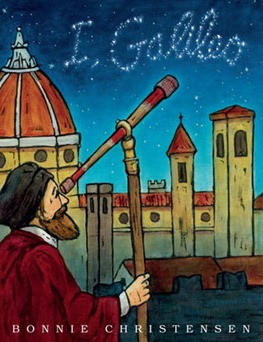
I, Galileo by Bonnie Christensen

Told in the first person, this look at Galileo’s life is made all the more personal through the unique point of view.   Galileo tells the tale from the house and walled garden he is imprisoned in.  Blind and aging, he recalls his childhood and the way that he helped his father with his musical experiments after leaving the university with no degree.  He was offered a teaching position in the same university a bit later, but he refused to be traditional and instead wore what he liked and tested Aristotle’s laws of physics.  He was soon let go of his teaching role and headed to another university where they were more interested in his experiments.  There he invented the compass and the telescope.  Looking through his telescope, Galileo discovered that the sun is the center of the universe.  It was then that his troubles truly began.  For seven years, he was bound to silence about his findings until a new man became pope.  When Galileo finally published his findings, they so incensed people that he was tried for heresy before the Inquisition.  And so the story comes back to the old man imprisoned in the walled garden.

Through a brief preface, Christensen sets the stage for the time period of Galileo’s life.  It will help modern children understand the technology that was not available in that day.   Her afterword is equally intriguing and helpful, explaining that it took almost four centuries (until 1992) for the Catholic Church to admit they were wrong to condemn Galileo.  Christensen paints a picture of the world around Galileo well.  His discoveries, his world of academia, the political and religious powers at play, and his mistreatment at their hands.  This book is exceedingly readable.

It is also lovely.  The illustrations are done in jewel tones that have a depth and richness.  They almost recall stained glass with their thicker black lines and the light that shines in each of them.  Even the image of Galileo before the Inquisition plays with light and color. 

A choice pick for libraries looking for a readable and interesting biography of this heroic scientist.  Appropriate for ages 6-9.

Reviewed from copy received from Random House Children’s Books.

Review: The World’s Greatest Lion by Ralph Helfer

worlds greatest lion

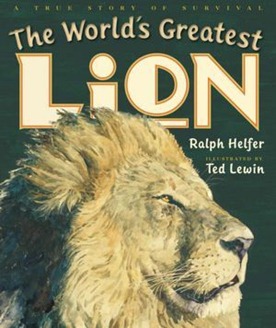
The World’s Greatest Lion by Ralph Helfer, illustrated by Ted Lewin

This is the story of Zamba the lion, one of the most well-known animal actors in film history.  Zamba appeared as the MGM Lion as well as in many commercials and shows.  Here, the focus is on how Zamba lost his parents and his survival as an orphan cub in Africa before being found by a woman and rescued.  Zamba was allowed to roam free and grew larger and larger until she could no longer safely care for him.  Happily, she had heard about Africa USA, an organization looking for a lion.  Africa USA offered a safe haven and trained animals to not be aggressive.  Zamba arrived at the ranch owned by Ralph Helfer and slowly grew gentler.  The family’s children used him as a warm place when watching TV and his best friend was one of the dogs on the ranch.  Thanks to his rare gentle nature, Zamba worked in television and film.  Then one day, a flood hit the ranch and forced Ralph to release all of his wild animals in an attempt to save them.  Zamba led all of the animals to safety, proving himself to be the world’s greatest lion.

As author of the book, Helfer tells his own story as well as Zamba’s here.  It is the story of the organization he founded, the one that saved Zamba’s life.  Through his training, Zamba was able to live a full life, filled with danger, learning and gentleness.  The details Helfer shares add depth to the story.  His moments of adventure are exciting but it is those moments of Zamba just being a lion that really are special.

Lewin gives us gold-hued images filled with the dust of Africa.  His illustrations celebrate the connection of animal and human, especially during the chaos of the storm.  Beautifully realistic, these illustrations fully capture the love between Helfer and Zamba.

This is a picture book biography that animal-loving children will enjoy immensely.  Appropriate for ages 5-7.

Reviewed from copy received from Philomel Books.

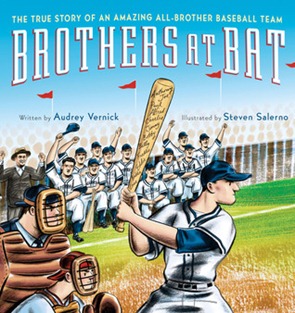
Review: Brothers at Bat by Audrey Vernick

brothers at bat

Brothers at Bat by Audrey Vernick, illustrated by Steven Salerno

In one family from New Jersey, there were 12 baseball-playing brothers: the Acerra brothers.  All of the brothers played high school baseball and their high school had an Acerra on it 22 years in a row!  In 1938, the oldest nine brothers formed their own semi-pro baseball team.  Their father coached the team and they played on dirt fields that were littered in rocks.   Each of the brothers had a different skill set than the others.  Some were slow runners but great players, others posed for the cameras naturally, one was a great pitcher that people still talk about today.  But all of them supported one another.  Then came World War II and the team disbanded as six of the brothers headed off to war.  Happily, all six brothers returned from war.  The brothers played their last game together as a team in 1952.  By that time, they were the longest-playing all-brother baseball team ever.  In 1997, the brothers were honored by the Baseball Hall of Fame.

Vernick shares this story of brothers who played together for most of their lives with a real sense of wonder and amazement at what they achieved.  The story celebrates their strong brotherhood and sense of family as well as the love of baseball.  Vernick offers all sorts of details that really create a vivid picture of the family dynamic and their lives. 

Salerno uses a vintage style for the illustrations that firmly roots this picture book in the time period.  They are colorful and action filled. 

A great non-fiction picture book for baseball fans, brothers, or people who enjoy a little sports with their history.  Appropriate for ages 6-9.

Reviewed from library copy.

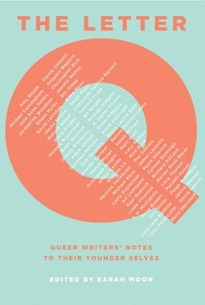
Review: The Letter Q

letter q

The Letter Q: Queer Writers’ Notes to Their Younger Selves edited by Sarah Moon

This was one of those books that I wanted to last forever.  I lingered over it, though I had a problem with not just wanting to read them all in one breath.  The entire book is made up of letters from successful gay and lesbian writers to their younger, usually teen, selves.  They are filled with hope, humor and acceptance for what they themselves thought, felt and lived.  Almost all are love letters to that younger, insecure and questioning person who is often closeted and always queer.  There are names here that teen readers will be familiar with: Malinda Lo, David Leviathan, Bruce Coville.  There are many others to be discovered through this book. 

Though the book is specifically about being GLBTQ, all teens will find it inspirational.  As one letter says, all of us have something that is queer about us.  All teens need to accept themselves, see themselves in that future state, and reach for those dreams.  All teens need to know that their thoughts and feelings are ok, whatever they are.  So I’d share this with straight and not narrow teens as well as GLBTQ teens too, of course. 

This is one of those books that should be in every public library.  It will probably be read in the back areas, the more private tables.  My ARC copy will be donated to a local café that has a GLBTQ club that meets regularly.  This is a book that café should have, since I can’t think of anything nicer to read with a cup of coffee.  Just as long as you are ready to really savor both.

Appropriate for ages 13-18.

Review: Dreams around the World by Takashi Owaki

dreams around the world

Dreams around the World by Takashi Owaki

Meet thirteen children from around the world who are ready to share their dreams with you!  Photographer Takashi Owaki traveled the world, including 55 countries on six continents and interviewed over 1400 children about what they wanted to be when they grew up.  In this book, he shares the dreams of some of those children.  Each child and their dream is accompanied by photographs, their age, name and country, along with a short paragraph about where they live.  At the end of the book, all of the countries are shown on a world map.  The book is a celebration of our diversity but also our universal dreams.

Owaki’s photographs are the heart of this book, especially the full-page image of each child looking directly into the camera.  The writing itself is simple, speaking to how Owaki met the child and the family they live with.  The smaller images with each story also help give context, showing activities and the environment.  My only quibble with the book is that it would have been nice to have the map done in a smaller way with each child to help with understanding the geography.

Originally published in Japan, this is a book that celebrates our world and the beauty of dreams.  Appropriate for ages 5-8.

Reviewed from copy received from One Peace Books.

Review: Rachel Carson and Her Book That Changed the World by Laurie Lawlor

rachel carson and her book

Rachel Carson and Her Book That Changed the World by Laurie Lawlor, illustrated by Laura Beingessner

This is a biographical picture book about the environmentalist Rachel Carson.  The book covers her childhood, which she spent outside in her family’s woods, orchards and fields.  Her mother loved nature and passed her passion on to her daughter.  Though times were tough and her father struggled to make enough money to support the family, Rachel was able to attend Pennsylvania College for Women in Pittsburgh.  It was during this time that she started to be concerned about the environment. Rachel decided to become a biologist and received her Master’s Degree, becoming one of the few female biologists.  After some time jobless due to the Great Depression, her two skills of science and writing came together in a job for the Bureau of Fisheries writing radio scripts about sea life.  After World War II, Rachel became alarmed at the chemicals being sprayed everywhere.  Though she had been diagnosed with breast cancer, she continued work on Silent Spring which caused such a reaction that new laws were created to protect the environment.  This book tells the story of a woman who was smart, scientifically gifted, and passionate about the natural world she loved so much. 

Lawlor pays real homage to Rachel Carson here.  It is the story of her entire life, from the early days of connecting with nature through her years of study to the final, vital book she wrote.  Hers is an inspirational story of what can be done by someone who is smart and passionate about a subject.  It is also a great story about a woman who defied the conventions and followed her dreams.  Lawlor makes Carson both intensely human but also heroic.

The illustrations are done in a simple style with ink and watercolor.  They celebrate the natural world around Carson with plenty of the greens of the woods and the blues of the waters.  And in each, Carson is observing and making notes.  It’s a glimpse of a woman who is a scientist first and foremost.

This is a celebration of a groundbreaking book by a groundbreaking woman.  Appropriate for ages 5-8. 

Reviewed from library copy.