Top 2012 Children’s Nonfiction to Wake Your Brain Cells

Here are my top ten picks for children’s nonfiction this year.  Most are picture books and I’ve snuck one in for teens as well.  The links below will take you to my full reviews.

boy who harnessed the wind fantastic jungles

The Boy Who Harnessed the Wind by William Kamkwamba – Autobiographical picture book about a teen boy from Malawi who built a windmill out of scraps.  Luminous and compelling reading.

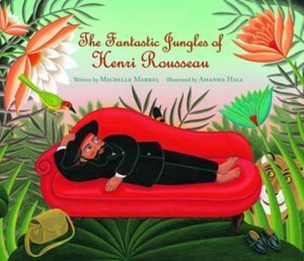
Fantastic Jungles of Henri Rousseau by Michelle Markel – A striking and superb biography of the artist who came to his craft late in life.

georgia in hawaii island

Georgia in Hawaii by Amy Novesky – This gorgeous picture book biography takes a look at Georgia O’Keeffe’s trip to Hawaii and how it impacted her art.

Island: A Story of the Galapagos by Jason Chin – Learn about the history of the Galapagos Islands and the wonders of nature and evolution in this incredible read.

12843717-the-letter-q life in the ocean

The Letter Q by Sarah Moon – (My sneaky way of putting in my favorite teen nonfiction book) This entire book is letters from gay and lesbian authors to their younger selves.  It’s an inspirational collection worth lingering over.

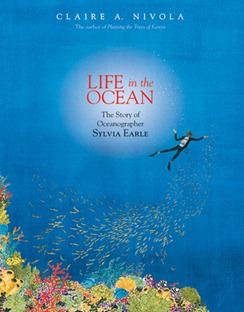
Life in the Ocean by Claire A. Nivola – Journey deep under the sea with this inspiring biography of biologist and oceanographer Sylvia Earle.

looking at lincoln mrs harkness and the panda

Looking at Lincoln by Maira Kalman – A fresh and radiant biography of Abraham Lincoln that manages to be both colorful and playful.

Mrs. Harkness and the Panda by Alicia Potter – A marvelous picture book biography of an unlikely adventurer willing to take amazing risks.

ocean sunlight seed by seed

Ocean Sunlight by Molly Bang – Learn about how the sun makes life on earth possible with this winning combination of poetry and science.

Seed by Seed by Esme Raji Codell – This beautiful picture book biography makes the story of Johnny Appleseed resonate with modern readers with his focus on the environment and shared community.
Review: Seed by Seed by Esme Raji Codell

seed by seed

Seed by Seed: The Legend and Legacy of John “Appleseed” Chapman by Esme Raji Codell, illustrated by Lynne Rae Perkins

Two modern children are transported back in time from the busy highways filled with cars to the quiet woods of the late 1700s.  From there, the story of Johnny Appleseed, really named John Chapman, is told.  The differences between the world back then and our modern world are explored.  Then the way of life that Johnny Appleseed embraced that of using what you have, respecting nature, sharing, making peace, and reaching your destination in small steps is tied back to how important those things are still for us today.  His planting of seeds changed the landscape of our country.  The book ends asking what seed you will plant.

Codell writes with a wonderful lyricism paired with a directness.  It makes for a book that is straight-forward but also written with care to create a specific mood.  Chapman’s story is filled with legend, especially in his relationship with nature and animals.  While some of it may be tall tales, it contributes to the wonder that surrounds this man.  Codell made a choice to have some of that in her book and it works very well, distinctly noted as legend rather than fact.

Perkins’ illustrations vary from page to page.  Most of the art is done in watercolor and gouache, creating bright colored images that embrace the natural and feel clear and crisp.  Other pages incorporate burlap bags and needlework.  It’s a clever use of materials of the period that really add another dimension to the illustrations.

A beautiful look at a man who stand for much of what we are seeking in modern society.  This book reaches beyond the legend and finds the real Johnny Appleseed.  Appropriate for ages 6-8.

Reviewed from library copy.

Review: Harlem’s Little Blackbird by Renee Watson

harlems little blackbird

Harlem’s Little Blackbird: The Story of Florence Mills by Renee Watson, illustrated by Christian Robinson

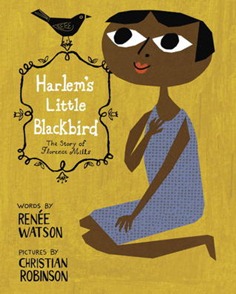
This is a picture book biography of Florence Mills, a singer well-known during the Harlem Renaissance.  It follows her from her childhood as the daughter of former slaves in a tiny house in Washington, DC. where she was always singing and dancing.  She became known as a small girl with a big voice, but often faced racism and segregation when she was performing.  She quickly learned to use her voice for activism as well as song.  Florence became known not only across the nation but around the world for her voice.  She traveled internationally, and continued to be an activist and to give back to the poor.  Applauded for her singing, this book celebrates her good deeds just as much as her voice.

Watson writes a compelling story of a woman who was more than a beautiful songbird.  She fought back against the bigotry of her time and also gave back to the community she came from.  Watson distills Mills’ story into one that children can easily relate to.  It exposes the overt racism of a previous time and will give children much to discuss about how far our society has come and how much farther we have to go.

Robinson’s illustrations are done in cut-paper and collage.  They have a great texture to them, often showing a physical depth that is very appealing.  The colors are bright and vibrant, fitting colors for this equally vibrant woman.

A very successful picture book biography of a woman whose voice broke down barriers along with her good work.  Appropriate for ages 7-9.

Reviewed from copy received from Random House.

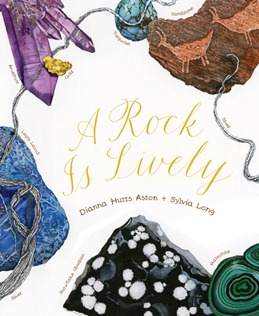
Review: A Rock Is Lively by Dianna Hutts Aston

rock is lively

A Rock Is Lively by Dianna Hutts Aston, illustrated by Sylvia Long

Another stellar collaboration by the team that created An Egg Is Quiet, A Seed Is Sleepy, and A Butterfly Is Patient, this nonfiction picture book focuses on rocks and minerals.  The book begins with rock melted as magma beneath the earth.  It talks about what makes up rocks and how old they are, as well as the rocks that we find in space.  Rocks as tools and weapons are explored, mixed in with the amazing rock interiors that surprise and delight. The different types of rocks finish off the factual piece of the book, but the bright and beautiful illustrations continue all the way to the final lapis lazuli endpages. 

Aston manages to write nonfiction as if each sentence is filled with delight.  Her enthusiasm for the subjects she writes about is evident in her writing, inviting young readers to get just as interested as she is.  The art carries that same enthusiasm in its bright colors and details.  Done in watercolor, the colors are surprisingly deep and lush. 

If you have the first three books from these amazing collaborators, this is a must-buy.  It should be on the shelves of any school or public library, sure to get young people exploring a new subject.  Appropriate for ages 7-9.

Reviewed from copy received from Chronicle Books.

Review: Island: A Story of the Galapagos by Jason Chin

island

Island: A Story of the Galapagos by Jason Chin

Follow the birth of a group of islands to the present day in this book that beautifully documents the wonders of the Galapagos.  Opening with the drama of a volcanic eruption six million years ago, the book shows how plants and animals arrive at a new island in the ocean.  As time goes by, the island turns from barren rock to a place of lush green.  Specific attention is paid to the evolution of creatures and plants that are found only on these islands.  Young readers will fully understand why finch beaks grew larger, seagulls got larger eyes, and tortoise shells changed shape.  The book ends with Darwin arriving on the shores of one of the islands.  This book is a celebration of these islands and the wonders of nature.

Chin’s book offers information that is solid and fascinating packaged with illustrations that capture the details of what is being explained.  It makes for a book that is bright and energized and that is clearly nonfiction as well.  The story of the birth and life of an island makes for a magnificent tale that readers are sure to respond to.

In his art, Chin brings the reader up close to what is happening on the island.  We get to look between the mangrove roots at sharks, watch pelicans feast on fish in the lagoons, and see land iguanas float on logs to reach the island.  Even better, as I mentioned earlier, the process of evolution is detailed so that readers can see the gradual but necessary changes that occurred.

This is one incredible nonfiction book that teachers, parents and students will enjoy looking through and learning from.  Appropriate for ages 6-8.

Reviewed from library copy.

Review: Colorful Dreamer by Marjorie Blain Parker

colorful dreamer

Colorful Dreamer: The Story of Artist Henri Matisse by Marjorie Blain Parker, illustrated by Holly Berry

Matisse grew up in a French town that was industrial and gray.  Despite this, he dreamed in bright colors.  He was a boy who did not do well in school, at music, or really at much of anything except dreaming.  Matisse decided to study law in Paris, but he discovered that being a law clerk was very dull, copying legal documents word for word by hand.  Due to the stress, Matisse ended up in a hospital bed for months.  It was there that he started painting to pass the time.  Now he had found exactly what he was good at.  It wasn’t easy, there were times he lacked food and money, but he worked very hard at his art.  Years later, Matisse found himself sick and in bed again in his old age.  He could no longer stand at an easel, so he turned to making cut-out collages, and those pieces turned out to be some of his most celebrated creations.

Parker vividly tells the story of a boy who grew up as a very unlikely artist.  From his colorless surroundings to the fact that he had never discovered his artistic gift, it is amazing that Matisse became what he was.  I appreciate particularly her celebration of the creative and the imaginative.  She also makes sure though that young readers know how much work it took for Matisse to reach success and that it did not come instantaneously.  It’s a book that speaks to everyone having a gift, but also the hard work it takes to achieve it.

Berry’s art plays black-and-white against brilliant color.  The gray world of Matisse’s youth is shown in intricate pencil illustrations, but pales against the radiant color of his dreams and his art.  As the pages turn, Matisse’s world becomes the same colors as the art he creates, demonstrating that he has finally found his place in the world as a whole.

Beautifully illustrated and written as an inspiration to young people looking for their own special place in the world, this is a very special look at a famous artist.  Appropriate for ages 5-8.

Reviewed from copy received from Dial Books.

Review: Life-Size Farm by Teruyuki Komiya

life size farm

Life-Size Farm by Teruyuki Komiya

This fourth in the “Life-Size” book series takes on farm animals in glorious full-size photographs.  Just like the others in the series, there are panels that offer more detailed information, including the animals name, age, and scientific name.  There are details about physical characteristics that are explained further as well as a list of facts.  All of these are presented in bright colors and with a playful feel.  But it is the photographs in their large size and with the clarity and detail that they offer that will have children taking this book home and lingering over it.

Several of the pages unfold to show even larger images of animals.  The huge furry alpaca and the enormous cow will generate lots of interest.  What is most amazing here is that the size of all of the animals is surprising and fun.  Even better, the quality of the photographs is always high and offer lots of small details to pay attention to.

A great pick for library shelves, though the size is large enough to make them not fit on shelves easily!  This is an excellent addition to a popular nonfiction series for children.  Appropriate for ages 5-9.

Reviewed from copy received from Seven Footer Kids.

Review: Helen’s Big World by Doreen Rappaport

helens big world

Helen’s Big World: The Life of Helen Keller by Doreen Rappaport, illustrated by Matt Tavares

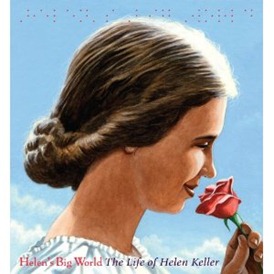
This picture book biography of Helen Keller celebrates both the accomplishments of Helen Keller in overcoming her world of darkness and silence and those of her teacher Annie Sullivan.  The book begins with Helen as a small baby, before she had an unknown illness at 19 months that took her sight and hearing away.  It then moves through her attempts to continue to communicate, the frustration that caused her tantrums, and the slow progression of learning that led to the seminal moment at the water pump that connected the letters in her hand to the outside world.  Readers will see how Helen learned to write, read in Braille, and put her hands on people’s faces to feel their lips move so she could understand their speech.  The book continues to show how Helen Keller spoke up for social injustices that she felt were wrong.  This is a testament to what a brilliant mind and a great teacher can create.

Rappaport has somehow condensed the complicated story of Keller’s life into a very readable picture book that has a brisk pace and invites readers to find out more about this remarkable woman.  Throughout the book, Keller’s own words are used to illustrate points in the story.  Shown in their own font that is colorful and set apart from the rest of the text in size too, her words shine.

Tavares’ illustrations reveal the marvel of Helen Keller’s learning and education.  There is a light to the images once the learning begins that contrasts with the darkness of her earlier life.  Throughout Keller is shown experiencing the senses she does have, from the scent of a rose to the feel of the breeze on her face. 

An inspirational figure, Helen Keller continues to be a beacon for overcoming obstacles and using one’s mind.  This book is a beautiful tribute to her.  Appropriate for ages 8-11.

Reviewed from library copy.

Review: Hands around the Library by Susan L. Roth

hands around the library

Hands around the Library: Protecting Egypt’s Treasured Books by Susan L. Roth and Karen Leggett Abouraya

Told from the point of view of one of the protesters in modern Egypt, this is the true story of how the Alexandria Library was saved during the protests.  As the crowd moved toward the library, which was built on the same ground as the ancient Library of Alexandria, the library director came outside and spoke to them.  He pointed out that the library had no gates to lock and no way to protect the large doors made of glass.  It was up to the people to save the treasures inside.  The crowd pressed on and the shouting grew louder.  But then one young man ran up the steps of the library and joined hands with the library director.  Then more and more people  joined hands, a living barrier protecting the library. 

The writing here tells the story clearly and concisely.  There is fear of the mob mentality woven into the story, a trepidation at what could happen with that many passionate and angry people in a large group.  The energy of that mob and that mood carries the book forward.  That moment of decision by the crowd hangs jewel-like in the book, the one person who does the right thing first and then those who follow.  It’s a book and a story that pivots in a moment of bravery. 

Roth’s collages capture the press of the crowd and its passion, but also the fact that these are regular people who were creating change.  The illustrations have a flatness to them that works well much of the time.  It is particularly effective when hands are joined in a chain. 

A powerful look at the importance of libraries and the bravery of a few, this book is also a reminder that we are witnessing history being made.  Appropriate for ages 5-7.

Reviewed from copy received from Dial Books.