Review: Little Dog Lost by Monica Carnesi

little dog lost

Little Dog Lost: The True Story of a Brave Dog Named Baltic by Monica Carnesi

Children along the banks of the Vistula River were the first to spot the little dog floating on the ice floes.  Firemen tried to help rescue the dog, but were unable to reach him before the river carried him away.  The river carried the dog into the Baltic sea where a ship arrived.  The crew members tried to rescue the dog, but it proved difficult.  At one point, the dog even slipped into the water but managed to pull itself back up onto the ice.  Finally, the crew managed to get a boat into the water and move close enough to the ice the dog was on and rescue him.  After warming up and getting dry, the dog was adopted by the crew and named “Baltic.”

This true story of a dog on the ice inspired the author to create a picture book demonstrating the heroism of both man and dog.  Unlike many nonfiction books, this is one that can be used with preschoolers and even toddlers.  The story is kept very simple, with only a few sentences on each page, making it move ahead quickly.  Add to that the drama of the floating dog and the fear that he will not survive and you have a picture book that is a real treat to read.

Carnesi’s artwork echoes that same child-friendly simplicity with its fuzzy dog.  The round-faced people are equally charming and inviting to young readers.  My favorite part was turning to the final page that tells more details about the rescue and recognizing the man holding Baltic from his depiction in the book. 

This entire work is charming, great fun to read, and also an inspiring story.  Appropriate for ages 3-5.

Reviewed from copy received from Nancy Paulsen Books.

Review: The Camping Trip That Changed America by Barb Rosenstock

camping trip

The Camping Trip That Changed America: Theodore Roosevelt, John Muir, and Our National Parks by Barb Rosenstock, illustrated by Mordicai Gerstein

Teddy Roosevelt and John Muir had little in common growing up except for one thing: they both loved the outdoors and the wilderness.  So in 1903, when President Roosevelt read a book by John Muir that pleaded for people to save the trees, he couldn’t stop thinking about losing all of the trees in the mountain forests.  Roosevelt set out to meet with Muir in Yosemite.  After a few pictures, the two men rode off together with no entourage or photographers along.  Roosevelt got to see the giant sequoias, listen to Muir’s stories, see valleys carved by glaciers, and awaken under inches of snow.  Together the two men dreamed a new dream for the United States and its wild areas, one where they were protected for generations to come.

Rosenstock tells this story with a wonderful joy that permeates the entire work.  She captures the differences between the two men clearly but binds them together through their love of the outdoors.  The natural parts of the story are also captured in imagery and distinct moments where the men connect with each other and with the wilderness itself. 

Gerstein’s illustrations have a depth to them that nicely captures both the men and the natural beauty.  The quiet of Roosevelt’s life is shown in deep colors and stillness.  It contrasts powerfully with the blues, golds and greens of the natural world that is light filled and also full of action. 

This is a celebration of two men and the difference they made in our lives by creating the National Parks.  It is also an invitation to head out and explore the parks for yourself, looking for your own moments of connection to the wilderness.  Appropriate for ages 7-10.

Reviewed from copy received from Dial Books.

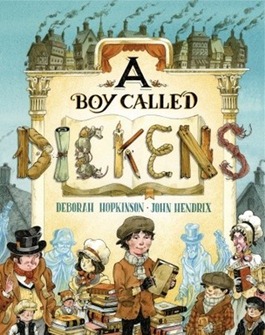
Review: A Boy Called Dickens by Deborah Hopkinson

boy called dickens

A Boy Called Dickens by Deborah Hopkinson, illustrated by John Hendrix

Enter the world of Charles Dickens’ childhood in this picture book.  The fog and cold of London will enfold you, along with the smoking chimneys and the dankness of the Thames.  Twelve-year-old Dickens worked in Warren’s blacking factory, wrapping bottles of blacking for sale.  He entertained the boy next to him with his stories when they could get away with it.  Dickens worked ten hour days and when work is finally completed, he headed home to his tiny attic room where he lived alone.  His family was in the debtors’ prison with only Dickens bringing in any money at all.  When his father and family is released from prison, Dickens’ life changes and he is finally allowed to go to school.  This book celebrates the 200th anniversary of Dickens’ birth in a way that will resonate with children.

Hopkinson’s story begins with an invitation into London and into understanding the world at that time better.  It is actually like entering a novel by the great writer.  Readers will chase after the fast-moving Dickens until they figure out where he is headed.  There is an element of play and fun from the get-go, even though the subject here is very serious. 

Hendrix’s illustrations show the gritty world that Dickens grew up in.  Yet all is not fog and work, there is the beauty of story, the world of imagination.  It’s an impressive mix of historical accuracy and a more whimsical take on creativity. 

Picture book biographies of historical figures can be tricky, since so much information needs to be shared.  Here the balance of story telling and imagery is deftly done, creating a book that is noteworthy.  Appropriate for ages 6-9.

Reviewed from library copy.

Review: Just a Second by Steve Jenkins

just a second

Just a Second: A Different Way to Look at Time by Steve Jenkins

Jenkins always manages to make science and nature even more fascinating than it usually is.  In this book, he shows the passage of time in unique and  intriguing ways that will get young scientists thinking differently.  What happens in one second?  Well, in that second a bat can make 200 calls or hummingbird beats its wings 50 times.  What happens in one minute?  In a minute a grizzly bear can charge up to one half-mile or a skydiver falls 2 miles during free fall.  How about an hour?  A day?  A week?  Longer?  For all of these, Jenkins selects intriguing examples of what happens during that time period that will have you thinking about time and what can be done in ways you never expected.

Jenkins’ paper collage art is on display here, vibrant against the plain backgrounds of the pages.  His exacting art uses pattern, subtle color changes and textures to great effect.  His collage work is done with such attention to detail that it often doesn’t look like cut paper work.  It is as beautiful as his work always is.

Jenkins has selected fascinating bits of trivia to put on display here.  This book will not give you the complete story of the natural examples, but will definitely open readers’ minds to new ways of looking at time and action.  It is one of those books that invites you to explore the ideas that capture your imagination further in other places. 

A great gateway book that broadens the mind, this nonfiction book is appropriate for ages 5-9. 

Reviewed from library copy.

Review: Who Has What? by Robie Harris

who has what

Who Has What? All About Girls’ Bodies and Boys’ Bodies by Robie H. Harris, illustrated by Nadine Bernard Westcott

Have a child asking about their body and the ways that boys and girls are different?  Here is a picture book for younger children that answers those questions clearly, simply and with a great matter-of-fact tone.  Told through a family trip to the beach, the book starts with the child characters having questions themselves.  Emphasis is placed on the fact that boys and girls are mostly the same in their bodies.  They both love to play, love to laugh, but they do have some body parts that are different.  Even then, most of their body parts are the same.  As the children move into the changing rooms, the different body parts are shown and defined.  The book covers both the external organs and the internal ones.  As always, Harris presents the information with clarity and makes it easy to understand.

This book is appropriate for preschoolers who are asking questions about their bodies.  The answers here cover the body parts only.  No sexual explanations are given in this book about how babies are made or arrive.  It’s a great early lesson in bodies that speaks to the questions children that age have.

Westcott’s illustrations are charming and factual, nicely combining clear images of the body parts but also having an inviting cartoon feel.  The addition of the dogs in the dressing rooms and when talking about general body parts will also help answer questions that children have about pets.  It’s another way that this book is clearly designed for this specific age group.

Ideal for families looking for clear information to share with their children, this book belongs in every public library.  Appropriate for ages 4-8.

Reviewed from library copy.

Review: Coral Reefs by Jason Chin

coral reefs

Coral Reefs by Jason Chin

Chin follows up the success of Redwoods with this equally fine read.  The nonfiction magical realism continues, this time exploring coral reefs.  A girl enters the New York Public Library and selects this same book from the shelves.  As she turns the pages, coral begins to grow around her on the tables and floor.  She learns new facts about coral reefs when suddenly the room is flooded.  She continues to read, happily floating with the fish and sea turtle of the reef.  The food chain is explored and sharks appear in the water.  Soon she is floating in the city, entirely flooded with the reef growing upon it, almost unrecognizable through the coral, blue water and the creatures.  The book ends with another group of children seeing the girl dripping outside the library, taking the book and reading it with her.  They all swim together into the coral reefs.

As a librarian, I always love books that are set in libraries and that speak, as this one does so clearly, to the power of shared reading and libraries in children’s lives.  Chin mixes nonfiction facts with his magical settings in ways that astonish and engage. 

The facts on each page work with the illustrations, which demonstrate the facts in picture form.  Chin’s art is lovely from the floating delight of the girl to the menacing sharks to the light that plays in the water. 

This is a book that invites you in and teaches you facts and information while you too are happily floating along.  Appropriate for ages 5-8.

Reviewed from copy received from Roaring Brook Press.

Also reviewed by:

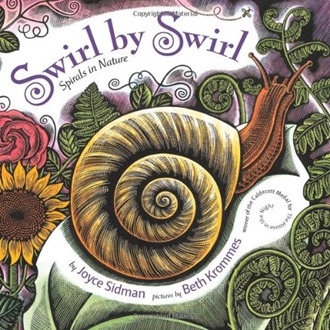
Review: Swirl by Swirl by Joyce Sidman

swirl by swirl

Swirl by Swirl: Spirals in Nature by Joyce Sidman, illustrated by Beth Krommes

Two incredible talents worked together to bring us one of the most stunningly lovely books of the year.  It explores the different ways that spirals and swirls appear in nature.  There are the animals curled up for the winter underground, shells, unfurling ferns, hedgehogs, octopus tentacles, whirlpools and tornadoes.  This book is a masterpiece of simplicity and complexity, just like the swirls that it speaks about.

With verse by Joyce Sidman, winner of a Newbery Honor and illustrations by Caldecott winner Beth Krommes, this book is immediately something special.  The two have brought readers a poem spiraled inside intensely lovely images.  One gets the sense of unwinding a spiral when reading the verse, as it loops and dances.  The illustrations too are filled with a movement that is natural and free.

There is a simplicity about the verse that is misleading.  Sidman’s verse is tight and well crafted, showing a restraint and skill.  Krommes’ illustrations on the other hand are filled with details, lines of motion, and jewel tones.  Astonishingly lovely, the illustrations have a fully dimensional feel to them and celebrate the swirl and spiral to great effect.

Highly recommended, this book successfully celebrates shape, design, science and nature in a single beautiful work.  Appropriate for ages 3-6.

Reviewed from library copy.

Check out the book trailer to see the illustrations for yourself:

Also reviewed by:

Review: The House Baba Built by Ed Young

house baba built

The House Baba Built: An Artist’s Childhood in China by Ed Young

Illustrator Ed Young grew up in Shanghai during World War II.  His father managed to get them a house that was safe because he built it himself.  He made a deal with the landowner that he would build a house and after 20 years, the landowner would get it free and clear.  But in those 20 years, Ed Young’s family lived there.  It was a huge home with a swimming pool, space to roller skate on the roof, staircases to slide down, and lots of other places to play.  This is the story of growing up in that house with the war raging around them, but also feeling very safe as a family because of the house.  It is the story of welcoming people beyond their family to stay with them, giving refuge and forming a larger family unit.  It is the story of years of playfulness and joy together despite the outside forces because his father thought brilliantly and quickly.

It will come as no surprise to those who know Young’s work that this is a beautifully designed book.  Young weaves together paper cutting, sketches, painting and photographs into a dreamlike world of his childhood where some things stand out crystal clear and others are fogged by time.  It is like looking into someone else’s memories along with them.  They are beautiful and mesmerizing.

This book may have trouble finding an audience.  While the illustrations are gorgeous, the story is told in vignettes rather than one large story.  This technique will resonate more with slightly older readers than usual picture book preschoolers.  On the other hand, teachers looking for a book to inspire telling a biography in more than words will delight in this book.  It will share aloud well and the illustrations will invite readers into Young’s world.

A book for older elementary school readers who may take some encouragement to pick it up.  Once they do, they will be transported to Shanghai in the 1930s and 40s.  Pair this with Drawing from Memory by Allen Say for two artist’s childhoods in Asia.  Appropriate for ages 7-10.

Reviewed from ARC received from Little, Brown.

Review: Balloons Over Broadway by Melissa Sweet

balloons over broadway

Balloons over Broadway: The True Story of the Puppeteer of Macy’s Parade by Melissa Sweet

For over 80 years, there have been huge balloons in the Macy’s Parade.  We have Tony Sarg to thank for that.  Even when Tony was a small boy, he was inventing things.  He figured out a way to feed the chickens in the morning without having to get out of bed.  He wanted to be a marionette puppeteer, but was born in a time when marionettes were not being used anymore.  So he figured out how to build them and started performing on Broadway with his marionettes.  From there, he got a job designing the holiday windows for Macy’s where he did puppets that moved through gears and pulleys.  After that, he started working on parades.  He first built balloons that were held by stiff sticks, but they needed to be higher so more people could see.  So out of necessity and through tremendous creativity, he figured out how to make balloons fly high but still be controlled and seem lifelike.  We are all lucky enough to still be able to see the work of Sarg every Thanksgiving in the Macy’s Thanksgiving Day Parade. 

This book is all about dreaming big and then figuring out a way to make those huge dreams come to life.  Sarg’s life is also about following your own personal bliss and making a living doing what you love.  It is a tribute to creativity and imagination on a grand scale.  Sweet has created a book that celebrates all of this and remains a biography of a real man too.

Her art is a tremendous part of the book’s success.  Through a mix of painting and collage, she brings Sarg’s world to life.  Fabrics, different paper, objects and maps all find their way into the illustrations, creating new textures, dimension and color.  They are illustrations that celebrate on almost every page, filled with bright colors and ingenuity.

Highly recommended, this book should be added to everyone’s must read list for Thanksgiving titles, but don’t keep it just for that time of year.  It is also a great book to discuss creativity and unusual jobs!  Appropriate for ages 6-8.

Reviewed from library copy.

Also reviewed by: