Review: A Butterfly Is Patient by Dianna Hutts Aston

butterfly is patient

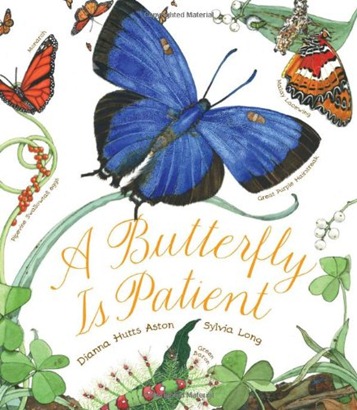
A Butterfly Is Patient by Dianna Hutts Aston and Sylvia Long

This third book in their series together continues the beautiful detail and natural information of A Seed Is Sleepy and An Egg Is Quiet.  Here the subject is butterflies and the book begins with the egg and caterpillars, moving quickly into metamorphosis with the clear knowledge of where exactly children will be intrigued.  The book speaks to butterflies’ roles in pollination as well as their camouflage, drinking, and poisonous capabilities.  Readers will be intrigued with the scaly close-up of a butterfly wing and with the long-travels of the migrating monarch.  This book is full of great details that will have everyone understanding that butterflies are many things as well as lovely to look at.

Aston and Long create books that have readers lingering.  When I share them with my son, we take our time on the pages, talking about our favorite names of the butterflies, our favorite caterpillars, the most lovely butterflies.  He has used the fact about butterfly scales on their wings at least twice in conversations I have overheard since we read this.  When we found a dead monarch in our driveway, he was elated to be able to touch the wing and talked about how it felt “as soft as air” for a long time afterwards.

These are gateway to science books, offering just the right tone and perfectly selected facts.  Add the illustrations that are large, interesting and filled with details.  You now have the ideal package to get children interested in the nature right in their own backyards.

If you haven’t read any of these books, run to your library and get them!  This is one gorgeous and inviting look at butterflies.  Appropriate for ages 6-8.

Reviewed from library copy.

Also reviewed by:

Review: Magic Trash by Jane Shapiro

magic trash

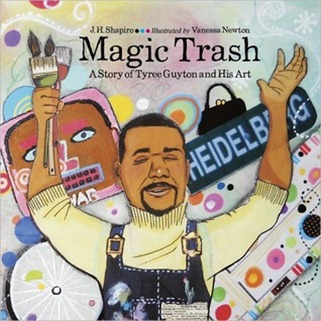
Magic Trash: A Story of Tyree Guyton and His Art by J. H. Shapiro, illustrated by Vanessa Brantley-Newton

This is the life story of Tyree Guyton.  Tyree grew up in Detroit in a large family.  He was always picking up stray objects and creating things with them.  At age nine, Tyree decided he wanted to be an artist.  But as the years passed, he worked many jobs, none of them artistic.  When he returned back home, his street has changed from a bustling neighborhood into a stretch of dilapidated  houses.  So Tyree went to work, painting everything he could find.  Houses got polka dots, bright colors were everywhere, found objects were incorporated.  But not everyone loved Tyree’s work, they considered it garbage.  Houses were knocked down by the city, until finally after years, Tyree’s art was safe.  This year marks the 25th anniversary of the Heidelberg Project, certainly something to celebrate!

Shapiro has written this book with a sparkle and jazz that suits the subject.  Her storytelling is impressive as she creates moods that change from one page to the next as the story progresses.  She weaves in rhyming lines at times, adding to the distinctive feel of her words.

Brantley-Newton’s art is done in mixed media, incorporating found objects, torn pages filled with words, painting, pattern and texture.  Her art is bright, beautiful and vibrant.  Against the distinctive backgrounds, her characters stand out with great charm.

A look at street art that is part of the street, this book will be enjoyed by art teachers and budding young artists alike.  Appropriate for ages 6-9.

Reviewed from copy received from Charlesbridge.

Review: Bugs by the Numbers by Sharon Werner

bugs by the numbers

Bugs by the Numbers by Sharon Werner and Sarah Forss

The creators of Alphabeasties and Other Amazing Types return with a bug book where it is all done by the numbers.  After an energetic introduction, readers turn pages to see bugs made up of numbers.  The numbers have special reference to that insect, whether it is the number of legs, number of eyes, or how far they can jump.  The design of the book is eye-catching and very engaging.  The ground is bright colors that change from page to page and the bulk of the numbers are explained there.  But other pages have large flaps that open:  wood for the termites, a tree for the walking stick, and leaves for the caterpillar.  This is a vibrant book that will have everyone engrossed in learning facts about bugs.

The typographical design is truly amazing with the insects fully rendered in numbers, used in different sizes and amounts of boldness.  The backgrounds are primarily white with large areas of color, leaving the detail to the insects themselves.  It is a strong design that is intriguing and great fun.

This book worked particularly well read-aloud, which is something I had not expected.  The facts read naturally and provide lots of opportunities for further discussion.  There are facts that are well known and others that are strange and intriguing.  It makes for a great book for kids to nod along that they know the information and then in the next sentence to be learning something new.

A great bug book, this deserves a place in every public library.  I know it will be one of my picks for holiday presents for any nature-loving kid.  Appropriate for ages 5-8.

Reviewed from library copy.

Also reviewed by
Book Review: The Mangrove Tree by Susan L. Roth

mangrove tree

The Mangrove Tree: Planting Trees to Feed Families by Susan L. Roth and Cindy Trumbore

This book tells the true story of Dr. Gordon Sato in picture book format.  The village of Hargigo in the African country of Eritrea was dry and the animals could not find enough to eat.  Dr. Sato had the idea of planting mangrove trees on the shore of the salty Red Sea.  The trees can survive the salt and would give women in the village a way to earn money close to home from planting the trees.  The trees also help by giving off oxygen too.  The goats and sheep ate the leaves from the trees and grew stronger, living longer and having healthier babies.  The mangrove trees also changed the habitat along the shore, creating hiding places for sea creatures that helped the fish grow larger and the fishermen improve their catch.  This is the story of Dr. Sato, who through science changed the lives of people not only in Hargigo, but around the world.

Trumbore has written a clever dual story here.  On one side of the page, a simple cumulative story is told of the mangrove trees by the sea.  On the other side, readers get much more detailed information about the science and impact of the planting of the trees.  Finally, at the end of the book, readers can see photographs of the actual villagers, the trees and Dr. Sato. 

Roth’s illustrations are eye-catching and inventive.  Using collage, she has created such texture, color, and natural feel.  Her illustrations have depth, showing the people at work, giving individual coats to the sheep and goats, and celebrating the bright colors the people wear.  It is a very rich illustration that celebrates the setting and the work that went into the project.

Highly recommended, this book is a beautiful mix of nonfiction and picture book that is ideal for elementary science about the environment.  It celebrates the impact that one man can have on the world, inspiring youth to think about what they can contribute too.  Appropriate for ages 5-8.

Reviewed from library copy.

Also reviewed by BookDragon.
Book Review: The Bravest Woman in America by Marissa Moss

bravest woman in america

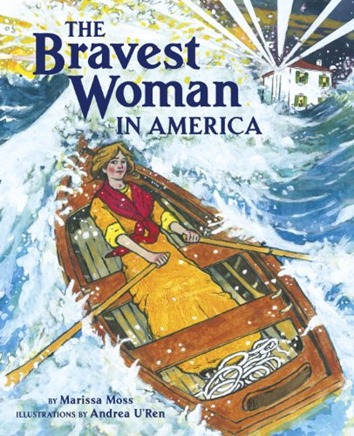
The Bravest Woman in America by Marissa Moss, illustrated by Andrea U’Ren

Ida Lewis loved the sea, from the crash of the waves to the bite of the ocean air.  When her father got a job as a lighthouse keeper, she was thrilled.  He had to cross back and forth twice a day to check the light, and he took Ida with him, teaching her how to row.  He also taught her to care for the lamp and how to rescue people without capsizing herself.  When Ida turned 15, her family moved out to live next to the lighthouse.  Ida dreamed of becoming the keeper herself one day.  That day came early when her father got ill and could no longer care for the lighthouse.  So Ida helped more and more.  Though she had never rescued anyone, she rowed out to save some boys in a sailboat that capsized.  It took all of her determination and strength to save them, but she did.

This book works on so many levels.  It is a true story about a real hero who defied what society expected of her and became what she dreamed of.  Additionally, it is the story of a girl who was strong, brave and amazing.  A girl who relied on her own strength and wits to save others rather than to be rescued herself.  Beautiful. 

Moss writes the story with drama and action, yet is never heavy handed.  She builds up to the accident nicely, showing it happen and then building to the climax of the rescue.  This is an rescue story that will have readers cheering.

U’Ren’s art is done in watercolor, ink and acrylic.  The colors are deep and lovely, from the changing colors of the sky to the blues and greens of the water that change with the storm.  Ida Lewis is always shown as a young lady, never masculinized at all.  It adds to the charm and drama of the story.

Highly recommended, this is a great book choice for women’s history units or for any child to learn that girls are heroes too.  Appropriate for ages 5-8.

Reviewed from copy received from Tricycle Press.

Book Review: Bring on the Birds by Susan Stockdale

bringonthebirds

Bring on the Birds by Susan Stockdale

This is a bright and bold picture book about birds.  Written in simple, rhyming text, the book is a celebration of the diversity of birds around the world.  It shows birds of different sizes, colors and habitats.   Some are active, others sitting, and still others hang upside down.  There is a section at the end of the book that has more information on each bird as well as a list of nonfiction titles about birds for children to explore. 

The text here is so simple that it glides past.  The rhythm and rhyme is gentle and unifies the book.  The illustrations are the glory of the book offering simple backgrounds that the birds shine against.  Even in their simplicity, the illustrations manage to convey the birds’ habitat and size. 

Definitely not for the birds, this is a very successful nonfiction picture book for young readers.  Appropriate for ages 2-4.

Reviewed from copy received from Peachtree Publishers.

Also reviewed by:

Book Review: Meet the Dogs of Bedlam Farm by Jon Katz

meetbedlamfarm

Meet the Dogs of Bedlam Farm by Jon Katz

This is the very engaging story of the four dogs who live with the author at Bedlam Farm.  Each of the dogs has a particular job that they do and do well.  All except for Lenore, she doesn’t have a clear job to do.  Rose, a border collie, helps out with farm chores like herding sheep.  Izzy is also a border collie, and his job is to visit people who are sick as a therapy dog.  Frieda, part rottweiler and par German shepherd, guards the farm, even chasing the farm cats up trees.  But what does Lenore do?  Lenore reminds Rose that it is OK to play.  She showed Izzy how to live in a house and eat from a bowl.  She shows Frieda how to be friendlier.  She has the most important job of all, creating a family from the individual dogs.

Katz has captured the personality of each of his dogs in both his writing and his photographs.  He tells the story of each of the dogs, how they came to live at the farm, and portrays the jobs that each of them have.  The book is engagingly written with a repeating question of “But what is Lenore’s job” at the end of each section on another dog.  The details of their lives are funny, touching and underline the connection of this family of canines.

An ideal addition to any public library, this book will fly off the shelves and into the hands of dog lovers.  Happily, it is also a nonfiction book that will work when shared aloud, so consider it for your next dog-themed story time.  Appropriate for ages 4-7.

Reviewed from copy received from Henry Holt & Company.

Also reviewed by BookDragon.

Check out the book trailer too:

Book Review: Meadowlands by Thomas Yezerski

meadowlands

Meadowlands by Thomas F. Yezerski

This nonfiction picture book tells the story of the history of the wetlands that are now known as the Meadowlands in New Jersey.  From hundreds of years ago, when the wetlands had 20,000 acres of marshes through to the 1800s when the land was drained and filled in with dirt to the 20th century when the industries came to surround the Meadowlands with their factories.  The wetlands were used as a garbage dump, filled with waste and filth.  It became a problem area in New Jersey until the state decided that it needed to be cleaned up.  By 1985 with the clean up and then the developers, there was less than 7000 acres of wetlands left.  But the wetlands began to recover, with time the lack of pollution and the rivers and tides cleaned the water and allowed plants, birds, fish and animals to return.  This is a celebration of wetland recovery and the strength of the ecosystem as well as a stirring call to action.

Yezerski offers just the right amount of information here for an elementary-aged audience.  From the brief history of when the wetlands were unchanged, readers see how steadily the impact of humans deteriorated the size and quality of them.  The garbage portion of the story is startling, stark and brief, indicating the small amount of time it took to do such extensive damage.  When the book turns to the recovery of the Meadowlands, the tone lifts and the text turns to celebrating the nature returning to the area.

The pages of the book are bordered with objects pulled from that illustration.  So the two-page spread of the 1800s is bordered with a knife, musket, scythe, trap, kettle, muskrat and more.  This adds to the feeling of time changing and the area changing along with it.  The watercolor illustrations are often looking at the wetlands from above, showing the devastation and changes.  Beautifully, as the wetlands recover, the illustrations become more close and intimate with the wetlands and the animals.

Get this one on your elementary nature and ecology shelves.  It is a readable and very successful look at wetland renewal for children.  Appropriate for ages 7-10.

Reviewed from copy received from Farrar, Straus & Giroux. 

Book Review: Vincent van Gogh and the Colors of the Wind by Chiara Lossani

VAN_GOGH_EER-US-Casecover.indd

Vincent van Gogh and the Colors of the Wind by Chiara Lossani, illustrated by Octavia Monaco

Based on Vincent van Gogh’s letters to his brother Theo, this book explores how Van Gogh became one of the greatest painters.  Vincent is enthusiastic and always moving as a child.  When he got older, he became a preacher like his father but was fired from that job because he preached as much about art as Jesus.  Vincent then became a full-time painter, but everyone doubted this man who dressed like a scarecrow and wandered the fields.  Vincent discovers the Impressionists and finds friends among them, but his work suffers as he spends time in Paris and away from nature.  Vincent is finding his voice as an artist, creating paintings that are groundbreaking and surprising.  All with the support of Theo, his brother and best friend.

Lossani writes in prose here, but it flows like poetry.  She uses gorgeous imagery in her text, such as when she compares Gauguin and Van Gogh: “Can two volcanoes stand side by side without causing a calamity?”  Her prose has a modern feel, an artistic flow that works well with the subject matter.

Immediately upon seeing the cover of this picture book, you know it is something unique.  The illustrations have an energy to them.  Without imitating Van Gogh’s work, they somehow capture the feel, the flow, and the colors.  They are dynamic, modern and push the boundary of art being used in picture books for children.

This is a dynamic biographic picture book for children that will work well when used with elementary children in a classroom.  It is also one that would work well for families heading to an art museum.  Appropriate for ages 7-10.

Reviewed from copy received from Eerdmans Books for Young Readers.

Also reviewed by Fuse #8.