The Boy Whose Head Was Filled with Stars: A Life of Edwin Hubble by Isabelle Marinov

Cover image

The Boy Whose Head Was Filled with Stars: A Life of Edwin Hubble by Isabelle Marinov, illustrated by Deborah Marcero (9781592703173)

Born in the late 1800s, Edwin loved the stars from a young age. At eight, he was given a telescope by his grandfather, and they headed into the Missouri night to see the stars up close. Edwin was a good student who loved math and learning about the universe, but his father wanted him to do something else with his life. So Edwin studied law before becoming a high school teacher. It wasn’t until after his father’s death that Edwin felt he could study astronomy. His first job was at Mount Wilson Observatory, the world’s largest telescope. There, he spent years studying the Andromeda nebula, eventually proving that it was a separate galaxy. Edwin continued to classify and learn more about galaxies, discovering that they move away from each other and that the further away they are, the faster they move. Eventually, the Hubble Telescope was launched, named after this man who studied the stars and increased our understanding of the universe.

In her debut picture book, Marinov shows real skill in taking a lifetime of accomplishments and making them accessible for young readers. She writes with a tone that shares the facts of Hubble’s life but also shares his personality, his wonder at the universe and the hard work and resilience it took for him to make his discoveries. As Hubble and others ask big questions about the universe, these statements are done in a silver print that elevates them and will have the reader marveling along.

The illustrations are done in a whimsical style that uses fine ink lines to share small details of large telescopes and landscapes. Using the darkest of black ink, Marcero illuminates her pages with stars that sweep across the paper. One gatefold opens to reveal a series of nebulae to wonder at.

A strong and interesting look at one of the most famous astronomers. Appropriate for ages 6-8.

Reviewed from copy provided by Enchanted Lion.

Try It!: How Frieda Caplan Changed the Way We Eat by Mara Rockliff

Cover image

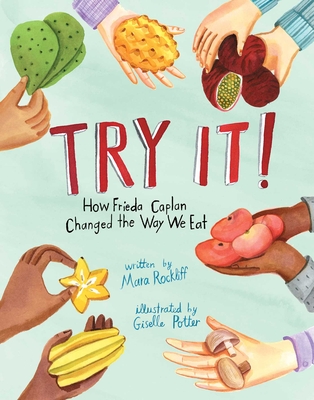
Try It!: How Frieda Caplan Changed the Way We Eat by Mara Rockliff, illustrated by Giselle Potter (9781534460072)

When Frieda Caplan started working at the Seventh Street produce market in Los Angeles, there were only potatoes, bananas, tomatoes and apples for sale. Caplan thought it might be work giving something new a try. So she started selling mushrooms. Soon she was known as the Mushroom Queen and had her own stall at the market. She became known as a person who would taste anything and started selling kiwis, jicama, blood oranges, Asian pears and much more. Over the years she introduced consumers to many new things, including seedless watermelons in 1962, horned melon in 1984, and fresh lychee in 2015. Caplan’s daughters now work with her in her produce stall, introducing finds of their own and offering their unique and informed view of what the next big thing might be.

Rockliff offers a dynamic look at the woman who changed how America eats fruits and vegetables. Her fearless approach to trying new things combined with a deep instinct about what will work for the market. Beautifully, the book focuses on Caplan herself but also richly shows the things that she introduced to American stores. Readers are sure to find new fruits and vegetables on the pages here, and perhaps be brave enough to try then when they make their way to supermarkets across the country.

Potter’s illustrations are richly colored and warm. They show Caplan in the 1950s when she started and then steadily move forward in time, nicely showing the time period through the clothing of the people. The fruits and vegetables are rainbow bright and nicely labeled with their name and the year that Caplan discovered them for the U.S. market.

Bright, intelligent and full of juicy details. Appropriate for ages 4-6.

Reviewed from copy provided by Simon & Schuster.

Nicky & Vera: A Quiet Hero of the Holocaust and the Children He Rescued by Peter Sís

Cover image

Nicky & Vera: A Quiet Hero of the Holocaust and the Children He Rescued by Peter Sís (9781324015741)

As Czechoslovakia is taken over by the Nazis in 1938, one quiet man stepped forward and saved almost 700 children. At age 29, Nicky was invited to visit Prague while on a ski trip. At the same time, Vera was growing up outside of Prague, happily adopting stray cats. They were one of the only Jewish families in the town, but that didn’t matter in their lives. The in October the German army marched into Czechoslovakia and Vera’s parents learned of a British man who was saving children. That man was Nicky. Understanding that he could do something, he worked in Prague making lists of children and finding train connections. When he returned to London, he found foster families for the children and acquire visas and tickets with his own money, sometimes needing to create his own stamps. Vera left home with 76 other children on a train. In total, 669 children reached London safely. No one heard of Nicky’s quiet work until his wife found the records. Then Nicky’s work was revealed to everyone on a popular TV show, and his life is still celebrated.

Sís has created a haunting yet also celebratory nonfiction picture book that describes the Nazi invasion of Czechoslovakia through a child’s eyes and also offers the lens of a man who realizes the potential human disaster about to occur and does something to rescue the children. The tension between the two is beautifully done, creating a deep understanding of what was at stake and the speed at which something needed to happen. The book is one that will make you actually cry, particularly towards the end when the survivors are there to thank Nicky for what he did for them. Crushingly moving.

As always Sís’s art is entirely its own style. He offers overhead maps of Vera’s small town and her life. He also shares maps of Europe and whimsical images that are almost folkloric in their storytelling. It’s a lovely mix of story, truth and heroism.

Truly remarkable, this is a picture book to read with tissues nearby. Appropriate for ages 7-10.

Reviewed from e-galley provided by Norton Young Readers.

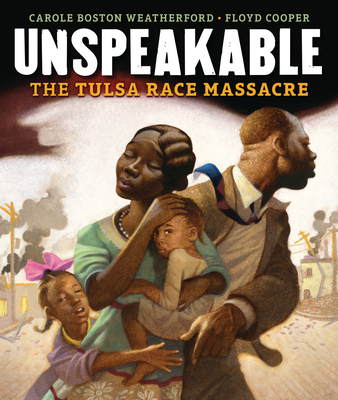
Unspeakable: The Tulsa Race Massacre by Carole Boston Weatherford

Cover image

Unspeakable: The Tulsa Race Massacre by Carole Boston Weatherford, illustrated by Floyd Cooper (9781541581203)

This nonfiction picture book offers a gripping look at one of the worst racial violence incidents in American history. In Tulsa, Oklahoma, a community called Greenwood was formed by Black people descended from Black Indians, former slaves, and those fleeing the racism of the segregated South. Along a one-mile stretch of Greenwood Avenue, over 200 Black business started, becoming known as Black Wall Street. But there were people in Tulsa who were not alright with the growth of Black wealth. In 1921, those tensions turned into action when a white teen accused a Black young man of assault. A standoff at the jail resulted in the deaths of two Black men and ten white men. The white mob stormed Greenwood, burning it to the ground. 300 Black people were killed, hundreds more injured and more than 8,000 were left homeless. The survivors were moved into camps and eventually rebuilt, but never spoke of the massacre. Today, the truth is being spoken of and addressed through reconciliation efforts.

Weatherford does an incredible job telling this terrible truth, showing the beauty and potential of the Black community in Tulsa and then sharing its eventual destruction at the hands of a mob. Weatherford has family ties to other race massacres in the United States, which led to her this, the worst incident. Her author’s note shares some photographs and more of the history. Weatherford’s initial focus on the community built in Tulsa, makes the the burning of the area all the more impactful for the reader. The tragedy’s magnitude is carefully shown in numbers and continued impact.

Cooper’s illustrations are incredible. Cooper’s grandfather grew up in Greenwood, a history that he rarely spoke about. Cooper captures the promise of Greenwood with its libraries, churches, doctor’s offices and more. He shows the hotel, the bustling streets, the children playing safely in the neighborhood. He gives history faces that look right at the reader, demanding that they see what happened.

Tragic, powerful and insistent that change happen. Appropriate for ages 7-10.

Reviewed from e-galley provided by Carolrhoda Books.

Runaway: The Daring Escape of Ona Judge by Ray Anthony Shepard

Runaway: The Daring Escape of Ona Judge by Ray Anthony Shepard, illustrated by Keith Mallett (9780374307042)

Ona Judge was a slave in the household of George and Martha Washington. While Washington worked to free the fledgling union from the British, he depending upon slaves in his household. Ona began working in slavery for Martha Washington at age 10, often playing with their grandchildren and sometimes being mistaken for one of them. The book explores the posh lifestyle that Ona lived amongst and yet was not truly part of. She was treated well, but still enslaved. When she was given to one of the granddaughters, Ona decided to escape. She chose the difficult life of a fugitive slave over than of the slavery.

Shepard uses a particularly successful structure in this picture book. He frames Ona’s story by asking repeatedly why she ran? He points out the opulence she lived in and the remarkable moments in history she saw. Shepard thoroughly explains exactly why Ona escaped, showing her being taken from her mother at a young age, being treated as more of a pet than a person, and being given to the haughty granddaughter. The structure leads to the clear answers of why she needed to escape.

Mallett’s illustrations beautifully evoke the historical period. They are filled with carriages, women’s clothing, fire places and some images of famous historical figures. It is Ona though who glows on the page, her face always lit from within and filled with the potential of freedom.

A picture book that brings the shamefulness of slavery forward, showing that everyone needs to be free. Appropriate for ages 6-8.

Reviewed from e-galley provided by Farrar, Straus & Giroux.

Sibert Medal

The Robert F. Sibert Informational Book Medal is awarded annually to the author(s) and illustrator(s) of the most distinguished informational book published in the United States in English during the preceding year. 

HONOR BOOKS

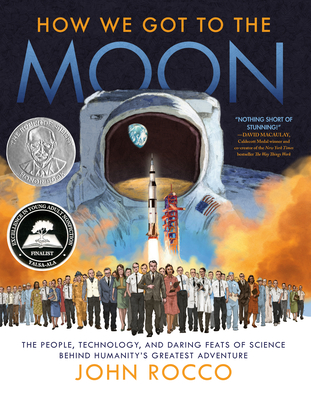
How We Got to the Moon: The People, Technology, and Daring Feats of Science Behind Humanity’s Greatest Adventure by John Rocco

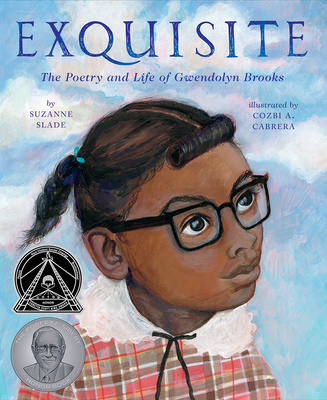
Exquisite: The Poetry and Life of Gwendolyn Brooks by Suzanne Slade, illustrated by Cozbi A. Cabrera

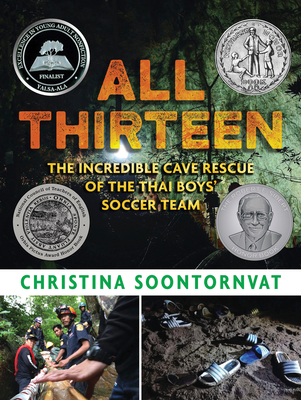
All Thirteen: The Incredible Cave Rescue of the Thai Boys' Soccer Team Cover

All Thirteen: The Incredible Cave Rescue of the Thai Boys’ Soccer Team by Christina Soontornvat

WINNER

Honeybee: The Busy Life of Apis Mellifera by Candace Fleming

YALSA Excellence in Nonfiction

YALSA’s Award for Excellence in Nonfiction honors the best nonfiction book published for young adults (ages 12-18) during a Nov. 1 – Oct. 31 publishing year.

FINALISTS

All Thirteen: The Incredible Cave Rescue of the Thai Boys' Soccer Team Cover

All Thirteen: The Incredible Cave Rescue of the Thai Boys’ Soccer Team by Christina Soontornvat

The Cat I Never Named: A True Story of Love, War, and Survival by Amra Sabic-El-Rayess and Laura L. Sullivan

How We Got to the Moon: The People, Technology, and Daring Feats of Science Behind Humanity’s Greatest Adventure by John Rocco

The Rise and Fall of Charles Lindbergh by Candace Fleming

You Call This Democracy?: How to Fix Our Government and Deliver Power to the People by Elizabeth Rusch

WINNER

The Rise and Fall of Charles Lindbergh by Candace Fleming

111 Trees by Rina Singh

Cover image for 111 Trees

111 Trees: How One Village Celebrates the Birth of Every Girl by Rina Singh, illustrated by Marianne Ferrer (9781525301209)

Part of the Citizen Kid collection, this nonfiction picture book explore the story of how one village in India came to celebrate the birth of girls. Sundar grew up walking with his mother to get water through the heat. until she is killed from a snake bite. After this, Sundar takes comfort in hugging trees, thinking of his mother. Sundar grew up and taught his children to love nature as much as he does. He works for a mining company and grows so worried about what they are doing to the local environment and their unwillingness to plant trees to help that he leaves his job. He runs for election and becomes the head of the village. When his daughter dies, he plants trees in her memory. He has an idea, declaring that every girl born in the village will be welcomed by the planting of 111 trees. Sundar is mocked for this idea that goes against customs, but he does not give up. He steadily speaks with people, convincing them of the impact they could have on the local environment by planting these trees. As the trees grow, life in the village changes. Now the women don’t have to walk long distances to get water, the fruit of the trees help feed the children and families, and girls can go to school with the boys as the gender inequality is overturned.

Singh builds her story with care, showing Sundar’s childhood with his mother and then his loss of her as the deep inspiration for his idea. She demonstrates how one man’s quest to fix the environment can make an enormous difference not just for him but for an entire community, the future of the girls that grow up there, and the quality of life for all. Singh does not lecture, instead showing how resilience and perseverance can eventually pay off. The Author’s Note at the end of the book offers more information on Sundar and the other customs that he has ended, including child marriage.

The illustrations show the changing landscape as the trees are planted. From a desert-like wasteland, the steady increase in trees transforms the landscape and the pages to lush green. The images focus on the interplay between human and nature, showing a community that even when skeptical continued to listen.

An inspiring picture book that tells the true story of one man’s quest to bring back trees and stop gender inequality. Appropriate for ages 5-7.

Reviewed from e-galley provided by Kids Can Press.

You’re Invited to a Moth Ball by Loree Griffin Burns

Cover image for You’re Invited to a Moth Ball

You’re Invited to a Moth Ball by Loree Griffin Burns, photographs by Ellen Harasimowicz (9781580896863)

Combining detailed instructions, plenty of encouragement and vivid photography, this book invites families and classes to create their own nighttime moth ball. The first steps are understanding moths and then putting together the supplies and tools you will need: including a sheet, rope, UV collecting light, and your own camera and flashlight. Prepare the screen and then also make sure you have a snack, one for the moths of course! Now you have two types of bait: light and nectar. Patience is part of the process, as more moths will come as the night gets later and darker. Take your time, be gentle, and marvel at these creatures that live all around us.

Burns offers such a merry invitation to readers in this book, making it feel like a true celebration of insects that we often take for granted or don’t even think about. Her encouragement to do research is appreciated, dedicating time in her set up of the moth ball to model reading books and learning about the creatures you are going to view. Her instructions are child-centered, creating a process that children can do themselves and participate in directly.

The photographs also center on the children managing the entire process themselves. When night falls, the magic in the photos happens as children carry their own lights, the moths arrive and the real party begins. The images of the moths themselves show their proboscis, furry bodies and amazing wings.

A grand project to immerse children and families into wildlife, insects and spending the night outside. Appropriate for ages 5-9.

Reviewed from library copy.