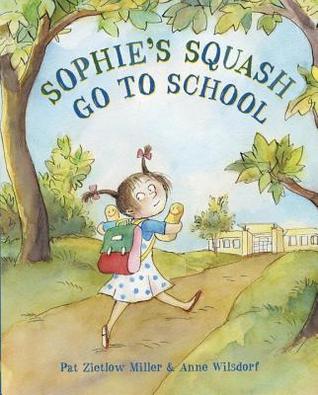
Sophie’s Squash Go to School by Pat Zietlow Miller

Sophie's Squash Go to School by Pat Zietlow Miller

Sophie’s Squash Go to School by Pat Zietlow Miller, illustrated by Anne Wilsdorf (InfoSoup)

Released June 28, 2016.

This is a wonderful sequel to one of my favorite recent picture books, Sophie’s Squash. Sophie is heading to school for the first time, bringing her best friends, her squash Bonnie and Baxter, with her. She has no interest in making new friends, because after all she already has her squash. But one kid, Steven Green, just won’t leave her alone. He sits near her, plays near her and even breathes on her. Steven wants to be friends but Sophie just won’t let him. Then as Sophie realizes that her squash friends have a limited time they can be with her, Steven comes up with a great idea to create a new friend. After all, humans make great friends too.

Miller has kept that same tone she used in the first picture book about Sophie and her squash. A large part of that is Sophie herself, who is beautifully headstrong and determined to decide what is going to happen. She rejects a lot of school from the chairs to the milk to the children around her. Readers will see children approach and try to befriend Sophie and her utter disdain for them. Then there is Steven, who won’t take even Sophie’s blunt rejections to heart. The interplay between Sophie and the other children will be familiar to readers and may help with first day jitters too.

Wilsdorf’s illustrations are done in watercolor and ink. They are bright and cheery, showing the school room in particular in all of its colorful bounty. Then there are other pages, where the circle of life and produce makes things barren and dreary, late fall gardens that reflect Sophie’s mood.

A rich and noteworthy sequel to a beloved first book, this is one to reach for as school approaches. Appropriate for ages 4-6.

Reviewed from ARC received from Schwartz & Wade.

The Sword in the Stove by Frank W. Dormer

The Sword in the Stove by Frank W Dormer

The Sword in the Stove by Frank W. Dormer (InfoSoup)

Two knights can’t find their other companion, Harold, but begin to find odd things in their stove. First it’s a sword, though one knight insists that that sword could have been put there by pirates. Then it’s a shield, which could have been put there by vikings but also might be Harold’s. When they discover Harold’s helmet in the stove as well, they really start to worry. Finally the mystery of Harold and the stove is solved, though not happily for our rather daft knights.

I must admit that I’m a fan of dark picture books. Add in wild slapstick humor that can be read aloud like Monty Python and you have my full attention and appreciation. This book merrily combines that sort of humor with a dark ending that will appeal to many children. The ending too may be dark but is also just as funny as the rest of the book, so it should not cause nightmares or problems for children. The language throughout the book is glorious with “rapscallion” and “howling aardvarks” and “gribnif” dancing across the page. Told entirely in dialogue, this picture book is great to read aloud with no pause in the action or the mystery so even squirmy audiences will appreciate this one.

Dormer’s art plays along with the slapstick feel as the two knights try to solve the mystery. The watercolor illustrations pop on the solid backgrounds, showing the imagination of the knights as well as their own dynamic with one another as one is certain that Harold left items in the stove and the other dreams up wild solutions.

Screamingly funny, this picture book would be ideal to share with a group of elementary school students who will not be worried about the dark twist and will adore the humor. Appropriate for ages 4-7.

Reviewed from copy received from Atheneum Books for Young Readers.

On Bird Hill by Jane Yolen

On Bird Hill by Jane Yolen

On Bird Hill by Jane Yolen, illustrated by Bon Marstall (InfoSoup)

A child goes walking on Bird Hill with their dog, along a shoreline and down paths. On Bird Hill there is a tree that shines with both dark and light. On the trunk is a limb with a twig. On that twig is a nest with a bird on it. Under the bird is an egg and then the chick begins to hatch. The chick hatches and stretches and looks down from the tree, sees everything around him, even the child walking away.

This is the first picture book by Yolen for a new series with Cornell Lab of Ornithology. It plays with the traditional cumulative nursery rhyme style, creating a story that builds and builds. The language is simple while the concept is complicated. It’s a story that insists upon the reader looking closely and seeing beyond the basics to what lies underneath. The book is also circular and spiraling, showing the interplay between humans and nature as one and the same. There is a real playfulness about it and also a deep seriousness that provides a dynamic tension in the book.

The illustrations are wild and whimsical. The world is similar to ours but also so different, filled with green grass, circular ponds, unique trees and interesting birds. They have an almost folksy quality to them that merges with modernism too. They depict nature’s connection to our own lives, particularly in the scene where the shell the chick has hatched from shows the house the child lives in.

A master author has created a poem that dances and lifts which is accompanied by illustrations that surprise and delight. Appropriate for ages 2-5.

Reviewed from library copy.


My Dad at the Zoo by Coralie Saudo

My Dad at the Zoo by Coralie Saudo

My Dad at the Zoo by Coralie Saudo, illustrated by Kris Di Giacomo (InfoSoup)

This is the sequel to My Dad Is Big and Strong, But… which was a wonderful French import. This second book is equally dynamic and successful, continuing the role reversal between father and child in the first book. Here, the father and son head to the zoo together, because Dad just can’t wait to go there. He has trouble waiting in line without bouncing everywhere. Then he has to go to the bathroom. He has a melt down about not having any ice cream until his son distracts him with a porcupine. Even leaving the zoo is tricky, since Dad is sure to want a toy from the souvenir shop even when his son says no.

This book like the first has a gorgeous sense of humor throughout. The dynamic between father and son is reversed completely and children will get the humor effortlessly as they see their own potential behavior play out in an adult. The humor is never mean and always zany, creating a feeling that will make everyone smile.

Di Giacomo’s illustrations add to that zany humor as the very large father figure dwarfs his son on every page. Even his interactions at the zoo are played for laughs as he poses with his arm around the flamingos. The illustrations use subtle color and a cartoon style to create their own unique feel.

A great read aloud that is just right for any family, particularly after an outing. Appropriate for ages 4-6.

Reviewed from copy received from Enchanted Lion.


I’m a Girl by Yasmeen Ismail

I'm a Girl by Yasmeen Ismail

I’m a Girl by Yasmeen Ismail (InfoSoup)

A little girl donkey keeps on getting mistaken for a boy. She knows that others think that she should be nice, but she’s “sweet and sour, not a little flower.” She rides really fast on her scooter too and people think she’s a boy as she zooms past them. She takes off her clothes down to her underwear to jump in the pool too. After each time she is mistaken for a boy, she insists over and over again that she is a girl! In the end she meets a boy who is mistaken for being a girl and the two of them rejoice in dressing and being exactly who they are.

This is a lovely and very accessible look at gender stereotypes and the children who act as themselves and against societal expectations. I appreciate the book going beyond external trappings and looking at behavior and what a child finds fun. So girls can be noisy, messy, fast and exciting. This book can be used just as a dynamic picture book about gender but it could also be used in a classroom to discuss differences and similarities and why it is good to be yourself.

The illustrations are done in watercolor that is vibrant and bright. The little blue donkey dances across the page moving at breakneck speed and clearly have a great time. The use of her beaded necklace shows the speed that she is going at and also shows that she does have some more feminine aspects to her dress as well. It’s a subtle way to speak to the mix of feminine and masculine traits that we all have.

A radiant picture book about breaking gender stereotypes, this book introduces a jolly female protagonist. Appropriate for ages 2-4.

Reviewed from ARC received from Bloomsbury.


Bring Me a Rock by Daniel Miyares

Bring Me a Rock by Daniel Miyares

Bring Me a Rock by Daniel Miyares (InfoSoup)

A demanding grasshopper wearing a crown insists that the other insects bring him a rock! Big rocks to build his pedestal so that it is suitable for a king. So the insects bring back rocks and the king accepts most of them with little grace. One though, carried by the smallest insect is not worthy of being part of his pedestal and is rejected along with the little bug who brought it. Now the grasshopper king has created a pedestal to sit high upon with all of the rocks piled one upon another. But it is not balanced and begins to tip. Luckily though, the small pebble that the little bug brought is just right to save the day.

Miyares has written this picture book entirely in dialogue and almost all of it in the imperious and demanding voice of the grasshopper. That makes for a great read aloud where storytellers can get into the character and exaggerate it for comic effect. Then the little bug also speaks and in the end equalizes the roles of all of the insects alongside the king. The end is a welcome twist where the kind is on his pedestal but so are all of the other bugs too.

The illustrations are done in watercolor and digital resulting in a book that is filled with light and lush greens. The grasshopper and the other insects are colorful against the yellow sky and greenery and the critical pebble glows white on the page, immediately showing its importance even before it is used.

Read this one aloud with plenty of energy and dynamics and it will add plenty of zing to any summer story time. Appropriate for ages 2-5.

Reviewed from copy received from Simon & Schuster Books for Young Readers.


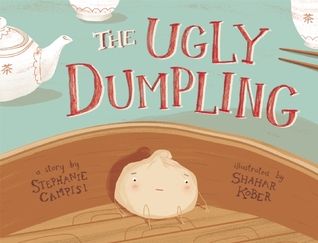
The Ugly Dumpling by Stephanie Campisi

The Ugly Dumpling by Stephanie Campisi

The Ugly Dumpling by Stephanie Campisi, illustrated by Shahar Kober (InfoSoup)

In a dim sum restaurant, one dumpling is sad because he is considered ugly. He tried to make up for it with outfits or wrinkling his brow, but he was always the one left behind and ignored.Then a cockroach came along and offered to show the Ugly Dumpling the beauty in the world. They explored the kitchen together with all of its wonders. Then the Ugly Dumpling noticed something. There were more ugly dumplings who looked just like him! He was in fact a steamed bun and fit in perfectly. The same could not be said for the cockroach though when he was revealed to all in the dining room. But by that point, the Ugly Dumpling knew just what to do.

This is a clever riff on the Ugly Duckling story that manages to tweak the story just enough to keep it fresh and new but also so that the traditional tale is still able to be seen as well. It is the character of the cockroach that makes this book really work. The addition of a friend to model self-esteem even if you are unique is crucial here and then for the tables to turn at the end of the story. The text is simple and straight-forward, making it a great book to share aloud with a strong story arc.

Kober’s illustrations are jaunty and lively.  Showing the kitchen as a kind of wonderland is magical with the towers of plates that look like skyscrapers, the woks that are almost volcanic, and the landscapes of flour. The emotions of the dumpling and other characters are done clearly and the illustrations are large enough to work with a group nicely.

A strong pick for a book to share aloud, this dynamic picture book is sure to suit everyone’s tastes. Appropriate for ages 3-6.

Reviewed from library copy.


Circle by Jeannie Baker

Circle by Jeannie Baker

Circle by Jeannie Baker (InfoSoup)

As a young boy in a wheelchair dreams of flying, a godwit takes off from the beach. The bird embarks on a journey from Australia or New Zealand to the Arctic and then back again, performing the longest unbroken migration in the world. The reader gets to see the long and arduous flight with only one stop to eat along the way. The godwit reaches the Arctic where he attracts a mate and has chicks, but not all of them survive the predators. The chick who survives is left behind by his parents to make the journey separately as the godwit returns to the air to fly back south.

The bulk of the book is on the remarkable godwit and his story of grit and resilience on his journty. Framing that story though is the story of a boy and his recovery, allowing the bird to speak to the importance of endurance and spirit as anyone is facing difficulty. The text is poetic and lush, containing evocative phrasing like “they follow an ancient, invisible pathway” and “One chick hides, crouched and still, disappearing into the colors of the land.”

Baker’s art is simply awe-inspiring. Using collages, she creates entire worlds on the page. The tundra in the Arctic has individual blades of grass that fade into mosses and lichen while the godwit tries to defend his nest against a fox. Other pages capture landmarks like the Great Barrier Reef. There are northern mountain ranges, large cities and southern beaches. The illustrations are incredible.

A noteworthy picture book, this book is filled with information on a remarkable animal accompanied by exceptional illustrations. Appropriate for ages 4-7.

Reviewed from library copy.


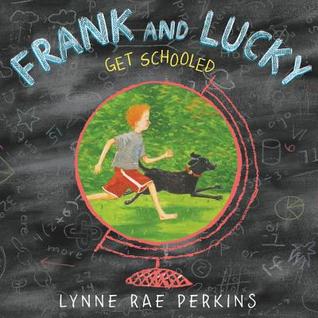
Frank and Lucky Get Schooled by Lynne Rae Perkins

Frank and Lucky Get Schooled by Lynne Rae Perkins

Frank and Lucky Get Schooled by Lynne Rae Perkins (InfoSoup)

Frank was having a horrible day until his parents took him to get a new dog at the shelter. That’s when Frank met Lucky and Lucky met Frank. They learned a lot about each other, but they also both just loved learning things. Lucky loved science, especially learning about the ducks in the pond. He also loved exploring nature, handily bringing a lot of it back with him when he returned home so that Frank could study it closely. There was math too, questions about how many dog biscuits Lucky deserved and how much hair he could shed. Dogs can even be heroes, though Lucky may not have been particularly heroic when eating the entire birthday cake. Art, languages, geography and more were studied as Lucky and Frank spend time together. There is so much to learn when on walks together!

This is an unusual picture book, one that is immensely clever and completely noteworthy. Perkins doesn’t create a linear picture book here, rather the story of a boy and his dog is specifically told in different school subjects. This makes the book a very dynamic read and offers wry insights into the perspective of both dog and human as they spend their days together outdoors. The focus is on exploration and learning, which both of them do in different but also parallel ways. There is humor throughout, intelligently speaking to the relationship of human and pet but also to learning in a larger way about life.

The art by Perkins is stellar. Done in pen, ink and watercolor, the illustrations are humorous but also delicate and realistic. With different and interesting perspectives used, each page is different from the next but also part of a cohesive whole. A dynamic mix of different sized illustrations makes the book all the more fun to read.

Children will respond to the idea of learning in life and outdoors and will also love Lucky right from the beginning. Appropriate for ages 4-7.

Reviewed from copy received from Greenwillow Books.