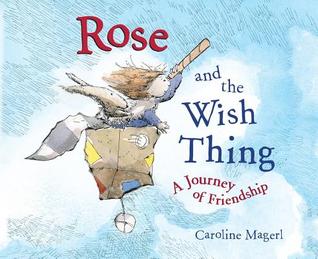
Rose and the Wish Thing by

Rose and the WIsh Thing by Caroline Magerl

Rose and the Wish Thing: A Journey of Friendship by Caroline Magerl (InfoSoup)

This gentle picture book tells the story of a girl who has moved to a new home. When she looked out her window one night, she made wish. But the wish thing did not come. Rose could not be comforted when the wish thing did not respond. Nothing worked to calm her. Her entire family searched for the wish until they came to the sea. That is when they saw the box floating on the water. In that box, was the wish thing: a thing of tiny stitches and a red glass heart. And that is what let Rose head outside of her new house and make friends.

This Australian import has a gorgeous softness to it in both images and text. The story is warm and nurturing with a large family trying to comfort Rose, a rambling house with a garden, and a big furry dog. It is also a lovely strange tale that is not straight forward, but meanders a bit, travels a lot, and finds something special along the way. Magerl’s language is noteworthy too:

The evening tide came with gentle fingers to roll over the crabs and rock the stones.

The illustrations are soft and detailed. The fine ink lines are colored with watercolors which makes them both detailed and gorgeously nuanced in color. Pages of Rose and her family are alternated with illustrations of the wish thing’s journey to Rose. There is plenty of drama along the way.

A warm and gentle look at loneliness and how it can be transformed. Appropriate for ages 3-5.

Reviewed from e-galley received from Penguin Random House and Edelweiss.
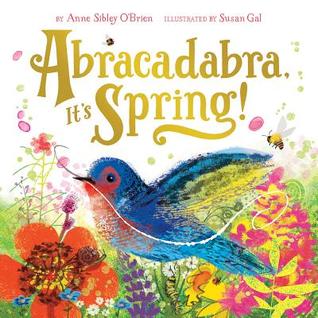
Abracadabra, It’s Spring by Anne Sibley O’Brien

Abracadabra Its Spring by Anne Sibley OBrien

Abracadabra, It’s Spring by Anne Sibley O’Brien, illustrated by Susan Gal (InfoSoup)

Through a series of large flaps, this picture book demonstrates the transformation from late winter into spring. From the very first page, snow melts away to show bare ground as rabbits watch in wonder. Green shoots become crocuses. Bare branches burst into soft pussy willows. Birds fly, nests are built, eggs hatch. Even children change their clothes and head outside into the warm day. This is a magical way to introduce small children to the wonder of seasonal change.

The gatefold flaps in this book are sturdily built and are the size of the full page, thus less likely to rip and tear. The entire book focuses on magical words, each one leading to opening the flap and revealing an amazing transformation as spring arrives. The effect works really well with the poetic wording of the book also adding to the wonder on the page. The rhyming is done well and the vocabulary while child friendly will also allow some growth for small children.

The illustrations by Gal have a gorgeous natural feel to them. They were done with charcoal and digital collage which keeps the roughness of the paper and charcoal and adds the feeling of watercolor or other paints. It’s very effective and captures the ethereal nature of spring as it passes.

Bright and engaging, this picture book will be a great pick for springtime story times. Appropriate for ages 1-3.

Reviewed from library copy.

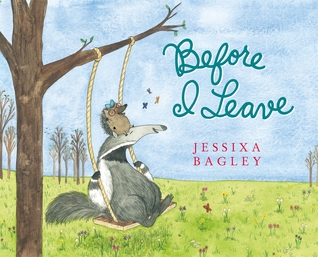
Before I Leave by Jessixa Bagley

Before I Leave by Jessixa Bagley

Before I Leave by Jessixa Bagley (InfoSoup)

The author of Boats for Papa returns with another poignant picture book. Hedgehog’s family is moving away. They are packing boxes and getting ready to leave. Hedgehog and her best friend Anteater decide to spend one last time playing together. They act as if nothing is changing at all, playing on the swings, heading out in the boat, sharing ice cream and enjoying their forts. Hedgehog is scared to leave and saying goodbye is very sad. But once she reaches her new home, Anteater is still right there in her memories.

Bagley has an incredible way with telling touching stories. Her deftness with these tender moments is all about the balance of emotion with not overplaying it into sentimentality. In this picture book, she balances the angst of moving with the idea that best friends can survive moving apart. While there is real emotion in leaving there is also a light of hope at the end that is so beautifully timed that it shines.

Bagley’s animal characters are pure bundles of personality, demonstrating emotions clearly, sometimes sulking and sad and other times bouncing in happiness. Her world is filled with color and her illustrations range from pages filled with details to smaller discreet moments. The interplay between the two work very well as the characters form memories with one another.

A lovely book about moving away from a best friend, this book handles the subject with gentleness and pure heart. Appropriate for ages 2-4.

Reviewed from copy received from Roaring Brook Press.

The Secret Subway by Shana Corey

The Secret Subway by Shana Corey

The Secret Subway by Shana Corey, illustrated by Red Nose Studio (InfoSoup)

Released March 8, 2016.

This amazing nonfiction picture book takes a look at New York in the 1860s and the lack of options for transportation on the crowded and dirty streets. Everyone knew that something needed to be done, but no one could agree on exactly what that was. Then Alfred Ely Beach had an idea to build a railroad powered by forced air. Beach knew though that he couldn’t propose to create a railroad under the streets, so instead he proposed that he’d build a tube to carry mail. Even Boss Tweed agreed with the plan. So Beach set to work creating a railroad to carry people and not mail. But it was not going to be as easy as just building the machine. He still had Boss Tweed and above ground politics to deal with!

Corey writes with great energy in this picture book. While nonfiction and historical, the book is fascinating and one immediately roots for Beach as he begins to plan and then dig under New York City. The slow digging under the earth is tantalizingly told. Then the rush of opening and the speed of the train are offered with a breathless tone and fast pace. The ending is sad but also hopeful, since everyone knows that air-driven trains are not the way subways were designed. There is a feeling of remembrance at the end, of one man’s amazing dream that led to other opportunities to tunnel under New York City.

It is always a joy to see work by Red Nose Studios. The book opens with a look at how the illustrations are done with figures made from wire and foam and then polymer clay for the faces. There is such attention to detail throughout with the gorgeous tube-shaped subway car appearing like magic. Done with serious flair for the dramatic and a great sense of style, this picture book’s illustrations are noteworthy and wonderful.

A great pick for fans of machines and inventions, this is also a book just right for dreamers of all sorts. Appropriate for ages 6-9.

Reviewed from e-galley received from Penguin Random House and Edelweiss.
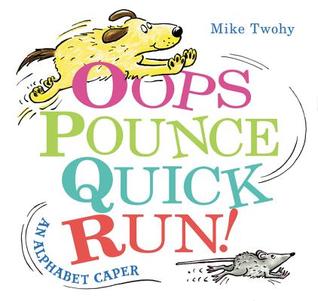
Oops, Pounce, Quick, Run! by Mike Twohy

Oops Pounce Quick Run by Mike Twohy

Oops, Pounce, Quick, Run! by Mike Twohy (InfoSoup)

This fast-paced picture book is built entirely around the alphabet with one word per page. The book starts with a mouse happily “Asleep” in his chair when in comes a “Ball.” Soon a “Dog” is poking his nose into the mouse hole and putting his “Eye” up to it to peek inside. Then the chase is on filled with jumping around the “Kitchen” and “Living room.” The mouse eventually returns the ball to the dog in a wrapped present and the two happily fall fast asleep side by side.

The appeal of this picture book is in its zany energy level that keeps the pace flying along. The chase is a merry one throughout filled with moments of slapstick comedy. It has a sort of Tom and Jerry feel to the entire book made all the more fun by the alphabetic structure of the tale. Simple and fast-paced, this book may have to be read again to slow down a bit and enjoy it.

The illustrations are just as simple as the story itself. Done in a style that will work well when shared with a group, they will project right to the back of a room. The illustrations add to the fast pace with plenty of images of running, dashing, jumping and lines that create more motion on the page.

A dynamic alphabet book that is filled with cheerful energy. Appropriate for ages 1-3.

Reviewed from library copy.

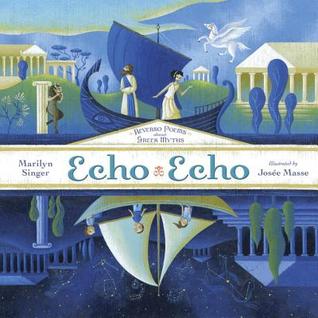
Echo Echo by Marilyn Singer

Echo Echo by Marilyn Singer

Echo Echo by Marilyn Singer, illustrated by Josée Masse  (InfoSoup)

Singer returns with another collection of her amazing reverso poems this time focusing on Greek mythology. The format which has poems which read one way read forward and another way read in reverse, looks at myths from two divergent points of view. This is particularly effective with Greek myths because they so often have two points of view embedded in them. The poems focus on myths such as Pandora’s box, King Midas, Medusa, Icarus and Narcissus. Though brief, these poems capture the essence of each myth, exposing their complexity in a few choice words and phrases.

Singer has done it again. Her amazing reverso poems must be read with care by young readers who have to pay close attention to punctuation to see the difference in meanings between the two poems. The poems are dazzling as they lay open the themes of each myth, the drama being played out in the story and the differing points of view of the main characters. This is one intelligent display of word play that is incredibly difficult to even imagine doing.

Masse’s illustrations each play upon the theme of different sides or points of view. With visual lines down the middle, the two sides both work together as a whole and show the differences between the two poems. The illustrations echo the poems closely, offering a visual feast in addition to the richness of the words.

Another winner for Singer and her reverso poetry, classrooms teaching mythology will love to have this book on hand for accessible and bite-sized looks at many myths. Appropriate for ages 6-9.

Reviewed from copy received from Dial Books.

Apples and Robins by Lucie Felix

Apples and Robins by Lucie Felix

Apples and Robins by Lucie Felix (InfoSoup)

Released March 8, 2016.

So simple and so clever, this picture book takes the wonder of shapes and page turns to a new height. Apples are made of circles and red, turn the page and the white circles on a red background transform into red apples and green leaves. A ladder appears from a stack of six rectangles and one long one. A robin flies onto the page as ovals and triangles are framed by a circle cut out. The book comes together as a birdhouse is built in the apple tree and soon robins and apples are thrown into disarray as the page turns reveal a big storm. The simple elements though return and things are set to rights once more.

There are a lot of books with cut outs on the market. Few though have this book’s flair with surprises and a sense that with each page turn there is a reveal. Even the very simple ladder somehow surprises and delights. The combination of apples and robins may not seem clear at first, but that too is revealed in a playful way as the book comes together into a cohesive whole filled with enough drama to keep those pages turning quickly.

The illustrations are simple and lovely. They use basic shapes in a compelling and creative way. As I mentioned earlier, it is the reveal that works so well here with each page turn having a sense of magic about it.

Smart and lovely, this is a brilliantly designed book. Appropriate for ages 2-4.

Reviewed from copy received from Chronicle Books.


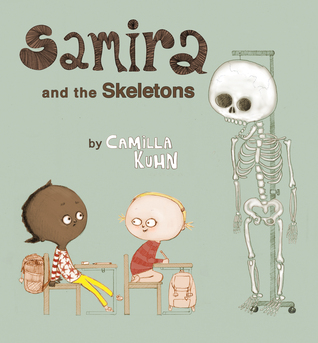
Samira and the Skeletons by Camilla Kuhn

Samira and the Skeletons by Camilla Kuhn

Samira and the Skeletons by Camilla Kuhn (InfoSoup)

Samira is having a good day, enjoying school and spending time with her best friend, Frida. But then her teacher says something perfectly horrible. She explains that inside everybody is a skeleton with a skull, ribs, spine and more. Samira is horrified and soon can’t see anyone without seeing their skeleton without skin. She starts to avoid her classmates, particularly Frida. Luckily her mother has a great plan. She offers to remove Samira’s skeleton entirely right there in the kitchen. But Samira’s skeleton doesn’t want to lay still for the operation and runs outside and off to the park where Samira’s skeleton and Frida’s skeleton run around together and soon Samira can see Frida as herself once again. Of course, there is still tomorrow’s lesson to get through…

Samira is a child with a huge imagination, one that just won’t shut off easily either when it gets an idea. The story is a refreshing one with a parent who deals with the issue in a calm and playful way, saving the day. Samira herself is complex and interesting, a girl who visualizes ideas intensely, reacts to her own imagination with zing and has no problem being entirely herself.

The illustrations are fantastic with plenty of personality and good humor. Samira is an African-American child and her best friend is Caucasian. Another very clever aspect of this story is to show that we are all the same underneath our skin. So when Samira is seeing everyone as a skeleton, suddenly there is no race in the class, just bones. It’s a subtle message that the book introduces and never belabors.

A dynamic and funny look at the intersection of science and imagination. Appropriate for ages 4-6.

Reviewed from copy received from Eerdmans Books for Young Readers.

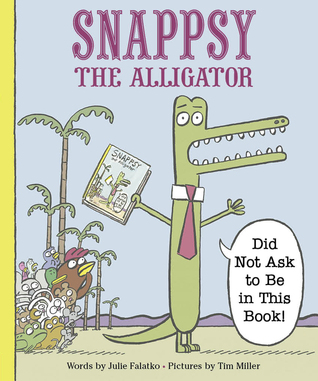
Snappsy the Alligator by Julie Falatko

Snappsy the Alligator by Julie Falatko

Snappsy the Alligator by Julie Falatko, illustrated by Tim Miller (InfoSoup)

Snappsy discovers his day taken over by a narrator in this picture book. The book begins with the narrator explaining that Snappsy was feeling “draggy” and even his skin was “baggy.” Meanwhile, Snappsy himself actually feels hungry. The narrator keeps talking about Snappsy’s every move, sometimes just describing what is happening in each image and other times adding too much drama. When Snappsy reaches the grocery store, the narrator focuses on the letter P too much. Snappsy decides to throw a party so there is something to do, and the narrator continues to cause mayhem as the story progresses.

Falatko’s writing is very funny. Her timing is wonderful, Snappsy often reacting just the way that the reader would, calling the narrator out for doing a bad job at times and other times getting snarky when the narrator has miscalled what is about to happen. The influence of the narrator’s voice on a story is shown very clearly here and is a great way to talk about the tone of writing and how that can change an entire book to read one way or another. That said, this book can also just be read for the giggles which is the perfect reason to pick up any picture book.

Miller’s illustrations have the feel of a vintage picture book, just right for this subject matter. They add to the humor from the expressions on Snappsy’s face to the homey aspects to the house that Snappsy lives in.

A smart, silly and richly funny picture book that is sure to have people laughing when it’s shared aloud. Appropriate for ages 4-6.

Reviewed from library copy.