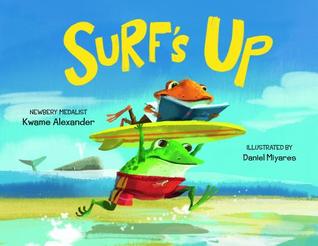
Surf’s Up by Kwame Alexander

Surfs Up by Kwame Alexander

Surf’s Up by Kwame Alexander, illustrated by Daniel Miyares (InfoSoup)

Dude comes to the window to let Bro know “Surf’s up!” But Bro is busy reading his book. Dude is shocked that Bro would prefer reading to heading to the beach. Bro comes along, still reading his book as they walk along. As they walk, he tells Dude about Moby Dick’s story and then reacts with gasps and amazement as the story continues. Bro finishes the book as they reach the beach and suddenly it is Dude who wants to read more than he wants to surf.

Told in a merry back and forth between the two frogs, this picture book is entirely in dialogue. The dialogue is wonderfully effortless, reading just like any two real people shooting the breeze, lightly teasing one another, and then enjoying the drama of a tale well told. There is a breeziness and hipness to the book as well that will appeal to modern children looking for a cool read.

Miyares’ illustrations are double-spread and cover the entire page. The world he creates wraps around the reader, much the way the story of Moby Dick encompasses both of the frogs. The drama of the story is told in a deep blue and gray palette while the frogs’ world is lighter. When both frogs are caught up in the whale tale together, that story entirely takes over the page and the frogs become characters in the book.

A dynamite and fresh book to show that everyone can get into a good book, even when the surf’s up. Appropriate for ages 4-6.

Reviewed from library copy.

The Book Itch by Vaunda Micheaux Nelson

The Book Itch by Vaunda Micheaux Nelson

The Book Itch: Freedom, Truth & Harlem’s Greatest Bookstore by Vaunda Micheaux Nelson, illustrated by R. Gregory Christie (InfoSoup)

This book is about the National Memorial African Bookstore and how it became a center for black culture in the 1960s. Told from the point of view of the son of Lewis Michaux, the owner of the store, this book looks at the figures like Malcolm X and Muhammad Ali who come to the store. It is also the story of how Michaux fought to have a store, selling books out of a pushcart at first and being denied a business loan from banks. Michaux was known for his slogans which he shouted on the street, told to his son and painted on the front of his store. The book continues through the assassination of Malcolm X. Readers must look to the note at the end to discover what happened to the store.

This nonfiction picture book speaks to the power of bookstores to inform and to keep a culture strong. One man’s vision comes to life thanks to his own determination and also the way that it spoke to others. The choice location near the Apollo Theater also helped get African-American celebrities to come to the store. The choice to have the story told from a child’s point of view was what makes this book appropriate and understandable for children.

The illustrations by Christie are filled with deep color and thick paint. They directly show the effort and intensity of determination of running a book store like this one. Some pages light with oranges and yellows while others are darkened by death.

A powerful book about an important book store and the vital need for information and books as part of a movement. Appropriate for ages 6-9.

Reviewed from library copy.

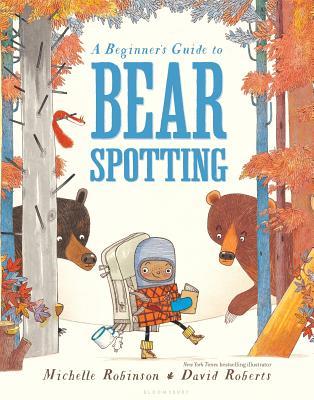
A Beginner’s Guide to Bear Spotting by Michelle Robinson

A Beginners Guide to Bear Spotting by Michelle Robinson

A Beginner’s Guide to Bear Spotting by Michelle Robinson, illustrated by David Roberts (InfoSoup)

A child heads into bear country with a helpful narrator who tries to offer needed advice in dealing with bears. First, the narrator tells the child of the two kinds of bears, but assures them that they will never see one. But then on the next page, the child is lucky enough to encounter a bear right away. And it’s apparently a black bear, not only due to its coloring but because it chases the child right up a tree. The child backs away slowly and runs right into a brown bear next. The child plays dead, but that only invites the black bear to come closer. Pepper spray doesn’t help, it just makes them hungry. But perhaps gum will be the solution! Or maybe not.

It is the interplay between the knowledgeable adult narrator and the child who manages to get into all sorts of furry trouble that makes this book such a great pick to share aloud. The bears are huge and fearsome but the book also makes sure to show that there are ways to interact with nature that leaves everyone alright in the end, if a little shaken. The book also mentions that it is not safe to really interact with bears like the child does in the book.

The illustrations are wonderful. They move from cartoon friendliness to pages of information that have a graph paper background. The use of a gender-free main character who has brown skin, makes this book all the more friendly to children from a variety of backgrounds. And the merry way that the child faces each obstacle adds to the light-hearted feel of the book.

A silly and jolly look at nature and bears that is sure to add laughter to a storytime. Appropriate for ages 3-5.

Reviewed from copy received from Bloomsbury.

The Perfect Tree by Chloe Bonfield

The Perfect Tree by Chloe Bonfield

The Perfect Tree by Chloe Bonfield (InfoSoup)

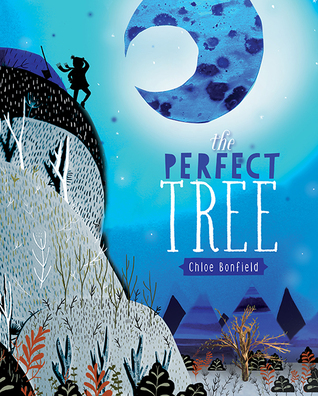
Jack headed out to find the perfect tree, one that was just right to chop down for firewood. But he was having trouble finding that perfect tree. Jack finally sat down under a tree in the forest in despair. Then a woodpecker offered to help Jack find the perfect tree. She flew to a tree and after knocking on a branch all sorts of birds flew out of it. Then a squirrel said that he too could show Jack the perfect tree. Taking Jack into a great oak tree, the squirrel revealed his stash of nuts and berries for the winter. Next a spider showed Jack her favorite tree where a web hung filled with water drops. It was then that Jack was inspired by the rain to find another perfect tree that was just right to stay dry under.

Bonfield has written an ecology picture book that focuses not on how wrong it is to cut down trees, but instead how the definition of “perfect” means different things to different creatures. And how your appreciation of an object in a new way leads to changes in the way you see the world. I appreciate that the book does not lecture about the environment or appreciating nature. Instead the book focuses on the beauty of nature and how it can transform us if we pay attention.

Bonfield’s illustrations are amazing. Done in papercut images and collage, they form two and three dimensional structures and then are lit so that there are shadows that play against other parts of the illustration that glow. The result is a picture book landscape that feels immersive and tangible.

A clever look at the pursuit of perfection and the power of nature. Appropriate for ages 4-6.

Reviewed from library copy.
 

The Wheels on the Tuk Tuk by Kabir Sehgal

The Wheels on the Tuk Tuk by Kabir Sehgal

The Wheels on the Tuk Tuk by Kabir Sehgal and Surishtha Sehgal, illustrated by Jess Golden (InfoSoup)

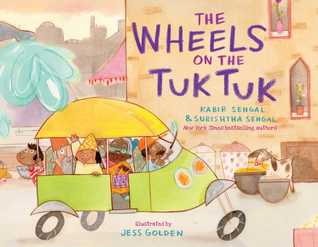
This picture book puts an Eastern Indian twist on The Wheels on the Bus rhyme. Here it’s the tuk tuk taxi’s wheels that go round and round instead. The picture book captures the hustle and bustle of a city in India with people getting on and off the tuk tuk, rupees going ching ching as payments are made, and people having to squish in together.The tuk tuk stops for cows in the road and also for a drink of chai for the driver. There are spraying elephants and then the trip ends with Diwali fireworks in the sky. It’s a merry and dynamic ride that pays homage to the original while being uniquely its own story.

It is the energy of this book that makes it so much fun. The setting is captured in small moments that make sure that readers know that they are somewhere specific and exceptional. The rhyme retains its dynamic pace with the tuk tuk filling with passengers of all ages as the book moves along the streets of India.

The illustrations in the book are bright and cheery. They show busy streets with monkeys, cows, goats and more. Good food appears like steaming chai and poppadoms and then is happily shared with one another.

A superb look at another culture through a familiar preschool rhyme, this picture book invites readers along for a ride of a different sort. Appropriate for ages 2-4.

Reviewed from library copy.

The House that Zack Built by Alison Murray

The House that Zack Built by Alison Murray

The House that Zack Built by Alison Murray (InfoSoup)

Zack built a house out of blocks outside under a tree. A fly buzzed by, the cat stalked the fly, then got more interested in the cream up high on a shelf. The dog was asleep when down fell the cream, knocked over by the cat who was still looking to catch that fly. The lambs in the field are calm and quiet, then the dog runs through still covered in cream and the sheep dash out of the field. Then Zack looks around, amazed at the mess of the farm. He jumped into action and set it all right. Then they all sat quietly and looked at the incredible house that Zack had built.

This British import is a cumulative tale that doesn’t solely stick to the traditional structure of building and building onto the length of the sentence with each new addition. Instead here it is the story itself that is the focus and the cumulative structure is used when it works and then merrily abandoned to make the storyline work better and to also make the book much more enjoyable to read. The result is a cumulative tale that will not leave you breathless or with a spinning head when shared aloud.

Murray’s art is simple and friendly. The illustrations will work well for a crowd since they are not filled with small details. Children will enjoy the cat in particular as it causes almost all of the problems that emerge.

There is a real satisfaction in this story of watching chaos happen and then having it set to rights. Appropriate for ages 2-4.

Reviewed from library copy.

Solving the Puzzle Under the Sea by Robert Burleigh

Solving the Puzzle Under the Sea by Robert Burleigh

Solving the Puzzle Under the Sea: Marie Tharp Maps the Ocean Floor by Robert Burleigh, illustrated by Raul Colón (InfoSoup)

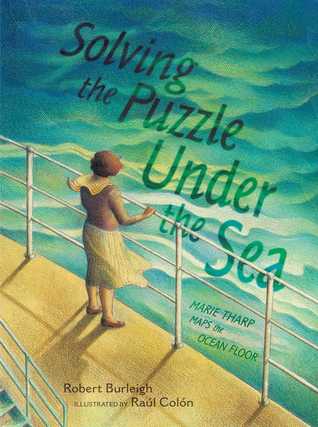
This picture book biography tells the story of Marie Tharp, a scientist who was the first to map the ocean floor. The daughter of a mapmaker, Marie grew up following her father into the field as he created his maps. In the 1940s, Marie became a scientist and looked for a place to focus her attention where she could have a new idea. Scientists were just starting to measure the ocean depths using soundings, using echoes to assess depth. Marie worked to piece all of these measurements together into a map of the ocean floor, revealing mountain ranges under water and helping prove the theory of plate tectonics as she revealed a deep narrow valley running the length of the Atlantic Ocean. Marie Tharp is one of the 20th centuries most important scientists thanks to her discoveries as she mapped the ocean floors of our planet.

Burleigh has once again captured a female scientist and the importance of her role in science and in breaking barriers. The understated drama here is nicely handled, the defensiveness of some male scientists, the way that women were not welcome on boats, and the quiet way that Tharp worked to make her own unique impact on science. As readers see the importance of perseverance in scientific discovers and the importance of resilience in the face of resistance, they will understand that these apply to their own lives as well.

Working once again with Burleigh, Colón shows in images the vital importance that mapping the ocean floor had in understanding our planet and the way that it functions. The mapping of the ocean floor offers great images from the large maps to the underwater scenes that invite readers to think about what lies unseen under the ocean.

A dynamite pick for public and school libraries, this is an opportunity to learn about an important female scientist. Appropriate for ages 7-9.

Reviewed from library copy.

Daniel Finds a Poem by Micha Archer

Daniel Finds a Poem by Micha Archer

Daniel Finds a Poem by Micha Archer (InfoSoup)

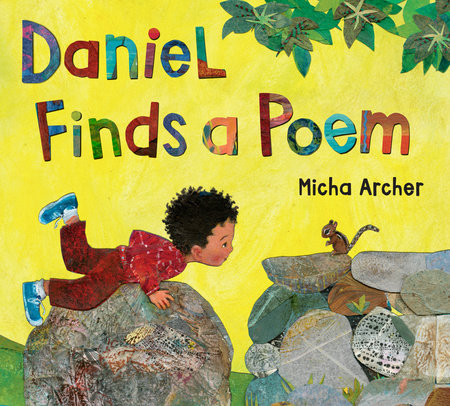
When Daniel discovers that there will be Poetry in the Park on Sunday, he begins to wonder what poetry is. The friends he has made in nature help him start to understand it. Spider says that poetry is “morning dew when it glistens.” For Squirrel, it is “when crisp leaves crunch.” Frog sees it as “a cool pool to dive into.” Owl has many ideas about stars, moonlight and her own silent wings. As Daniel listens to all of the creatures, he realizes that he has created a poem, one that lets him see poetry everywhere just as they do.

Archer’s look at poetry is delightful. She shows poetry connected to each creature’s life, each animal having its own unique way of viewing the world and then turning it into something poetic and special. Young readers will understand poetry just as Daniel does, piece by piece, symbol by symbol in an organic and natural way. While Daniel’s poetry at the end is lovely, I really enjoyed that the book had one final moment where Daniel finds his own personal piece of poetry.

Archer’s illustrations are exceptional. Using a layered technique that involves paint, hand-made block prints, and collage, the illustrations are rich and detailed. They have deep colors that sing on the page and a complexity in texture that is particularly pleasing.

A lush and striking book about poetry and its power in everyone’s life. Appropriate for ages 3-5.

Reviewed from ARC received from Nancy Paulsen Books.

Where My Feet Go by Birgitta Sif

Where My Feet Go by Birgitta Sif

Where My Feet Go by Birgitta Sif

Follow the activities of a young panda and his feet as he goes through his day. First, in the morning his feet go into yellow boots and head outside. He pretends he is walking through a jungle (actually a garden), climbing a high mountain, splashing in the ocean, and crossing a dangerous bridge. In the afternoon, his feet help feed the dinosaurs (birds), swing high in the sky, and cross a sandy desert. At night, his feet explore underwater in his bath and shoot into the sky like the stars as he listens to a bedtime story. Where do your feet go?

This picture book is told by the little panda in first person, aiding in the use of imagination throughout the book. Children will recognize their own daydreams and moments of pretend as the panda goes through his day. The book is simple and playful, inviting children to see what their own feet are up to that day.

The illustrations are hand-drawn with pencil and then digitally colored. They are filled with bright colors like the yellow boots. At the same time, they are subtle too with some parts that read as watercolors particularly in the sky. Filled with shadows to add depth, the entire book has a very unique feel.

Something special is afoot with this picture book that is sure to give children some kicks. Appropriate for ages 2-4.

Reviewed from digital galley received from Penguin Random House and Edelweiss.