Big Friends by Linda Sarah

Big Friends by Linda Sarah

Big Friends by Linda Sarah, illustrated by Benji Davies (InfoSoup)

Birt and Etho are best friends. They love to spend time together up on Sudden HIll with their big cardboard boxes playing pretend. They imagine that they kings or pirates. They run and leap, sail and fly. They can be loud or quiet together. But then one cold day, Shu brings his box up the hill and asks to join them. Etho agrees to let Shu play, but the more he joins them the more left out Birt feels. Then one night, Birt smashes his box and stops going up Sudden Hill anymore. Is there any way to fix their friendship? Maybe with some boxes and a lot of imagination!

Sarah captures the feeling of a friendship hitting a snag with great precision and care. She crafts the story so that readers will feel Birt’s sudden isolation, the way that the easy play of two children falls apart when joined by a third. Sarah uses symbolism too, particularly when Shu appears. It is a “cramping cold” day that day, foreshadowing the emotions that Birt will feel. As they play as a threesome that first day, they watch “one kestrel and two lost clouds.” This lovely writing is striking and conveys emotions so clearly.

The illustrations by Davies create an entire world for the children. There is the beauty of Sudden Hill filled with flowers and grass combined with the joy of big boxes for play. Then as the story changes, the illustrations convey Birt’s emotions. The sky turns dark and sullen. There are lonely moments back at home where he is isolated and shut in. And finally, the exultant joy at finding a way to be together again.

A lovely book about the perils and possibilities of friendship. Appropriate for ages 3-5.

Reviewed from library copy.

Beatrix Potter and the Unfortunate Tale of a Borrowed Guinea Pig by Deborah Hopkinson

Beatrix Potter and the Unfortunate Tale of a Borrowed Guinea Pig by Deborah Hopkinson

Beatrix Potter and the Unfortunate Tale of a Borrowed Guinea Pig by Deborah Hopkinson, illustrated by Charlotte Voake (InfoSoup)

Published to celebrate the 150th anniversary of Potter’s birth, this picture book tells the true story of an event in Potter’s childhood. Beatrix loved animals from a very young age. In fact, she and her brother had quite a collection of animals over the years from a family of snails to rabbits trained to walk on a leash. Beatrix also loved to draw and paint her animals. One day, she wanted to paint a guinea pig so she borrowed one from a neighbor. The guinea was a magnificent specimen named Queen Elizabeth. Beatrix promised to return Queen Elizabeth the next morning “unharmed.” Unfortunately though, she would not be able to keep that promise!

Hopkinson adopts a wonderfully wry tone throughout this picture book where readers know that something horrible is going to befall Queen Elizabeth. There is lovely foreshadowing from the title but also from the demise of other creatures in Beatrix’s care, including the family of snails who simply dried out and lizards eaten by birds. The pacing here is delicately balanced, allowing plenty of time for the dread to creep in as Beatrix takes the guinea pig home.

Voake’s illustrations are done in pen and watercolor, showing the world of Victorian England as well as the myriad pets owned by the Potter family. Voake includes parts of Potter’s own diaries in the illustrations, showing her detailed look at her pets and also illuminating how some of them died.

This picture book offers a humorous look at young Beatrix Potter who would become known for her images of animals living through what many children do when they care for others pets or even their own. Appropriate for ages 4-6.

Reviewed from copy received from Schwartz & Wade.

My Dog’s a Chicken by Susan McElroy Montanari

My Dogs a Chicken by Susan McElroy Montanari

My Dog’s a Chicken by Susan McElroy Montanari and Anne Wilsdorf (InfoSoup)

Lula Mae really wants a puppy, but her mother tells her that times are hard and she will just have to make do. So Lula Mae takes a look around and decides that maybe a chicken could be a good dog. She finds the most likely chicken, one that is confident, and grabs it. She names the “dog” Pookie and puts a hair ribbon on its head. Her mother insists that whatever Lula Mae calls it, she’s not to bring it into the house. Soon Pookie is starting to act like a dog. She shepherds the other chickens around. She acts like a guard dog when Cousin Tater threatens Lula Mae and the baby with a garter snake. Pookie even manages to perform a search and rescue when Baby Berry goes missing.

This fanciful picture book is brimming with down home warmth. The book’s premise is wonderfully quirky, the substitution of a chicken for a dog. Readers will expect it to go very badly, but this book takes a more positive spin. Even as Pookie starts to act like a dog, she is still clearly a chicken reacting the way a chicken would in that situation. The humans interpret it differently, adding to the fun of the entire story.

Wilsdorf’s illustrations are done in watercolor and ink. They are filled with bright colors and show a vibrant rural lifestyle filled with chickens, woodpiles, and crops. Some of the illustrations show the paths of people (and chickens) running around and convey the panic of trying to find Baby Berry. Sharp-eyed children will spot him by following Pookie’s path.

Funny and entirely individual, this picture book is about making do and following your own heart. Appropriate for ages 4-6.

Reviewed from digital galley received from Penguin Random House and Edelweiss.

Bringing the Outside In by Mary McKenna Siddals

Bringing the Outside In by Mary McKenna Siddals

Bringing the Outside In by Mary McKenna Siddals, illustrated by Patrice Barton (InfoSoup)

This picture book invites children to head outside and play in every season. The book begins in spring with children outside carrying umbrellas and jumping in puddles. They play with worms and get good and muddy. Then they head inside to dry off, dump out their boots, and mop up. Summer comes next with sand, water and shells. They carry it back inside with them too as they wash up from all of the sunshine. Autumn is next with apples and leaves that need to be picked off and raked up. Finally, there is winter with snow and ice that can be carried in and the children thawed out before a fire.

This is truly a celebration of playing outdoors. Each season begins with the line “We’re bringing the outside in, oh, bringing the outside in…” When the children head inside the line is repeated and readers can see how parts of being outside are actually brought inside with the children. The book ends with a collection of items saved from their year outside and slightly older children wanting to look through all of their treasures together.

The illustrations show such joy from the children as they spend time together outside. Grins spread ear-to-ear on their faces as they fly kites, stomp in puddles, jump in leaves and sled in snow. This book is pure warmth too, as children dry off, warm up and come back inside happily as well.

A book that shows the pleasure of being out of doors, this picture book should lead to a great ramble outside. Appropriate for ages 2-4.

Reviewed from digital galley received from Penguin Random House and Edelweiss.

I Hear a Pickle by Rachel Isadora

I Hear a Pickle by Rachel Isadora

I Hear a Pickle (and Smell, See, Touch, and Taste It, Too!) by Rachel Isadora (InfoSoup)

A book about your senses, this picture book invites the youngest of children to think about their senses and the many ways they use them in life. Starting with hearing, the book offers examples of different things that children may hear in their day like birds, bees and waves. There are also things you can’t hear, like worms. There are loud and soft noises too. Smelling has good smells like soap and bad smells like sneakers and baby diapers. Sight offers light and dark, the joy of wearing glasses to help you see, and the fun of reading. Touch has animals and rain, but also things not to touch like hot stoves or electric plugs. Taste is filled with foods, even ones like spinach that you may not want to eat at first. And then it all comes together in one crunchy pickle in the end.

Isadora uses small pictures on the page to show all sorts of interactions with the world. Children will enjoy seeing the things that they have done and then will want to talk about other ideas they have of things they have experienced with their senses. This is a book that starts a conversation with small children. Are there other things that are crunchy to eat? Other things that are dangerous to touch? Other things that you can’t hear at all? This book invites that sort of exploration of the child’s own world.

A joyous exploration of all of your senses that will have toddlers listening hard. Appropriate for ages 2-4.

Reviewed from library copy.

Bear Is Not Tired by Ciara Gavin

Bear Is Not Tired by Ciara Gavin

Bear Is Not Tired by Ciara Gavin (InfoSoup)

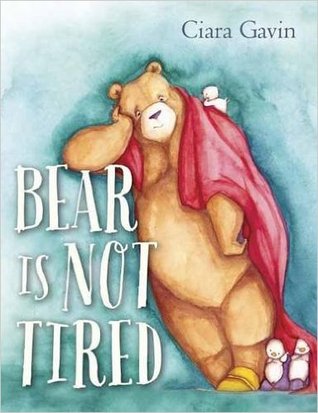
This is the second book featuring Bear and his adopted family of ducks. In the first book, the bear and ducks had to figure out a home that worked for all of them. In this follow up, bear is getting steadily more and more sleepy as winter approaches. But ducks don’t hibernate and Bear worried about missing out on things throughout an entire season. So Bear decided not to sleep, but the ducks started to notice that Bear was acting differently. Bear tried and tried to stay awake, but nothing seemed to work. Finally Mama Duck pulled Bear aside and promised that if he slept through the winter, he would not miss a thing. And it was true!

Gavin has written another winning picture book about the unusual pairing of a family of ducks and a solitary bear. Here the story focuses on Bear and his unique need to sleep through the cold months. It’s a story that will speak to families who have people who respond differently to things, who like different activities, but still want to be with one another. Perhaps the ducks’ ways of including Bear in everything despite him being asleep will inspire new ways of thinking for human families to stay close even when they are doing different things.

Gavin’s art work has a lovely gauzy quality to it, giving Bear his huge softness. Meanwhile the little ducks are done in firmer lines. All of them have personalities that brighten the page and enhance the story. The little ducks are all characters, and it is clear through their body language alone how much all of the animals love one another.

A lovely winter read, perfect for curling up on a cozy couch or snuggled at bedtime. Appropriate for ages 3-5.

Reviewed from library copy.

A Big Surprise for Little Card by Charise Mericle Harper

A Big Surprise for Little Card by Charise Mericle Harper

A Big Surprise for Little Card by Charise Mericle Harper (InfoSoup)

Released February 9, 2016.

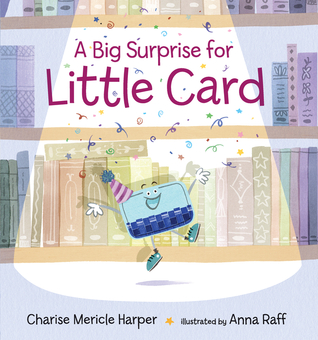
Every card has a special grown up job, except for Little Card and Long Card. There were cards who were price tags, others were office folders, others were postcards. So the two cards waited for their special letter to arrive. But on the day the letter arrived, the two cards collided and cards went everywhere. Little Card picked up a letter and read that he was going to be a birthday card! He got lots of training and found that he loved everything about being a birthday card. But one day when he got home, Long Card was there and told him there had been a mix up. She was the birthday card and he was a different type of card. It was too late to be trained again, so Little Card was sent off immediately to work at the library as a library card. He tried to use his birthday card training at his new job, but his loud singing wasn’t welcome. Little Card soon learned though what special things were available at the library and was thrilled in the end to know that he could be at the library more than once a year!

This clever take on libraries and having a library card is very nicely structured. The exuberance of Little Card makes the book read aloud well. Children will enjoy the pleasure of the birthday card part of the book, the loud singing, the cake, and the balloons. One might think that that would overshadow the more quiet library portion of the book, but the author made sure to make the library part just as appealing, so the result is that libraries are shown as being just as much fun and just as joyous as a birthday party. Hurrah!

The illustrations of the book are just as fun and buoyant as the story itself. Done in ink washes, pencil, pen and ink, and stamps, they were also colored digitally. They have a nice simplicity to them that will make this book easy to share with groups. The sprightly Little Card dances (literally) across the page and invites children to have a great time with the book and at the library.

A jaunty picture book about libraries, this book will be welcome for library tour groups as well as for introducing children to libraries as a place of fun. Appropriate for ages 3-5.

Reviewed from ARC received from Candlewick Press.

ABC Dream by Kim Krans

ABC Dream by Kim Krans

ABC Dream by Kim Krans (InfoSoup)

This wordless alphabet book is a wonderful mix of concept book and also guessing game. Each double-page spread is dedicated to one letter and filled with natural elements that demonstrate that letter being used. The detailed illustrations invite readers to look closely and explore what other items they can spot that start with that letter. Nicely, the book ends with a list for each letter so adults can help make sure all of the details are noticed. This alphabet book is a unique and wondrous book that invites whimsical dreaming even as young ones learn their alphabet.

The illustrations are the entirety of this book. They are a gorgeous mix of pen and ink fine lines and watercolor washes. This combines black and white detail with touches of color that enliven the pages. Each illustration is its own fine composition with colors that complement one another and invite you to lean in and look even closer.

One of the more unique alphabet books around, this picture book will delight adults and children alike. Appropriate for ages 2-4.

Reviewed from copy received from Random House Books for Young Readers.

Whatever Happened to My Sister by Simona Ciraolo

Whatever Happened to My Sister by Simona Ciraolo

Whatever Happened to My Sister by Simona Ciraolo (InfoSoup)

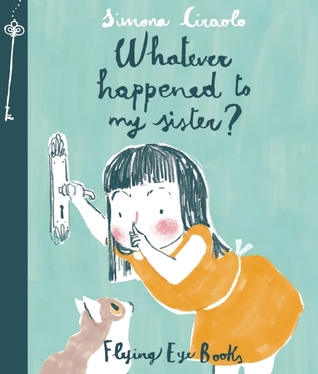
A little girl knows that something strange is happening to her older sister. She has gotten a lot taller lately and never wants to play any more. She doesn’t like pretty things and has become very secretive. She spends a lot of time in her room alone with the door shut. The little girl tries to seek out advice from her sister’s friends, but they all seem to be acting in a similar way. Her mom and dad are no help at all either. Then the little girl realizes that she misses her big sister so much and the way they used to be together. But maybe someone else feels that way sometimes too.

Ciraolo has created a funny and shining look at the transition from childhood to being a teenager. Told from the first-person perspective of the younger sister, the book reflects her confusion about the changes she sees in her older sister. Any child living with a tween or teen will relate to this book, laugh at the teens with their earbuds in, and also share in the feeling of being left behind. Throughout, Ciraolo honors the emotions of the child with a real tenderness.

The art is modern and dynamic with playful colors that surprise with some page turns. They beautifully convey the emotions, pages with loneliness are filled with gray while moments of connection are a glowing orange that jumps off the page.

A strong book about a moment in life that can be painful to process, this book shows how growing up can also be done side-by-side. Appropriate for ages 4-6.

Reviewed from copy received from Flying Eye Books.