Glow by W.H. Beck

Glow by WH Beck

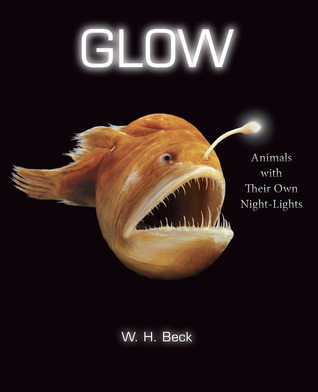
Glow: Animals with Their Own Night-Lights by W. H. Beck (InfoSoup)

This nonfiction picture book invites young readers to explore the world of bioluminescence. Set against black backgrounds these glowing creatures pop on the page. The book not only shows different organisms that glow, but also explains why they glow too. Children will learn the terms for the chemicals that allow the light to be created and also see that there are some creatures who glow but no one knows quite why. Filled with dazzling photographs, this is a book that will fly off the shelves of public libraries as kids are hooked by the fish on the cover.

Beck has the book written at two levels. The larger font offers a less specific look at the organisms themselves and therefore a simpler experience. The smaller font allows readers to learn more about each creature. More information on each is also found at the end of the book where size, Latin name, and the depth they live at is given for each. This is a book that is engaging and fascinating. The text is restrained and focused, offering enough information to appeal but never standing in the way of the dazzling creatures themselves.

The photographs in the book are exceptional. Each shows the light of the creature against a black background, allowing that creature attention by the reader. The photos were taken by several different photographers, yet they make for a cohesive book thanks to their similar nature and the beauty they depict. I particularly enjoyed the firefly photo and the glowing shoreline.

An awesome book that is sure to appeal to children who enjoy nature and bizarre creatures, this is a winning science book for public libraries. Appropriate for ages 4-7.

Reviewed from copy received from HMH Books for Young Readers.

Frankencrayon by Michael Hall

Frankencrayon by Michael Hall

Frankencrayon by Michael Hall (InfoSoup)

This picture book has been cancelled. The crayons in the story are saddened that the picture book won’t be happening. After all, they have costumes and were going to tell an amazing story. But now that someone is actually reading the cancelled story, they may as well tell the reader exactly why the picture book has ended. It is all because of the horrible scribble that suddenly interrupted the story. They tried to clean the page, but the scribble just got larger and larger. It was out of control and everyone was so disturbed by it that they forgot to tell Frankencrayon that something was wrong. So when the crayons playing him entered on Page 22, they ran right into the scribble. It would take some quick thinking and fast action to save the story.

Hall has such a playful approach to picture books that one never quite knows what sort of story they are heading into. This book is great fun from the set up of the “cancellation” to the crayons in costumes. It is clever and humorous with exactly the sort of humor that preschoolers adore. Children will not be scared by anything here thanks to the use of crayons and the horror being a scribble on the page. This one reads aloud beautifully, filled with voices of the pencil, the crayons, and even one evil scribbler.

The cut paper collage pops on each page, the crayons bright with their colors and delightful in their different sizes after clearly having been merrily colored with for some time. The pointy pencil too somehow has its own personality. The solution that Frankencrayon comes up with is exactly what children would think of and adds to the visual appeal of the book.

This funny picture book is perfect to share aloud with a group of preschoolers who may love to do their own transformations of scribbles into something more friendly. Appropriate for ages 3-5.

Reviewed from copy received from Greenwillow Books.

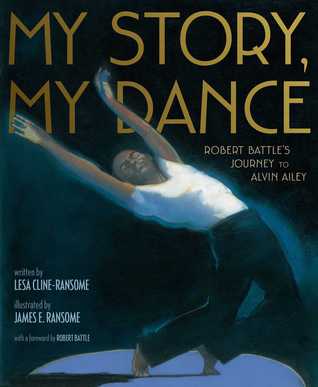
My Story, My Dance by Lesa Cline-Ransome

My Story My Dance by Lesa Cline Ransome

My Story, My Dance: Robert Battle’s Journey to Alvin Ailey by Lesa Cline-Ransome, illustrated by James E. Ransome (InfoSoup)

Starting from his birth through his rise to Artistic Director at the Alvin Ailey American Dance Theater, this picture book celebrates Robert Battle’s life. Born with bowed legs, he was taken in by his aunt and uncle and then raised by his cousin Dessie. It was with Dessie that he discovered a love of music and words. He sang in the church choir and after he got his leg braces off, he began to take karate. At age 13, he started dance late in life for a dancer. Soon Robert was noticed by his high school dance instructor and then auditioned for The New World School of Arts. As he grew, he got to see the Alvin Ailey dance troupe perform and was awed by them. Moving to New York City to attend Julliard, his dancing reached another level and progressively he moved to work with Alvin Ailey. This story of talent and determination celebrates dance and the power it has to communicate.

The prose by Cline-Ransome is spry and fast moving. She shows the importance of family in Robert’s upbringing, even if his mother was not in the picture. The theme of the warmth of family plays throughout the book, from the early pages to the very end where Robert Battle is speaking to the Alvin Ailey audience. The author makes sure to not only talk about the facts of Battle’s life but also shows how his early disability and his willingness to work exceedingly hard played into his later success.

Ransome has done the illustrations in this picture book biography in pastels. The rich colors are gorgeous on the page. He uses them to show the richness of Battle’s life and then when the book shows the movement of dance, he uses them to create the moves from one position to another fluidly across the page in a rainbow of sketches.

A lovely biography on a contemporary figure in American and African-American dance, this picture book is rich and powerful. Appropriate for ages 6-8.

Reviewed from copy received from Simon & Schuster Books for Young Readers.


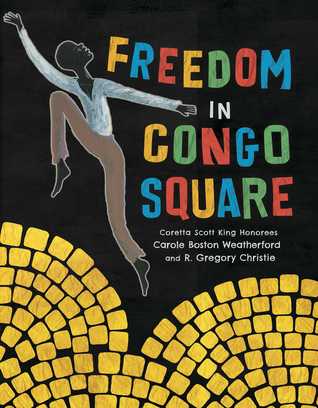
Freedom in Congo Square by Carole Boston Weatherford

Freedom in Congo Square by Carole Boston Weatherford

Freedom in Congo Square by Carole Boston Weatherford, illustrated by R. Gregory Christie (InfoSoup)

A lovely mix of poetry and nonfiction, this picture book takes a serious look at slavery and the unique situation in New Orleans. In New Orleans, Congo Square was the one place where slaves were allowed to congregate once a week on Sundays. The book counts down to Sunday, each day filled with brutal work and the harrowing harshness of slavery. As Sunday approaches, one can feel spirits looking forward to it. When it finally arrived, slaves and free blacks congregated together, able to celebrate the songs and society of the African homes they were stolen from.

This book is carefully framed and placed in history with a combination of a foreward by historian Freddi Williams Evans and an Author’s Note placed at the end of the book. In both places, Congo Square is explained in detail. The real magic though happens with Weatherford’s poetry. It has a rhythm to it, a structure that is almost musical. The text is deceptively simple as it speaks to the depth of human heart even in the face of slavery and the importance of having a place to congregate like Congo Square.

Christie’s illustrations are incredible. They evoke primitive art with the lengthened and stylized people done in deep black. The pages are filled with bright colors that may seem merry, but then they are filled with slaves doing hard work. They also have twisted black trees in the outside scenes, the tortured branches speaking to witnessed horrors.

An important nonfiction picture book that has poetry that sings in mourning about slavery but also sings of the beauty of the strength of the human spirit too. Appropriate for ages 7-9.

Reviewed from copy received from Little Bee Books.

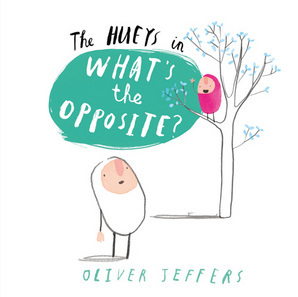
The Hueys in What’s the Opposite? by Oliver Jeffers

The Hueys in Whats the Opposite by Oliver Jeffers

The Hueys in What’s the Opposite by Oliver Jeffers (InfoSoup)

The Hueys are back with another book, this one focused on opposites. One Huey starts by asking another what the opposite of beginning is, but that stumps the other one. So they move on to easier opposites like here and there, up and down, yes and no. Each of the opposites is acted out by the characters with lots of humorous touches that make the book a delight to read and share. As always, the Hueys have exactly the right tone for a preschool crowd, this time making the concept of opposites great fun to learn.

Jeffers has a real gift for quiet humor that is shown mostly in the illustrations while the text stays focused and matter of fact. Sharing this aloud is not about just reading the text, but also exploring the illustrations together to make sure that you don’t miss the smashed cup of tea when the cat is gotten down from the tree (by sawing it down). At times the text gets in on the fun too, like when the Huey caught on a desert island is unlucky at first, then lucky and then sadly, unlucky once again.

Children will enjoy that the opposites get more complex at the end of the book. A discussion of whether a glass is half full or half empty should lead to everyone joining the Huey with his hurting head. The end of the book adds to the merriment finally answering the original question of the opposite of beginning.

A real joy to read and share, this picture book will appeal to both existing Huey fans and will also earn new ones. Appropriate for ages 3-5.

Reviewed from copy received from Philomel Books.

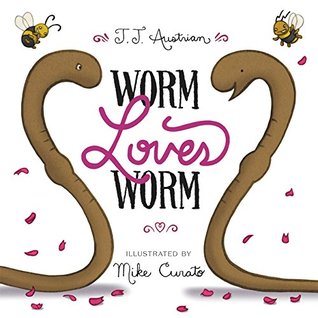
Worm Loves Worm by J.J. Austrian

Worm Loves Worm by JJ Austrian

Worm Loves Worm by JJ Austrian, illustrated by Mike Curato (InfoSoup)

Two worms have fallen in love and decide to get married. They get lots of advice from other insects. Cricket offers to marry them. Beetle insists on being the “best beetle.” The Bees want to be the bride’s bees. Cricket tells them that they need rings for their fingers, but they don’t have fingers so they wear the rings as belts. There has to be a band and a dance even though the worms don’t dance, they just wiggle. Then come the clothes and the cake. But which worm is the bride and which is the groom?

Austrian has created a completely fabulous picture book. What starts as a look at weddings and marriage broadens to become about the ability to marry whomever we love. By the end, the gender of either worm stays completely ambiguous and all that matters is that they can be married to one another because they love each other. The message is simple and creatively shown. The gender-free worms are a perfect pick for the main characters, offering lots of personality without committing to either gender.

Curato’s illustrations are wonderfully jolly. They capture the rather sanctimonious Cricket and the stuffy beetle with their conservative dress and attitudes. The merry bees are more friendly, but also help insist on a bride and groom. The worms themselves contrast with the others in their plainness and joy in one another. While they are unruffled by the rules of being married, their take on love wins in the end.

A celebration of the freedom to marry, this picture book is sure to cause a new stir among the same crowd bothered by And Tango Makes Three. Enjoy! Appropriate for ages 3-5.

Reviewed from copy received from Balzer + Bray.

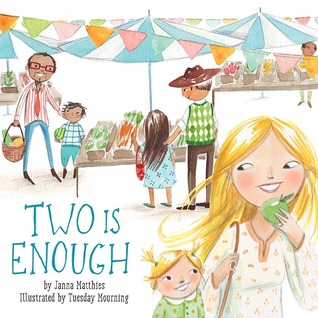
Two Is Enough by Janna Matthies

KidsLogoORIGINALFILE

Two Is Enough by Janna Matthies, illustrated by Tuesday Mourning (InfoSoup)

This picture book shows how one-parent families thrive with lots of attention to the child. It speaks to two being a great number, just right for snowball fights and ice skating. Two is perfect in spring too when planting seeds or picking bouquets. In the summer, two is just right for ice cream cones, building sand castles, and riding tandem bikes. When fall arrives, two is right for playing in leaves, carving pumpkins and marshmallow roasts. Two is just right the whole year long.

Matthies has written a bouncy rhyme here that lends a lot of dash to this picture book. The rhyme bounds along, encouraging children in one-parent families to see themselves as having something entire special. The book can also offer encouragement for children who have a parent who is away often too. As Matthies runs through the seasons and the joy of doing things with one another, she makes sure to show how two people can have a great time doing all of the things you may see as group activities. In fact, they are all the more special when done one-on-one.

Mourning offers a multicultural look at these families as well. Parents of different races appear throughout the book with three families forming the heart of the story. There are mothers with a child and fathers with a child. Grandparents also make an appearance, taking care of grandchildren in much the same way.

This engaging picture book offers a cheery look at small families and the joy that they bring throughout the seasons. Appropriate for ages 2-4.

Reviewed from library copy.


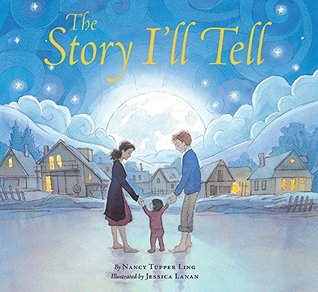
The Story I’ll Tell by Nancy Tupper Ling

The Story Ill Tell by Nancy Tupper Ling

The Story I’ll Tell by Nancy Tupper Ling, illustrated by Jessica Lanan (InfoSoup)

An adoptive mother knows that her son will eventually ask her where he came from. She dreams of what she will tell him. Perhaps that he floated down from a hot-air balloon. Or that he was delivered by horseback by a man in a cape. Or that she found him in the garden among the tiger lilies. Or that she rescued him from a dragon queen. But the story of where he really came from is special enough, filled with joy and tears, with winged flight over the ocean. That is the story to tell.

Each of the stories that the boy’s mother creates contains a touch of truth. Throughout there is a tie to China, there is flight, crossing long distances, and a story of rescue. This imaginative look at the power of international adoption and the formation of a family is endearing and magical. The stories create a beautiful rhythm among themselves, dancing and weaving a tale that invites children to see their adoption as something particularly special.

Lanan’s art evokes that same special magical feel. Throughout the book, there are creatures in the clouds, dragons rising into the sun, roosters summoning dawn. Each shows a future part of the story, the tiger lilies gracing the garden gate long before they are mentioned in the book. Fish float on walls, ribbons tie each experience to the next. It is a rich tapestry of illustration filled with Chinese symbols.

A gem of a book for adoptive families, this picture book conveys the joy of adoption and the wonder of finding one another and forming a family. Appropriate for ages 4-6.

Reviewed from e-galley received from Lee & Low Books and Edelweiss.

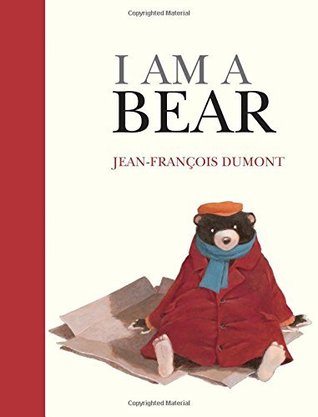
I Am a Bear by Jean-Francois Dumont

I Am a Bear by Jean Francois Dumont

I Am a Bear by Jean-Francois Dumont (InfoSoup)

Told in the first person, this is a story of a bear who finds himself living on the streets of a city. He has a stack of cardboard boxes that make up his home. He isn’t welcome in any of the stores, and finds it safer to scrounge for food after dark. That means that he sleeps most of the day. He had tried to talk with people, but he scared them since he’s such a big bear. He gave up after awhile, paying no attention to those walking past him anymore. Until one day, a little girl notices him and talks directly to him. She returns the next day too and the bear has made an effort to clean up himself and his home. She calls him a teddy bear and visits again and again. Suddenly the bear has something to look forward to each day, and there is hope.

Dumont is the author of The Chickens Build a Wall and the series of silly books that follow it. This book though is a departure from that frenetic cheery tone. Here there is darkness, hunger and need. Here there is a bear who clearly is not actually a bear, but treated as such by society. It does not matter if young readers realize that the bear is a symbol. The story works much the same with a real bear or a real person. The life is hard, the city stark, and hope nonexistent, at first.

The art here is lush and lovely. It shows life on the street both from the bear’s point of view and also from that of an observer like the little girl. The buildings lean and tower above, the traffic is dangerous and close, and the alley is like a canyon. With sharp angles, the perils of life on the street are evident here as appropriate for a child.

A book that will help talk about homelessness and that offers a way forward, kindness. Appropriate for ages 3-5.

Reviewed from copy received from Eerdmans Books for Young Readers.