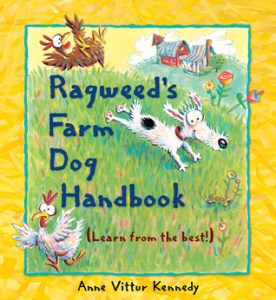
Review: Ragweed’s Farm Dog Handbook by Anne Vittur Kennedy

Ragweed's Farm Dog Handbook by Anne Vittur Kennedy

Ragweed’s Farm Dog Handbook by Anne Vittur Kennedy (InfoSoup)

Ragweed is an experience farm dog and he is willing to offer the reader his advice on how to be the best farm dog. First thing to know is not to wake the farmer in the early morning. That is the rooster’s job. Of course, if you do happen to wake the farmer, you would get a biscuit when been thrown out of the house. Pigs can be tricky too. It is not your job to roll in the mud, that is the pigs’ job. In fact, if you do get muddy you end up getting a bath, which is not fun. Of course, there is the biscuit you get afterwards. Ragweed has advice on chickens, sheep, and cows. Each time he offers firm advice, proceeds to ignore it himself and then manages to earn a treat along the way. Readers will get the humor immediately and will love this scrappy little dog who always manages to work everything out to his own advantage: biscuits!

Kennedy writes a clever take on a handbook here. There are other books that have unreliable lead characters who then do the opposite of what they are saying, but the addition of the treats to the equation makes this book all the more fun. The writing is wonderfully conversational and loose. It uses the voice of Ragweed to tell the story, offering an eager and bouncy tone that suits the book perfectly.

Kennedy’s art is bright and sunny. Ragweed pops on the page against the green grass of the farm. His tail almost seems to wag on the page and his eagerness and joy shine. His energy carries through all of the art, from the cows who look at him very skeptically (and with reason) to the panicked sheep to the dazed hens.

This wild romp of a book will be embraced as a read-aloud for farm and dog stories. Appropriate for ages 3-5.

Reviewed from library copy.
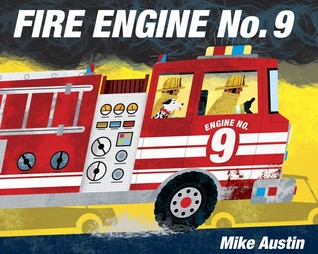
Review: Fire Engine No. 9 by Mike Austin

Fire Engine No 9 by Mike Austin

Fire Engine No. 9 by Mike Austin

Released September 22, 2015.

This picture book embraces the drama of responding to a fire, showing firefighters sliding down their pole, heading out to the fire, and then putting it out. Along the way, they hook the hose up to the fire hydrant, save a baby, and head directly into the burning building. The book is filled with sounds like alarms sounding, sirens blaring, smashing windows, and the water rushing out of the hose. Climactic and action-filled, this picture book is perfect for the youngest fire-fighting enthusiasts.

Short and filled with almost entirely words that relate to the sounds of a fire response, this book reads quickly and effortlessly. The pacing is frenetic but also systematic like the response itself. The entire book has the feel of excitement but also of an elite team that is prepared to help people.

The art is vibrant and filled with motion. When the fire engine is rushing to the fire, the entire vehicle leans forward with the speed. Dark smoke appears on the page as they reach the fire, billowing over the rest of the city. Bright reds are used very effectively as a background color to amp up the drama and imply the heat of the fire. One of the firefighters is revealed to be a woman at the end of the book, something got a cheer out of me.

Sirens, trucks, action and rescues make this simple book about fire fighters a dynamic pick for toddlers. Appropriate for ages 2-4.

Reviewed from digital galley received from Random House Books for Young Readers and Edelweiss.

Review: Snap! by Hazel Hutchins

Snap by Hazel Hutchins

Snap! by Hazel Hutchins, illustrated by Dušan Petričić

Released September 22, 2015.

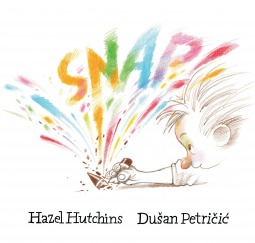
Evan had a new set of crayons that were perfect until he accidentally broke the brown crayon. He tried to fix it by pressing it together and taping it, but nothing worked. Then Evan realized that one broken crayon is actually two crayons! As Evan continued to color, more crayons snapped. When he stepped on one, he found that he could create different things with the crushed color and with others without wrappers. Evan’s only green crayon disappeared under the stairs and then he didn’t have any green at all, until he discovered that yellow and blue combined to make green. Soon Evan was mixing all sorts of colors. Finally he is left with only three colors: red, blue and green and no space to color any more. But Evan has starting thinking in new ways and finds a way to make new discoveries and art.

Hutchins has taken a universal moment in childhood, when the first crayon breaks and made it into a celebration of creativity and thinking in new ways. The discoveries outweigh the loss of a whole crayon, creating new opportunities and new ways to color and draw. The part where he steps on a crayon is so well done, allowing youngsters to see situations like that as a chance for discovery. Throughout the tone is jolly and inviting, just the antidote to perfectionism we need.

Petričić’s art is very appealing. Evan is a boy who is colored the same bright colors as his crayons, allowing him to pop on the page even as it fills with art. At the same time, he is rendered partially as an uncolored person, which makes for a very modern and intriguing look. The scribbles and child art are done well, always filled with experimentation and ideas. 

Combine this with a crayon craft and you will have a great program, just be ready for some of the children to snap your crayons on purpose! Appropriate for ages 2-4.

Reviewed from digital galley received from Annick Press and NetGalley.

Review: Mango, Abuela and Me by Meg Medina

Mango Abuela and Me by Meg Medina

Mango, Abuela and Me by Meg Medina, illustrated by Angela Dominguez (InfoSoup)

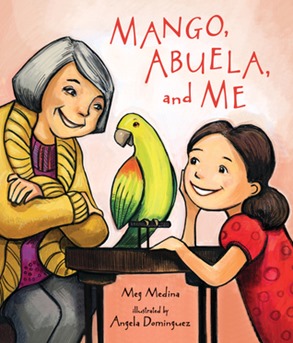
Mia’s abuela has come to live with Mia and her family in the United States. She can’t speak English and Mia can’t speak Spanish, so the two of them spend time together in silence, feeding the birds and watching TV. Mia’s mother reminds her of how a classmate learned to speak English and Mia starts to work to teach her abuela the new language. They point at things and share the English and Spanish words. Mia labels items around the house with their English names. Then when Mia and her mother go to the pet store for treats for her hamster, Mia sees a parrot that she knows will remind her abuela of the home she left. Mango, the parrot, starts speaking both languages and helps Mia’s abuela connect with both her past and her granddaughter.

Medina has written this picture book with a lovely clarity of voice. The first person narrative is told from Mia’s point of view and shows the growing relationship with her grandmother, from the first shy days to the later part of the book where they are happily chatting and reading together. The book speaks to the importance of family and also to the ways that language can be learned and shared. It is particularly important that Mia learned Spanish too.

The illustrations are simple and colorful. They show the limited space that the family has, so Mia and her grandmother share a room together. The urban setting is shown with a bright friendliness that captures a vibrant community. The chronicling of the growing relationship is shown very effectively in the images.

A strong picture book that celebrates families and new language learners. Appropriate for ages 4-6.

Reviewed from library copy.

Review: The Story of Life by Catherine Barr

The Story of Life by Catherine Barr

The Story of Life: a First Book about Evolution by Catherine Barr and Steve Williams, illustrated by Amy Husband (InfoSoup)

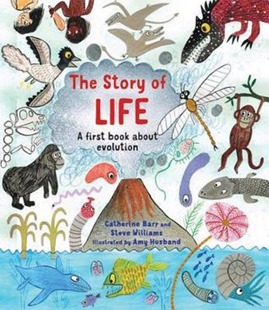
Starting before there was life on earth, this nonfiction picture book takes readers on a journey from 4.5 billion years ago to today. Volcanoes and black ocean water with some areas that were warm from underwater volcanoes created the tiny bits that formed the basis of life. Cells started growing, some using sunlight, water and oxygen that changed the very earth itself. Over millions of years, cells developed into different forms of life and became the first animals. The seas became full of life and animals and plants started to expand to the land. Then an unknown disaster hit and most of the life on earth was destroyed. It became cold and dark, giving a chance for huge dinosaurs to emerge and take over. Millions of years passed again and insects and mammals appeared. A meteor hit the world though, and then it was time for the mammals to survive. Humans evolved from those mammals and spread across the world, bringing us to the present day.

This basic look at evolution offers a sense of the length of time that it has taken to get us from basic cells to humans today. On each two-page spread there is information on how long ago this scene was taking place. The text on the page has lots of information on the changes happening, the progress towards new life, and also the series of disasters that has caused sudden death on the planet. This is a fascinating look at evolution that is appropriate for even preschool children to begin to understand the science that created life on earth.

The illustrations by Husband are playful and fun. They add a lighthearted touch to the serious scientific information. At the same time, they are have scientific labels for important objects and ideas that let children better understand the progress of evolution that they are learning about.

A strong picture book that explores evolution and will inspire children to learn even more about prehistoric times. Appropriate for ages 4-7.

Reviewed from copy received from Frances Lincoln Children’s Books.

Review: The Tiger Who Would Be King by James Thurber

Tiger Who Would Be King by James Thurber

The Tiger Who Would Be King by James Thurber, illustrated by Joohee Yoon

Released September 15, 2015.

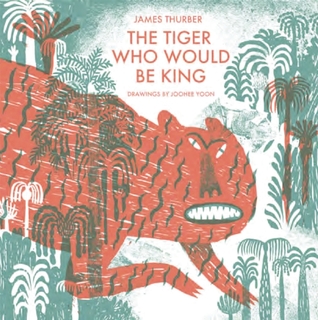
Thurber’s profound story is brought to vivid life in this new picture book version. Tiger wakes up and decides that he wants to be king of the beasts, declaring to his wife that he will be king before the night is over. He believes that others are calling for change as well and that the moon will rise in his colors, striped and orange. Lion though is not willing to give up his title. The two start fighting and soon all of the animals in the jungle are fighting too, though many don’t know why they are fighting. Eventually after an immense battle, there is only one survivor, Tiger. He may be king, but there are no beasts to rule any more.

Yoon takes the words of Thurber and creates a picture book that is startling and incredible. She captures in expressions, the pride of declaring yourself to be a ruler, the shock of the old ruler being challenged. The epic battle is shown on pages that fold out to a four-page spread that brings to mind Picasso’s Guernica in its confusion and brutality. Done in only two colors, the green and orange capture the moist heat of the jungle. Though the illustrations appear to be prints, they are actually done with a combination of hand drawing and computer art. However it was done, it is pure brilliance.

A great book to spur discussion about war, pride and costs, this picture book will resonate with young readers. Appropriate for ages 5-8.

Reviewed from copy received from Enchanted Lion Books.

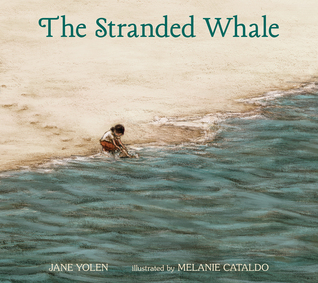
Review: The Stranded Whale by Jane Yolen

Stranded Whale by Jane Yolen

The Stranded Whale by Jane Yolen, illustrated by Melanie Cataldo (InfoSoup)

In the fall of 1971, Sally and her brothers were walking home from school along the dunes in Maine. Sally spotted a big gray thing on the beach and realized that it was a stranded whale. The children grab their sweaters and use them to keep the whale wet. One of the brothers ran off to call for help and people from the community arrived with buckets. They tried rocking the whale to get it back to the ocean, but she was too big and they were too weak and small. Sally stayed by the whale’s huge eye, even as it breathed its final breath. The children were seen as heroes for what they did that day, but Sally knew that it would be so much more wonderful to have been able to see the whale return to the ocean.

Yolen writes with such poetry about nature that you are right there and experiencing it alongside Sally and her brothers. Yolen captures the world of the beach in her poems, showing all of the small living things that Sally dashes by on her way to the ocean with her sweater. Most evocative are the scents of the whale, who smells “of fear and deep water” at first. Then the whale last breath:

The sigh smelled like seaweed,

like lobsters in Dad’s traps,

like gutted fish on the pier.

Such imagery that captures in a subtle way the scent of death too.

Cataldo’s illustrations make sure to keep the scale of the enormous whale consistent from one page to the next. On some pages there is an expanse of grey flesh with one huge eye looking out. The effect is humbling, showing that nature is both bigger than us and also a part of us too. The illustrations are beautifully done, playing light and dark against one another as the whale slowly perishes.

A brave book that does not shy away from grief or wonder. Appropriate for ages 6-9.

Reviewed from library copy.

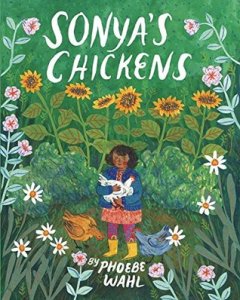
Review: Sonya’s Chickens by Phoebe Wahl

Sonyas Chickens by Phoebe Wahl

Sonya’s Chickens by Phoebe Wahl (InfoSoup)

Sonya was given three tiny chicks by her father. It was her job to take good care of them. At first, the chicks liked in the house in a cardboard box while Sonya’s parents fixed up the coop in the yard. Soon they grew into pullets and were living outside. They followed Sonya everywhere she went. She took good care of them, giving them food and water and cleaning out their coop. They grew into three large happy hens and started laying eggs. Then one night, Sonya was woken by squawking in the chicken coop. She headed outside and one of her chickens was no longer there, only two hens were up in the rafters hiding. Sonya’s father explained that a fox had gotten the hen and told her about why he would have taken her. Sonya and her family had a funeral for the hen and worked to repair the coop so that a fox could not get in again. Then the circle started once more when one of the eggs began to hatch.

Wahl embraces honesty about the death of pets and grief in this picture book. Beautifully told, the loss of the chicken may surprise some readers. It is handled with care and truth, the father in the story explaining that the fox has to hunt for his family in order to feed his kits. Sonya is allowed time to express her feelings, supported by her family. The ending of the book has a new chick joining Sonya’s flock and her willing to continue on despite the loss. It’s a lesson in resilience.

The illustrations in this picture book are impressive. Done with watercolor, collage and colored pencil, they are vibrant and richly colored. The images show a mixed-race family in a rural setting, something that isn’t seen enough in picture books. They have a great textural feel and also depict a fully-realized home and family with most of the pictures taking up an entire page with their rich colors.

An honest look at grief and loss of a pet, this picture book is a winner. Appropriate for ages 4-6.

Reviewed from library copy.

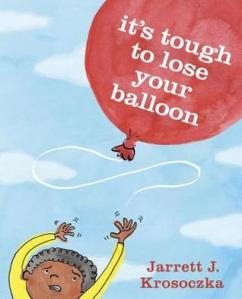
Review: It’s Tough to Lose Your Balloon by Jarrett J. Krosoczka

Its Tough to Lose Your Balloon by Jarrett Krosoczka

It’s Tough to Lose Your Balloon by Jarrett J. Krosoczka

Released September 8, 2015.

The creator of the Lunch Lady graphic novels returns with a picture book that takes bad events and turns them around. The book begins with a child losing a balloon but then says that Grandma will see it as she flies home on the plane. Your sandwich falling into the sand may make you sad, but it will make seagulls happy. Wet shoes are horrible, but being barefoot is great! One after another unfortunate events are turned around into something to even look forward to. This optimistic picture book will have you looking for a day filled with lemons rather than lemonade.

The text of the picture book is simple. The situations captured here are universal and children will respond to all of them. From scraped knees to melted ice cream, these are situations that could ruin anyone’s good mood. But this book restores all of it to be OK with cool bandages and an upside-down solution instead.

The art too is simple. Krosoczka makes sure to use a wide range of races on the page, showing visually how universal both the good and the bad can be. The simplicity of the illustrations with their watercolor washes makes for a book that can be used with groups. I can also see children coming up with their own positive spins on bad things as an activity.

Positivity galore in this picture book that will brighten any gloomy day right up. Appropriate for ages 4-6.

Reviewed from digital galley received from Knopf Books for Young Readers and Edelweiss.