Review: Sharing the Bread by Pat Zietlow Miller

Sharing the Bread by Pat Zietlow Miller

Sharing the Bread: An Old-Fashioned Thanksgiving Story by Pat Zietlow Miller, illustrated by Jill McElmurry

Released September 22, 2015.

Told in rhyme, this picture book is a celebration of a family preparing Thanksgiving dinner together. The nineteenth century American traditions echo our modern ones closely. Readers will see the turkey go into the wood-burning oven. Dough for the bread is kneaded and allowed to rise. There is cranberry sauce made on the stove and a pumpkin pie with hand-whipped topping. Mashed potatoes are added to the feast as well as a jug of cider. Soon everyone is gathered around the table and prayers are said together. It’s an American Thanksgiving done in true traditional style.

The rhyming stanzas evoke a feeling of a jaunty folksong as they tell the story of a family making their Thanksgiving dinner. The rhymes create a great rhythm to the book, that will have toes tapping if they are read with enough snap and vigor. The rhyme and rhythm combine to create a strong framework for the book, one where there is a building anticipation for the meal and for the family to all arrive. There are extended family present, including adult siblings, aunt, uncle and grandparents. Throughout, there is lots of work to be done but it is all done in good cheer and everyone lends a hand.

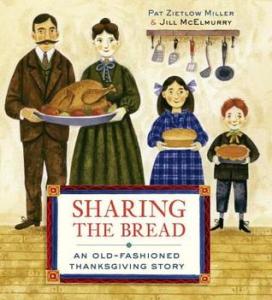
McElmurry’s illustrations have a folkart quality to them that works well. Done in paint, the illustrations are simple and warm, inviting you back in time to share a meal that is familiar to everyone. There are lots of period details in the images such as water pumps, dried herbs in bunches on the wall, a wash tub, and large cast iron pots and pans.

Warm and flavored with tradition and love, this book is as gratifying as a fresh loaf of bread. Appropriate for ages 4-6.

Reviewed from digital galley received from Schwartz & Wade and Edelweiss.
Review: Something Extraordinary by Ben Clanton

Something Extraordinary by Ben Clanton

Something Extraordinary by Ben Clanton (InfoSoup)

A little boy has lots and lots of different wishes that he hopes come true. He wishes to be able to fly, to breathe underwater, that the robot he drew could come to life. Then they could play together in the rain that would come in seven different colors and flavors. He wishes for fangs and a tail. He wishes to be able to talk to animals and to have lots of wild and strange pets. But in the end, he mostly wishes that something extraordinary would happen to him. Something real. And suddenly, it does!

Clanton excels at taking very simple premises for his books and making them into something engaging and intelligent. In this book, it is all about wishes and dreams with a big dollop of imagination too. The bulk of the book is spent with the boy and his wild wishes that he only hopes could come true. In the end though, the book comes down to earth and the boy just wants something amazing to happen in real life. He takes a moment then to look around himself and realizes that there are wonderful things happening right there, especially out in nature.

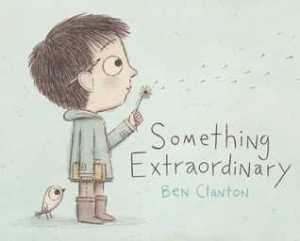
The artwork here is understated and subtle. Even during his wildest and most colorful wishes, the colors are muted and subdued. It isn’t until the ending when the boy realizes that there is wonder around him in real life that the colors lose their subtlety and start to really sing.

Big dreams and wild wishes may not come to fruition here, but reality is certainly “something extraordinary” in the end. Appropriate for ages 3-5.

Reviewed from copy received from Simon & Schuster Books for Young Readers.

Review: Edmond, The Moonlit Party by Astrid Desbordes

Edmond the Moonlit Party by Astrid Desbordes

Edmond, The Moonlit Party by Astrid Desbordes, illustrated by Marc Boutavant (InfoSoup)

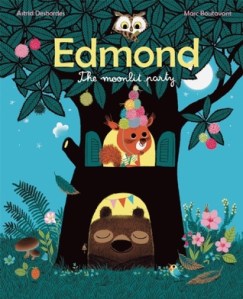
Edmond, the squirrel, lives in a chestnut tree and hardly ever goes out. He spends his time making nut jam, reading stories, and making pompoms. George Owl lives in the tree above Edmond. He spends his time out and about, gathering items to create his amazing costumes. Harry, the bear, lives in the bottom part of the same chestnut tree. He loves to throw parties and was just planning his upcoming one. It would have a nothing tart, very mysterious, and would encourage people to wear costumes. Edmond longed to go to a party in the tree, but never had. So when George smells Edmond’s latest batch of nut jam as the party gets started, George encourages him to attend even if he doesn’t have a costume to wear. Soon Edmond is at the party, dancing and having a great time and he decides that parties suit him just fine after all.

This French import is a radiant read. The three different residents of the tree all have distinct personalities. Edmond is lonely and looking for connections, George enjoys disguises and Harry is rather distracted in the midst of his party planning. It all turns out for the best as the three neighbors get to know one another, or at least Harry and Edmond to, since George is dressed in a very realistic seagull costume. The text here is lush and gives insight into each character, making the book more appropriate for older preschoolers and children already starting school.

Boutavant’s illustrations have a seventies vibe. Done in the flat bright colors of that time, the illustrations have lots of details to explore and offer real glimpses into the lives of the three denizens of the tree. The bright colors vibrate on the page, brilliant blues, reds and yellows are used as background colors and add a lot of energy to the story.

An exploration of neighbors and being yourself, this picture book is cheery and vibrant. Appropriate for ages 4-6.

Reviewed from copy received from Enchanted Lion Books.

Review: Out of the Woods by Rebecca Bond

Out of the Woods by Rebecca Bond

Out of the Woods: A True Story of an Unforgettable Event by Rebecca Bond (InfoSoup)

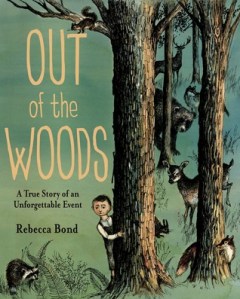
Inspired by a true story, this picture book tells of the author’s grandfather’s life in Ontario, Canada in 1914. Antonio lived with his family in a hotel run by his mother. He spent his time with the hotel workers since there were no children around. He helped the cooks, the maids, and watched as others hauled wood and repaired buildings. The hotel had three stories with a space to feed crowds of people, individual rooms for travelers and then a large open dormitory space for others. He loved spending time in the forest around the hotel too. Then one year when Antonio was almost five, it was dry as could be. When smoke was spotted in the distance, everyone knew they were in real trouble. All of the people fled the building and stood in the lake watching the fire come closer. Then something amazing happened and the animals too left the forest and entered the water, standing near the humans and close to one another, predator and prey alike. When the fire ended, the hotel was still standing and the animals returned to the burned forest, but Antonio never forgot what he witnessed that day.

Bond captures the time period, allowing readers to really explore the hotel that Antonio lived in, showing us all of the floors and the hard-working men that the hotel served. The text offers details such as describing Antonio’s room as a place that was off the kitchen and had once been a pantry. Even small things are noted like the travel bags men carried and the fact that they sometimes had guns along too. Through these details, the entire hotel comes alive on the page.

The illustrations in the book also add to the details from the long distance view of the hotel on the lake to the finely drawn images showing the interior. Small details are captured in sepia tones and fine ink lines, allowing us to get a glimpse into the past and a way of life. The same details continue even as the fire rages and the animals come into the water. Realistic and lovely, the animals’ body language shows how wary they are and yet how desperate too.

A true story brought to life through details and wonder. Appropriate for ages 4-6.

Reviewed from copy received from Farrar, Straus and Giroux.

Review: Double Happiness by Nancy Tupper Ling

Double Happiness by Nancy Tupper Ling

Double Happiness by Nancy Tupper Ling, illustrated by Alina Chau

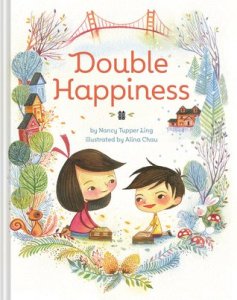
Told in individual poems, this is the story of a brother and sister who must move away from San Francisco and the extended family they have there, including their beloved Nai Nai. Before they leave, their grandmother gives them empty boxes to fill with reminders of where they have been. For Jake there is a penny, gum rolled into a snake shape, and a blue-green marble. For Gracie, there is a panda from home, a eucalyptus leaf, and one final elusive element from home. The children have adventures in the airport, make the transition to a new home with wintry weather, and throughout their connection with their family and their heritage stays strong.

Ling writes poems that shine with warmth. She captures what it feels like to be a beloved child in an extended family and the angst of leaving that place for another. Wrapped throughout the poems are references to China and Chinese-American culture that makes this book a real joy for its diversity that stays so strong throughout. The poems are individual but work together into a picture book that offers a way to cope with a move and to capture the changes and experiences along the way.

Chau’s illustrations are bright and friendly. The children are small on the page compared to the adults, and their size changes with the emotions they are feeling. Both are bright rays of colors on the page with their banana yellow and plum outfits. The illustrations too swirl with Chinese characters as well as symbols like the phoenix and dragons.

This book speaks to the emotions of moving through lovely poetry but also a concrete way to focus on the positive in the change. Appropriate for ages 4-6.

Reviewed from copy received from Chronicle Books.

Review: Duck’s Vacation by Gilad Soffer

Ducks Vacation by Gilad Soffer

Duck’s Vacation by Gilad Soffer (InfoSoup)

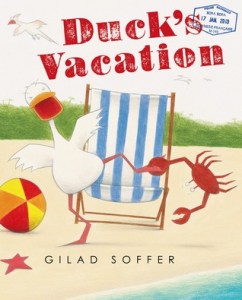
Duck is out on the beach having a relaxing vacation when suddenly, you arrive. And you turn the page! Duck is frustrated because he is on vacation and doesn’t want any kind of bother to happen. And you keep turning pages! As the pages turn, some bad things do start to happen from a bird pooping on Duck’s head to a crab pinching his toes. Then people start to arrive and the beach gets very crowded. It starts to rain and Duck says that it can’t get worse, but it certainly can. There could be snow! Or maybe pirates! Are you willing to stop turning the pages and not find out what happens next?

Originally published in Hebrew, this is a book that will have young readers and listeners giggling as the pages are turned. Duck is such a grumpy thing from the moment the first page is turned. Of course this is a trope used in one of my favorite childhood books, The Monster at the End of This Book. The reaction of characters to a reader turning pages really works well. The reader controls the pace of the reaction, and can delight in causing things to happen in a static book. It is also a set up that works really well read aloud.

Soffer’s illustrations play up the humor to top effect. The crowds of people who swarm the beach almost obscure Duck, the snow turns his bill blue, and the pirates, well he’s not cold anymore! Duck also has a range of emotions that he can display thanks to his expressive eyebrows that are sure to be in some sort of grimace.

Funny and a great choice to share with a preschool group. Appropriate for ages 3-5.

Reviewed from copy received from Feiwel and Friends.

Review: Bernice Gets Carried Away by Hannah E. Harrison

Bernice Gets Carried Away by Hannah Harrison

Bernice Gets Carried Away by Hannah E. Harrison (InfoSoup)

Bernice is not having a good time at the birthday party and the cloudy day suits her mood. Her piece of birthday cake didn’t have a frosting rose on it like the others. Her soda was warm and tasted like prune grapefruit flavor. And then the big kids hit the pinata down before she even got a swing and the only candy Bernice got was a stepped-on gumdrop. So when the clown showed up with a huge bunch of balloons, Bernice grabbed them away and took them all for herself. But there may have been a few too many, and she floated up and up. She floated past other animals in the tree who were having a bad day too. She floated up until she got stuck on the bottom of the gloomy cloud. When she looked down, she realized that her problems were pretty small from a distance. Then she set out to change her day to a sunny one after all.

Harrison captures all of the elements of a bad mood and a horrible day. When you are already in a bad mood, nothing much can fix it except yourself. Harrison makes sure that it’s a substantially bad day, one that most children would have difficulty coping with. She does it with subtle humor, making the single gumdrop a stepped-on one and the soda flavor truly icky. She also makes sure that while the result is a more cheerful day, it takes a little while to get there and the change though fast does make sense.

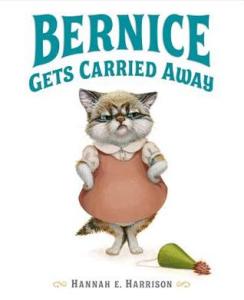
The cover alone made me laugh out loud. Harrison knows her cats and no creature can look quite as grumpy as a wronged feline. The facial expressions of all of the animals are priceless. The paintings are detailed to the point where you can see individual hairs on the animals faces. Each one has a distinct personality, even if they are one in a crowd of little animals. Then the mood change happens and it’s like Bernice is a completely different little kitten with wide eyes and an internal glow.

Purely satisfying and fun, this picture book is a happy treat to share. Appropriate for ages 4-6.

Reviewed from copy received from Dial Books.

Review: Marvelous Cornelius by Phil Bildner

Marvelous Cornelius by Phil Bildner

Marvelous Cornelius: Hurricane Katrina and the Spirit of New Orleans by Phil Bildner, illustrated by John Parra

Cornelius worked in the French Quarter of New Orleans. He was a garbage man who loved his job. He greeted everyone in the neighborhoods and made sure that the streets were clean of even a single wrapper. He had amazing calls he used with his driver, shouting “Woo! Woo!” when it was time to stop and “Rat-a-tat-tat!” when it was time to drive on. He didn’t just carry bags from the curve, he tossed and juggled them, adding dance steps to his routine job. He could launch bags through the air one after another and they landed in a perfect pyramid on the truck. But then Hurricane Katrina came to New Orleans and the city streets filled with mud and muck and piles of garbage. At first Cornelius was overwhelmed by the work to be done, but he started the same way he did every day and soon others started helping too.

This picture book is based on the true story of Cornelius Washington who was a sanitation worker in New Orleans. The Author’s Note speaks to his connection with Cornelius’ family and a reporter who had gotten to know him before the storm. In this book, Cornelius’ story is told in folklore style, offering him and his amazing spirit that he displayed every day a space to be honored and appreciated.

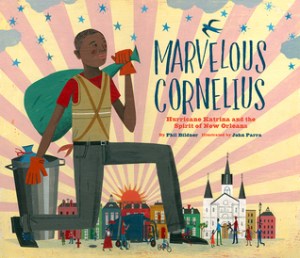
Parra’s illustrations play to the heroic feeling of the book, Often showing Cornelius with stars behind his head or rays of the sun. The painted illustrations have a gorgeous roughness to them in texture that also connects the subject to history and makes the entire book feel timeless and sturdy.

An homage to a man who did a humble job with style and energy, this book is also about survival and what it takes to be an everyday hero. Appropriate for ages 5-8.

Reviewed from copy received from Chronicle Books.

Review: I’m New Here by Anne Sibley O’Brien

Im New Here by Anne Sibley OBrien

I’m New Here by Anne Sibley O’Brien (InfoSoup)

Follow three new students in the United States in this picture book. Maria is from Guatemala, Fatima is from Somalia and Jin is from Korea. The three students are all new to school and new to America. They face the same challenges in learning English and understanding the new culture they are in. There is a new language to learn, new alphabet to use, They feel alone, sad and confused. Steadily they start to use their new language to make new friends. They show others their culture and alphabet and they start to take chances and share aloud in class. They find their place in this new land.

O’Brien captures the challenges faced by children arriving from different countries and shows their universal feelings. The book is one that works in both directions, both welcoming children to classrooms and also providing American children with an understanding of what it feels like to be new and learning a new language. This book will be very helpful when new children from other countries join a classroom and can also be used as a discussion starter about emotions and feelings.

The art here is simple and welcoming. The children are shown in bright colors and the format is large enough to share with a class. The emotions are also drawn clearly on the page, allowing children to both read about how they are feeling and also see it demonstrated too.

This book celebrates diversity and new arrivals in the United States. It gives space for children to keep their own strong ties to their home cultures while also creating a new home here. Appropriate for ages 5-7.

Reviewed from library copy.