Review: Enormous Smallness by Matthew Burgess

Enormous Smallness by Matthew Burgess

Enormous Smallness: A Story of E.E. Cummings by Matthew Burgess, illustrated by Kris Di Giacomo (InfoSoup)

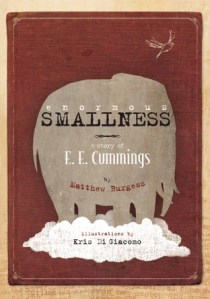
This picture book biography of the great poet E. E. Cummings is exceptional. Focusing on Cummings’ early years primarily, the book invites young readers to view their own world with wonder and to try to put it into words. As a young boy Cummings was already creating poetry, starting at age three. His mother wrote down his poems for him as he recited them aloud. His imagination extended to art as well, but his real love was words which he approached very playfully, often creating his own words or mashing ones together into new ones. The book emphasizes the hard work that Cummings put into his craft, including spending lots of quiet time observing the world around him for inspiration. After graduating from Harvard, Cummings headed to New York City where he found new inspiration all around him. He served in World War I and published his first books soon after the war ended. His poems were both loved and controversial as he toyed with form and words. Filled with Cummings’ poems as examples, this picture book is a joy to read.

Burgess does a great job with his prose which introduces the young Cummings and his early poems and then follows him as he grows older and his poems grow with him. I appreciate that the book was not attempted to be written using Cummings’ unique style. Rather it is a book that pays homage to the art, the inspiration and the man himself. Spending so much time on Cummings’ youth makes the book much more appealing to young readers who will find inspiration both in Cummings’ age when he began to write and in his poems simplicity.

The art by Di Giacomo is filled with textures and patterns. Words dance across the page, playful and light. They often break free of the lines of prose, merging to be part of the art itself. Words float up on breezes, lengthen with hot summer days, and zing with the style of New York City.

A fabulous biographical picture book, this book is a great introduction to E.E. Cummings and his work. Appropriate for ages 6-9.

Reviewed from copy received from Enchanted Lion Books.

Review: Polar Bear’s Underwear by Tupera Tupera

Polar Bears Underwear by Tupera Tupera

Polar Bear’s Underwear by Tupera Tupera

Polar Bear has lost his underwear and he can’t remember what they looked like. It’s up to readers to turn the pages and help Mouse find Polar Bear’s underwear. Could it be the striped underwear? Nope, those are Zebra’s favorite ones. The pair covered in doughnuts and treats belongs to Pig. The little flowery pair is too small for Polar Bear but fits Butterfly perfectly. Rabbit wears carrot printed underwear…on his head! One after another, there are no Polar Bear underwear. But wait, could it be that Polar Bear had them on all along?

Sure to elicit giggles, this book uses die cuts on pages to great effect. The first page shows just the underwear and little readers will delight in turning the page and seeing who they belong to. Each one makes sense with the animal on the next page, making a book that is nicely satisfying even as it is full of humor.

The illustrations are strongly done and will project well to a room of children. With plain brown paperbag backgrounds, the collage illustrations pop on the page, whether for pink pigs or black cats. The twist at the end works very nicely with the illustrations, since readers can turn back to the very first page and notice the trick carried throughout the entire book.

Funny and delightfully clever, this Japanese picture book is sure to find a happy audience in the United States. Appropriate for ages 2-4.

Reviewed from copy received from Chronicle Books.

Review: Drum Dream Girl by Margarita Engle

Drum Dream Girl by Margarita Engle

Drum Dream Girl by Margarita Engle, illustrated by Rafael Lopez

Inspired by a true story, this picture book is about a girl who refused to allow societal rules to stop her from her musical dreams. In Cuba, girls were not drummers, but one girl dreamed of pounding drums big and small and making amazing music. Everyone said that only boys could be drummers though, so she kept quiet about her dreams.Everywhere she went though she could hear drumbeats that were all her own. Finally the girl dared to start drumming on real drums and she joined her sister in an all-girl band. Her father did not approve of her drumming but eventually allowed her to play for a teacher to see if she could really drum. And she could!

Engle, known for her gorgeous poetic books for older readers, has created a marvelous picture book here. Reading like poetry, the book looks deeply at a girl who refused to give up her dream to play the drums, even as she hid the dream deep inside herself. It is a book that celebrates artistic gifts even as it works to dismantle gender stereotypes and show that girls have the same artistic skills as boys do. The build up in the book is done with real skill, allowing readers to thrill at her accomplishments as her hard works comes to fruition.

Lopez gives us a bright-colored glimpse of Cuba in this picture book. Filled with lush plants, starlight, water and birds, the illustrations shine on the page. Done in acrylic paint on wood board, they have a great texture to them as well as an organic quality that adds to their depth on the page. The result is a picture book that is vibrant and rich.

A dynamic picture book that celebrates music and breaks stereotypes, this book will inspire children to follow their own dreams. Appropriate for ages 4-6.

Reviewed from library copy.

Review: Miss Hazeltine’s Home for Shy and Fearful Cats by Alicia Potter

Miss Hazeltines Home for Shy and Fearful Cats by Alicia Potter

Miss Hazeltine’s Home for Shy and Fearful Cats by Alicia Potter, illustrated by Birgitta Sif (InfoSoup)

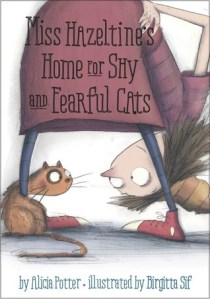
Miss Hazeltine opened a home for the most fearful of cats and owners brought their cats to her for help. Other cats arrived on their own, including Crumb, who was the most timid. Miss Hazeltine taught the cats lessons to help them build their confidence from Bird Basics to How Not to Fear the Broom, the hardest class of all. Even though Crumb hid under the bed, he too got Miss Hazeltine’s positive attention as she praised him for not being scared of the dark. Then one day after many, many cats had arrived, they ran out of milk. Miss Hazeltine set off in the dark to get some, but met with a fall into a ditch. When she did not return, the cats worried but they all hesitated to head out into the night. Crumb was the only one who had heard where Miss Hazeltine was going, so it was up to him to lead a rescue by cats who were once shy and fearful.

Quirky and wonderfully odd, this picture book will resonate with children who may be afraid of a variety of things. Potter’s language is filled with lovely moments of humor and equally marvelous times of quiet. Using lists of things like fears or lessons, she creates a strong storyline that is very appealing. The character of Miss Hazeltine is strongly written, a woman embracing her own unique skills. Crumb too is a small and shy cat who grows the heart of a lion by the end of the book. Filled with plenty of growth and development of characters, this is great fun to share aloud.

The illustrations by Sif add a great level of spirited oddity to the book. Miss Hazeltine is lanky and loving. The cats use their tails as much as their faces for expression. The setting ranges from the cozy house filled with cats to the deep dark strangeness of the woods. In all of them, the eyes of the cats glow and fill the setting with plenty of life.

Add this to any cat story time or a unit on bravery for a winning read! Appropriate for ages 4-6.

Reviewed from digital galley received from Knopf Books for Young Readers and Edelweiss.

Review: Meet the Dullards by Sara Pennypacker

Meet the Dullards by Sara Pennypacker

Meet the Dullards by Sara Pennypacker, illustrated by Daniel Salmieri

The Dullards are a very boring family and that’s just the way that Mr. and Mrs. Dullard want it to be. But lately their three children, Blanda, Borely and Little Dud, have been giving then bad shocks. The children want to read books, play outside, and have fun. The parents are so horrified that they move to a duller neighborhood. Once there though, they need to make sure their home is boring enough by getting rid of the colorful wallpaper and then watching the paint dry. Even that won’t stop their children though, so they move back to their original home, just in time for the circus to come to town. Luckily for their children, the Dullards sleep very soundly.

Pennypacker offers an inventive riff on The Stupids, one that embraces the dull side of life. She perfectly captures the humor of a family wanting to just be bored all of the time, taking it to such a level that the humor is laugh-out-loud funny. From their reaction to chunky applesauce to asking to have the vanilla flavor removed from their ice cream, the book is a joy to share aloud. Beautifully, the humor is delivered in the ideal deadpan manner, matter-of-fact and with a straight face (of course). The Dullards wouldn’t have it any other way.

Salmieri captures the gray dullness of the Dullard’s lives very nicely, using images like the children watching an unplugged TV and seated on the bare floor. He contrasts that with the children who may be dressed in the same dull colors but are independent thinkers who add color in many other ways. The illustrations add so much to the book, creating those moments where the children are doing their own thing much to their parents dismay.

Funny and vibrant despite its dull subject, this picture book is sure to get even the most bored children giggling. Appropriate for ages 4-6.

Reviewed from library copy.

Review: Feet Go to Sleep by Barbara Bottner

Feet Go to Sleep by Barbara Bottner

Feet Go to Sleep by Barbara Bottner, illustrated by Maggie Smith

In a house on the beach, Fiona doesn’t want to go to sleep. She’s had such an amazing day that she doesn’t want it to end! But she is just a little tired after all that they’ve done. As she climbs into bed, she starts with her toes, telling them to go to sleep. She tells her feet next, remembering how they loved stomping in the waves. Then come her knees that had held her strong on the sand as she build a castle. Her legs are the next to go to sleep, after spending the day running. Her tummy ate lots of berries during the day and goes to sleep too. Fiona works her way all the way up to her ears, eyes and mouth, until finally her mind is quiet enough to sleep.

With a proven technique, Bottner demonstrates a way that children can calm themselves at bedtime by both taking control of their body and mind but also celebrating the day that they have had. The book shows the technique clearly rather that teaching it to the adult separately. This approach to bedtime is simple and calming, creating moments where child and parent can share what they found joy in during their busy day. Fiona’s mother stays with her for most of the process, but leaves as Fiona finishes on her own, shutting her ears and eyes to the activity around her and drifting gracefully off to sleep.

Smith’s illustrations use an inset image to show in the large portion of the picture the grand and sunny day that Fiona has experienced and then in a smaller and darker image Fiona putting a body part to sleep that matches the activity of the larger picture. The book shines with the joy of a beach vacation captured in all of its wild colors and sun. Yet at the same time it is an immensely soothing book with its focus on quiet and calm.

A bedtime book that just might result in actual sleep! This picture book shows a different way for parents to approach bedtime wiggles. Appropriate for ages 3-5.

Reviewed from digital copy received from Edelweiss and Knopf Books for Young Readers.

Review: This Is Sadie by Sara O’Leary

This Is Sadie by Sara OLeary

This Is Sadie by Sara O’Leary, illustrated by Julie Morstad

Released May 12, 2015.

Sadie can take a cardboard box and make it into a ship where she looks for land, but not too hard. She can sail all the way around her room before breakfast. Sadie loves to spend time with her friends, whether in real life or in books. She has pretended to be all sorts of things from mermaids to wild boys raised by wolves. She can be Alice in Wonderland or a hero on a horse. She can even have wings, almost invisible ones but they can still take her flying. She fills her days with imagination, play and reading. What could be better?

O’Leary captures the wonder of a child’s imagination in this gorgeous picture book. Right from the beginning the tone is light and playful, inviting the reader to see the world as Sadie does. Perhaps they have wings too? Adults do not appear in the book at all, giving the entire story to Sadie and her imagination. They are referred to in passing, but that’s about it. The book whirls with ideas, all gathered together from heroes to wings to undersea adventures, we are riding along with Sadie in each of her imaginary places. It’s a confectionery of creativity.

Morstad’s illustrations are done in gouache and watercolor. They fully embrace the worlds that Sadie envisions, bringing them into full color vibrancy on the page. The book changes from the imaginative worlds to Sadie’s room and reality, but each are just as winningly portrayed as the other. Her room has lovely touches like a mushroom lamp, beds for stuffed animals, and a chair piled high with books.

An invitation to come and play is clear in this imaginative picture book that will dazzle readers. Appropriate for ages 3-5.

Reviewed from digital galley received from NetGalley and Tundra Books.

Review: It’s Only Stanley by Jon Agee

Its Only Stanley by Jon Agee

It’s Only Stanley by Jon Agee (InfoSoup)

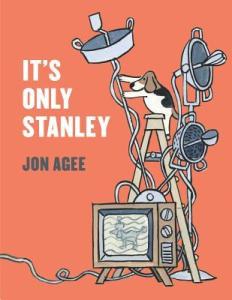
Something odd is happening tonight in the Wimbledon house. There are mysterious noises. The first noise is Stanley the dog howling at the moon. But then new noises start. The clanking noise is Stanley fixing the oil tank in the basement. A little later, the funky smell that makes the cat ill turns out to be Stanley cooking catfish stew in the kitchen. The buzzing noise is Stanley fixing the family’s old TV in the living room. Splashing noises are Stanley fixing the plumbing. Each noise wakes up the human family and the father has to head out to see what is happening. But just as everyone is starting to get very cranky from loss of sleep, something happens that shows exactly what Stanley has actually been up to all night.

Agee is a master at creating understated books that have a distinctive feel about them. Here he takes a strong matter-of-fact tone and uses it to add to the silliness of the entire book. Told in natural-feeling rhyme, the book has a buoyant tone that makes it great fun to share aloud. Throughout the book the father heads out each time without much emotion and returns to report that it is just Stanley and what the dog is up to. The oblivious family heads back to bed only to be awoken again and again. This builds wonderful tension until it’s released with a literal bang.

Agee’s art is done in his unique style with flat color and thick black lines. Throughout, readers will be able to watch for clues as to what Stanley is actually up to and readers who are paying close attention will figure it out before the family does. Even those children who don’t piece together the clues will want to re-read the story to notice them. Also keep an eye on the cat who seems to always get into the worst of it as the story progresses.

Not a bedtime story despite being set at night, this picture book is strikingly funny and has a grand warped feeling throughout. Appropriate for ages 4-6.

Reviewed from copy received from Dial Books.

Review: My Pen by Christopher Myers

my pen

My Pen by Christopher Myers (InfoSoup)

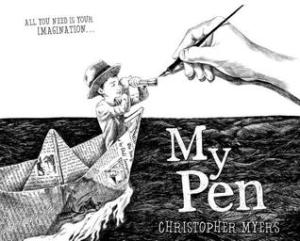
A new picture book from an award-winning illustrator which shows the power of art in a child’s life. Using powerful sketches, the book talks about the freedom and self-esteem that comes from creating art. Myers also speaks to the importance of imagination and creativity, showing an elephant in a teacup and the protagonist riding a dinosaur. He plays with different perspectives and plays the simplicity of ink and pen art against the complexity of world problems that art also speaks to. Even mistakes and errors are embraced along the way, showing children that the goal is not perfection but the experience of creation.

Beautifully written and illustrated, this picture book is a compelling look at creativity and art. The words in the book demonstrate the various aspects of art, showing a playfulness throughout but also allowing moments of gravity and seriousness as well. The book ends with an encouragement to the reader to pick up a pen and see what worlds they discover inside it.

The real focus of this picture book is the art, which is incredibly beautiful. Done in pen, of course, the art is detailed and distinctive. The boy’s face is expressive throughout, as he takes imaginary travels and as he responds to making mistakes on the page. Thanks to the creative subject, one is never sure what is going to be revealed on the next page. With art of this quality, it’s a delight to turn the pages and discover each new image.

Share this with art teachers or in units that encourage creativity. Then have pens ready for children to create their own art on the page, blots and all. Appropriate for ages 4-6.

Reviewed from library copy.