Review: The King and the Magician by Jorge Bucay

king and the magician

The King and the Magician by Jorge Bucay, illustrated by Gusti

There once was a powerful king who asked his subjects who the most powerful man in the kingdom was, and they replied that he was, of course.  The one day, the King heard about a man who had a different power than he had, a humble magician who had the power to predict the future.  Even worse, the King discovered that the magician was well respected and beloved.  So the King called the Magician before him after devising an evil plan.  He would ask the Magician if he could really tell the future.  If the Magician answered “No” then he proved he had no power.  If he answered “Yes” then the King would ask him to predict his own death.  Either way, the King would immediately kill him.  But then a strange thing happened and the Magician declared that he could see the future and that he would die at the same time as the King.  Suddenly, the King’s plan meant nothing.  He could not kill the Magician without hurting himself.  So instead he started protecting the Magician.  Still, the Magician had much more to teach him, if the King would listen.

Bucay has created a picture book that has depths to it.  It is a fairy tale of a king and a magician but it is also about creating one’s fate, listening to wisdom and being willing to change.  It is a book that continues even after some may have ended it with the Magician ensconced in luxury and being protected by the King.  Happily, it doesn’t end there, because the more profound part of the story follows when the relationship between the two men burgeons into friendship and deep caring for one another.  It is a story of how enemies become friends, how power can be used for good.  In a word, it’s exceptional.

Gusti’s illustrations add to that feeling of a very rich and amazing read.  Using paint and collage, the illustrations have a still regal bearing.  There is a strength and solidity to them that grounds this story, making it more realistic.  There are also touches of whimsy, like the teddy bear that accompanies the powerful king everywhere. 

Strong, enchanting and profound, this picture book will start discussions about power, enemies and truth.  Appropriate for ages 4-6.

Reviewed from library copy.
Review: Blue on Blue by Dianne White

blue on blue

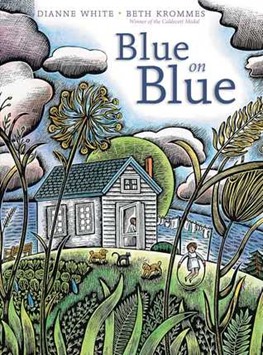
Blue on Blue by Dianne White, illustrated by Beth Krommes

On a family farm, the day starts out with bright sunshine and laundry drying on the line.  Soon though, clouds move in and the weather changes, becoming colder.  The rain starts to fall and it falls for a long time, combined with thunder and lightning.  When the rain slows, the dogs and the little girl head outside, discovering along with the pigs the joy of muddy play in the sunshine.  Sun sets and baths are given.  The night ends with the sparkle of stars in the night sky and everyone tucked into bed except for the whales jumping in the moonlight.

Told in very simple poetry, this picture book shines and shimmers on the page.  White’s poem captures the wildness of a summer storm, the feeling of the endlessness of the rain, and then the slow return to sunshine and warmth.  In particular, she creates that sense of impending storm beforehand as well as the slow pitter patter of the drops as they slow and then end.  Her poetry is complete accessible for even the smallest of children who will enjoy the repetition and the farm setting with all of the animals.

Krommes is a Caldecott-award winning illustrator.  Her scatchboard and watercolor illustrations are incredibly detailed and marvelously textured.  She creates a sense of place so clearly here, with the little house perched on the edge of the water, the whales jumping, and the farm.  Her detailed art plays homage to the simple things in the life, the cat on the other side of the screen door, a jumprope over a bedpost, abandoned umbrellas, and mud. 

This book is a joy and is a perfect springtime or summertime read when the big storms are blowing through.  Appropriate for ages 3-5.

Reviewed from copy received from Beach Lane Books.

Review: Supertruck by Stephen Savage

supertruck

Supertruck by Stephen Savage

There are many brave and hard-working trucks in the city.  There are trucks that help put out fires.  There are trucks that tow.  There are trucks that fix power lines.  And then there is the quiet little garbage truck that just picks up garbage.  Then one day a snow storm hits the city.  All of the trucks are stranded in the snow and unable to move.  All but one little truck, who takes off his glasses and trades in a snowplow.  The little garbage truck heads off to save the day! 

This very simple picture book has a radiant appeal to it.  It combines very cleverly the appeal of trucks and superheroes without it feeling forced at all.  With just the right amount of text for toddlers, even the youngest of children will find lots to love here. 

A lot of the appeal of this picture book is in the illustrations which are bold and colorful.  The boxy trucks are shown against silhouettes of the city, allowing them to really shine.  Perhaps the best touch are the large glasses on the garbage truck before he transforms into Supertruck.  Fans of Superman will find that little touch completely endearing.  And am I the only one who can see a line of toys coming straight out of these illustrations?

Clever, dynamic and heroic, this picture book will please little truck and superhero fans alike.  Appropriate for ages 2-4.

Reviewed from copy received from Roaring Brook Press.

Review: The Everlasting Embrace by Gabrielle Emanuel

everlasting embrace

The Everlasting Embrace by Gabrielle Emanuel, illustrated by E. B. Lewis

A toddler spends her day in Mali strapped to her mother’s back.  Told from her point of view, this picture book celebrates the strong bond that occurs between mother and child as they spend their entire day together.  The little one is bound to her back and they move as one.  She is there as her mother beats millet with a pestle.  There when her mother carries it back home in a basket balanced on her head.  During the day, her mother tickles her, reaching behind to touch her little girl.  They dance together, the rhythms of their day lulling the baby to sleep at times.  They shelter together in the shade the big basket of mangoes makes when her mother carries it.  When they return home, the little girl carries her teddy bear bound to her back.  These days together are precious as the little girl will soon be too big to carry all day.  But the bond they have formed together will never go away.

Emanuel lived in Mali for a year after graduating from college.  While she was there, she shared stories aloud with a little girl, but found that there were no picture books that she could read her about her own country and lifestyle.  So Emanuel created this one.  It is a very strong debut picture book with writing that is confident and a point of view that is unique.  Told from the view of the little girl on her mother’s back, one never worries that she is being neglected or ignored as the mother goes through her day.  Rather one quickly realizes that she is content, cared for and completely part of her mother’s daily life.

Lewis is an extraordinary illustrator.  He captures life in Mali clearly on the page, showing the mother and daughter together at home, walking through the markets, doing chores and spending time together even when the mother is busy doing other things.  There is a joy in his images, a dedication to truly capture this country and its way of life on the page.

Strong, beautiful and unique, this picture book takes children on a journey to Mali where they will see life lived differently and warmly.  Appropriate for ages 4-6.

Reviewed from copy received from Viking.

Review: Tiptop Cat by C Roger Mader

tiptop cat

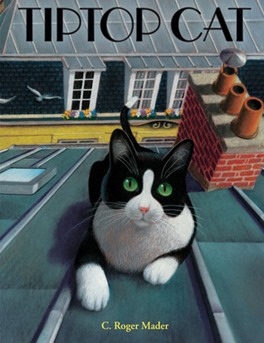
Tiptop Cat by C. Roger Mader

When the cat comes to his new home, he sets out to explore.  He looks around discovers that he can get outside to the balcony.  And from there, he can head up and up to the rooftop where he finds a favorite spot on the top of a chimney.  Then one morning as he is dozing on the balcony, a pigeon comes and lands on the railing.  The cat turns into a hunter and starts stalking the bird, finally pouncing on it.  But birds can fly, and cats cannot.  So the cat fell, down, down, down.  Falling right through an awning and into the arms of a man.  No bones were broken, but the cat lost any desire to head outside.  He hid in baskets, under rugs and behind curtains.  But then, a crow came to the balcony and strutted up and down and once again the cat became interested in the outdoors and in his favorite high-up place.

Mader captures the essence of a domestic cat on the page.  From the very first image of the cat with birthday ribbons, readers will know that this is an author who understands cats and the way they think.  Mader uses very simple language in the book, letting the images tell much of the story.  In fact, the illustrations are so very strong that the book could easily be wordless.

And the illustrations are stunning.  They are detailed and realistic.  The format switches from full page and double page spreads to panels that move the action forward in a wonderfully energetic way.  As the cat moves to the fateful pounce, the panels show him edging forward, lengthening the time before the moment of movement.  In the same way, the larger pages show the cat’s fall down and down, making it last and last, creating real drama on the way down. 

This dazzlingly illustrated picture book will have cat lovers meowing with joy and even the smallest children leaned forward to see what befalls this fearless feline.  Appropriate for ages 2-4.

Reviewed from library copy.

Review: Quest by Aaron Becker

quest

Quest by Aaron Becker

This follow-up to the Caldecott Honor winning Journey continues the wordless travels of the two characters from the first book.  The two children head off on a fantasy quest this time after a king comes through a door and hands them a map.  He is dragged off by soldiers but as he goes, he drops his orange crayon, one that is just like their red and purple ones.  The two children go through the door and find themselves in a new world.  They embark on a quest to bring all of the crayons together, venturing into the depths of the sea, onto desert islands, to pyramids and temples.  At each one they gather another crayon color until they reach the pinnacle of the temple where the bad guys almost get them…

Becker has created a wordless book that has the same appeal as the first book.  The pace here is rapid, giving only a few images for each color that is gathered.  That offers the wild pace of an adventure novel or film, so it suits the subject.  The fast ride adds greatly to the appeal here, never bogging down and always revealing new visual wonders to explore. 

Becker’s art shines on the page.  He creates entire worlds that have real depth to them, that take readers on amazing adventures.  There are great details of color on the page, and I love the way that the various creative ideas of the children all remain in place at the end of the book, completely come to life. 

A celebration of art and creativity, this book along with its predecessor will become beloved reads.  Appropriate for ages 3-6.

Reviewed from library copy.

Review: Flora and the Penguin by Molly Idle

flora and the penguin

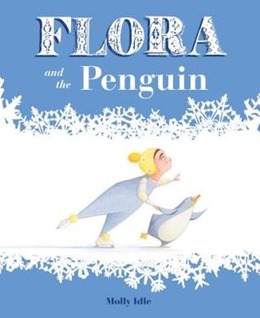
Flora and the Penguin by Molly Idle

This is a delightful wintry follow-up to Flora and the Flamingo, a book that stole my heart when it came out.  With clear connections to the ballet of the first book, this second book has Flora on ice skates swirling with a penguin.  Flora puts on her skates and the penguin climbs out of the water and the two glide together across the page, through different flaps to lift, landing synchronized jumps side-by-side.  But then the penguin disappears back into the water and Flora is left skating alone.  The penguin returns with a fish for Flora, but Flora tosses it back into the water.  The penguin is entirely angry and dejected, so Flora figures out how to repair the budding friendship. 

Idle tells so much in her wordless books.  Who knew that a penguin could communicate so very clearly with the tip of its head, the tilt of its wings and the set of its shoulders.  Flora too communicates her feelings clearly on the page to great effect.  It’s a book that explores friendship, dance and the joy of winter play.

The illustrations are top notch, they invite the reader to glide along with them.  The flaps on different pages are ingenious ways to have readers participate, culminating in one amazing jump the two characters do together.  They amazingly leap right off the page, or perhaps it’s the book that leaps out to catch them.  Beautiful, icy and pure joy.

Another magnificent offering by Molly Idle, this book will be embraced by fans of the first and will make a great holiday gift.  Appropriate for ages 3-5.

Reviewed from copy received from Chronicle Books.

Review: Winter Candle by Jeron Frame

winter candle

Winter Candle by Jeron Frame, illustrated by Stacey Schuett

The residents of the apartment building at Juniper Court celebrate a variety of holidays in the winter months.  It begins with Nana Clover at Thanksgiving who somehow forgot to get candles for her Thanksgiving table.  The building super finds her a lumpy candle and she uses it for her centerpiece.  Two weeks later, the Danziger family needs a havdalah candle for Sabbath.  Nana Clover gives them the lumpy candle she used.  A few days later, Kirsten needs one more candle for her Saint Lucia crown.  In winter, Donte’s little brother has chewed up one of the Kwanza candles.  Later in the winter, a new family has moved into the apartment building.  While they are waiting for their father to come back, the power goes out.  Guess which little candle helps light their night along with that of all the residents!

Filled with a strong sense of community and diversity, this picture book is about more than a litany of different traditions.  Using the small lumpy candle as a symbol, the book speaks to the power of shared moments as a family, the importance of a larger and supportive community, and the beauty of differences.  In each case, the candle is not what the family is looking for.  It’s the wrong color, the wrong shape, and the wrong size.  But it also works in all of its lack of perfection.  The writing in the book is weaves the various stories together, moving the candle from family to family and creating strong bonds.

The illustrations have a traditional feel.  They capture the power and beauty of the candle light as it shines in each family’s apartment.  In the final story, that light leads the father back home and thanks to the illustrations we believe that its power is more than one candle, more than the darkness, and as strong as the community around it.

Ideal for celebrating winter holidays in a way that is not Christmas centered, this picture book is a welcome addition to library shelves.  Appropriate for ages 4-6.

Reviewed from library copy.

Review: What Forest Knows by George Ella Lyon

what forest knows

What Forest Knows by George Ella Lyon, illustrated by August Hall

This poetic exploration of the seasons invites young readers into the forest to see what happens to the animals and plants as the seasons change.  It begins with snow, which is something the forest knows well.  It also knows about waiting, so it waits as the animals in the forest sleep and rest during the cold.  Then buds come and creeks run and birds fly and it’s spring.  All of the animals and insects awaken and come out into the growing grass.  Fruit arrives with fall, nuts ready for squirrels to harvest.  Animals eat to survive the next winter.  Finally, there is snow again in the forest and an invitation to make the forest yours too.

Lyon’s poem is glorious.  She winds through the forest along with the breezes, touching down and pointing out exactly the right things.  It’s a poem that is organic and natural, celebrating everything in the woods, the ongoing changes, and allowing us to see ourselves reflected in the woods as well.  This book is an invitation to explore during all seasons, to look for birds and bugs and mammals as we walk. 

Hall’s illustrations add to that immense appeal of nature and the forest.  His paintings play with the light as it changes through the seasons as well as the colors of the trees and the grass as the time passes.  They are dappled and lush, filled with the movement of the wind and the movement of the leaves. 

A great addition to the crowded shelves about seasons, this picture book combines poetry with gorgeous illustrations.  Appropriate for ages 4-6.

Reviewed from copy received from Atheneum Books for Young Readers.