Review: Oliver and His Egg by Paul Schmid

oliver and his egg

Oliver and His Egg by Paul Schmid

Oliver from Oliver and His Alligator returns in a second book.  While on the playground, Oliver finds an egg, really a large smooth rock, that he imagines will hatch into a big orange-polka-dotted dinosaur.  He would have a new friend and they would go on adventures together.   As Oliver dreams of their adventures, the other children find that he is sitting on the “egg” waiting for it to hatch.  So he tells them of his enormous dinosaur-sized dream and they all have to find eggs of their own.

Schmid’s picture book is simple and cheery.  Oliver is a creative little boy, inventing his own worlds.  The book also shows that all children can be creative and use their imaginations.  Just as in the first book, the text is minimal, offering less than a sentence on each page.  It suits a book that is about imagination to have so much left unsaid.

The illustrations are simple too.  Clearly drawn characters are done in simple lines with small touches of color.  They are combined with the rock “eggs” that are photographed stones, giving them a weight that the light illustrations don’t have.  It’s a dynamic combination on the page.

A cheerful follow-up picture book, this second outing for Oliver is great fun for toddlers.   Appropriate for ages 2-4.

Review: What If…? by Anthony Browne

what if

What If…? by Anthony Browne

Joe is headed to a birthday party and its the first one that he’s ever gone to.  He’s very nervous about what is going to happen at Tom’s party and whether he will enjoy it or not.  Joe’s mother walks him to Tom’s house.  They know what street it is on but not the house number, since Joe lost the invitation.  So along the way they peek into windows to see which is the correct house.  But the things they see in the windows don’t help Joe feel better at all.  There are old people with a staring dog.  There’s an elephant.  And then there are a couple of houses where the people are being very strange indeed.  By the time they find Tom’s house, Joe and his mother are both worried.  Will the party be fun?

This is a book that is permeated by Browne’s signature style.  I love the idea of finding a party by peeking into windows.  Even better, Browne takes it as an opportunity to create wild flights of fancy in each window, each of which is unique and strange.  Most of the text of the book is the discussion between Joe and his mother as they walk down the street, with her trying to persuade him that he will have fun at the party. 

Browne’s art really tells a lot of the story on the page.  The discussions between Joe and his mother are shown in panels with speech bubbles.  They are shown in only blues while what they see in the windows are done in full color.  This makes the different windows pop on the page, in stark contrast to the limited palette of the main characters.  By the end of the book though, Joe and his mother are full color once the party is over. 

Another wondrous book by Browne, this is perfect for getting children worried about new experiences to be creative and even a bit wild about how they think about them.  Appropriate for ages 4-6.

Reviewed from library copy.

Review: Daytime Nighttime by William Low

daytime nighttime

Daytime Nighttime by William Low

A simple and lovely introduction to the creatures that children can see around their houses in both day and night.  The book starts with daytime and the question “What do you see in the daytime?”  The large images throughout show animals like butterflies, rabbits, beavers, and more.  In the middle of the book, a new question is posed about the nighttime.  Now the animals shown are bats, frogs, fireflies and raccoons.  The book ends with the final animal, a teddy bear held by a little girl as she falls asleep in bed. 

Ideal for toddlers, this book only has two full sentences and the rest of the text are single words that identify the animal on the page.  Adults can make it into a game where the child names the animal on the page.  The illustrations of the animals are large and vibrant.  They capture the feel of light and dark in a way has elements of both a photograph and a painting. 

A great pick for bedtime reading, this book will be enjoyed by very small animal lovers.  Appropriate for ages 1-3.

Reviewed from library copy.

Review: Alice Waters and the Trip to Delicious by Jacqueline Briggs Martin

alice waters and the trip to delicious

Alice Waters and the Trip to Delicious by Jacqueline Briggs Martin, illustrated by Hayelin Choi

A follow-up to Farmer Will Allen and the Growing Table, Martin continues to focus on food creators in this new book about Alice Waters.  It follows Waters from her studies in France where she learned about food.  When she returned home, she wanted to share her food finds with her friends but her home was too small to accommodate all of them.  So she created a new kind of restaurant that was like eating in someone’s home, Chez: Panisse.  The book follows Waters on her quest to find fresh, locally-grown foods and produce.  It finishes with her focus on children learning to grow their own foods in schoolyards across the country.  This is a picture book biography that will inspire young readers to grow, eat, and discover their own trip to delicious.

Martin’s text reads as verse on the page, the stanzas unrhymed but spare and filled with moments in Waters’ life that are worth lingering over.  Martin explains in simple terms what the goals of Waters are, but she also manages to inspire and let the ideas soar upwards on the page.  She invites young readers to dream their own dreams, offering them a book about how one person accomplished theirs. 

Choi’s art has a great feel to it with a mix of bright colors and a strong organic feel that is entirely appropriate to Waters.  Throughout the illustrations, readers will see how important people are to Waters’ accomplishments from her friends to her team at the restaurants to the children who plant their school gardens. 

A dynamic and delicious look at the life of Alice Waters, filled with all of the mouth-watering moments of her life.  Appropriate for ages 6-9.

Reviewed from ARC received from Readers to Eaters.

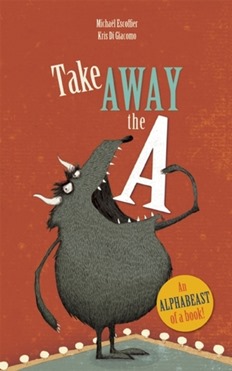
Review: Take Away the A by Michael Escoffier

take away the a

Take Away the A by Michael Escoffier, illustrated by Kris Di Giacomo

A delightful new approach to the alphabet book, this picture book goes through the alphabet and offers words where you take away a letter and get a new word.  So, for example, for letter A, “beast” becomes “best” when you take the A out.  The concept is a simple one, but handled superbly throughout so that it never becomes repetitive or dull.  Instead there is a wonderful humor that pervades the entire book.  Look forward to the end of the alphabet where the simple premise of the book becomes much trickier to pull off, and of course the Z is not to be missed. 

This is the first book by this French author/illustrator team that was not translated from French.  This book with its word play was written in English and offers art and text that is entirely original.  Still, the book has that certain French flair to it that marks their collaborative work.  Escoffier’s word play makes it all look so easy, but young readers will quickly learn that it is not as they try to come up with their own, particularly certain letters.

Di Giacomo’s art is a large part of the European feel of this book.  Her illustrations here tell a story on the page, as if the reader has interrupted a scene in motion by opening the book to that page.  The animals seem to be relating to one another more than to the reader, just waiting for them to go away so that they can begin speaking again.

Clever and deceptively simple, this is a great alphabet book for youngsters who have been read too many as well as elementary children who enjoy word play.  Appropriate for ages 4-6.

Reviewed from copy received from Enchanted Lion Books

Review: Telephone by Mac Barnett

telephone

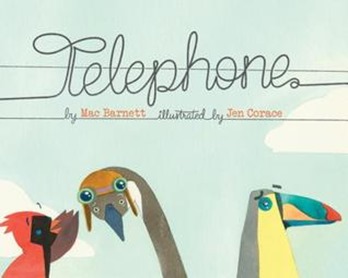
Telephone by Mac Barnett, illustrated by Jen Corace

A mother bird wants her son Peter to come home for dinner, so she sends the message down the telephone line, literally.  It moves from one bird to the next, but the message immediately gets garbled as each bird adds their own take.  Readers will notice that each bird has its own interests that are added to the message and that the illustrations give hints about the topics that will be included that time.  This is a clever twist on the children’s game of telephone, one that has hilarious results and a resoundingly satisfying ending.

Barnett takes a simple concept in this picture book and makes it extraordinary.  His humor is great, making sure that each statement passed along by the birds rhymes but also taken huge liberties with the subject matter.  When the ending comes with a silly bird where the message becomes much longer and incorporates all sorts of things from earlier messages, it makes for a brilliant break in the pattern that sets the final message up perfectly.

Corace’s art is wonderful.  She shows the birds in silhouette on the wire, indicating early to readers what the story will be about.  The illustrations range from close ups of the birds on the wire to more distant shots that show the human neighborhood beneath the wire.  It is all done with great energy, humor and bright colors.

A winning picture book that is clever, funny and simply wonderful.  Appropriate for ages 3-5.

Reviewed from copy received from Chronicle Books.

Review: Little Green Peas by Keith Baker

little green peas

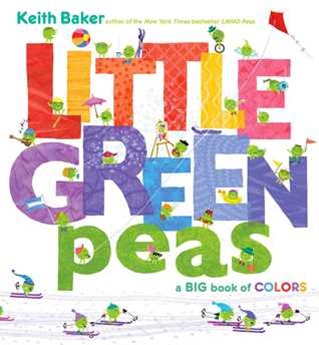
Little Green Peas: A Big Book of Color by Keith Baker

The peas return for their third book, this time focusing on colors.  Peas play on each page, surrounded by a specific color that also shows up in huge letters across the double page spread.  Told in rhyme, the colors are named and objects that are that color are named too.  Young readers can find those objects on the page.  Turn to the next and you get to see even more little green peas enjoying themselves with that color.  Then on to the next.  This colorful read has a great playfulness to it that will keep the youngest readers giggling as they learn their colors.

Baker knows just when his rhyme and structure have reached their limit and then turns it just slightly to make it fresh again.  His little peas are doing all sorts of things on the page and part of the fun of the book is lingering and just seeing what is happening to each little pea.  The illustrations are big and bold, the colors deep and strong.  Yet the little peas and their detailed big fun make this a book best shared one on one.

A great pick for learning colors, children will enjoy the little peas on each page.  Appropriate for ages 1-3.

Reviewed from library copy.

Review: Ninja Red Riding Hood by Corey Rosen Schwartz

ninja red riding hood

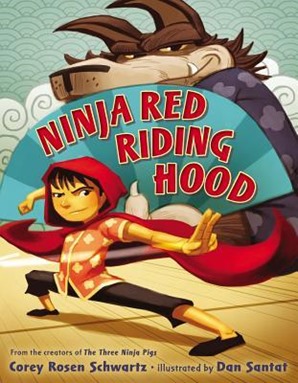
Ninja Red Riding Hood by Corey Rosen Schwartz, illustrated by Dan Santat

This companion to The Three Ninja Pigs mixes ninja training, wolves and girls in red capes into one great homage to the traditional tale.  Wolf can’t catch any animals to eat.  They all defeat him with their ninja skills, so he decides to get training himself.  After practicing for hours, he heads into the woods where he sees Riding Hood carrying a treat to her grandmother.  He suggests that Riding Hood pick some flowers for her grandmother, and dashes off to the grandmother’s house himself.  She isn’t home, so he puts on her clothes.  After Riding Hood slowly realizes that this is not her grandmother in a wonderful mix of traditional and martial arts storytelling, it is revealed that Riding Hood has also had ninja training.  But when the two are evenly matched, it will take one butt-kicking grandmother to save the day.

Schwartz mixes the traditional tale with ninja skills and martial arts to form a tremendously fun book that happily does not leave the original story too far behind.  The moments of the story where the original story is followed closely are quickly turned into a more Japanese and ninja storyline.  Cleverly mixed, one never quite knows what is going to happen from page to page, making it all the more delightful to read and even better to share with a group.

Santat’s art has his signature modern style.  He has a natural feel for comedic timing and that is used extensively in this book.  He mixes in Japanese touches throughout, from the dojo to grandmother’s traditional Japanese home.  Bright, bold and filled with action, this book begs to be shared.

Another successful twisted tale, let’s hope there are more ninja folk tales coming!  Appropriate for ages 4-6.

Reviewed from library copy.

Review: I’m My Own Dog by David Ezra Stein

im my own dog

I’m My Own Dog by David Ezra Stein

This dog takes care of himself.  He tells himself to roll over, he throws a stick for himself and then goes to get it, he scratches his own itches.  Except for the one in the middle of his back, he can’t quite reach it.  So when a human follows him home and knows right where to scratch, the dog adopts him.  He teaches the human how to hold a leash, how to play the stick game, and how to follow commands.  Yes, he has to clean up after the human, but in the end the two of them become the best of friends.

A clever twist on people getting a dog, in this book it is the dog that gets the person.  Stein plays up the humor with his short text that is done entirely from the point of view of this very independent canine.  The book is a quick read with a zippy pace that adds to the pleasure.  Stein’s illustrations are bright and loose.  The watercolor gives a flowing feel to the images and offer gorgeous colors on the page as they mix.

One dynamite dog book, this one will get kids giggling but ends with the honest truth of finding a new best friend.  Appropriate for ages 3-5.

Reviewed from library copy.