Review: Alice Waters and the Trip to Delicious by Jacqueline Briggs Martin

alice waters and the trip to delicious

Alice Waters and the Trip to Delicious by Jacqueline Briggs Martin, illustrated by Hayelin Choi

A follow-up to Farmer Will Allen and the Growing Table, Martin continues to focus on food creators in this new book about Alice Waters.  It follows Waters from her studies in France where she learned about food.  When she returned home, she wanted to share her food finds with her friends but her home was too small to accommodate all of them.  So she created a new kind of restaurant that was like eating in someone’s home, Chez: Panisse.  The book follows Waters on her quest to find fresh, locally-grown foods and produce.  It finishes with her focus on children learning to grow their own foods in schoolyards across the country.  This is a picture book biography that will inspire young readers to grow, eat, and discover their own trip to delicious.

Martin’s text reads as verse on the page, the stanzas unrhymed but spare and filled with moments in Waters’ life that are worth lingering over.  Martin explains in simple terms what the goals of Waters are, but she also manages to inspire and let the ideas soar upwards on the page.  She invites young readers to dream their own dreams, offering them a book about how one person accomplished theirs. 

Choi’s art has a great feel to it with a mix of bright colors and a strong organic feel that is entirely appropriate to Waters.  Throughout the illustrations, readers will see how important people are to Waters’ accomplishments from her friends to her team at the restaurants to the children who plant their school gardens. 

A dynamic and delicious look at the life of Alice Waters, filled with all of the mouth-watering moments of her life.  Appropriate for ages 6-9.

Reviewed from ARC received from Readers to Eaters.
Review: Take Away the A by Michael Escoffier

take away the a

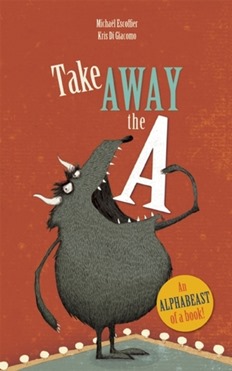
Take Away the A by Michael Escoffier, illustrated by Kris Di Giacomo

A delightful new approach to the alphabet book, this picture book goes through the alphabet and offers words where you take away a letter and get a new word.  So, for example, for letter A, “beast” becomes “best” when you take the A out.  The concept is a simple one, but handled superbly throughout so that it never becomes repetitive or dull.  Instead there is a wonderful humor that pervades the entire book.  Look forward to the end of the alphabet where the simple premise of the book becomes much trickier to pull off, and of course the Z is not to be missed. 

This is the first book by this French author/illustrator team that was not translated from French.  This book with its word play was written in English and offers art and text that is entirely original.  Still, the book has that certain French flair to it that marks their collaborative work.  Escoffier’s word play makes it all look so easy, but young readers will quickly learn that it is not as they try to come up with their own, particularly certain letters.

Di Giacomo’s art is a large part of the European feel of this book.  Her illustrations here tell a story on the page, as if the reader has interrupted a scene in motion by opening the book to that page.  The animals seem to be relating to one another more than to the reader, just waiting for them to go away so that they can begin speaking again.

Clever and deceptively simple, this is a great alphabet book for youngsters who have been read too many as well as elementary children who enjoy word play.  Appropriate for ages 4-6.

Reviewed from copy received from Enchanted Lion Books

Review: Telephone by Mac Barnett

telephone

Telephone by Mac Barnett, illustrated by Jen Corace

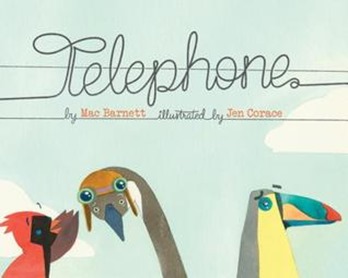
A mother bird wants her son Peter to come home for dinner, so she sends the message down the telephone line, literally.  It moves from one bird to the next, but the message immediately gets garbled as each bird adds their own take.  Readers will notice that each bird has its own interests that are added to the message and that the illustrations give hints about the topics that will be included that time.  This is a clever twist on the children’s game of telephone, one that has hilarious results and a resoundingly satisfying ending.

Barnett takes a simple concept in this picture book and makes it extraordinary.  His humor is great, making sure that each statement passed along by the birds rhymes but also taken huge liberties with the subject matter.  When the ending comes with a silly bird where the message becomes much longer and incorporates all sorts of things from earlier messages, it makes for a brilliant break in the pattern that sets the final message up perfectly.

Corace’s art is wonderful.  She shows the birds in silhouette on the wire, indicating early to readers what the story will be about.  The illustrations range from close ups of the birds on the wire to more distant shots that show the human neighborhood beneath the wire.  It is all done with great energy, humor and bright colors.

A winning picture book that is clever, funny and simply wonderful.  Appropriate for ages 3-5.

Reviewed from copy received from Chronicle Books.

Review: Little Green Peas by Keith Baker

little green peas

Little Green Peas: A Big Book of Color by Keith Baker

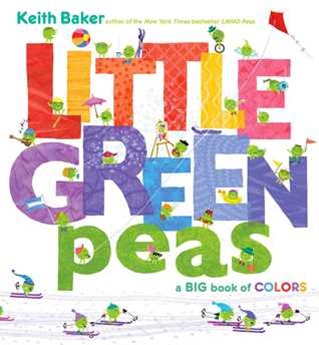
The peas return for their third book, this time focusing on colors.  Peas play on each page, surrounded by a specific color that also shows up in huge letters across the double page spread.  Told in rhyme, the colors are named and objects that are that color are named too.  Young readers can find those objects on the page.  Turn to the next and you get to see even more little green peas enjoying themselves with that color.  Then on to the next.  This colorful read has a great playfulness to it that will keep the youngest readers giggling as they learn their colors.

Baker knows just when his rhyme and structure have reached their limit and then turns it just slightly to make it fresh again.  His little peas are doing all sorts of things on the page and part of the fun of the book is lingering and just seeing what is happening to each little pea.  The illustrations are big and bold, the colors deep and strong.  Yet the little peas and their detailed big fun make this a book best shared one on one.

A great pick for learning colors, children will enjoy the little peas on each page.  Appropriate for ages 1-3.

Reviewed from library copy.

Review: Ninja Red Riding Hood by Corey Rosen Schwartz

ninja red riding hood

Ninja Red Riding Hood by Corey Rosen Schwartz, illustrated by Dan Santat

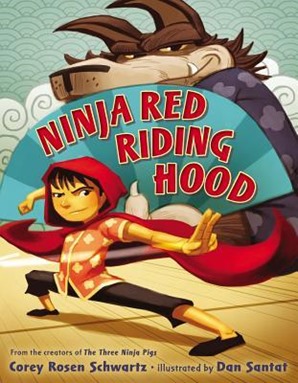
This companion to The Three Ninja Pigs mixes ninja training, wolves and girls in red capes into one great homage to the traditional tale.  Wolf can’t catch any animals to eat.  They all defeat him with their ninja skills, so he decides to get training himself.  After practicing for hours, he heads into the woods where he sees Riding Hood carrying a treat to her grandmother.  He suggests that Riding Hood pick some flowers for her grandmother, and dashes off to the grandmother’s house himself.  She isn’t home, so he puts on her clothes.  After Riding Hood slowly realizes that this is not her grandmother in a wonderful mix of traditional and martial arts storytelling, it is revealed that Riding Hood has also had ninja training.  But when the two are evenly matched, it will take one butt-kicking grandmother to save the day.

Schwartz mixes the traditional tale with ninja skills and martial arts to form a tremendously fun book that happily does not leave the original story too far behind.  The moments of the story where the original story is followed closely are quickly turned into a more Japanese and ninja storyline.  Cleverly mixed, one never quite knows what is going to happen from page to page, making it all the more delightful to read and even better to share with a group.

Santat’s art has his signature modern style.  He has a natural feel for comedic timing and that is used extensively in this book.  He mixes in Japanese touches throughout, from the dojo to grandmother’s traditional Japanese home.  Bright, bold and filled with action, this book begs to be shared.

Another successful twisted tale, let’s hope there are more ninja folk tales coming!  Appropriate for ages 4-6.

Reviewed from library copy.

Review: I’m My Own Dog by David Ezra Stein

im my own dog

I’m My Own Dog by David Ezra Stein

This dog takes care of himself.  He tells himself to roll over, he throws a stick for himself and then goes to get it, he scratches his own itches.  Except for the one in the middle of his back, he can’t quite reach it.  So when a human follows him home and knows right where to scratch, the dog adopts him.  He teaches the human how to hold a leash, how to play the stick game, and how to follow commands.  Yes, he has to clean up after the human, but in the end the two of them become the best of friends.

A clever twist on people getting a dog, in this book it is the dog that gets the person.  Stein plays up the humor with his short text that is done entirely from the point of view of this very independent canine.  The book is a quick read with a zippy pace that adds to the pleasure.  Stein’s illustrations are bright and loose.  The watercolor gives a flowing feel to the images and offer gorgeous colors on the page as they mix.

One dynamite dog book, this one will get kids giggling but ends with the honest truth of finding a new best friend.  Appropriate for ages 3-5.

Reviewed from library copy.

Review: You Are (Not) Small by Anna Kang

you are not small

You Are (Not) Small by Anna Kang, illustrated by Christopher Weyant

An orange bear declares to a smaller blue bear that the shorter one is “small.”  The little one says that that is not true, rather the orange bear is “big.”  The orange bear shows that he has other big creatures just like him and just his size, but so does the blue bear.  The two groups start to argue and fight about whether they are big or small.  Then another creature arrives and another one yet that help put size into perspective for everyone. 

This very simple book has a great sense of humor throughout.  The creatures that seem like bears to me are fuzzy and friendly.  Against the white background, the bears pop on the page.  With only a few lines per page, this book will be enjoyed by small children learning about concepts like big and small.  The humor makes the entire lesson in size and relativity completely enjoyable and it will be a book that children will ask to be read again.  There is even a great little (or big) twist at the end.

Weyant’s illustrations are a large part of the appeal of the book.  The New Yorker cartoonist has created fuzzy creatures that are loveable and cute as can be, no matter what size they are.  Weyant has clearly loved playing with the differences in sizes, creating characters who live large on the page.

Bold illustrations, charming characters and funny situations make this a winning picture book for the smallest (and largest) among us.  Appropriate for ages 2-4.

Reviewed from ARC received from Two Lions.

Review: Julia’s House for Lost Creatures by Ben Hatke

julias house for lost creatures

Julia’s House for Lost Creatures by Ben Hatke

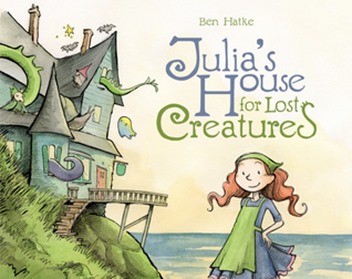
The author of Zita the Spacegirl has created his first picture book and it has all of the charm and zip one would expect.  Julia lives in a house carried on the back of a turtle.  They arrive on a quiet beach by the sea where Julia quickly settles in, but it is far too quiet.  So Julia makes a sign that says “Julia’s House for Lost Creatures.”  She didn’t have to wait long before something is at the door, and then more and more creatures.  Soon she has a house full of odd beasts, including a dripping troll, a patchwork cat, a dragon, a ghost, and a mermaid.  Things quickly get out of hand as they all make themselves at home.  Now Julia needs another plan, and maybe another sign or two.

Hatke’s jaunty protagonist is what makes this book work.  She moves quickly and with plenty of determination and is filled with ideas.  One can almost see her thinking on the page.  Perhaps the best part of the book is when she becomes overwhelmed and has to rethink.  The book has been galloping along and then pauses as Julia does, slowing to a pace that lets one catch their breath.  It’s a wonderfully done moment just like many others in the book.

Told very simply, the book relies nicely on the illustrations to show much of the action rather than the text explaining it.  This makes for a very readable picture book, but also one that is better for lap reading than for a group.  Listeners will want to look closely at the page even before the amazing creatures fill them.

An exceptional picture book debut, one hopes that Hatke keeps created both picture books and graphic novels for children.  Appropriate for ages 4-6.

Reviewed from copy received from First Second.

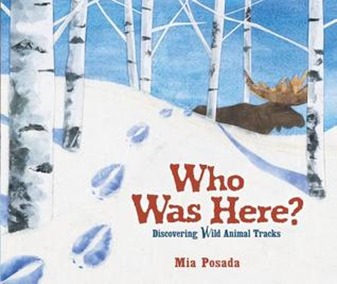
Review: Who Was Here? by Mia Posada

who was here

Who Was Here? Discovering Wild Animal Tracks by Mia Posada

The riddle of animal tracks is deciphered here in a fun guessing game.  The tracks of each animal are displayed along with information about the tracks and the animal that left them.  Readers then turn the page to see whether they guessed right about what animal left those tracks.  The pages with the animal have scientific information about the animal, their size, weight and their tracks.  Tracks are left in mud, snow, sand and more.  These too are hints about the animals, making the book speak to habitat too.  This interactive book will have children embracing science and learning about animals without even realizing it.

Posada encourages children to learn more in the final pages of her book.  She gives hints to decode animal tracks, offering ideas of what to look for in unknown tracks to help identify them.  The book ends with links to websites and recommended books to read.  Posada uses the page turn to great effect in this book, allowing the reveal to be a big part of the delight of reading this book.  The guessing game element will be popular in story times but also for single readers. 

Done in watercolor and collage, the illustrations have dimension and texture.  The animals pop on the page and their tracks are clear and beautiful.  When Posada has two creatures from the same habitat, their tracks are well defined and clearly different from one another.  This adds to the fun of the read.

A nonfiction picture book that children will enjoy, this readable and accessible book will be a hit at any story time.  Appropriate for ages 6-9.

Reviewed from digital galley received from Netgalley and Millbrook Press.