Review: Miss Brooks’ Story Nook by Barbara Bottner

miss brooks story nook

Miss Brooks’ Story Nook by Barbara Bottner, illustrated by Michael Emberley

A sequel to Miss Brooks Loves Books, this picture book celebrates story telling.  Missy loves going to Miss Brook’s Story Nook right before school each day.  She takes the long way to school, because otherwise she has to go past Billy Toomey’s house and he steals her hat and yells at her.  Then one day at Story Nook, the power goes out so they have to tell their own stories.  Missy though insists that she’s a reader not a storyteller.  But soon she is telling her own story, inspired by Billy Toomey.  It is the story of an ogre named Graciela who has a pet snake that escapes.  The trick is that Missy needs to figure out a satisfying ending to her story of an ogre and a bully.

Bottner has created another engaging story filled with humor and clever solutions.  Miss Brooks is inspiring with her enthusiasm for books and stories and the way she encourages the children to keep making their stories better.  It’s a joy to see Missy tell her very creative story, struggle with some of it but persevere and create a satisfying tale for the entire class to enjoy.

Emberley’s illustrations add a lot of zing to the book.  He captures moods so clearly in his characters from the jaunty excitement of Miss Brooks to Missy’s ever-changing moods.  They are told through expressions and also body language. 

Smart and funny, this is a book to inspire young readers to create their own stories just like Missy.  Appropriate for ages 6-8.

Reviewed from digital copy received from Edelweiss and Random House.

Review: Forget Me Not by Nancy Van Laan

forget me not

Forget Me Not by Nancy Van Laan, illustrated by Stephanie Graegin

This look at the impact of Alzheimer’s is personal and touching.  Told in the first person, the book looks at the changes of Julia’s grandmother.  Her grandmother used to make favorite foods, have her house just so, and even smelled of cinnamon and lilac when they cuddled.  But as time passed, her grandmother started forgetting more and more.  She made mistakes and even started to forget who her family members were.  A little later and Julia’s grandmother started to forget what they had done together in the past, she wasn’t allowed to drive anymore, and her cooking wasn’t the same.  She got worse and worse until she had to be given special care in a home.  Julia and her family have to make the best of it, and that means that Julia has to find a way to continue to connect with her grandmother even though she can’t remember her.

Van Laan uses a delicacy of language her to weave her story.  Since the entire book is about loss of memory and the loss of a grandparent to Alzheimer’s, this delicacy sets a lovely tone for the book.  As the changes start to happen, Van Laan describes them: “But ever so slowly, like a low tide leaving the bay, a change came along.”  Filled with constant change, the book captures moments along the way, showing how Julia’s grandmother is worsening but also how they continue to keep her spirit alive and well during the changes.

Graegin’s illustrations show the changes in the grandmother but also maintain a sweetness that never leaves the story.  Despite the grandmother’s decline, the light remains bright in the illustrations and the family stays close knit in a visual way.

There are many books about Alzheimer’s available now, but this one takes just the right tone and gives information that young children are looking for.  Appropriate for ages 4-6.

Reviewed from digital galley from Edelweiss and Random House Children’s Books.

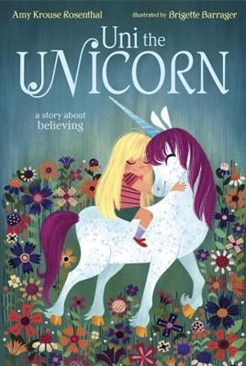
Review: Uni the Unicorn by Amy Krouse Rosenthal

uni the unicorn

Uni the Unicorn by Amy Krouse Rosenthal, illustrated by Brigette Barrager

Released August 26, 2014.

Do you believe in unicorns?  One might expect the main question of this book to be just that, but instead it’s a question of whether unicorns should believe in little girls.  Uni was a normal unicorn in most ways.  She may have had extra sparkly eyes and her mane may be extra luxurious, but she could heal with her horn like the others and make wishes come true too.  But the one thing that made Uni different was that she believed that little girls were actually real!  Her parents just smiled at her when she insisted little girls were real and her friends laughed at her.  But Uni just knew that somewhere in the world was a little girl just for her.  And out in the world, there was.

Rosenthal has written a book with a surprise twist that makes it fresh and radiant.  Using the unicorn as the heart of the book and indisputably real is a delightful way to approach this mythical beast.  Rosenthal writes that both the unicorn and the girl are looking for a friend who is “strong smart wonderful magical.”  The emphasis on that rather than beauty is appreciated, particularly in a book about unicorns. 

Barrager’s art is lush and colorful.  Her digital illustrations feel like pop art with their modern edge.  Showing Uni longing for her little girl by reading books and drawing pictures is a clever and clear way to tie her to the little girls who may be longing for a unicorn.

I’m not a huge unicorn fan and hate drippy books that are too sweet.  Unicorn fans will adore this book and those of us on the lookout for books that are saccharine will be pleasantly surprised.  Appropriate for ages 3-5.

Reviewed from ARC received from Random House Children’s Books.

Review: Flashlight by Lizi Boyd

flashlight

Flashlight by Lizi Boyd

Released August 12, 2014.

The author of the fantastic Inside Outside returns with another wordless book featuring the same little boy.  Here the boy is outside in a tent at night and uses his flashlight to explore.  As he moves around, his flashlight shows white and color against the deep black and greys of the rest of the scene.  He locates his lost yellow boot, finds different animals out at night, sees plants and fish, and finds an apple to eat.  But then he trips and his flashlight goes flying until it is found by a raccoon who uses it to show the boy himself in the beam.  Then all of the animals get a turn with the flashlight until they lead the boy back to his tent.

I adore this book.  It is so simple with the pitch blackness of the page, the grey lines that show the characters and nature, and then that surprising and revealing beam of light that cuts a swath through the darkness.  One reason it works so well is that the rest of the page is not complete darkness, instead you get a feel of the woods around and the animals, but when the light does shine on them even more is shown. 

Boyd uses small cutouts on the page to great effect.  They reveal dens, flowers, small touches.  In their own subtle way, they too shine a light of attention on even smaller components of the illustrations.  They are a subtle but important part of the book.

Beautiful, dark and mysterious, this picture book is a wordless story of exploration and wonder.  Appropriate for ages 2-4.

Reviewed from copy received from Chronicle Books.

Two by Tullet

Herve Tullet is one of the most innovative picture book authors around today.  I look forward to his books to see what he will come up with.  This year, we have two new books by him.

help we need a title

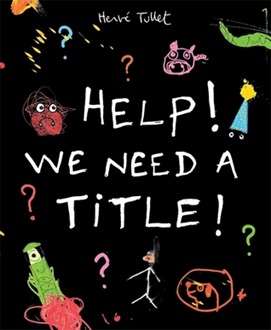
Help! We Need a Title! by Herve Tullet

This first book is not quite ready to be read yet.  In fact, the characters inside are still getting ready.  There isn’t really a story, though they are looking for one.  And the characters themselves are rough sketches rather than lovely images.  In fact, the entire inside of the book is a mess.  Perhaps if we found an author?  But even that doesn’t help much, especially when the characters are disappointed in the story he creates for them.  Yet in the end, it is a book, with a story, some funny moments, and it even manages to tell readers how a book is created and what its elements are.

Quite clever, once you get past the rough illustrations and embrace them as part of the concept.  Tullet himself appears in the book, his photographed head and shoulders plunked onto a drawn body.  The entire book feel unfinished, but that’s exactly the way it’s supposed to feel.  This is a clever way to introduce young children to authors, writing, and how stories are crafted.

mix it up

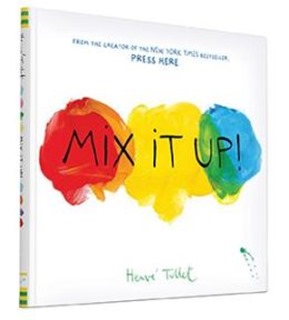
Mix It Up! by Herve Tullet

Released September 16, 2014.

Following his clever Press Here, this book invites readers to touch the pages once again.  Except in this book, readers are mixing colors, mashing things together, combining things, and having a marvelous messy time.  Tullet excels at creating books that are immensely participatory despite having no flaps or pop ups.  It’s all in the readers’ imaginations and that’s such a wonderful thing.

I consider this one of the best picture books about color that I have ever seen.  Thanks to the feel of mixing the paints yourself, readers are left with a deeper understanding of color.  They will get to add white to colors and see what happens, and black as well.  They create secondary colors from primary ones and leave their own hands on the page too.  Clever, interactive and wildly imaginative, this is another winner from Tullet.

Both books are appropriate for ages 3-5 and both will be embraced by readers of all ages.

Review: The Girl and the Bicycle by Mark Pett

girl and the bicycle

The Girl and the Bicycle by Mark Pett

This follow up to The Boy and the Airplane features a girl who is longing for a new green bike that she sees in a shop window when walking with her little brother.  But she doesn’t have enough money for it, even after emptying her piggy bank, digging through pockets in the laundry and looking under the couch cushions.  She even tries selling lemonade and her toys.  That autumn, she has another idea to make money and finds someone willing to pay her for raking leaves.  She continues to do chores for them through the winter and into the next summer.  Finally, she has enough money for the bicycle.  But when she gets to the store, the bike is gone.  Don’t worry, her hard work will pay off in the end!

Pett has a touch for wordless picture books. The subtle humor throughout also helps make the book very readable and approachable for children.  They will relate to the longing for a new toy and through this book will learn about the power of resilience, hard work and patience. 

Pett’s subjects could easily veer into saccharine qualities, but that is nicely avoided thanks to his deft timing throughout the book and the way that the sweet endings come with real sacrifice and work on the part of the characters.  His illustrations have a vintage feel but also a modern cartoon aspect.  Done in sepia tones, the dark green of the bike pops clearly on the page. 

A wordless book for slightly older preschoolers, this book is a rewarding read.  Appropriate for ages 4-6.

Reviewed from copy received from Simon & Schuster.

Review: Here Comes Destructosaurus! by Aaron Reynolds

here comes destructosaurus

Here Comes Destructosaurus! by Aaron Reynolds, illustrated by Jeremy Tankard

Destructosaurus enters town tipping buildings over as he rushes in.  His feet are filthy from seaweed and fish.  He is angry and shoots flames from his mouth, doesn’t he know he needs to burp quietly and keep his mouth closed?  Destructosaurus gets grumpier and starts to show attitude, throwing buildings around and generally throwing a temper tantrum too.  But then he finds what he was looking for the whole time and settles down, but he won’t stay to help clean up the mess.  Maybe someone else will?

Told in an adult voice scolding Destructosaurus for his lack of manners and his tantrum, this picture book is a blast to share aloud.  Children will immediately recognize the tone of the voice and will delight in it being focused on a rampaging monster.  The humor here is wonderfully broad and right in your face.  It will appeal to toddlers who have their own tantrums and older children who will enjoy the play of monster movie and parent.

Tankard’s illustrations are bight colored and loud.  They zing with energy as the monster enters the city and destroys it.  The monster is done in thick strokes that set him apart from the landscape, allowing him to pop and seem even larger than the surrounding buildings.

A zany and fun look at tantrums, this book will be appreciated by parents and children alike.  Appropriate for ages 2-4.

Reviewed from copy received from Chronicle Books.

Review: Matilda’s Cat by Emily Gravett

matildas cat

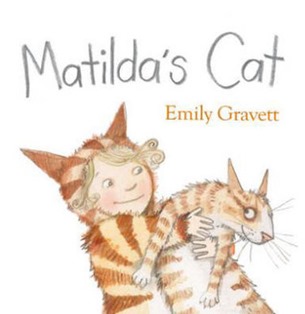
Matilda’s Cat by Emily Gravett

Matilda thinks her cat loves to do a lot of things.  But really, it’s Matilda who loves playing with wool, climbing in boxes, and riding bikes.  All of those things scare her cat.  It’s Matilda who loves tea parties, hats, and swords.  She loves drawing pictures, climbing trees and reading bedtime stories.  And she does it all dressed in her cat costume.  At the end of the book, Matilda has crossed off all of the things she likes because her cat doesn’t like them and made a huge list of everything her cat does NOT like.  But there is one thing her cat does like after all, Matilda!

Gravett excels at creating quirky and marvelous picture books for children.  Here she captures the reaction of a cat perfectly on the page, his ears back and his eyes wide with worry.  The text is at first a list of everything that the cat should like, but then the lists clearly turn to what the little girl enjoys instead.  Through it all, the cat’s concern is the same but it is still inquisitive enough to stay around Matilda and all of her activity. 

The simple text lets the illustrations tell the real story and the real reaction of the cat.  It was a great choice to have Matilda look very much like her cat, so the two show different reactions to the activities.  The illustrations pop against the large amount of white space, making this a book that could happily be shared with a group, since it read aloud well.

A great pick for reading at story time or units about pets or cats, this picture book is another winner from Gravett.  Appropriate for ages 3-5.

Reviewed from copy received from Simon and Schuster.

Review: Sparky! by Jenny Offill

sparky

Sparky! by Jenny Offill, illustrated by Chris Appelhans

A little girl wanted a pet but her mother would only let her have a pet that doesn’t need to be walked, bathed or fed.  So the girl went to the library and the school librarian pointed her towards sloths.  Her sloth arrived in the mail and she named him Sparky.  She immediately took him to his tree where he went promptly to sleep.  He didn’t wake up for two days.  She tried playing games with him but they didn’t really work since the girl won every single time.  The only game that Sparky could win was Statue.  He was really good at it.  That weekend, Mary Potts came over to see the sloth, but she didn’t approve.  She said her parrot could say twenty words and her cat could walk on its hind legs.  The girl said that Sparky could do tricks too, and now she would have to prove it.  But what in the world can Sparky actually do?

Told in the first person by the little girl, this book celebrates a pet may not be able to do traditional tricks like other more active animals, but definitely can hold its own as a companion.  Offill has created a wonderful story filled with gently funny moments like trying to play hide-and-seek with a sloth that doesn’t move.  As the girl trains the sloth to do tricks, I was happy to see that Sparky remained steadfastly a sloth and didn’t change into something else at all. 

Appelhans’ illustrations also have a great quietness to them.  Done in watercolor and pencil, they are subtly colored, with the backgrounds and characters primarily in browns.  Then there are occasional pops of red too.  My favorite picture is the sloth arriving via mail with his arms, legs and head popping out of the box and the up arrow facing straight down as if he should be carried on his head. 

This is a book that is slow, steady and heartfelt, just like Sparky himself.  Appropriate for ages 3-5.

Reviewed from copy received from Random House Children’s Books.