Review: The Pilot and the Little Prince by Peter Sis

pilot and the little prince 

The Pilot and the Little Prince: The Life of Antoine de Saint-Exupery by Peter Sis

Born in a time when airplanes were just arriving in the skies, French author Antoine de Saint-Exupery had dreams of flying himself.  At age 12, Antoine made his own flying machine that didn’t work.  He spent his days at the nearby airfield watching the pilots fly.  He even convinced one of them to take him up with him.  After serving in the military, Antoine took a job delivering the mail by plane.  Antoine was put in charge of an isolated airfield himself.  It was there that he started to write, but he also kept on flying, helping create new air routes in South America.  He returned to France eventually and got married.  He continued to both write and fly even after moving to New York, having famous adventures and also creating his beloved Little Prince.

Sis beautifully shows the life of a man with two strong passions: writing and aviation.  He very effectively ties the two together, showing how they support one another though they may seem so separate and apart.  This is a book less about the creative process of an artist and more about the adventures that he had that inspired his writing and the eventual creation of a character who is beloved around the world. 

As always, Sis’ illustrations are dazzling in their minute details.  He playfully puts faces on mountains that form the landscape below the plane.  He creates the Manhattan skyline in fine lines with the red of the sun peeking over the horizon.  And then there are the smaller touches on the page that one lingers over and that add further information as well.

A dynamic picture book biography of an unusual author, this book demonstrates that there are many paths to becoming a writer and that the best path is your very own.  Appropriate for ages 6-9.

Reviewed from library copy.
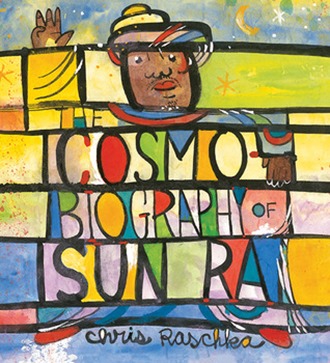
Review: The Cosmobiography of Sun Ra by Chris Raschka

cosmobiography of sun ra

The Cosmobiography of Sun Ra by Chris Raschka

Caldecott Medalist Chris Raschka has both written and illustrated this picture book biography of the jazz musician Sun Ra.  Sun Ra claimed that he came from Saturn.  He came to earth in 1914 in Alabama and he was named Herman and called Sonny.  From the very beginning, Sonny loved music.  He learned to be a musician as a young child and also studied about philosophy.  As a teen, Sun Ra was already a professional musician.  When World War II came, he refused to become a soldier and instead was labeled a conscientious objector.  After the war, Sun Ra returned to his music and formed The Arkestra.  They made wild jazz music, created their own costumes, and toured the world sharing their music.  Sun Ra left earth in 1993, having changed it for the better with his music.

Raschka has created a celebration of Sun Ra on these pages.   His text is playful and invites readers into the book.  It opens with the idea that Sun Ra was from Saturn and scoffs at that, but then plays along with it as a premise throughout the book.  Intelligently, children are invited in on the humor and can see what is really happening that way.

Raschka’s illustrations are bright and loose.  They suit the jazz of the music with their free flowing lines, deep colors and they way they capture landscapes as well.  These are illustrations that celebrate music on a deep level.

A beautiful picture book about a jazz legend, this picture book should be welcome in all library collections.  Appropriate for ages 6-8.

Reviewed from library copy.

Review: Emily’s Blue Period by Cathleen Daly

emilys blue period

Emily’s Blue Period by Cathleen Daly, illustrated by Lisa Brown

An intriguing mix of subjects, this picture book combines art with divorce and it works gorgeously.  Emily really likes the work of Picasso and the way that he put body parts in odd places in his cubist work.  It reflects the way that Emily feels about her own family life, with her father now living in a different home than the rest of them.  Emily tries to help her father pick out furniture for his new home, but it’s not easy and her little brother quickly becomes problematic at the store and has to be carried out.  Even art becomes less fun for Emily.  She feels blue a lot of the time and not like using any other colors.  Then her art teacher shows her about collage, and Emily finds a way to express her feelings through her art and depict her family in their own unique style.

Told in short chapters, this picture book is just right for elementary students.  The unique combination of subjects works particularly well, each supporting the other and allowing them to be explored in more depth.  Daly manages to use art to show the emotions of children experiencing a divorce and the divorce to show the importance of art in expressing yourself when you can’t find the words. 

Brown’s art is light-handed and friendly.  She captures Picasso’s art with that same light touch and creates Emily’s blue time with plenty of blue but no darkness.  The result is a book that is filled with light, despite it’s more somber subjects.  It keeps the book from being too serious and allows the emotions to surface nicely.

A striking combination of art and real life, this picture book truly shows the power of art in one’s life.  Appropriate for ages 5-8.

Reviewed from library copy.

Review: Tuesday Tucks Me In by Luis Carlos Montalván

tuesday tucks me in

Tuesday Tucks Me In: The Loyal Bond between a Solider and His Service Dog by Luis Carlos Montalván

A child-friendly version of this author’s adult book about his service dog, this picture book version is told from the dog’s point of view.  Focusing on a single day together, the book shows how Tuesday takes care of Luis and helps him cope with his PTSD symptoms as they arise.  Tuesday also helps Luis remember to take his medication.  The two visit a veterans hospital together and then relax a bit at the dog park where Tuesday gets to play just like any other dog.  Throughout their day together in the city, Tuesday is there to reassure Luis when walking, when it gets too crowded, and when he gets overwhelmed.  But this is a special day and Luis has a surprise for Tuesday! 

This book tells such an important story, not only about a service dog but about the recovery of a veteran surviving PTSD.  The text is simple and straight forward, following the pair throughout their day.  What shines from the page are the pictures, the obvious love the two have for one another, the joy they find together, and the support that goes both directions.  Tuesday is wonderful in images, just the kind of gentle dog that everyone wants to love. 

Children who need service dog help will see themselves on the page.  The book expands the idea of what service dogs are for, offering a broader look at the power of these dogs to aid and calm. 

A very strong nonfiction picture book, this would make a good addition to dog story times and units on soldiers.  Appropriate for ages 4-6.

Reviewed from library copy.

Review: Norman, Speak! by Caroline Adderson

norman speak

Norman, Speak! by Caroline Adderson, illustrated by Qin Leng

A boy and his family adopt a dog from the animal shelter.  The boy has a hard time choosing a dog and finally decides to take Norman, because he’s been there the longest.  Norman was a stray and doesn’t really have a tail, more of a stump, but he can wag it along with his entire backside.  Once they got home, they discovered that Norman did not follow basic dog commands at all.  He just tilted his head sideways and didn’t do anything.  The family realized that Norman was just not smart, but at least he was funny and friendly.  Then one day in the park, a man was playing with his dog and Norman started to follow the commands!  But the boy couldn’t understand a word of what the man was saying, he was speaking in Chinese.  Norman spoke Chinese!  Now it was up to the family to figure out how to communicate with their Chinese-speaking dog.

Adderson’s gently humorous text leads readers to simply believe that this is the story of a rather slow dog being adopted into a family.  The twist of the language appears abruptly, changing the course of the book and the reader’s opinion of Norman in an instant.  It works tremendously well thanks to the set up in the text before that.  Perhaps the best part of the book is the family’s attempt to learn Chinese so they can speak to their dog.  I love that the solution is changing themselves instead of changing Norman.

Leng’s illustrations have the same quiet humor as the text.  They feel like glimpses of real life moments, unstaged and candid.  Done in simple lines and quiet colors, they support the story and help tell it.

A celebration of diversity and differences in doggie form, this picture book is just as clever as Norman.  Appropriate for ages 4-6.

Reviewed from library copy.

Review: Not My Girl by Christy Jordan-Fenton

not my girl

Not My Girl by Christy Jordan-Fenton and Margaret Pokiak-Fenton, illustrated by Gabrielle Grimard

Continue the story of When I Was Eight with this second picture book by the authors.  The picture book versions follow two highly acclaimed novels for elementary-aged children that tell the same story at a different level.  In this book, Margaret returns home to her native family from the outsiders’ school.  Her hair has been cut short, she has trouble speaking the language of her people, and her skills are more suited to school than life in the Arctic.  When her mother sees her for the first time, she exclaims “Not my girl!” and rejects her daughter.  Slowly, Margaret begins to rebuild her old life and relearn the ways of her family and their traditional life.  But it takes time to be accepted by her mother and to find her way around her newly reunited family.

The Fenton family writes all of their books from the heart, clearly creating a case for the damage of the white people and their schools on the lives of Native people and their children.  This book serves as the other side of the story from When I Was Eight, demonstrating that even when children were returned to their families it was not easy to integrate once again into that society because of the changes wrought by the schooling system.

Grimard’s illustrations show the Arctic landscape, the way Margaret doesn’t fit in with her clothing or her ways.  It also shows the love of her father, his patience and understanding and the slow thaw of her mother and her anger.  Grimard captures these emotions with a delicacy and understanding of all of them.

Another impressive entry into the story of Margaret and her childhood, this book should be paired with the first picture book to best understand Margaret’s story.  Appropriate for ages 5-7.

Reviewed from library copy.

Review: Edward Hopper Paints His World by Robert Burleigh

edward hopper paints his world

Edward Hopper Paints His World by Robert Burleigh, illustrated by Wendell Minor

Released August 19, 2014.

Even as a child, Edward Hopper lived as an artist.  He spent his days drawing as much as he could, preferring drawing to playing baseball with the other boys.  After high school, he headed off to New York City to study art.  Then Hopper went to Paris to learn even more, spending time painting outside.  When he returned to the US, he got a job as an illustrator for magazines, but wanted to spend time painting what he wanted to, not for others.  He started painting old houses in his work and after getting married he spent time wandering the countryside on Cape Cod, finding scenes that moved him and they weren’t the typical images of gardens and farms.  He also painted things in the city that spoke to him.  Eventually the critics and galleries discovered Hopper and he gained attention, but it didn’t change him, even his final work speaks to his unique vision and approach.

Burleigh has written a book about an important American painter but even more than that, he has captured the small things that made him great.  The book speaks to the importance of allowing yourself time to learn a craft and getting an education.  It also speaks to staying true to yourself and your vision whether it is accepted at the time or not.  And then there is the importance of perseverance and following your dream even if it doesn’t make a lot of money.  Hopper teaches all of this in his quiet way.

Minor’s artwork shines in this picture book.  He brilliantly captures the feel of Hopper’s work without copying it directly but these images are also clearly Minor’s own as well.  Pictures of some of Hopper’s most famous work is shared at the end of the book and it is there that one realizes what a profound mix of two artists’ work has happened here.

A very strong addition to the growing collection of picture book biographies about artists, this book has much to offer budding young artists as well as art classes.  Appropriate for ages 6-9.

Reviewed from ARC received from Wendell Minor.

Review: Queen Victoria’s Bathing Machine by Gloria Whelan

queen victorias bathing machine

Queen Victoria’s Bathing Machine by Gloria Whelan, illustrated by Nancy Carpenter

Queen Victoria longs to get out of the heat of the summer as well as her itchy clothes and tight corset and just be able to swim in the sea.  But her lady-in-waiting collapses even considering the scandal that could take place if someone were to see the queen before she reached the water!  The queen gives up the idea, realizing that there is no way that she could be properly dressed and still able to swim.  Prince Albert though wants to try to figure out a way to get his beloved wife into the water.  Albert came up with many ideas, but none of them worked.  Then he struck upon a wonderful idea, a wheeled wooden cart that could be pulled right into the water.  This true story of a queen who wanted a touch of freedom ends with an image of the restored bathing machine that is now on the Isle of Wight in England. 

Whelan takes a wonderfully playful look at solving the queen’s swimming problems.  She makes sure that at the base of the entire story is the adoration between Albert and Victoria, a rich love story even though they were monarchs and parents.  Cleverly having a fainting lady-in-waiting who is the voice of propriety in the book helps children understand the expectations of decorum in a previous day.  Whelan writes in a free rhyming verse here, the looseness of the poems feel simple by belie that skill that it takes to write in this style.

Carpenter’s illustrations also have a sprightly humor to them.  They also celebrate the love of the two historical figures.  Perhaps the most joyful images are Victoria finally able to swim and cavort in the water.  Or maybe it is the final illustration where Victoria is happily held in Albert’s arms dripping and happy. 

This piece of historical fiction is based on a true story and shows creativity and problem solving galore.  Appropriate for ages 5-8.

Reviewed from copy received from Simon & Schuster.

Review: B Is for Box by David A. Carter

b is for box

B Is for Box by David A. Carter

With the happy little box on the cover smiling at you, this book is impossible not to want to open and explore.  It is made all the more enticing by being a David Carter pop-up book.  Happily this alphabet pop-up does not disappoint.  Done in a simple style, the pop-up features are mostly about pulling tabs or turning wheels.  There is a small finale at the end, but don’t expect large elaborate pop-ups in this little book.  Instead they are just right for small hands to explore and not damage.  Built of heavy paper stock, this pop-up would make a good one to start small children on the wonders of books that turn into 3D.

Carter’s text is has a lively lilt to it and carries nicely throughout the alphabet.  There are no huge surprises here in the text, the delight mainly comes from the pop-ups, the tabs and the levers.  Though simple, they have a strong appeal, just as opening the flaps on the pages do too. 

Careful toddlers will enjoy this book that will dance them through the ABCs with ease.  Appropriate for ages 2-4.

Reviewed from copy received from Little Simon.