Review: Migrant by Jose Manuel Mateo

migrant

Migrant: The Journey of a Mexican Worker by Jose Manuel Mateo, illustrated by Javier Martinez Pedro

In this bilingual book, a boy from Mexico talks about the changes in his family and his village as people leave Mexico to find work in the United States.  The story begins with the boy speaking about his village and how it used to be as a farming community with small farms where he would play.  But then things changed and soon the village was just women and children with all of the men gone to find work elsewhere.  When his mother was unable to find work in the village and his father’s money stopped arriving, the had no choice but to leave too.  The story changes to one of escape, hiding and running, one that mirrors that boy’s games as a small child, but they are no longer fun here.  The family makes it safely to Los Angeles, but there are new barriers in the way with the new country.
migrant inside

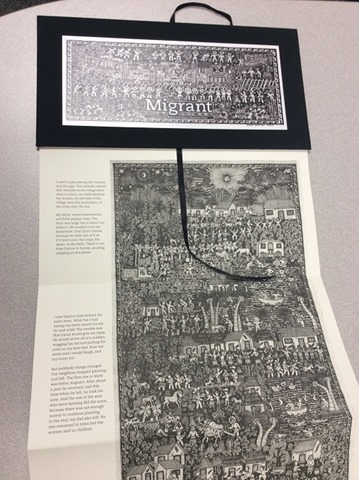
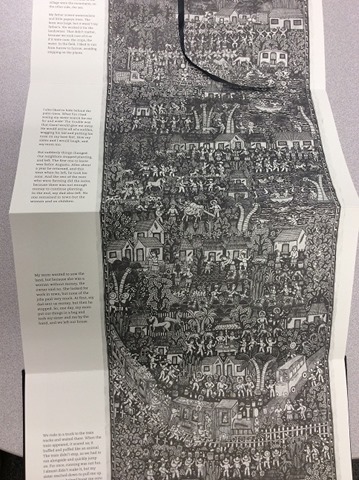
Told in a unique vertical format that echoes the ancient codex, this book uses its format to great effect.  First, it mirrors the sense of a journey across distances, across cultures.  Just opening this book feel different and special and then the length of the single page captures that sense of travel and quest.  The voice of the book is also exquisitely done.  The boy looking back on his childhood, seeing the changes and then the contrast of his childhood with the frightening present is filled with a taut tension that never goes away.
migrant pages

Even as I gush about the writing, I can’t say enough about the art.  Done in a single pane that continues through the entire vertical book, it shows the village, the train that allows their escape, and finally LA.  The art has an ancient feel to it, filled with tiny details, many people, plants, houses, and more.  It’s a tribute to the history of Mexico, the thousands of people who cross the border, and the beauty of their courage.

Unique and incredibly lovely, this book is one that won’t work in public libraries due to the format.  But it’s one that is worth celebrating despite that limitation.  Get this in special collections!  Appropriate for ages 7-10.

Reviewed from copy received from Abrams Books.

Review: Pom and Pim by Lena Landstrom

pom pim

Pom and Pim by Lena and Olaf Landstrom

When Pom heads outside, the sun is shining and the day is beautiful.  Pim, a stuffed toy, goes out too.  But the day isn’t completely full of good luck, in fact Pom and Pim experience a lot of bad luck along the way.  Somehow though, these bad moments turn into good ones.  So when Pom falls down, there is money on the sidewalk and they get to have ice cream!  The ice cream gives Pom a tummy ache, but then there is a balloon in the room.  The balloon pops when Pom takes it outside, but it’s just in time to make a raincoat for Pim before the rain comes.  Then it’s a lovely rainy day.

Landstrom plays with optimism in this book.  Pom goes from merry to dejected in moments, just like any toddler, bouncing right back again with the next new distraction or change.  The story is very simply told with the illustrations telling much of Pom’s reaction to the described situations.  Pom is never given a gender, making this a book that will speak to all genders equally and children will see themselves reflected on the page. 

The illustrations clearly reflect Pom’s emotions, as Pom changes moods from one page to the next.  They are also wonderfully simple which fits into this story very nicely.   The result is a book for toddlers that they will understand and relate to.

Grab this one when looking at emotions with toddlers, its everyday events will be something that any child has probably experienced.  Appropriate for ages 2-4.

Reviewed from library copy.

Review: It’s an Orange Aardvark! by Michael Hall

its an orange aardvark

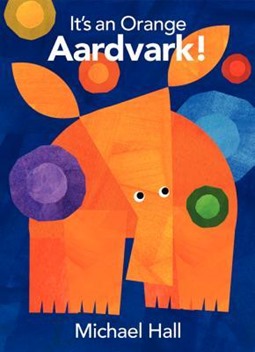
It’s an Orange Aardvark! by Michael Hall

Five little ants are woken up by the sound of rain outside their tree stump.  In order to figure out what is making the noise, they drill holes in the stump to look outside.  One ant explains that aardvarks are gray and sneaky, and of course hungry for ants!  But when they drill the first hole, they see orange not gray.  Perhaps it’s an orange aardvark come to eat them!  They drill another hole and that one shows blue, so they think it’s an orange aardvark wearing blue pajamas.  As they drill more holes, more colors are shown and their story about the orange aardvark gets more and more elaborate.  Savvy young readers will know what all of these colors mean, but the pleasure of this book is seeing just how silly the little ants become.

Hall is the author of My Heart Is Like a Zoo and continues to display his skill with bright colors, large formats and die cuts in this new title.  The mix of surprise, guessing and silliness makes this book great fun to read.  Add in identifying different colors and the book becomes almost a game to read aloud.  Even better, there is wonderful suspense with each page turn as the ants come up with their next spectacular speculation.

Done in large format and pops of bright colors, the illustrations have the same appeal as Lois Ehlert and Eric Carle with their sharp edges and cut paper format.  The die cuts are used just enough to make the book more suspenseful and fun.  They also all line up, consistent throughout the book.

A jolly picture book that is full of fun, this is a colorful and witty way to learn about colors and aardvarks.  Appropriate for ages 2-4.

Reviewed from copy received from Greenwillow Books.

Review: The Lion and the Bird by Marianne Dubuc

lion and the bird

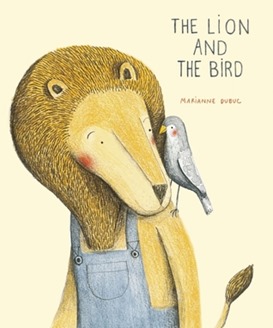
The Lion and the Bird by Marianne Dubuc

One day a lion discovers a hurt bird in his garden.  He bandages the bird’s damaged wing, but then the rest of the bird’s flock flies away, migrating for the winter.  So the lion takes the bird into his home.  Throughout the winter, the bird and the lion spend each day together doing all sorts of things.  And the lion notices that the winter doesn’t seem as cold with a friend along with him.  Then spring arrives and the bird’s wing has mended, so the bird heads off to join its flock as they return for the warm weather.  Lion is once again alone and now he misses his friend.  Lion spends all summer alone, tending his garden.  Then autumn comes again and Lion hopes to see his friend return, but will he?

Dubuc is a Canadian author who is internationally known.  She has a decidedly European vibe to her work with its quietness and the message of larger things written in the small world she creates on the page.  She cleverly shows the passing of the seasons using pages of white that allow space for the time to pass for the reader.  The book is also a lovely riff on The Lion and the Mouse, except in this book the lion is the one doing the kindness for another creature and the payback of the kindness is more delicate in the form of friendship.

Dubuc’s art is exceptional.  Her fine lines show both close-ups of the friends together and also vistas of the world they live in.  There is a feeling of smallness, closeness and a limited world that Lion lives in.  That contrasts with the bird leaving on migration and exiting this close world.

A noteworthy picture book, this new title by Dubuc is charming and warm.  Appropriate for ages 3-5.

Reviewed from copy received from Enchanted Lion Books.

Review: A Mom for Umande by Maria Faulconer

mom for umande

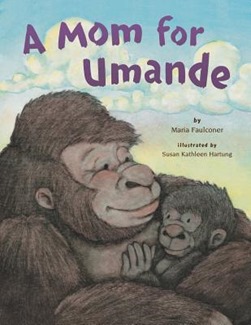
A Mom for Umande by Maria Faulconer, illustrated by Susan Kathleen Hartung

Based on a true story, this picture book tells of how a baby gorilla found a mother of his own.  When Umande was born, his mother didn’t know how to care for him.  So the keepers of the zoo had to step in and help, taking care of his infant needs and later showing him to to play and eat as a young gorilla.  After he was 8 months old, the zoo moved Umande to a different zoo across the country where Lulu, an experienced gorilla mother was waiting for him.  They were slowly introduced to one another, but soon enough they were a pair.  Umande had found his mother!

This story of a baby gorilla makes a wonderful picture book.  Faulconer uses just enough detail about the zoo staff and the efforts they took to raise baby Umande to make it fascinating.  She keeps the pace brisk and the story moving forward, making it just the right length for young readers to enjoy.  The text also reads aloud well, and this would be a nice addition to story times about mothers.

Hartung’s art captures the charm of gorillas on the page.  Even though Umande’s real mother didn’t know how to care for him, the art is carefully done to show that the gorillas are more baffled than mean or careless.  The cautious approach of the new mother gorilla and Umande as they are introduced is portrayed in a touching way on the page as is the final connection of the two gorillas.

This book is sure to speak to adoptive families as well as fans of gorillas and zoos.  It is a great pick for story times on any of these subjects.  Appropriate for ages 3-5.

Reviewed from copy received from Dial.

Review: Following Papa’s Song by Gianna Marino

following papas song

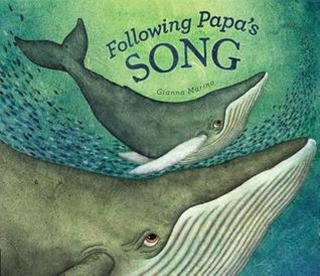
Following Papa’s Song by Gianna Marino

Little Blue and his Papa are traveling farther than they ever have before as they migrate, following the song of the other whales.  Little Blue has lots of the questions and his father encourages him to keep listening for the song.  As they travel, Little Blue learns about the different layers of the ocean.  Then he notices light in the darkness below and just has to head down and see what it is for himself.  He discovers a magical layer of life in the ocean, but when he heads even lower there is darkness and no other creatures are there.  Little Blue tries calling for his Papa, but his little voice doesn’t carry far in the cold water.  Then he remembers that he needs to listen and he hears his father’s call from above.

Marino paints a beautiful picture of father and child care and love.  Her use of whales and their calls is a smart choice that really makes the theme of being lost as a child work well on a higher level.  The advice to stay still and listen will also work for young humans hearing the story.  The book is simply written so that even the youngest of children can enjoy this underwater story.

Marino’s art is filled with currents and colors.  She creates light and water that dances and moves on the page, clearly creating different layers in the ocean.  I particularly enjoyed the use of bright pink to show the layer of the ocean with all of the life in it that tempts Little Blue downward.  The greens and blues of the ocean water truly come to life on the page here.

A lovely story about fathers, children and the importance of listening when you are lost.  Appropriate for ages 3-5.

Reviewed from copy received from Viking.

Review: Naked! by Michael Ian Black

naked

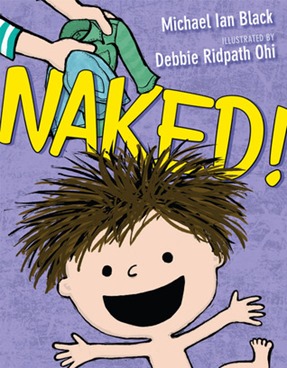
Naked! by Michael Ian Black, illustrated by Debbie Ridpath Ohi

A little boy streaks naked through his house, followed closely by his mother holding a towel.  He leaves a trail of bubbles and puddles behind, shouting “I’m naked!” as he runs.  He even manages to snag a cookie and eat it naked as his mother towels him off.  Then he has a great idea!  He could just dress this way all the time: at school, on the playground, dancing…  But wait!  Capes are cool too.  So then he wears just a cape and manages to be mostly naked but also caped as he runs around.  Finally, he catches a chill and agrees because he is so cold to put on pants, a top, even slippers, though he keeps the cape on.  And it is off to bed, dressed and warm.

This book perfectly captures the joy of a young child in being entirely naked and running around.  Parents will immediately recognize the stage and children will giggle along as the child in the book dreams of all of the places he can go naked.  Perhaps best of all in the book is the mother’s response which is acceptance and then managing to get the little boy dressed without tears or tantrums.  She respects his enthusiasm but also gets him dressed in the end.

Ohi’s illustrations are vibrant and joyous.  She fills the page with the running little boy, moving across the page celebrating just how naked he is.  The illustrations are cute, clear and large format, so they will work with a group.  Beware though, reading this too a group of preschoolers could have wild results!

Silly, happy and great fun, this naked romp is one that fans of No, David! will enjoy.  Appropriate for ages 2-4.

Reviewed from copy received from Simon & Schuster Books for Young Readers.

Review: Brother Hugo and the Bear by Katy Beebe

brother hugo and the bear

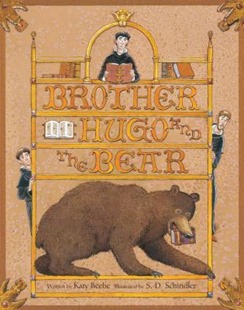
Brother Hugo and the Bear by Katy Beebe, illustrated by S. D. Schindler

Brother Hugo’s library book is due, but he can’t return it because it was eaten by a bear!  So Brother Hugo is instructed that he must create a new copy of the book.  First, Brother Hugo has to go to the monastery of the Grand Chartreuse where they have a copy of the book.  On the way, he can hear the bear snuffling behind him, but manages to reach the monastery and safety in time.  On his return to his own monastery, he can hear the bear snoring in his sleep, so he hurries back.  Then the real work begins, but he has the help of his fellow monks.  They must get a sheepskin, stretch it and scrape it, get parchment paper, and get them ready to write upon.  Then comes making the pens and inks that will be required.  Finally, Brother Hugo must sit and copy the book word for word.  Finally, the book has to be bound.  As he worked, Brother Hugo could hear the bear and the snuffling.  When the book was completed, the monks offered Brother Hugo a clever way to get to Grand Chartreuse safely despite the word-hungry bear, but even with their help Hugo finds himself face-to-face again with the great beast looking for books.

In this book, Beebe has created a fascinating look at the treasure and value of books and the efforts that it once took to create them by hand.  By inserting the question of the bear into the book, the story moves ahead very effectively, offering a nice plot point in what could have been a much quieter tale of book making.  The bear also offers a touch of humor into the story, for even those of us who agree that books and words are as sweet as honey will be amazed at this bear’s appetite for books.

Schindler’s art incorporates word art that hearkens back to illuminated texts such as the one that Brother Hugo recreates in the book.  Done in fine lines and with precision, the art is detailed and adds much to the story.  I particularly enjoy the scenes of Brother Hugo crossing the countryside, because they clearly evoke a different time and place.

This historical fiction nicely incorporates how books were once made into a tale filled with gentle humor and one hungry bear.  Appropriate for ages 4-6.

Reviewed from copy received from Eerdmans Books for Young Readers.

Review: This Is a Moose by Richard T. Morris

this is a moose

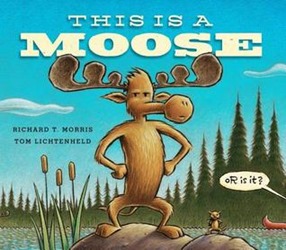
This Is a Moose by Richard T. Morris, illustrated by Tom Lichtenheld

A movie director is trying to create a documentary about the Mighty Moose.  You know, the ones that eat plants and drink from lakes.  But instead what he gets is a moose who wants to be an astronaut.  And his grandmother who wants to be a lacrosse goalie.  And somehow a giraffe who wants to be a doctor is also brought into the  movie!  Then there is a grand plan to get the moose who wants to be an astronaut into space.  No matter what the poor director does, no one pays him any attention just doing what they want to do.  There are plenty of more twists along the way too in this hilarious picture book.

Morris writes with an ear for dialogue and yelling.  The book reads aloud perfectly, the tones matching the fonts, the silliness reaching amazing heights.  At first the book is serious with the mighty moose, but that lasts only for a page or two before it becomes pure farce, which will delight young listeners.  They will also delight in the fact that the “adult” voice of the director is ignored for much more fun pursuits as the character join forces to launch the moose into space. 

Lichtenheld’s illustrations add to the laughs as the characters stand up to the structure of the book and completely mess with the system.  Lichtenheld plays with perspective, throws the characters bodily around, and adds plenty of motion to the page.  This is one wild and silly book, a farcical festival.

Got silly kids?  Get this book!  Guaranteed giggles in no time at all.  Appropriate for ages 4-6.

Reviewed from library copy.