Review: Poor Doreen: A Fishy Tale by Sally Lloyd-Jones

poor doreen

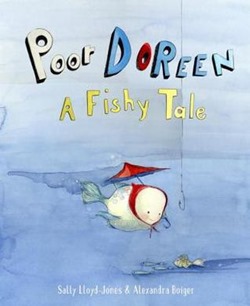
Poor Doreen: A Fishy Tale by Sally Lloyd-Jones and Alexandra Boiger

Mrs. Doreen Randolph-Potts is a very rare Ample Roundy Fish who is headed to visit her cousin who has just had a baby, or 157 babies to be exact.  So Doreen is swimming down the river when she spots what she thinks is a tasty dragonfly, but it is not.  It is actually a lure held by a fisherman, but Doreen does not know that and she gulps it down.  Soon Doreen is lifted into the air and plunked into a basket.  She thinks she is just there for a little rest before she heads on her journey, but she is wrong again.  Instead a Great Heron snaps her up and carries her off.  But as he has her in his jaws, Doreen thanks him for the ride.  She then manages to insult him by asking if he is an egret and when he tries to answer her she falls down, down into the water again.  So that leaves two very embarrassed creatures:  a fisherman and a heron who both lost their catch that day and one rather confused but safe Doreen who makes it to her cousin’s home with a great story to share.

Doreen is a great character, always looking on the bright side of her world though in a rather confused way.  She’s an optimist through and through, one who always sees the best, though sometimes at her own peril.  The book is designed to be read aloud with the fonts leading readers along the way.  It has great pacing for sharing aloud as well as a good amount of humor which always helps.  The language of the writing is also very special.  Here is my favorite line of the book to give you some of the flavor: 

By the water’s edge

a Fisherman wearing a coat the color of the sun

and a Great Blue Heron wearing a coat the color of a stormy sky

with a neck like an S

for SPEAR

are fishing.

Wonderful writing with richness and depth, contrasts and foreshadowing.  It’s simply superb.

Boiger’s art is appropriately done in watercolor for this fishy story.  Doreen pops on the page with her bright scarf and umbrella, both in red.  The action is captured nicely on the page, filled with bubbles, swirls and motion. 

A clever and optimistic book, children are sure to root for Doreen on her great adventure.  Appropriate for ages 3-5.

Reviewed from copy received from Random House Children’s Books.
Review: The Most Magnificent Thing by Ashley Spires

most magnificent thing

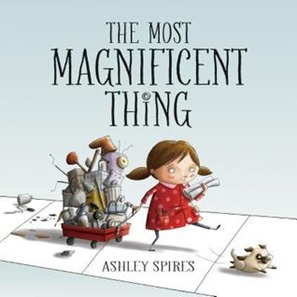
The Most Magnificent Thing by Ashley Spires

A little girl and her best friend, her dog, loved to do all sorts of things together.  Most of all, she loved to build and he loved to unmake things.  Then one day the girl had a great idea she was going to make “the most magnificent thing.”  First she figured out what it would look like, how it would work, and then came the easy part, making it!  She hired her dog as her assistant and they set out to find parts.  She built the thing, but when she and her dog stepped back, it wasn’t magnificent at all!  So she tried again, and again, and again.  Finally, after trying many times, she hurt her finger and she was very angry about all of the time, and the failures, and was ready to give up.  Luckily though, her assistant was there to give her encouragement to give it one more try, after a long walk.

Spires, the author of Binky the Space Cat, has created an ingenious little book.  Through clever storytelling she has written about the process of trial and error, the process of following through on a design and testing it, the creative process itself.  This is a young heroine with so much resilience and determination!  Her failures make her all the more brilliant and successful in the end.  And perhaps my favorite little twist is that people in her neighborhood find their own uses for her failed attempts. 

The art has the same wonderful modern quirkiness as her Binky books.  Though this is not a graphic novel format, she does use panes in her illustrations, making the iterations of her designs all the more fun to explore.  Done with minimal colors except for bursts of red, the illustrations are perfect for a design process.

Get this into the hands of math teachers who will appreciate a very readable book about trial and error.  It is also the perfect book for little girls to be inspired to use tools and create their own designs.  Appropriate for ages 4-6.

Reviewed from copy received from Kids Can Press.

Review: Chengdu Could Not, Would Not, Fall Asleep by Barney Saltzberg

chengdu

Chengdu Could Not, Would Not, Fall Asleep by Barney Saltzberg

Chengdu is a young panda who is having problems falling asleep.  Unlike all of the other pandas who are sleeping soundly on nearby branches, Chengdu just can not drop off to sleep.  He tosses and turns.  He tries different positions, even hanging upside down!  It takes him awhile, but he finally finds a perfect spot, and one that will surprise and delight readers.  But then, another little panda finds himself awake and what is he to do?

Saltzberg brings readers a clever and funny story of a little animal who cannot fall asleep.  The text is very simple and paired with large format illustrations that sometimes just features Chengdu’s eyes and other times show the very tired little panda looking straight at the reader in despair.  The resolution of Chengdu’s dilemma is very funny and satisfying.  It is guaranteed to get a giggle or two even from the sleepiest of listeners.

An ideal bedtime story, this book will have the littlest listeners happy and sleepy.  Appropriate for ages 2-4.

Reviewed from library copy.

Review: A Boy and a Jaguar by Alan Rabinowitz

boy and a jaguar

A Boy and a Jaguar by Alan Rabinowitz, illustrated by CaTia Chien

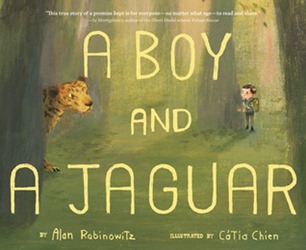
This is a stellar autobiographical picture book written by and about a wildlife conservationist.  Alan was a boy who could not speak clearly.  He battled stuttering all of the time except when he talked with animals.  When he visited the great cat house at the Bronx Zoo, he could whisper fluently into the ears of the cats.  He also spent a lot of time with his pets at home, speaking to them and telling them that if he ever found his own voice, he would serve as their voice since they had none and would keep them from harm.  Alan became the first person to study jaguars.  In Belize he felt at home in the jungle.  He worked to protect the jaguars and eventually had to speak for them in front of the President of Belize, hoping to save their habitat from destruction.  But can he speak clearly in the short 15 minutes he’s been given?

This book is made all the more compelling by the fact that it is true.  It gives readers a glimpse into the world of a child struggling with a disability, one that mars every verbal interaction he has.  And thanks to his ability with animals, readers quickly see beyond the stutter to the boy himself and to the gifts that he has to offer.  Even better, once Alan becomes an adult, readers get to see a man who is taking advantage of his uniqueness to make a difference in the world and for the animals he cares for so much.

Chien’s art is rich and varied.  She moves from backgrounds of wine red to brilliant yellow to the deep greens of the Belize jungles.  She shows an isolated boy, alone that contrasts beautifully with the man working happily alone in the jungle – so similar and yet so very different.

An extraordinary autobiography, this book shows readers not to judge anyone by how they speak but rather by what they do.  Appropriate for ages 4-7.

Reviewed from library copy.

Review: Rules of Summer by Shaun Tan

rules of summer

Rules of Summer by Shaun Tan

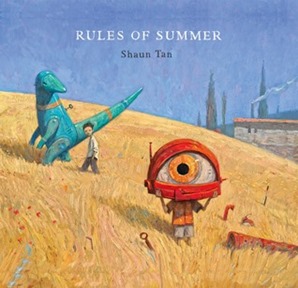
Enter the surreal world of two brothers with a picture told in few words and many pictures.  The book takes place in the previous summer and explains what one of the brothers learned that summer.  The lessons are strange, but the images are even wilder.  The first lesson is “Never leave a red sock on the clothesline.”  It is accompanied by a wonderful and magnificently creepy image of a huge rabbit the size of a house with a red eye staring over the wall as the two brothers cower on the other side.  As the pages turn, the world gets odder and odder, forming a cohesive world but one that surprises, horrifies and delights.

As Tan blends humor with his frightening images, one starts to see a world that is beyond our own and yet strangely parallel.  These brothers live in a different world, one with its own rules and laws but one that is hauntingly familiar to our own.  Perhaps my favorite series of images is the series of pictures for “Never wait for an apology” where the younger brother is padlocked in a small steam engine with smoke pouring from the smokestack.  Black birds fly past.  Since all of the other images were done as single picture, I didn’t expect to turn the page and see the image continue from farther away.  It all evoked so brilliantly the loneliness, the trapped feeling, the isolation of waiting for an apology. 

Tan continues to surprise and delight in this new picture book.  While not for everyone, there are some children who will adore this skewed world that speaks to our own.  Appropriate for ages 6-10.

Reviewed from copy received from Arthur A. Levine Books.

Review: Chandra’s Magic Light by Theresa Heine

chandras magic light

Chandra’s Magic Light: A Story in Nepal by Theresa Heine and Judith Gueyfier

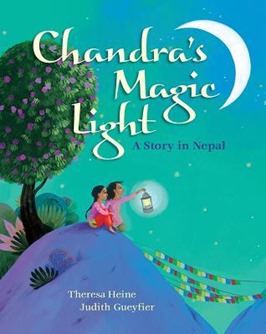
Chandra and her sister Deena were at the market when they saw a man selling a strange lamp.  There was a large crowd around him as he explained that the lamp gathered energy from the sun.  It would cost less money than a kerosene lamp over time, and it was much healthier too.  Chandra’s baby brother had a bad cough, and she knew that this lamp would help him.  But the lamp was too expensive for them so they headed home quickly to tell their father of the lamp.  But their father didn’t understand the need for a magic lamp or have the funds to spend on one.  The girls even showed their father a solar lamp that their neighbor had purchased, but still the cost was too high.  So the sisters decided that they would work to get the down payment for a lamp.  They picked rhododendrons in the hills and sold them at the market.  But even then, they did not have enough money.  This story focuses on the efforts of two girls to change the lives of their family members through one act of kindness and hard work.

This book draws the reader into the world of Nepal, evoking the sights, smells and sounds of the busy market before launching into an explanation of the importance of the solar lamps.  The authors make sure that readers understand the poverty of the family, the hardships they face and their inability to purchase the lamp they need.  The final pages of the book contain facts about Nepal and the way people live there. 

The illustrations are bright colored, filled with the colors of Nepal and with the bright colors of the clothing.  When the girls head to pick rhododendrons, the pages fill with the blossoms.  Those deep pinks and reds are also echoed throughout the home of the family and the clothes that the girls wear.  The colors are rich and saturated.

A strong female protagonist, a just cause, a glimpse of Nepalese culture, and a message of sustainability make this a strong addition to any library.  Appropriate for ages 4-6.

Reviewed from library copy.

Review: Eye to Eye by Steve Jenkins

eye to eye

Eye to Eye: How Animals See the World by Steve Jenkins

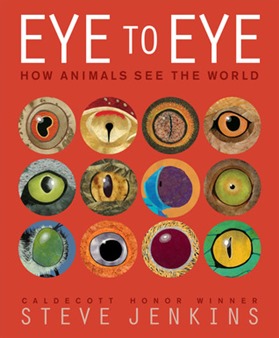
Explore different types of animal eyes in this gorgeous nonfiction picture book by the amazing Steve Jenkins.  In this book, Jenkins not only talks about the different kinds of animals eyes, explaining them in just the right amount of detail, but also looks at specific animals and their unique eyes.  Jenkins shares lots of facts, carefully chosen to be fascinating and fun.  One never knows what will be found on the next page and whether it will be looking right at you.

Jenkins makes sure that children will learn about evolution in this picture book.  His emphasis throughout is on the evolution from simple light-sensitive eyespots to the complex camera eyes of humans and hawks.  As always, his information is well-chosen and interesting.  It is accompanied by large-format images that are paired with smaller images that show the animals entire body.  This is science information at its best.

The eyes have it!  This is a book that belongs in all public libraries.  Appropriate for ages 6-9.

Reviewed from library copy.

Review: Elizabeth, Queen of the Seas by Lynne Cox

elizabeth queen of the seas

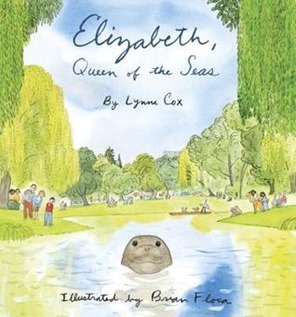
Elizabeth, Queen of the Seas by Lynne Cox, illustrated by Brian Floca

This is the true story of Elizabeth, an elephant seal, who decided she wanted to live in the warm waters of the Avon River near the city of Christchurch in New Zealand.  People are happy to have Elizabeth in the river, often spending time watching her swim.  Then Elizabeth decides that her favorite place to sun is the middle of a two-lane road.  It is flat and warm and perfect, except for the dangers of the cars to both Elizabeth and the people.  So Elizabeth is towed out to sea, to live with the other elephant seals.  But Elizabeth returns.  She is removed to the sea over and over again, each time taking her farther away from Christchurch.  But she still finds her way back to those warm river waters. 

Cox, a famous long-distance, open-water swimmer, has written her first children’s book here.  One would never know that it is her first.  She writes with a grace and simplicity that make her book entirely readable but also poetic too.  She incorporates imagery that will help children understand Elizabeth better: “Moving up the soft shore like a giant inchworm.”  She also uses descriptive language to draw contrasts between the waters in the river and those in the cold sea. 

Floca, winner of the 2014 Caldecott Medal, uses his fine-line drawings to show the merry spirit of Elizabeth both when she is in the warm river waters and upon her amazing returns after being towed away.  Floca’s illustrations of Elizabeth on the warm road and her surprise but lack of alarm when the cars approach are beautifully done. 

A winning story that tells the story of one unique elephant seal and the town that she decided was her home.  Appropriate for ages 5-7.

Reviewed from copy received from Random House Children’s Books.

Review: The Patchwork Torah by Allison Ofanansky

patchwork torah

The Patchwork Torah by Allison Ofanansky, illustrated by Elsa Oriol

David’s grandfather was a scribe.   He had been asked by the rabbi to write a new Torah for their synagogue because the old one was fading.  David watched his grandfather work for a year on the new Torah and then store it away, explaining that a Torah is not something to be thrown out.  Years later, as David was learning to be a scribe from his grandfather, a couple came to them bringing a Torah that they had hidden from the Nazis.  It was badly water damaged and his grandfather tucked that Torah away too in the hopes of working on it someday.  David grew up to be a scribe and inherited his grandfather’s cabinet with the two scrolls inside.  One day, the rabbi called and told him that there had been a fire in the synagogue and the Torah was damaged.  That scroll too was put away.  Finally, Katrina hit New Orleans and a Torah was rescued but damaged too.  David suddenly had an idea and worked for months to take the four scrolls and patch them together into one complete Torah that would be unlike any other.

Ofanansky builds this story slowly and steadily.  Each Torah comes into the book with a full story and history.  Each is unique and ruined in some way, but worthy of being rescued and reused.  It is the ultimate in recycling.  The book also pays homage to the long history of scribes who care for and create Torah, showing the dedication that it takes to learn the art and skill. 

The art by Oriol has a quiet nature too.  The paintings are suffused in yellow light and warmth.  Even the days of the tragedies that happen to the people and the Torah are light-filled and hope filled. 

A quiet and powerful story about renewal and reuse, this book speaks across religions to the importance of hard work and resilience.  Appropriate for ages 6-9.

Reviewed from library copy.