Review: Don’t Spill the Milk by Stephen Davies

dont spill the milk

Don’t Spill the Milk by Stephen Davies, illustrated by Christopher Corr

Penda lives in a tiny village in Niger with her family.  Her father has headed up into the grasslands with the sheep.  Penda volunteers to take her father a bowl of milk and has to try not to spill any along the way.  She puts the milk on her head and starts to walk.  She has to walk along the sand dunes and between the dancers at the rainy-season mask dance.  Then she takes a boat across the Niger River with the milk still on her head.  After that she has to climb one last mountain and there is her father.  She’s almost there when…  You will have to read whether Penda delivers the milk successfully or not.  

Davies has traveled extensively in Africa and carefully chose the setting of the Niger River thanks to its varied landscape and intriguing animals.  All of the landforms in the book exist in this area as do the animals too, including the unusual and endangered pale giraffes.  Davies writes with a lovely rhythm that moves the book along quickly.  Penda speaks to herself as she walks, reminding herself to pay attention in couplets of natural verse.

Corr’s art is eye-poppingly bright with yellow skies, orange hills, and blue water.  Against those bright colors, the characters wear even more color filled with designs.  The book evokes the vibrancy of Africa and the bustle of its villages. 

Expect small children to want to try to carry bowls of liquids on their own heads after this beautiful introduction to Africa.  Appropriate for ages 3-5.

Reviewed from library copy.

Review: How to Train a Train by Jason Carter Eaton

how to train a train

How to Train a Train by Jason Carter Eaton, illustrated by John Rocco

Did you know that trains make great pets?  Well this is the book all about how to best keep a train as a pet and have it well trained too.  First, you have to decide what sort of train you want: freight, monorail or steam.  Then you need to catch one.  There are lots of ways to do this, but the best way is to catch their attention with smoke signals and then bribe them with coal.  You then have to name your train and try to set it at ease.  Spend time together and get to know one another.  Eventually if you have built enough trust, your train will let you ride him.  But it takes time to ride off into the sunset together.

Eaton sets the perfect tone in his writing.  The framework of a how-to book adds a level of structure that Eaton plays with throughout.  Reading along the way, Eaton invites you into his world of sentient trains where each reader is offered the opportunity to consider what type of train they would want as a pet and how they would care for it.  It’s a delightful world and one that lingers after shutting the cover.

Rocco’s illustrations are a large part of building that delight.  He has created trains that read as purely machine and yet have faces that smile directly at you.  He also maintains the scale of the trains, allowing them to be huge puppy-like beasts that have a great wildness as well.

This cheery book will delight train fans but also reaches far beyond them with its humor and world building.  Appropriate for ages 3-5.

Reviewed from library copy.
Review: Eat Like a Bear by April Pulley Sayre

eat like a bear

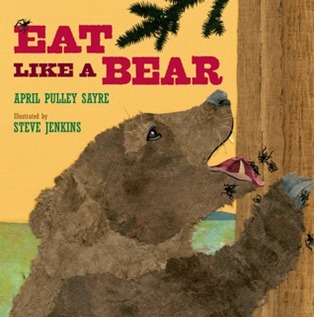
Eat Like a Bear by April Pulley Sayre, illustrated by Steve Jenkins

Released October 22, 2013.

Can you eat like a bear?  It means you will wake up very hungry in early spring and have to dine on sandy plants and frozen dead bison meat.  In May, you will have dandelions and cow parsnips to munch but you will still be hungry, so you eat some ants.  You will also eat clover and fish in icy streams for a meal of trout.  In July you will catch a squirrel you dig out of the dirt and in August you will have moths to munch.  September brings berries and October pinecones.  Then it is time to sleep for the winter, full with all of the various meals you have eaten for the rest of the year.

Sayre makes this book such fun to read.  She takes scientific information about what bears eat and makes it very accessible for a preschool audience.  She uses repetitive structures throughout the book, having the bear dig and pull to find food again and again.  This doesn’t just create a friendly structure for small children, it also underlines the fact that animals are in constant search for food.  Sayre also makes the book inviting by using the second person format, asking children if they can really eat like a bear.  I suspect many will stop saying yes when the ants, squirrels and dead bison appear in the diet.

The art of Jenkins is always beautiful, but he outdoes himself with the depiction of the bear.  I shared this book aloud with my son and we both spent time lingering over the first image of the bear.  Jenkins has managed to use the torn paper as fur, not only along the edges of the bear’s body but on its body too.  The result is fur so plush that you feel like your hand should sink into the page.

A glorious look at bears, this book is a fantastic introduction to a creature, its habitat and its diet.  Appropriate for ages 4-6.

Reviewed from copy received from Henry Holt & Co.

Review: The Children Who Loved Books by Peter Carnavas

children who loved books

The Children Who Loved Books by Peter Carnavas

This celebration of reading and books features a family that depends on their books for all sorts of things.  Lucy and Angus’ family is poor without a TV or a car, but they find everything they really need in books.  But there can be too much of a good thing as they find out when their little trailer home just won’t hold any more.  So they get rid of all of the books and clear out their tiny home.  But things aren’t the same.  The books that had taken up so much space also made the space between the family members smaller.  Then one day, a book falls out of Lucy’s backpack and the magic of reading happens all over again.

There is no move to hide that this book is purely about the joy of books in one’s life and the positive impact that reading together can have on a family.  Carnavas lets his message stand strong, which has positive and negative results.  A more subtle approach would have been more satisfying, yet the bold message lets you use the book with younger children.

Carnavas’ illustrations are filled with stacks and piles of bright colored books.  The family is clearly poor, but also clearly functional.  The morning after they return to reading, the family is stacked on top of one another in a tiny couch.  The quintessential image of a family coming closer together from reading.

Warm and cheerful, this Australian import will have book lovers smiling.  Appropriate for ages 3-5.

Reviewed from copy received from Kane Miller Publishing.

Review: Musk Ox Counts by Erin Cabatingan

musk ox counts

Musk Ox Counts by Erin Cabatingan, illustrated by Matthew Myers

The characters from A is for Musk Ox return for a counting book this time.  A counting book should be fairly straight forward, it’s counting after all.  But Musk Ox has different ideas.  Must to Zebra’s dismay, he doesn’t even make it to number one at the beginning of the book to be counted as one Musk Ox.  Instead he is on the page with 2 yaks.  Musk Ox offers to fix the problem on the page for number one, but still messes up the 2 yaks page.  Zebra is beside himself and a sulky Musk Ox heads back to page one on his own.  But he doesn’t stay there for long!  Expect plenty of counting chaos throughout the book though there is also some easy addition thrown in too. 

I enjoyed this book almost as much as the first one.  This one has the joy of returning to two engaging characters.  As with the first, you never know what is going to happen on the next page, making it very engaging reading.  Cabatingan writes the two characters with zingy dialogue and the book is a must for reading aloud. 

Myers’ illustrations add to the zany book.  He manages to keep crowded pages from being confusing as the number mount.  He also uses the effect of Musk Ox and Zebra peeking through from other pages very nicely. 

The result is a counting book worth sharing aloud to a group of preschoolers, and there aren’t many counting books that you can say that about!  Appropriate for ages 3-5.

Reviewed from copy received from Roaring Brook Press.

Review: The Invisible Boy by Trudy Ludwig

invisible boy

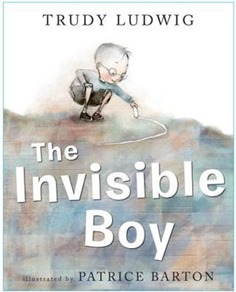
The Invisible Boy by Trudy Ludwig, illustrated by Patrice Barton

Brian is invisible.  His teacher never notices him in the classroom.  He doesn’t take up much space.  He never gets picked when kids choose kickball teams.  He isn’t invited to any parties.  Brian spends his time drawing dragons, pirates, aliens and superheroes.  Then Justin joins Brian’s class.  Justin uses chopsticks at lunch and eats different food than everyone else.  The other kids laugh at him and Brian feels happy being invisible.  Brian leaves Justin a drawing that says that Justin’s food looked yummy.  Justin talks with Brian about his art, but is quickly called away to play games with the others.  When a chance comes for them to work together on a class project, Brian starts to feel a lot more visible.

Ludwig paints a vivid picture of an isolated child here.  The true success on these pages is the capturing of very subtle forms of bullying rather than the overt type seen in so many picture books.  This is the type that involves exclusion from the group rather than physical violence.  Ludwig not only captures it, she also shows just how damaging being alone can be for a child.  At the same time, Brian is bright and creative and willing to connect.  Ludwig also shows how a single child can make a difference and bring someone who is invisible into the group.

Barton’s illustrations have a beautiful softness to them.  She incorporates paper art in her digitally painted work adding another dimension.  Brian starts out almost transparent and only done in pencil with no color at all.  As he starts to reach out to others, color comes to him and eventually he is just as fully colored as everyone else.  This visual transformation nicely captures what is happening emotionally.

A superb book about bullying and exclusion, this can be used to start discussions in a classroom or with a single child.  Appropriate for ages 4-6.

Reviewed from copy received from Random House Children’s Books.

Review: Line 135 by Germano Zullo

line 135

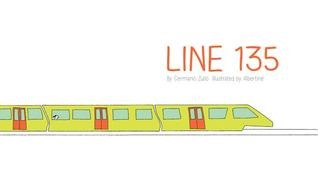
Line 135 by Germano Zullo, illustrated by Albertine

The duo that created Little Bird have returned with another lovely and fanciful story.  A little girl travels by train to her grandmother’s house.  The train starts out in the towering city and we are told at the beginning that her grandmother lives in the country.  The train travels from crowded cityscapes into more residential areas.  The little girl talks about all of the traveling she wants to do when she gets older.  As the pages turn, the landscape changes and eventually becomes very odd.  Flowers grow as tall as the train, strange creatures stand near a pond, then the pond itself looks very much like a beast of some sort and readers will know that they are on a surprising trip too.

Imported from Switzerland, this book starts out as a quiet thoughtful book about being comfortable living in both the city and the country and a love of travel.  Zullo’s text never changes from that musing tone, but it does speak to the right of a child to have opinions about how they want to live their lives. 

The girl’s dreams and imagination come to life in the illustrations.  The train is the sole zip of color on each page, while the surroundings are entirely in black and white fine-lined drawings.  They are detailed and lovely and the change from reality to dream world is done slowly and with deft pacing. 

This is a book that makes you want to start back at the beginning the minute you finish it so that you can see even more in the drawings.  Appropriate for ages 3-5.

Reviewed from library copy.
Review: My Blue Is Happy by Jessica Young

my blue is happy

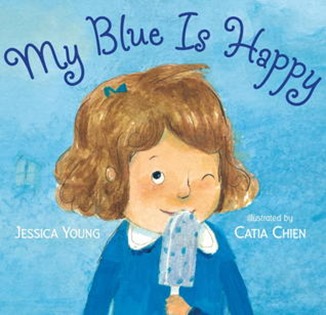
My Blue Is Happy by Jessica Young, illustrated by Catia Chien

Colors can be seen in many different ways and the little girl in this picture book tends to see them very differently than her family and friends.  Her sister says that blue is sad, but for her blue is happy like favorite jeans or the swimming pool.  Her mother says yellow is cheery, but for her yellow is worried like a wilting flower.  Her father says brown is ordinary, but it is also the color of chocolate syrup so it’s special too.  Useful for color identifying, this book takes it a level deeper to the feelings that colors evoke in each of us.

Young has created something of a poem here in her prose.  She uses a format with repetitive structures, each new person and their reactions to colors a stanza and also a set of pages.  Within this strong format, the exploration of feelings is done with a confidence that will allow young readers to voice their own.  Young takes unusual reactions to colors and makes them concrete with her examples too. 

Chien’s illustrations have a wonderful softness to them that frees the imagination.  Filled with the color that is being discussed, the illustrations celebrate each color and invite thoughts from children listening to the book. 

A lovely take on colors, this picture book will lead to plenty of discussion and would be a great jumping off point for craft and art projects.  Appropriate for ages 4-5.

Reviewed from library copy.

Review: A Moose That Says Moo by Jennifer Hamburg

moose that says moo

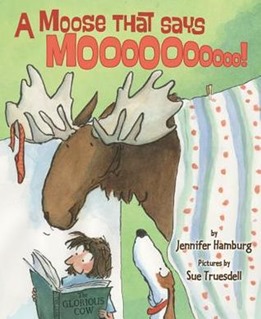
A Moose That Says Moo! by Jennifer Hamburg, illustrated by Sue Truesdell

Sitting near the laundry drying on the line, a little girl is reading books about animals.  She starts to think about having a zoo of her very own and what sorts of animals it would have.  It’s guaranteed that no other zoo has animals like hers!  There is a moose that says “moo,” bears that drive cars, tigers that swing in the trees, and sharks that read books.  At night, the animals have a big pillow fight that turns into one silly brawl with awakened goats, tap-dancing pigs that startle easily, tripping turtles, and even groundhogs that protest.  It will take one smart young girl to get everything put back together again even in this imaginary zoo.

Written in a rollicking rhyme, this book really celebrates the ridiculous and the silly.  Hamburg manages to create zoo animals with wild qualities that make the book a surprise on each page.  The result is a book that dances on the edge of losing control, but the firm hand Hamburg takes with the rhyme and rhythm keeps it within control and makes for a book that begs to be shared aloud.

Truesdell does an amazing job of managing to take all of the wild chaotic silliness of the book and turn it into illustrations that help it all make sense.  At the same time, she too revels in the silliness on the page and adds to it with small touches like a reading shark accidentally eating a book, the offer of many tissues to a sneezing tiger, and goggled bears in cars. 

Pure silliness, this book could merrily be wedged into many storytime themes.  Use it as a finisher since even antsy children will sit still for this wild ride.  Appropriate for ages 3-5.

Reviewed from copy received from Farrar, Straus and Giroux.