Review: Max and the Tag-Along Moon

max and the tag along moon

Max and the Tag-Along Moon by Floyd Cooper

When it’s time for Max to head home from his Granpa’s house, Max is very sad.  But his grandfather reassures him by saying “That ol’ moon will always shine for you…on and on!”  All the way home in the car, Max watches the moon as it travels along with them.  When they get home though, the moon has disappeared and Max once again feels sad and misses his grandfather.  As Max is alone in his bed that night, he looks out at the dark night with no moon.  As he watches, the moon returns from behind the clouds and Max once again feels connected to his Granpa. 

Cooper takes a very simple story of grandfather and grandson and makes it memorable with his amazing illustrations.  The story resonates with the connection of the two main characters and their love for one another.  The symbol of the moon and its light connecting them makes the book luminous and almost magical.  I appreciate a children’s picture book that is not just about an African-American child and family, but one that shows a loving male figure.

A large part of that magic are the illustrations that glow with the white-gold light of the moon.  Cooper plays with light and dark throughout the book.  Even on the pages without the moon shining, there are sources of light and shadow that are expressive and lovely. 

A strong African-American family is celebrated in this picture book that would add another level to any moon-centered storytime.  Appropriate for ages 4-6.

Reviewed from copy received from Philomel Books.

Review: Kenta and the Big Wave by Ruth Ohi

kenta and the big wave

Kenta and the Big Wave by Ruth Ohi

When the tsunami sirens sounded, Kenta headed up the big hill to the school just as he had practiced.  But along the way, he lost hold of his soccer ball and it rolled down the hill.  Kenta’s parents were already at the school and when they returned to their house, it was ruined.  They had to sleep in the school gym and search in the rubble for things to salvage.  But Kenta’s soccer ball had been carried off by the water.  Kenta tried making a soccer ball from scraps but it didn’t work well.  Meanwhile, his ball was being carried by the ocean until it reached another country.  Would it ever find its way back to Kenta?

Ohi has written a very simple but compelling look at surviving a natural disaster.  Her focus on a single beloved possession works particularly well.  I also appreciated that it was not a doll or a stuffed animal but rather something that older children can relate to.  It was also a good choice to not have Kenta and his family in direct peril and survive.  The safe status of everything but the ball and other material objects makes it easier for the ball to be important and mean more.

Ohi’s illustrations are filled with color.  The yellows of the grass pop against the blues of the ocean.  Kenta wears a bright red hoodie and stands out on each page.  The time the ball spends in the ocean is particularly lovely and quiet compared to the mess of the town.

Based on true accounts of objects appearing in other countries after the tsunami in Japan, this book celebrates the connection people can have without ever having met.  Appropriate for ages 4-6.

Reviewed from copy received from Annick Press.

Review: Night Sounds by Javier Sobrino

night sounds

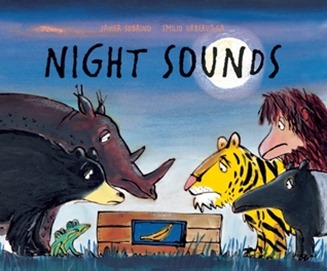
Night Sounds by Javier Sobrino, illustrated by Emilio Urberuaga

When the animals of the rain forest head to sleep, they are awakened by noises coming from a box.  The sound just goes on and on, “Wuaah, wuaah, wuaaah.”  Something is crying and won’t be easily comforted.  The animals do try to get it to be quiet, offering a blanket, water, and a doll.  But the crying only stops for a little while and then starts up again and again.  Finally Tiger heads off to find the mother.  Then the identity of the crier is revealed finally but there is more crying to come in a clever twist at the end.

Translated from the original Spanish, Sobrino does a great job of keeping readers guessing about the identity of who is crying in the box.  As each new sets of cries starts, their sounds change slightly and add variety to the book.  The structure of the book is based on repetition with some changes along the way.  It makes for a book that will work well for very small children but also has plenty of surprises for older preschoolers as well.

Urberuaga’s illustrations are filled with deep, rich colors.  They evoke the night beautifully and the animals sleepy eyes and lack of smiles show how very tired they are.  The reveal is cleverly done without any real visual hints, allowing it to be a complete surprise.

Great fun, this book could be made into reader’s theater with younger children and will also make a great bedtime story as long as a blanket, water and doll are provided ahead of time.  Appropriate for ages 2-5.

Reviewed from library copy.

Review: Little Red Writing by Joan Holub

little red writing

Little Red Writing by Joan Holub, illustrated by Melissa Sweet

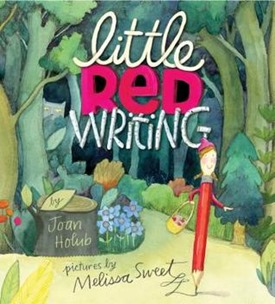
This is a fresh version of Little Red Riding Hood.  Here Little Red is a pencil and her assignment in school is to write a story, even though it can be quite dangerous.  Her teacher gives her a basket of words to use in case of an emergency, but also warns her to stick to her basic story so that she doesn’t get lost.  Little Red starts writing but soon tries to add more excitement to her story.  Before she knows it, she has bounced right off of the page and into a forest.  It’s a forest full of description, but that’s also something that can bog down a story.  Little Red has to use a word from her basket to get free.  More perils follow with sentences that run on, abandoned punctuation, and a growling voice and twirly tail that lead right to the principal’s office.  It is up to Little Red to both be a hero and finish her story.

Holub has written a very engaging new version of Little Red Riding Hood.  She successfully ties in tips on writing, not allowing them to force her to leave the basic story path.  Her writing is entirely engaging, the format of the story writing works well and she weaves the classic elements of the tale into this one so that it is different but still recognizable. 

Sweet’s illustrations are done in her signature combination of cut paper and drawings.  Her bright colors add much to the liveliness of the book.  She uses the cut paper to good effect throughout, allowing them to set aside important parts of the book as well as using fonts of various styles to really make the book stand out. 

A great pick for writing units, this is one of the best changed-up Red Riding Hoods that I’ve seen.  Appropriate for ages 4-6.

Reviewed from copy received from Chronicle Books.

Review: Mr. Wuffles by David Wiesner

mr wuffles

Mr. Wuffles by David Wiesner

The masterful Wiesner returns with another near-wordless picture book.  Mr. Wuffles is a cat who disdains most of the toys his master gets him.  Then one object gets his attention, a little metallic spaceship.  But this is not a toy!  It is filled with tiny aliens who are battered by being flung around by Mr. Wuffles.  Their equipment is damaged and they have to leave their ship and head out looking for help.  But Mr. Wuffles is close behind them and who can the aliens turn to for aid? 

This is a magnificent picture book that turns from a normal cat picture book into something much more interesting.  Wiesner has created a book that bridges genres effortlessly.  He also has created a wordless picture book that never seems to be missing them.  His story flows organically and is never forced.  It has touches of humor throughout especially where Mr. Wuffles himself is concerned.  I particularly enjoy the rows of untouched toys with price tags still attached that he walks past. 

Wiesner’s art is as strong as ever.  He pays attention to details both in the human home and later when the aliens arrive.  The juxtaposition of the aliens with the insects of the home is particularly well done.  The addition of cave paintings as communication is a delight.

Beautiful and funny this is a wordless masterpiece.  Appropriate for ages 4-6.

Reviewed from library copy.

Review: The Beginner’s Guide to Running Away from Home by Jennifer Larue Huget

beginners guide to running away

The Beginner’s Guide to Running Away from Home by Jennifer Larue Huget, illustrated by Red Nose Studio

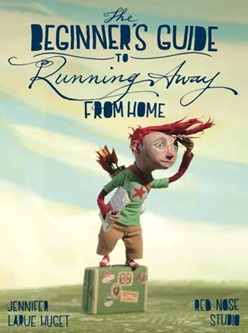
This book is a humorous look at running away from home done in the format of an instructional booklet on how exactly to run away.  First you have to find a reason for running away, perhaps a new baby, or your older brother can stay up later than you, or your mother threw away your candy wrapper collection.  Then you have to pack, make sure to take plenty of snacks including gum, that way you won’t need a toothbrush.  Then comes the farewell note.  Make it sad enough that your parents will cry when they find it.  Now you need to figure out where to live.  Keep walking until you can’t see your house anymore, then stop for a snack.  And think about living in the park forever, or if living with a friend would be better than at home.  But don’t think about what you like about your family at all or you might find yourself running back home.

Huget’s tone is perfect in her text.  She manages to be humorous about the situation but also not dismissive of the feelings that the child has.  Her wording works very nicely aloud, making this a book that is best shared and giggled at together.

Red Nose Studio, the illustrators of Here Comes the Garbage Barge, continue with their signature 3-D figures.  They use perspective very cleverly here, offering different levels of focus that show speed and point the eye to where they want you to look first.  The result are illustrations that are unique and dynamic.

Thanks to the humor and the illustrations, this is a book about running away that is worth seeking out.  Appropriate for ages 4-6.

Reviewed from copy received from Random House Children’s Books.

Review: Is It Big or Is It Little? by Claudia Rueda

is it big

Is It Big or Is It Little? by Claudia Rueda

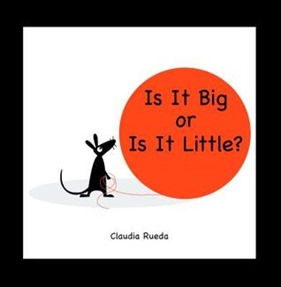
Explore opposites and perspective in this little book.  It is the story of a mouse and a cat, who chase across the pages, changing the perspective the reader sees from on each page.  Is the ball of yarn big as seen by the mouse?  Or is it little when seen by the cat?  Deep water for the mouse becomes shallow when the cat heads in.  Light objects for the mouse are heavy for ants.  And even the most scary creature can also be scared themselves. 

Rueda’s text is done in simple questions that show the opposite concepts clearly.  The real draw of this book are the illustrations which have a minimalism that is very appealing.  Done entirely in grays, black and orange, the illustrations have a pop edge to them that is both graphically pleasing and has great touches of humor.

Bright and bold, this book approaches opposites and perspective with a clever storyline and elegant illustrations.  Appropriate for ages 3-5.

Reviewed from copy received from Eerdmans Books for Young Readers.

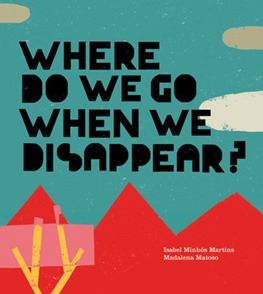
Review: Where Do We Go When We Disappear? by Isabel Minhos Martins

where do we go when we disappear

Where Do We Go When We Disappear? by Isabel Minhos Martins and Madalena Matoso

I recently reviewed My Neighbor Is a Dog, another new book by this author and illustrator duo.  In this book, the question of where people and things go when they disappear is explored thoroughly.  The result is a book that asks big questions and attempts to answer them or at least provide a framework to answer them.  The book begins with people disappearing and the idea that you must be missed in order to disappear, so disappearing takes two.  Then it moves on to other things that disappear like sunshine and clouds, socks and puddles, snow and noise.  It ends with the fact that everything disappears, even the most solid things like rocks over time will disappear. 

Translated from the Portuguese original, this book is thought provoking and fascinating.  Martins manages to right a book about big questions that answers them in a way that is exploratory and insightful and doesn’t turn quickly to a religious answer.  Instead she stays in the questioning place, allowing different ideas to surface and be discussed.  She does not provide any easy answers, meeting children right where they want the discussion to stay, where it leads to more and more questions.

Matoso’s illustrations are vibrantly colored and filled with strong shapes.  They appear to be block printed which adds to the organic feel.  She uses negative space brilliantly.  One example is her snow image with the background white and the flakes cut out circles that merge directly into the white and stand out against the other bright objects.

Challenging, thought-provoking and a book that will inspire discussion and help children find their own answers.  Appropriate for ages 5-7.

Reviewed from library copy.

Review: A Year with Marmalade by Alison Reynolds

year with marmalade

A Year with Marmalade by Alison Reynolds, illustrated by Heath McKenzie

One autumn, Maddy told Ella that she is going away for a year and asked her to take care of her cat, Marmalade.  Both Ella and Marmalade cry and cry when Maddy leaves.  Ella can’t find anyone to play in the leaves with her, pick and munch apples, or stomp in puddles.  Then one frosty morning, Ella wakes up to find her feet warm and Marmalade sleeping on her bed.  As winter arrives, Ella and Marmalade get closer and closer.  Spring comes and the two work together in the garden and head to the beach together.  Maddy returns with the autumn, but what will happen now with Marmalade?

This book is a smart mix of waiting for a friend to return and seasons.  Along the way, there is also the chance to make a new friend too.  The dance of the seasons moves the story along nicely, creating a timeline along which readers can see the relationship between Ella and Marmalade growing and changing. 

It is the illustrations that make this book more than just a book about friendship in a crowded picture book market.  McKenzie combines black and white line drawings with bursts of color.  Marmalade is always shown as a pop of orange, while the human characters remain black and white.  The effect has an appealing lightness.

A picture book about moving, friendships and change, this lovely little picture book would make a nice addition to units on seasons as well.  Appropriate for ages 3-5.

Reviewed from copy received from Simon & Schuster.