Review: This Is the Rope by Jacqueline Woodson

this is the rope

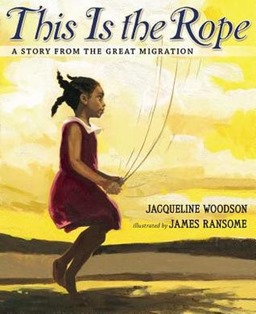
This Is the Rope: A Story from the Great Migration by Jacqueline Woodson, illustrated by James Ransome

Based on Woodson’s own family, this is the story of how one piece of rope serves as a symbol for the changes that came during the Great Migration of African Americans from the rural south to northern cities.  One little girl tells the story of how her grandparents moved to New York City, using the rope to tie their things to the top of the car.  The rope was used to tie up the drying flowers from their window boxes that reminded them of home.  It was used by the little girl’s mother to tug her toys and play jump rope.  It tied her mother’s belongings to another car when she went off to college.  Then it was used for more jump rope with the little girl and in the end to support the banner for their family reunion.  In the end, it was returned to the original grandmother in exchange for a new rope to jump with. 

Woodson adheres to a strict structure in this book that really makes it feel like folklore, connecting it verbally to other histories, other migrations, other families.  Each page begins with “This is the rope…” and then moves on to tell the next thing that the rope was used for in this changing family.  Turning the pages, readers can see the time change and the opportunities progress. 

Ransome’s illustrations are lovely.  His paintings capture light and its movement as well as the family as they change.  Most of them catch those fleeting moments of life, each connected by the symbol of rope.  The result is a rich and warm series of memories.

Beautifully written and illustrated, this book captures a period of time not seen in most picture books and a story of one family’s history.  Appropriate for ages 5-7.

Reviewed from copy received from Nancy Paulsen Books.
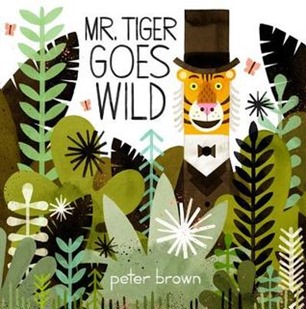
Review: Mr. Tiger Goes Wild by Peter Brown

mr tiger goes wild

Mr. Tiger Goes Wild by Peter Brown

Mr. Tiger was bored with the proper life he was living.  Filled with tea and stilted conversation each day, he longed to get wild.  Then one day, he does just that by starting to walk on four legs instead of two.  He felt better immediately.  And each day, got wilder yet: roaring, casing people, bounding across rooftops.  Then he took it one more step and left his clothes behind.  The other disapproved and sent him off to live in the wilderness unless he could change back and act properly.  So Mr. Tiger headed off.  The wilderness was glorious and Mr. Tiger went completely wild.  However, he also missed the people he left behind in town.  When he headed back to society though, he found that he’d had quite an impact without even knowing it.

This is a stellar picture book.  Brown tells a story that all children can relate to, that of being too wild and too loud and not acting appropriately.  The storytelling is exemplary with perfect pacing and plenty of humor.  That story is well-matched with the bright and bold illustrations.  From the get-go the orange of Mr. Tiger pops from the page, particularly when everything else is dirty sepia toned.  There are glorious moments, including the one where Mr. Tiger is wearing no clothes at all. 

This picture book is a welcome antidote to books on manners.  After all, we all need more wild in our lives.  Appropriate for ages 3-5.

Reviewed from library copy.

Review: Rifka Takes a Bow by Rebecca Rosenberg Perlov

rifka takes a bow

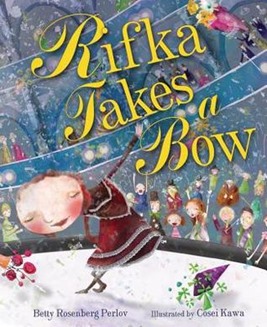
Rifka Takes a Bow by Betty Rosenberg Perlov, illustrated by Cosei Kawa

Rifka’s parents are actors in the Yiddish theater community, they work at The Grand and perform regularly.  So Rifka has grown up behind the stage, seeing them transform into different characters.  Sometimes they are so different, she isn’t really sure they are the same person.  When she goes to work with them, she gets to ride the subway and have a snack at the Automat.  She gets to look behind the stage and discover all of the illusions that go into doing theater.  Then one day, Rifka is climbing a set of stairs behind the stage and accidentally steps out during a performance!  What is a girl with acting in her blood going to do?

Written by a woman who herself grew up in the Yiddish Theater where her parents worked, this book captures the wonder of that lifestyle for a small child.  Perlov also shows us the intimate details of that world with the tricks of the stage, the joy of viewing a performance from the wings, and the obvious charm of having parents who are theater people.  This is a beautiful look at a world that has disappeared with the times.

Kawa’s artwork is very unique.  It has a wonderful modern feel thanks to the interesting proportions of the heads and bodies of the characters.  Perhaps the best touch are the little objects that dance in the air.  Whenever people are performing or communicating, they are there and flowing between them.  They offer a sense of the flow of this family and the flow that happens with the audience as well.

A joy to read, this book truly is a look at a lost world from the perspective of someone who actually lived it.  Appropriate for ages 5-7.

Reviewed from library copy.

Review: Foxy! by Jessica Souhami

foxy

Foxy! by Jessica Souhami

This North American version of a universal trickster tale is given a fresh but still classic take in this new picture book.  Foxy caught a bee and put it in a sack.  He met a woman with a rooster and asked her to look after his sack while he went to visit a friend, but insisted that she not look in the sack.  Of course, the woman did look in and the bee flew off.  So the Fox demanded her rooster in exchange.  This pattern continues with Foxy leaving the sack with another person and exchanging one animal for an even more large and tasty one.  Until he finally gets a little boy in his sack and meets up with a woman who understands how to trick a trickster.

Souhami incorporates rhythm and repetition into her story in a way that makes it a pleasure to read aloud.  Each new animal is gained in the much the same way with the structure carrying through from one to the next.  The result is a story that dances along with the wily fox, the readers able to settle into the traditional feel of the tale.

This would make a great choice for turning into storytelling, though it would be a shame to lose the bright and vibrant cut-paper illustrations seen here.  They have a great crispness to them that translates well to a group.

Perfection for reading aloud, this story is designed to be shared.  Appropriate for ages 4-7.

Reviewed from library copy.

Review: Thumpy Feet by Betsy Lewin

thumpy feet

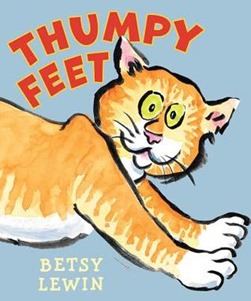
Thumpy Feet by Betsy Lewin

Cat owners will immediately see their own cats in Thumpy Feet.  He spends his day playing, sleeping, cleaning himself, and hunting.  The book takes a very simple but also very playful look at this active cat.  Small children will see their own days of naps and play reflected in this book and will also be drawn in by the jaunty rhymes and bright illustrations. 

Lewin keeps the book very simple with her language.  Using phrases like “flippy flip” and “yawny yawn” makes this a story that is great fun to share aloud.  The simplicity of the subject also lends this to be used very successfully with small children.  Additionally, the illustrations are large, bright and simple. 

This book is perfect for toddlers and librarians will be happy to add this jolly book to their cat storytimes.  Appropriate for ages 1-3.

Reviewed from library copy.

Review: Here I Am by Patti Kim

here i am

Here I Am by Patti Kim

This wordless picture book is the story of a boy and his family coming to an American city.  The signs don’t make any sense, the crowds are huge.  It’s noisy and big and confusing.  In the boy’s pocket is a red object from home.  It reminds him of what he left behind whenever he holds it in his hand.  He spends a lot of time at home, not interacting with anyone until one day, he drops his keepsake out of the window where a girl picks it up.  The girl heads off and the boy follows her and along the way discovers the greener parts of the city, food he recognizes, and people who are friendly.  In the end, he’s planted himself firmly into this new place.

Told entirely in pictures, this wordless book is written by a person who lived through this experience when they came to America from Korea forty years ago.  The book has an honesty that runs through it and nicely shows the time that it takes for someone to even see the positive in a new place.  It addresses the overwhelming feeling of homesickness and the jarring loss of language that isolates.  Beautifully illustrated, this book is one that has intricate images that come together to form a cohesive and powerful whole.

A remarkable capturing of the immigrant story, this book will speak to those who are immigrants and will also help others understand what children from other countries are going through.  The choice to make it wordless makes it all the more useful with immigrant populations in our communities.  Appropriate for ages 4-7.

Reviewed from digital galley received from NetGalley and Capstone Young Readers.

Review: Loula Is Leaving for Africa by Anne Villeneuve

loula is leaving for Africa

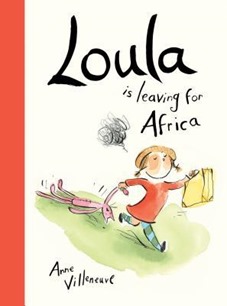
Loula Is Leaving for Africa by Anne Villeneuve

Loula has had enough of her mean triplet brothers and decides to run away.  She packs up her cat, tea set and best drawing.  She knows she wants to be far away from her brothers.  She announces to her parents that she is leaving for Africa, but neither of them seem concerned.  The only one who notices that she is running away is Gilbert, the family chauffeur.  Happily, Gilbert also knows just how to get to Africa.  It will involve riding camels, crossing a desert and taking a plane and a boat.  But most importantly, it also takes lots of imagination and one good friend.

Told with wonderful wit, this book starts out like many running away books and then takes a cheery turn.  Villeneuve tells the story with a light hand, allowing her illustrations to show the truth of what is happening while the text remains primarily dialogue.  The result is a book that has depth and creativity but reads quickly and effortlessly.

Villeneuve’s art evokes Madeleine and Babar somehow.  It has a timeless feel, swirls of watercolor.  One of the most effective images is the series of sky pictures as Gilbert and Loula sit along the river as the sun goes down.  The attention to color and the motionless pair next to each other capture those moments in life when all is perfection. 

A winner of a picture book, this is one that belongs in every running-away bag or bedtime stack.  Appropriate for ages 4-6.

Reviewed from digital galley received from NetGalley and Kids Can Press.

Review: Dee Dee and Me by Amy Schwartz

dee dee and me

Dee Dee and Me by Amy Schwartz

Told from the point of view of the younger sister, Hannah has had enough of her older sister Dee Dee.  Dee Dee always gets her way, gets the best seat, eats the best food.  She manages to do it in sneaky ways that seem nice as first but don’t end up that way for Hannah.  So Hannah decides to run away and packs up all the things she doesn’t want to share with Dee Dee.  In the end, she decides not to really run away because she can’t find her teddy bear.  But all alone, she spends time with the things she had packed up.  When Dee Dee appears having finally done something really nice for Hannah, Hannah puts her foot down and makes some new rules for them to play together.  This is a book that captures sibling relationships to a tee, or perhaps to a Dee.

Schwartz infuses her story with touches of humor that make Dee Dee’s tyrannical attitudes more funny than threatening.  Both Hannah and Dee Dee have strong personalities and individual perspectives.  Schwartz does a good job of telling Hannah’s story clearly but also making sure that Dee Dee is not vilified entirely.  The art is vivid and colorful, displaying a family home filled with small details and lots of flowers.  It is a home that you want to visit and play in. 

This is a superb telling of two siblings at odds that is filled with humor and charm.  Appropriate for ages 3-5.

Reviewed from library copy.

Review: How to Hide a Lion by Helen Stephens

how to hide a lion

How to Hide a Lion by Helen Stephens

Oh my, what a charmer of a book!  It is the story of a lion who comes to town to buy a hat.  But the people in town are afraid of him and chase him away.  He runs off to hide in a yard under a dog house where he is discovered by a little girl named Iris.  Iris immediately recognizes that he is a kind lion and invites him into her house.  They did their best to keep him hidden and Iris took good care of him by brushing his mane and putting a bandage on his hurt foot.  They also had a lot of fun, but that’s when they would almost be discovered.  A lion bouncing on a bed makes a lot of noise!  When Iris’ mother discovered the lion, the lion ran off.  He hid with the stone lions in front of the Town Hall.  While he was there, he saw two burglars leaving the Hall.  After the lion saves the day, everyone in town realizes what a kind lion he actually is and present him with… a hat.

Stephens has created a picture book that has a simple appeal.  The growing friendship between the lion and the little girl is done in a very organic and natural way.  Humor is sprinkled throughout as the little girl attempts to hide the lion.  Stephens also makes sure that even though the lion is kind, he is still completely a lion and an animal.  The two main characters are wonderfully different and make for compelling characters especially when paired.

The art in the book reads as vintage with their bright color washes.  The lines of the drawings are done with a light hand and are nicely simple.  This is a book that would be right at home next to Lyle Crocodile.  It reads immediately as a classic and hopefully will become one!

Too clever to be called sweet, this book is warm and friendly.  A perfect book to share with your big cat at home or to curl up like a lion and listen to.  Appropriate for ages 3-5.

Reviewed from copy received from Henry Holt and Co.