Review: Deep in the Sahara by Kelly Cunnane

deep in the sahara

Deep in the Sahara by Kelly Cunnane, illustrated by Hoda Hadadi

Released October 8, 2013.

Lalla wants to wear a malafa just like the other women in her family do.  Lalla tells her mother she wants to be beautiful just like her, but her mother says that a malafa is about more than beauty.  Lalla tells her sister that she wants to be mysterious just like her, but her sister says that a malafa is about more than mystery.  Seeing all of the women in their malafa, Lalla tells her cousin that she wants to be like all of them, but she replies that a malafa is more than that.  Her grandmother too says that a malafa is about more than tradition.  Finally, Lalla goes back to her mother and explains that she wants to be able to pray like her mother does.  Her mother agrees, saying “A malafa is for faith."  And the two face east and pray together in their malafa.

Set in Mauritania, this book celebrates the Muslim faith in a very beautiful way.  Written in the second person, readers are invited to see themselves as Lalla and learn about her faith and her world.  Cunnane writes beautiful descriptions of both the malafa themselves and also the community where Lalla lives.  There are donkeys, camels, and other exotic things, but Cunnane goes deeper than that and paints a world with pink houses shaped like cakes and silver heels that click on tiles.

Hadadi’s art is jewel toned and filled with details.  She has created a warm and loving community for Lalla to explore with the reader.  The beauty of the malafa are shown, the colors of the rooms, and the tangible love of an extended family.

An accessible and beautiful look at a Muslim community that dazzles.  Appropriate for ages 4-6.

Reviewed from digital galley received from Edelweiss and Schwartz & Wade.

Review: Nino Wrestles the World by Yuyi Morales

Nino wrestles the world

Nino Wrestles the World by Yuyi Morales

Everyone cheer for the incredible, the amazing Nino!  He is challenged to fight by wild opponents like The Guanajuato Mummy who is taken down by a tickle attack.  Next to challenge Nino is Olmec Head whose stony face is walloped by a Puzzle Muzzle move.  He has tricky moves to use on each one, taking one down at a time using all sorts of toys.  But finally, his real serious opponents arrive, Las Hermanitas!  Nino is going to have to use all of his wrestling and mental skills to beat these two little sister opponents.

Bold and colorful, this book evokes Lucha Libre, Mexican wrestling, right from the get go.  Morales celebrates this aspect of Mexican culture but puts her own child-friendly spin on it with wrestling different monsters using toys in Nino’s room.  She mixes the history of Lucha Libre masks with the actual monsters and the joy of a child who loves to wrestle any comers. 

The book nicely mixes Spanish and English and also switches fonts to further evoke the marquee effect of wrestling.  Add in the comic-book fonts for the various moves that Nino does and you have one very dynamic and inspired book.

This book shows everyone that books with multicultural characters can be wild fun to read!  Morales wins!  Appropriate for ages 3-5.

Reviewed from library copy.

Review: Volcano Rising by Elizabeth Rusch

volcano rising

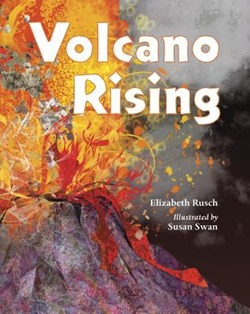
Volcano Rising by Elizabeth Rusch, illustrated by Susan Swan

Volcanoes can seem destructive, but in this nonfiction picture book they are shown to be sources of creation as well.  The process of eruption and magma is described and the book looks at the fact that different volcanoes move at different speeds.  The book is written in two levels, one for more of a picture book audience and the other for elementary students ready for detailed information.  While the simpler part stays general, the more detailed information includes specific volcanoes and stories of their eruptions.  The book makes volcanoes interesting rather than frightening, looking at how ash restores fields and how most creative eruptions can be out-walked by people.

Rusch’s two levels of text really stand apart from one another.  The simpler version really reads as a playful picture book complete with sounds.  It does still offer facts and information, but the deeper text is filled with those.  That longer text loses the playfulness of the shorter but is a wealth of information on volcanoes that even young enthusiasts will find fascinating.

Swan’s illustrations are done in cut paper and have a vivid color that really makes the volcanoes pop.  She shows various volcanoes in her art, contrasting them with one another nicely.  It is the images of eruptions that really explode on the page and will delight readers.

A double-layered book that can be shared in a storytime or in a science classroom.  Appropriate for ages 3-8.

Reviewed from copy received from Charlesbridge.

Review: The First Drawing by Mordicai Gerstein

first drawing

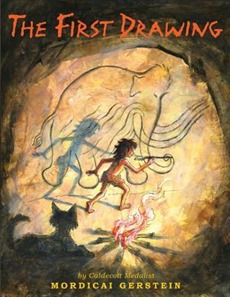
The First Drawing by Mordicai Gerstein

This picture book tells the story of how drawing first started.  Inspired by the the 30,000 year old paintings in caves in southern France, the story focuses on one boy who sees the world differently from everyone else.  When he looks at the clouds, he sees animals.  Everyone else just sees clouds.  When the firelight flickers on the walls of the cave as they go to sleep, he sees herds of beasts.  No one else does.  So he gets the name “Child Who Sees What Isn’t There.”  He tries to explain what and how he is seeing things, but it isn’t until he picks up a charcoal stick from the fire and actually draws the lines he is seeing that others can see it too. 

Beautifully told, Gerstein weaves the story of these caves into an exploration of how artists see the world in a unique and powerful way.  By choosing very tangible examples of how artists see, children reading the book will quickly realize that they are artists as well.  It is also helped by the use of  second person narrative, so that children are identified as the child who invented art.  The author’s note explains more about the caves as well as why Gerstein was inspired to tell the story of a child drawing. 

Gerstein’s art is bright and large.  He shows large swathes of sky filled with clouds, lands filled with animals, and makes sure that readers see the inspiration for the later art.  This contrasts with the tight closeness of the fire-lit cave that is all dancing flames and stone walls. 

A virtuoso picture book, this is a wonderful melding of history, possibility, and art.  Appropriate for ages 4-6.

Reviewed from library copy.

Review: Xander’s Panda Party by Linda Sue Park

xanders panda party

Xander’s Panda Party by Linda Sue Park, illustrated by Matt Phelan

Xander is planning a party just for pandas, but soon realizes that he is the only panda at the zoo.  So he changes the invitation to include all sorts of the bears at the zoo.  Then Koala is left out because she’s a marsupial, not a bear.  Xander chewed some bamboo and thought a bit, then changed the party to be for all mammals at the zoo.  After going through several more versions, Xander’s party changed to invite all of the animals at the zoo.  It was almost time for the party to start, when a truck and a crate arrived at the zoo.  It was a new creature for the zoo!  But would it ruin Xander’s updated party plans?

Clever, clever, clever.  This book carefully offers information on animal taxonomy to readers who will not even realize they are learning it thanks to the party-theme of the book.  Park’s writing is so impressive.  When I opened the book to see it rhyme, I must admit that I sighed.  But Park managed to created a rhyming book that is not written in stanzas.  She instead builds whole paragraphs that read like rhyming poems and make the rhymes work throughout the sentences.  It is a smart way to approach a book that harnesses the rhyme rather than galloping away with it.

Phelan’s art is entirely brilliant.  His lines have a looseness that really works, creating whole settings in just a few lines.  All of the animals have their own unique personalities.  I particularly enjoyed the rhino glaring from behind his wall and the montage of the different types of bears.  There are small touches throughout that add humor and coziness to the story.

A book that has science mixed with a message of inclusiveness, this is one has mass appeal.  Appropriate for ages 3-5.

Reviewed from library copy.

Review: Count the Monkeys by Mac Barnett

count the monkeys

Count the Monkeys by Mac Barnett, illustrated by Kevin Cornell

It is clear from the title that this book is about counting monkeys, and the title page explains that all one has to do is turn the page to do just that.  So here we go!  Wait.  1 King Cobra has scared off all of the monkeys.  Turn the page and 2 mongooses (or mongeese maybe?) have scared off the cobra but still no monkeys.  Keep turning pages and there are more animals that scare off the ones from the page before, but no monkeys at all.  The pattern is set until the 8 lumberjacks stick around for multiple pages.  And it will take something unusual to scare them off.  But even then, where are the monkeys?

Barnett has created another surprising picture book that turns a normal counting book merrily on its head.  He speaks directly to the reader, instructing them along the way on how to move the creatures off of the page, how to best turn the page, and explaining what just went wrong.  His silly approach to a counting book will find universal approval.

Cornell’s illustrations have a wonderful humor about them as well.  He takes Barnett’s vision and makes it colorful and bright.  All of the creatures have personality, from the crocodiles in vests and top hats to the self-satisfied wolves who clear out the grandmothers.  Each page has a twinkle to it that makes it fun to take a closer look at the pages.

Pure hilarity, this counting book is made to share out loud with a giggling group of preschoolers.  Appropriate for ages 3-5.

Reviewed from library copy.

Review: Lifetime by Lola M. Schaefer

lifetime

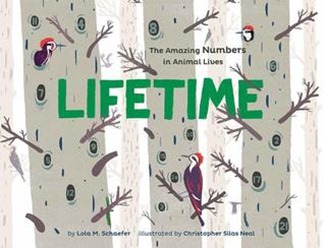
Lifetime: The Amazing Numbers in Animal Lives by Lola M. Schaefer

Take a unique look at what animals will do in a single lifetime in this book that combines counting, math and fascinating scientific facts.  The book focuses on how many times a single animal will do a behavior during their life.  The facts are based on estimations and opens with a description of how the numbers were figured out and explaining that each individual animal will be different than the estimate.  The book opens with one spider’s egg sac, the sole one she will create in a lifetime.  It then goes to the ten antlers that a caribou will grow and shed and moves on by tens.  The book ends with one thousand tiny baby seahorses, the number a single male seahorse will carry and birth. 

This is a spectacular way to introduce averages to children and estimation.  It is a celebration of the information that mathematics can provide to us about nature.  Schaefer has selected a wide variety of animals and intriguing facts about each of them.  Readers can find more in-depth information on the animals at the back of the book.  They will also find more information on averages and math there. 

Schaefer’s art adds to the appeal of this book.  Her illustrations have a boldness to them, a graphic quality that really works.  They are flat and vibrant, clearly laying items on the page for counting.  The book is a joy to page through since each page offers a new animal, a new habitat to see.

One of the most visually stimulating and smart concepts for a nonfiction picture book, this one is sure to beat the averages and be read more than once.  Appropriate for ages 4-6.

Reviewed from copy received from Chronicle Books.

Review: How To by Julie Morstad

how to

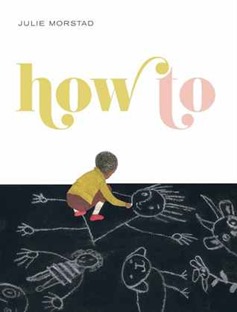
How To by Julie Morstad

This “how to” book does not describe mechanical endeavors, instead it is a luminous look at an eclectic collection of activities.  They include how to look like a mermaid, how to see the wind, and how to go slow.  Others are straight-forward ideas but the image shows a more inventive solution.  How to wash your socks has children dancing in a puddle wearing socks.  How to make friends is the cover image of a child drawing people with chalk.  The result is a book that is an elegant and lovely exploration of the creative.

Morstad creates beautiful books and this is no exception.  Here again she mixes a quiet sense of wonder into the book and combines it with gorgeous illustrations.  She uses fine lines, particularly when drawing the children on the pages.  Their hair and faces shine with the attention she has given them.  The ideas in the book are all creative and inviting.  This is a book that will entrance some children while others will be looking for more action.

Ideal for creative children who look at the world from a more whimsical point of view.  They will make friends in these pages.  Appropriate for ages 3-5, perfect for adults too.

Reviewed from library copy.

Review: Hello, My Name Is Ruby by Philip C. Stead

hello my name is ruby

Hello, My Name Is Ruby by Philip C. Stead

Ruby is a little bird who is eager to make new friends.  So she introduces herself to every animal she meets.  She’s also eager to learn all sorts of things so she asks all sorts of questions.  Along her journey, she meets different birds who travel in different ways, a giraffe, and many more.  Finally, she meets a bird who doesn’t sing like Ruby does, but he has heard Ruby’s name before.  So he takes her there and suddenly Ruby fits in, but a little bird like Ruby is completely unique so she manages to stand out anyway.

Filled with the same solid writing and art as his previous books, Stead has created a shining new protagonist here in little Ruby.  She is so similar to many children who are fearless when meeting strangers and eager to have conversations about anything at all.  There are many children who will see themselves and their energy in Ruby.  Stead puts page breaks at wonderful points in the story, creating stand-alone moments of flight and friendship that are exceptional.

As always, Stead’s art is stellar.  He manages in just a few lines and the tip of a head to capture Ruby’s spirit and vibrancy.  In the end, the range of Ruby’s friends is shone as a group and the image just sings.

A tiny but oh so impressive little bird will steal your heart in this vibrant picture book. Appropriate for ages 3-5.

Reviewed from copy received from Roaring Brook Press.