Review: Henry’s Map by David Elliot

henrys map

Henry’s Map by David Elliot

Henry was a pig who believed in being neat and tidy with everything in its place.  So when he looked out from his very clean sty, he was bothered by the messiness of the farmyard.  He decided to make a map, so that everyone could find things on the farm.  That meant he had to travel around the farm and write things down.  He included the sheep and the woolshed, Abigail the cow with her tree, Mr. Brown the horse and his stable, and the chicken coop.  Then all of the animals climbed up a nearby hill to look down on the farm and compare it to Henry’s map.  But when they looked closely, none of them were where they were marked on the map!  Luckily though, they all knew right where they belonged thanks to the map and back they all went, even Henry.

Elliot has a feel for writing picture books.  His pacing is delightful, the storyline is dynamic but not frenetic, and the characters are personable and ones that you want to befriend.  Henry is a little pig with a big vision, and there is satisfaction in him completing a big project on his own.  Elliot also nicely navigates having just the right amount of text on the page, enough to tell a full story but not too much to overwhelm or bog it down.  Add the twist of the animals being alarmed at not being in the same place as the map tells them they should be, and you have a very strong read. 

Elliot is the artist behind the Brian Jacques series of books.  Here his art has a wonderful playfulness but also a timelessness.  This book is beautifully illustrated with lots of jolly characters and one very serious pig.  The map itself looks like something a child would make complete with drawings and misspellings. 

A top pick, this picture book is perfect for map units in preschool and elementary school.  It also makes a fun addition to any farm or pig story time.  Appropriate for ages 4-6.

Reviewed from copy received from Philomel.
Review: 123 versus ABC by Mike Boldt

123 vs ABC

123 versus ABC by Mike Boldt

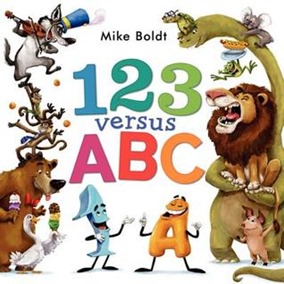
The letters and numbers just can’t agree in this book!  Is it a counting book or an alphabet book?  You will just have to read on to figure it out.  As the pages turn, it just gets more confusing.  Sure the first animal to appear is an Alligator, but there is just One.  Then there are Two Bears, Three Cars, and on and on it goes.  The book is narrated by the number one and the letter A, both of them arguing over what the book is really about.  Happily, they are both right in this mash up of an alphabet and counting book that is funny, silly and a romp of a read.

Boldt manages to make a counting and alphabet book that has a real freshness to it.  A large part of the success is in the humor, much of which is contributed by the two main characters, A and 1.  There little rivalry and clever asides add to the tension of the premise but also resolve in the end to something much more friendly.

Boldt’s art is bright colored and pays homage to vintage picture books.  The two main characters have a cartoon-like appeal to them with their broad expressions and Mickey Mouse gloves.  Boldt makes good use of white space throughout the book, allowing the mix of alphabet and numbers space to breathe on the page, something that becomes particularly important as the pages get more crowded.

Fresh and funny, this is one clever mash-up of ABCs and 123s that will appeal to every child who likes a lot of laughs.  It will work well with preschoolers who will enjoy the jokes as they review the content.  Appropriate for ages 3-5.

Reviewed from copy received from HarperCollins.

Review: I Am Blop! by Herve Tullet

i am blop

I Am Blop! by Herve Tullet

The author of Press Here returns with another simple and charming book.  Here the entire book is based around the shape of a “blop” which is something like a four-leafed clover, or a flower, or a butterfly.  With just a few words on each page, the youngest readers will discover a world of blops between these covers.  There are blops of different sizes, different colors, and they do a variety of things too.  Concepts are taught cleverly, such as mixing colors, what appears in a mirror, and opposites. 

While there are punch-out pages at the end of the book, this would still make a great pick for libraries to circulate.  I was particularly pleased with the mirror page and color mixing pages that add a special twist and fun to the book. 

Another great pick from Tullet, this book belongs in library collections and would make a great toddler read.  Expect to be drawing and seeing blops afterwards!  Appropriate for ages 1-3.

Reviewed from library copy.

Review: Flood by Alvaro F. Villa

flood

Flood by Alvaro F. Vila

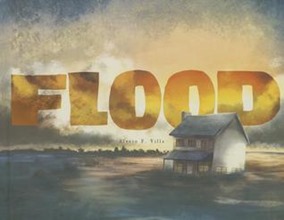
This wordless picture book shows the impact of a flood on a family.  The book starts with a sunny day at a house along the river.  The children are playing outside, the house is wrapped by a picket fence, and the windows are being replaced.  It is idyllic, beautiful and peaceful.  The storm front arrives along with the rain.  Sandbags are brought to the house and the family builds a wall of them to protect their home.  The new windows are boarded up and the family leaves their house behind.  Water quickly surrounds the house and soon it breaches the sandbags, rushing violently into the house.  The waters recede and the house is left, broken and damaged, filled with mud and muck.  But all is not lost, as the family rebuilds.

Though wordless, this book tells a powerful story of family, floods, loss and rebuilding.  The illustrations range from those colorful images of the perfect family home to images of destruction.  Vila captures the violence of these storms and the water itself.  There are several images that are very powerful including the first glimpse of the large storm front coming across the landscape to the close up of the water entering the home.  These natural images have a beauty to them but also a sense of foreboding.

This is a wordless book that will work well with a range of ages.  It is a timely read as well as weather systems grow more powerful and more families are facing natural disasters.  Appropriate for ages 4-7.

Reviewed from library copy.

Review: Wait! Wait! by Hatsue Nakawaki

wait wait

Wait! Wait! by Hatsue Nakawaki, illustrated by Komako Sakai

Translated from the Japanese, this little book is perfect for busy toddlers.  It follows some time in a toddler’s day when they move from one distraction to the next.  First, there is the butterfly fluttering past that won’t wait.  Then the lizard on the sidewalk slithers off without waiting.  Then come pigeons and next cats.  Finally, the little child is scooped up by a grown up and carried off on their shoulders with obvious delight.

This simple little book captures so nicely the speed of a toddler’s thoughts and the way that they can keep so busy with new discoveries in their day.  There is a wonderful gentleness to the book, where the animals and then the adult are just as much fun and intriguing as one another.  At the same time, there is a sense of discovery and awe as each new creature is found.

The text is very simple with the title repeated throughout and then one additional sentence added for each creature.  The illustrations shine.  They are wonderfully organic with textures while the colors remain subtle and natural. 

This book begs to be shared with one little child at a time, so that the animals can be identified and new discoveries of their own can be shared.  Appropriate for ages 1-3.

Reviewed from copy received from Enchanted Lion.

Review: The Boy Who Loved Math by Deborah Heiligman

boy who loved math

The Boy Who Loved Math: The Improbable Life of Paul Erdos by Deborah Heiligman, illustrated by LeUyen Pham

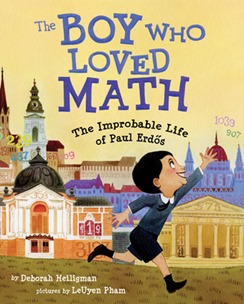
Paul Erdos grew up loving math from a very young age.  Growing up in Budapest, Hungary, Paul loved to think about numbers.  Unfortunately, he didn’t love school with all of its rules, so he was homeschooled by Fraulein, his nanny, until he went to high school.  Paul grew famous for his math but he still could not take care of himself and do his own laundry, cook his meals or even butter his own bread.  So when at age 21 he was invited to go to England to work on his math, he was worried about whether he could do it.  It turned out that buttering bread was not that difficult and that he would follow his own sort of lifestyle that ignored the rules.  So he traveled and did math around the world, staying with fellow mathematicians and relying on them to take care of him and his laundry and his meals.  He was the furthest thing from a stereotypical solitary mathematician to the point that people now have an “Erdos number” that shows how closely they worked with the amazing mathematician Paul Erdos.

This is such a wonderful biography.  It is a breath of fresh air in so many ways.  First, it plays against the stereotype of introverted and shy mathematicians working in solitude on formulas and instead shows Erdos as a vivacious man who didn’t just work with others, but depended on them.  Second, it shows mathematics as ever changing and new, something that is enticing and exciting.  Heiligman uses a light tone throughout as well as an obvious respect for Erdos’ brilliance and accomplishments. 

The illustrations share the same playful feel of the text.  Done in bold colors and dynamic motion, they have a humor that is welcome as well.  The look on Erdos’ face as he tries to butter his own bread for the first time is priceless and wonderful.  Children will be amazed that such a bright man would struggle with basic tasks.

A pleasure to read, this is an unusual biography that will make a welcome addition to nonfiction shelves.  Appropriate for ages 6-9.

Reviewed from library copy.

Review: Little Owl’s Orange Scarf by Tatyana Feeney

little owls orange scarf

Little Owl’s Orange Scarf by Tatyana Feeney

Little Owl lived with his mother on the edge of Central Park.  He loved lots of things like ice cream and riding his scooter, but he did not like his new scarf.  First of all, it was orange.  Second, it was itchy.  Third, it was way too long.  So Little Owl avoided wearing it whenever he could, but his mother kept on finding it and having him wear it anyway.  Nothing worked!  Then Little Owl took a class trip to the zoo and came back without his scarf.  It was lost for good this time.  So Little Owl helped his mother make his new scarf.  He loved it.  First of all, it was blue.  Second, it was soft.  Third, it was just the right size.  It was even perfect for visits to the zoo.

Feeney has struck just the right tone with this picture book.  Happily, it does not come off as whining but as a child who just does not like an article of clothing.  His attempts to lose the scarf or at least give it away are clever and cute.  The working together with his parent to create a new scarf is a smart turn in the story that leads to satisfaction for everyone.  When the little twist at the end is revealed, the story is entirely satisfying.

The art is kept very minimal and simple.  I must mention that the orange in the hardcover version I have is much more bright and intense than the cover above shows.  The entire book is done in black lines, orange and teal, making the colors very important.  The black lines are done with curls and playfulness that add to the light touch of the story as a whole.

Light and fun, this is a book that will work well at toddler story times, especially on winter days with scarves of their own.  Appropriate for ages 2-4.

Reviewed from copy received from Random House Children’s Books.

Review: Toys in Space by Mini Grey

toys in space

Toys in Space by Mini Grey

A group of toys are left outside overnight for the first time.  There is Wonderdoll, a robot, a cowboy and horse, a dinosaur, a sheep, and a rabbit.  All of them left in the dark, gazing up into the starry sky.  They are all scared, but then Wonderdoll starts to tell a story.  It is a story of seven toys left out at night under the stars, but then one star gets bigger and bigger until they can see that it is actually a spaceship!  The seven toys are beamed aboard the spacecraft and meet a glove-shaped alien who is missing his own favorite toy.  He has gathered toys from all around the world and kept them, but has not found his toy yet.  The seven toys help the alien figure out that he has to return the toys to earth and even throw him a party to cheer him up.  But will the alien ever find his own Cuddles again?

This picture book has the winning touch of Mini Grey.  She is always fearless in her storytelling and deeply understands the connection between child and toy as shown in her Traction Man books as well.  It also has the great combination of toys and aliens!  The story is wonderfully playful and children will wonder if it really happened right up to the very end. 

Grey’s art adds to the playful feel.  Each toy has its own personality visually but the seven together make quite the team.  She nicely incorporates speech bubbles into the story, giving it a comic feel that works well with the light-hearted art. 

Sure to be a hit with its combo of aliens and toys, this book will work well at a story time, or for cuddling after all the favorite toys are tucked in too.  Appropriate for ages 3-5.

Reviewed from copy received from Random House Children’s Books.

Review: Papa’s Mechanical Fish by Candace Fleming

papas mechanical fish

Papa’s Mechanical Fish by Candace Fleming, illustrations by Boris Kulikov

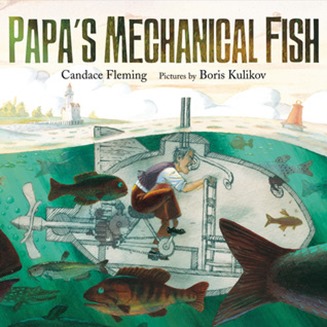
Based on a true story, this picture book reads more like a far-fetched fantasy.  Papa is an inventor but has never made anything that works.  All he needs is one incredible idea, but they don’t come easily.  So the family takes a trip to the lake where one of the children, the narrator of the book, asks what it is like to be a fish.  That gives Papa the incredible idea he was looking for.  The first version of his mechanical fish is so small that Papa himself can barely fit into it.  It almost works.  The second version is bigger and has a fin and a propeller and seats two people.  It almost works.  Whitefish III is even bigger, seats three, and is covered in copper.  It almost works too.  The fourth version is huge, fits the entire family, and…  Well, you just have to read the story to see how it ends.

The whimsy of these inventions is a large part of what makes this book so successful.  From the slow progress of the machines from one version to the next to the joy of seeing them tried out in the story, this is a book where you must find out what happens next.  Fleming has also written a charming story of a family that supports the inventor.  There is a rhythm to the story that makes it a pleasure, each attempt and failure met with similar satisfying responses from his family.  This makes the book work for a larger age range and makes reading it all the more fun.

Kulikov’s illustrations are a mix of realistic illustrations, huge fish that float past as inspiration in the water, and blueprints that let you glimpse the inside of each version of the submarine.  The entire book has a wonderful frantic quality to it, engaging the reader right in the moment of Aha! and then through the different trials. 

A treat of a book, this book will be inspiring to young engineers and inventors.  Appropriate for ages 5-8.

Reviewed from library copy.