Review: When Stravinsky Met Nijinski by Lauren Stringer

when stravinsky met nijinsky

When Stravinsky Met Nijinsky: Two Artists, Their Ballet and One Extraordinary Riot by Lauren Stringer

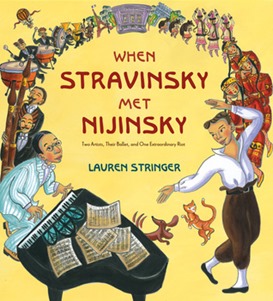
This is the story of how two Russian artists collaborated to create a revolutionary new ballet, The Rite of Spring.  When the two artists met one another, each of them started to change.  Stravinsky’s music changed and Nijinsky’s dance changed.  They inspired one another to try something entirely new and created a ballet based on Russian folk dances and folk songs.  Even at rehearsal, some of the musicians walked out, but enough stayed so that the show could go on.  When the ballet was first performed, the crowd was split.  Some people loved the new music and dancing, others were shocked and hated it.  The crowd took to the streets to continue to express their anger and appreciation.  This is a great picture book biography that captures the magic of creativity that results when two masters collaborate on something brave and new.

Stringer’s writing takes a complicated story and distills it to the most important points.  Young readers will quickly understand that the two men brought new ideas out of one another, finding each other inspiring.  Her art also speaks to the collaboration of these two men, using flowing lines and deep yet soft colors.  She inserts elements from the art of the time, referencing movements like cubism in both her text and art.  The end of the book has photographs of the two artists and dancers in the ballet.  It also has a longer look at their collaboration. 

A great choice for art and music classes, I’d recommend listening to The Rite of Spring with the group too.  Appropriate for ages 6-8.

Reviewed from library copy.
Review: Crankee Doodle by Tom Angleberger

crankee doodle

Crankee Doodle by Tom Angleberger

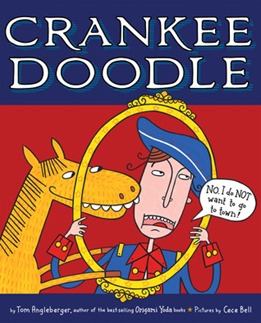
Brace yourself for a picture book that is entire silliness and proud of it!  In a riff on Yankee Doodle, this story tells readers that it was all the pony’s idea.  Yankee Doodle is bored and goes off on rants about how he doesn’t want to go to town or go shopping.  Then the pony suggests a feather for his cap, which starts another rant.  The pony finishes with a suggestion to call it macaroni.  After that rant, he explains that macaroni is another word for fancy, and that Yankee Doodle may want to call it lasagna instead.  In the end, the two of them head off to town, just like the pony wanted all along.

Angleberger writes with such a wry sense of humor here.  The rants by Yankee Doodle are a hoot to read aloud, the text heavy with indignation and exclamation points.  The sly pony seems to know just what he is doing as he lets Yankee Doodle blow off steam but gets his own way in the end.  The book ends with a historical note about the real history of the song.

The illustrations are done in gouache with a thick black line and bold colors.  The entire book pops visually and will work with larger groups of children thanks to its clarity and strong shapes. 

This one is a winner for story times.  Expect guffaws from children who know the song!  Appropriate for ages 4-6.

Reviewed from library copy.

Review: Becoming Babe Ruth by Matt Tavares

becoming babe ruth

Becoming Babe Ruth by Matt Tavares

This biographical picture book takes a look at Babe Ruth’s formative years.  It is the story of a small boy named George Herman Ruth who gets into lots of trouble, so much that his father puts him into Saint Mary’s Industrial School for Boys.  There he has to follow the rules and work hard.  Happily, there is also baseball and George gets to play it almost every day.  Best of all, there is Brother Matthias who serves as an inspiration and mentor for George’s baseball game and life.  As George gets better and better, he is finally whisked into the world of major league baseball, but he never forgot the school and the man who got him there. 

Tavares writes in such an engaging way that the pages fly by.  The sudden sternness of the school is told in short, abrupt sentences that enforce the martial feel of the establishment.  That contrasts directly with the long sentences that talk about the beauty of baseball.  Readers can almost feel themselves taking a big gulp of freedom on those pages. 

The joy Tavares feels about his subject is also palpable.  From eating ice cream with the boys from the school, to tipping his hat to them as he walks on the field, to the pleasure of hitting a ball, all are captured with a fondness and pleasure in the paintings that are the illustrations in the book. 

This is a baseball biography that children will find accessible and fascinating.  Play ball!  Appropriate for ages 6-9.

Reviewed from library copy.

Review: Octopus Alone by Divya Srinivasan

octopus alone

Octopus Alone by Divya Srinivasan

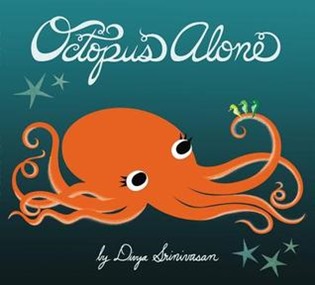
Octopus lives in a bustling reef filled with all sorts of sea life.  She watches the activity from her cave and three little seahorses come and visit her.  But Octopus just wants to be left alone, so she changes colors to hide and heads away from the reef.  As she travels away, the seahorses continue to follow her, watching her change colors and hide until Octopus finally leaves in a cloud of ink.  Eventually, Octopus comes to a very quiet part of the ocean where she can be left in peace with only silent jellyfish floating by and the drama of a whale zooming to the surface.  Nothing bothers her or watches her, so she falls fast asleep.  When she awakens, she starts to think about life in the bustling reef and she returns, ready to play once again. 

This is a shining example of a book where the writing and illustrations work seamlessly with one another.  The story of an introverted octopus who just needs a little time alone will speak to children who also feel that way at times.  Best of all, there is no lesson learned where being alone is dangerous or wrong, instead it is embraced as a time to see other beautiful things and recharge.  This is one undersea world where quietness and alone time is just fine, perhaps even spectacular.

The art in this picture book shines and glows.  Octopus and the other sea life pop against the dark blues and blacks of the watery background.  The art has a wonderful internal light that gives it a real sense of being underwater.  When Octopus heads out to be alone, the moment when she sees the whale is one of the most powerful and beautiful in the book.  It is handled with a lovely pause in the text and bubbles galore in the illustrations.

This is one glorious look at an underwater world that will speak to introverts and children who may feel shy at times.  Appropriate for ages 3-5.

Reviewed from copy received from Viking.

Review: Prairie Chicken Little by Jackie Mims Hopkins

prairie chicken little

Prairie Chicken Little by Jackie Mims Hopkins, illustrated by Henry Cole

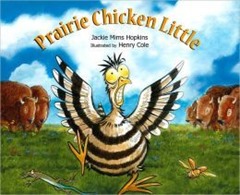
One day out on the grasslands, Mary McBlicken the prairie chicken heard a deep rumbling.  She ran off to tell Cowboy Stan and Red Dog Dan that a stampede was coming!  That is the set up for this prairie version of Chicken Little.  The prairie chicken soon has a prairie dog, jack rabbit, and meadowlark running with her to report the oncoming stampede.  Then they meet the coyote, Slim, who offers to show them a shortcut.  The friends realize what is happening before they enter the coyote’s cave and attack, drawing the attention of Cowboy Stan and Red Dog Dan who come to their rescue.  In the end, the source of the rumbling is not a stampede of course!

Hopkins has written this book to be read aloud.  The entire book has a rhythm to it that works very well, quickly setting a playful but fast pace for the story.  Readers will not need to have read Chicken Little to enjoy this new version, but children who know both versions will enjoy this one immensely too.  Hopkins also uses rhyming names that take the place of rhyming lines.  This is combined with nice rhyming repetition in some of the text, making this a treat to share aloud.

Cole’s illustrations are playful and filled with action.  The animals are all cartoony and friendly, even the sly coyote is more sly than fearful.  Thanks to his bright colors and large format, the illustrations will work well with a group of children.

Energetic and funny, this book is a good one to share with children learning about habitats as well as those looking for a good giggle.  Appropriate for ages 3-5.

Reviewed from copy received from Peachtree Publishers.

Review: Miss Maple’s Seeds by Eliza Wheeler

miss maples seeds

Miss Maple’s Seeds by Eliza Wheeler

This book will sweep you up like a breath of brisk autumn air.  Miss Maple is a little woman who spends her entire summer searching for seeds that have not gotten planted in the spring.  She brings them back to her maple tree and nurses them back to strength.  She washes them off, warns them to take care because they are so small, takes them on field trips to learn about being a seed, and reads them bedtime stories.  In winter they all burrow down together and fill the time with songs and stories.  Then when spring arrives, the seeds learn to dance in the rain and sink into muddy ground.  In May, it is time for the seeds to find the places they will grow, so Miss Maple launches them off.  Miss Maple then starts her journey with the seeds all over again, heading off on the back of a bluebird to find another year’s worth of stranded seeds.  Lovely and warm, this picture book is a joyous celebration of the seasons and the plants around us.

Wheeler has created a tiny motherly figure in Miss Maple, someone who loves and cares just for the good of the earth.  As the book progresses, she becomes almost a Mother Earth figure as her world turns with the seasons.  Wheeler’s writing is filled with wonderful small moments and details.  Miss Maple reads bedtime stories “by firefly light” and during the winter her animal neighbors share “supplies of hot maple syrup, old corn husks, and juicy fruit rinds.” 

Her illustrations show that same attention to detail.  This small world is filled with little touches that make it come alive.  The frogs in the nearby pond have a house in a log complete with front door and paned windows.  The seeds all sleep in small, cozy beds that are perfectly designed for seeds their size.  Then when Miss Maple launches the seeds off, she does it with winged baskets and other vessels that glow and float on the water.  This is a completely formed world that all readers will want to linger in.

Cozy and lovely, this picture book is a celebration of seasons and the earth, but it is also a reflection on the skill and care of nurturing.  Get this one for your Earth Day units and pull it out when covering seasons too.  Though I think it would be best of all curled up under warm blankets and watching autumn arrive.  Appropriate for ages 3-5.

Reviewed from copy received from Nancy Paulsen Books.

Review: The Boy and the Airplane by Mark Pett

boy and the airplane

The Boy and the Airplane by Mark Pett

This wordless picture book tells the story of a young boy who is merrily playing with his brand-new red airplane.  He runs with it, runs around it pretending to be a plane himself, and eventually throws it up into the air.  It lands on the roof where the boy where the boy is unable to reach it using a ladder or anything else that he tries.  He sits in discouragement under a tree and then is inspired when a maple seed drifts down and lands in his hand.  He plants the seed, watching it grow through the seasons and the years.  The ending is satisfying and lovely.  This book is about patience and dedication, but is also open to interpretation thanks to its wordless design and flowing storyline.

Pett manages to create a truly timeless book here.  The art is done in sepia tones with just a dash of red for the toy airplane.  The characters are even dressed in clothes that are universal.  The book has a great cyclical quality to it that works particularly well with the timeless feel.  The illustrations also have a contemplative feel to them that permeates the entire work.  This is a book that slows you down and gets you considering other options.

A great gift book for adults, this book will also be appreciated by young children who will see the humor in the boy’s solution.  Appropriate for ages 3-5.

Reviewed from copy received from Simon & Schuster Books for Young Readers.

Review: Brush of the Gods by Lenore Look

brush of the gods

Brush of the Gods by Lenore Look and Meilo So

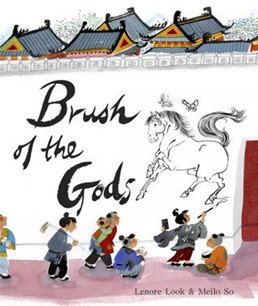
This is a picture book biography of Wu Daozi from the T’ang Dynasty, who is considered China’s greatest painter.  As a child, Daozi is taught calligraphy, but his brush does not want to just create Chinese characters.  Instead, he creates the first stroke and then turns it into an animal like a fish or a horse.  Daozi began to paint on walls, painting so fast that his sleeves opened like wings, gaining him the nickname of Flying Sleeves.  He painted every day and people began to leave coins for him that he donated to feed the poor.  As time passed, his skills grew even greater until the creatures he drew and painted became alive and left the flat surface of the walls.  He was then commissioned to paint an entire wall for the emperor, a project that took him many years.  In the end though, he created an entire world on a wall, one that you could almost walk right into.

Beautifully told and illustrated, this picture book biography takes a playful tone right from the beginning.  The sense that Daozi was not in control of his own gift makes for a wonderful insight into the drive and talent of artists and the way their talents can control them.  It is also a tribute to the skills gained by doing what you love and practicing a tremendous amount.  Daozi’s work and its lifelike quality is captured through a magical transformation to life in the story, making this feel much more like folklore than a biography.

Look’s text will work best for elementary-aged children, as she tells the story of hard work and talent combined into something spectacular.  They will also be more likely to understand the juxtaposition of biography and magical realism that is in the book.  Her writing is clear and lingers in all of the right moments and moves quickly when those moments are right too.  So’s illustrations are a tribute to Chinese art.  Done with clear brushstrokes, they also have fine details and small touches that make them shine.

This is a very impressive biography of an incredible artist that few children will be aware of before reading this book, making it perfect to share with children in art classes.  Appropriate for ages 6-8.

Reviewed from digital galley received from Random House via Edelweiss.

Review: The Day the Crayons Quit by Drew Daywalt

day the crayons quit

The Day the Crayons Quit by Drew Daywalt, illustrated by Oliver Jeffers

Published June 27, 2013

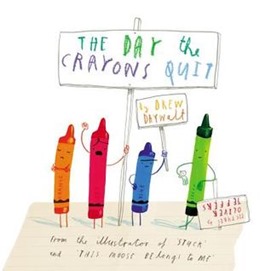
Duncan is all set to color, but when he opens his crayon box he finds all sorts of letters written to him by his crayons.  And they are all letters of complaint!  First, Red wants to complain about being overworked because of all of his work on apples and fire engines.  He even works holidays like Christmas and Valentine’s Day!  Other crayons like Beige are complaining about not being used enough.  Then there is the feud between Orange and Yellow about how is the real color of the sun, since Duncan uses them both.  Peach crayon is upset about having his wrapper peeled off leaving him naked and unable to come out of the crayon box.  Purple scolds Duncan for coloring outside the lines and Pink complains about not being used except by Duncan’s little sister.  Luckily, Duncan has a great solution to all of their complaints.

Daywalt has created a book that is such fun to read aloud.  Each crayon’s letter really has its own voice, making it a pleasure to give new voices for each crayon character.  This mix of tones and voices also results in a very robust story, much more than one might expect for such a simple concept.  The entire book is cheerful and has laugh-out-loud moments throughout.

Jeffers’ art is as always playful with his own particular whimsical touches.  His crayons come to life with just a few lines that convey emotion through eyes, mouth and arms.  Simple and completely convincing.

A colorful look at crayons, personalities and ultimately creativity, this picture book should be shared aloud with plenty of paper for coloring on.  Appropriate for ages 4-6.

Reviewed from copy received from Philomel.