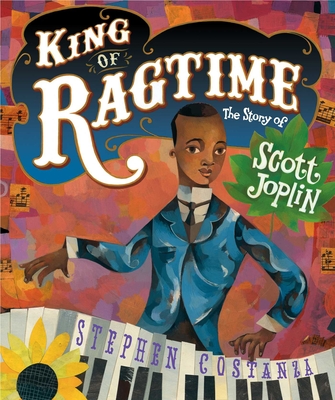
King of Ragtime: The Story of Scott Joplin by Stephen Costanza

Cover for King of Ragtime.

King of Ragtime: The Story of Scott Joplin by Stephen Costanza (9781534410367)

Released September 14, 2021.

Scott Joplin was a child who loved to listen to the sounds around him rather than using his own voice. He was the son of a man who was once enslaved. Their home was full of music with his father fiddling, his mother playing banjo and singing, and his siblings playing instruments too. Scott played the cornet. To find work, the family moved north to Texarkana where Giles found work laying tracks for the railway. Scott’s mother found work as a housemaid for a wealthy white family who happened to have a piano. When Scott came along to help, he saw the piano and started to play when he had time. Eventually, the Joplin family was able to purchase a piano for Scott and traded housework for lessons. Scott loved learning about the piano and music, but most of all he loved composing his own songs. He played all over town, and eventually made his way north to play in saloons and eventually in Chicago where he heard ragtime for the first time. Scott went to Sedalia, Missouri where he went to college and composed music. He tried to get his songs published and finally found a man willing to take a chance on a Black unknown composer. That’s how “Maple Leaf Rag” became a national sensation.

Constanza’s writing is full of rhythm and talks about music throughout. From his mother singing hymns to his family playing together to learning piano to getting work playing and composing, the entire book dances along to the importance of music in Joplin’s life. The writing also incorporates lots of sounds like the chirping of cicadas, the swish of brooms, the plink of the piano, and the OOM-pah! The writing is full of energy and tells the story of Joplin’s life with style.

The illustrations are bright and full of color and light. They have elements of quilts that fill the ground with patterns. The skies are blue with swirling clouds that dance in the sky. The towns are full of colorful buildings. Everything is inspiration for Joplin’s music, from the trains to the chickens to the flowers to the towns. It all comes together into one warm and bright world.

A jaunty and rhythmic biography of a musical legend. Appropriate for ages 5-8.

Reviewed from e-galley provided by Atheneum Books for Young Readers.
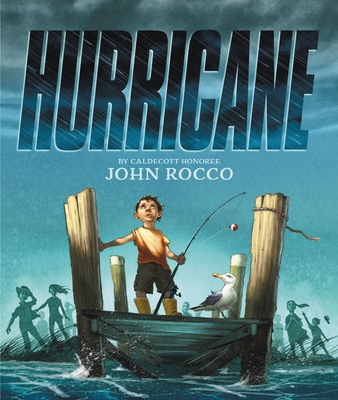
Hurricane by John Rocco

Cover image for Hurricane.

Hurricane by John Rocco (9780759554931)

The boy who narrates this story of a hurricane has a neighborhood dock that he loves. No one ever uses it except for him. It’s old, splintery and weathered, and just perfect. He can fish from the dock, catch crabs and swim. One day when he returned home from the dock, the air felt different and his father was putting boards over the windows. A storm was coming. The winds were big enough to shake the whole house and the river crept up the street. The next morning, the boy headed back to his dock, ready to fish. But his neighborhood looked different and the dock was destroyed. The boy asked everyone for help rebuilding the dock, but they were busy fixing their homes. So he knew he had to do it himself. Day after day, he worked on the dock all alone. Just when he was about to give up, help arrived. The whole town helped rebuild the dock into something that they could all share.

Caldecott-Honoree, Rocco, continues his exploration of natural disasters with this third book following Blizzard and Blackout. Rocco captures the joy of being near water, both when you have a treasured place that you can use alone and when it’s bustling and shared. The connection with nature is evident throughout the book, with the unnamed protagonist taking solace during the storm by imagining himself under his dock. The hard work the boy does to get his special place back is then supported by the community and shows the power of helping one another.

Rocco’s illustrations are full of sunshine and water at first. They show how the boy loves his time at the dock. Then the storm comes and Rocco has captured the unique lighting of pre-storm hours and then the darkness that descends. The devastation afterwards is realistic and dramatic, with trees down, shingles on the ground, and a flooded road. The moment that the boy sees his dock is particularly heart-wrenching and also a moment of resilience.

This picture book celebrates nature and community even in moments of devastation. Appropriate for ages 4-6.

Reviewed from e-galley provided by Little, Brown and Company.

Chez Bob by Bob Shea

Cover image for Chez Bob.

Chez Bob by Bob Shea (9780316483117)

As a rather lazy alligator, Bob comes up with a great plan to get birds to fly right up to his mouth. He opens a birdseed restaurant on his nose. After seasoning his birdseed with his favorite spices, so the birds would taste delicious, news soon spread about his restaurant among the bird community. Soon a small town grew around Chez Bob. Bob wanted to support the community, so he coached the bird basketball team and joined a book club. When a large storm came, Bob offered all of the birds shelter in his mouth. This was his perfect opportunity to eat them all! But he could hear them laughing and talking together and then looked around the empty town. He knew what he had to do.

Shea’s books are always a delight. This one contains just enough adult level humor that parents will enjoy reading it to their children multiple times. Just the book club page alone had me guffawing aloud, and there are lots of moments like that. While Bob may start out as a villain, I agree with him that hero isn’t too strong a word by the end of the story. There is great delight in watching Bob decide what he should do, all for the community good that he accidentally created.

Shea’s illustrations are large and bold, full of bright colors. They feature all sorts of little birds who come to Bob’s community and to Chez Bob too. Bob’s own scheming face is a delight as he plots to eat the birds. By the end though, the scheming grin turns into a genuine smile.

A delicious and sharp-toothed book about the transformation of a villain. Appropriate for ages 3-5.

Reviewed from e-galley provided by Little, Brown Books for Young Readers.

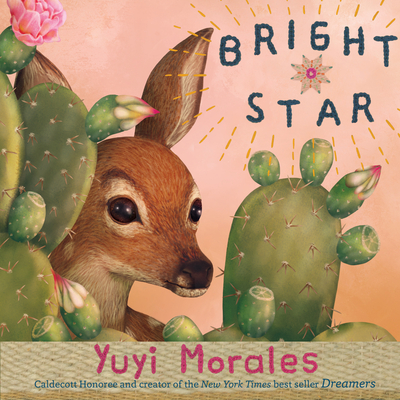
Bright Star by Yuyi Morales

Cover image for Bright Star.

Bright Star by Yuyi Morales (9780823443284)

Morales returns with her first picture book since her remarkable Dreamers. A fawn awakens in the desert, alive and bright. The fawn and its mother walk across the landscape, past lizards, jackrabbits, cacti and more. Sometimes, the fawn must lie low and hide so that it is safe, ducked low down among the spikes of the cacti. If the fawn feels afraid, it must shout it out loud, stuck at the endless concrete wall with barbed wire on top. The fawn isn’t alone. When rain comes, it offers secrets of the desert as it bursts into bloom, full of imagination. Just right for the fawn, or child, to realize that they are a bright star in our world.

Written in a combination of English and Spanish, this book speaks to the experience of children who have immigrated to the United States, whether through the desert and the past the wall or in another way. It is also a more universal celebration of children and their positive impact on the world, serving as a source of hope and opportunity to move beyond where we are now. Morales’ writing is beautifully simple and yet also evocative. Her weaving of the two languages is particularly striking.

Morales uses a wide variety of media in her illustrations. She uses handmade wool yarn from Oaxaca to weave words and textures. She used textures from photographs of concrete and fencing. She also created the amazing texture and feel of the children’s faces in the book using a photograph of a baby’s arm at a migrant shelter in Sonora. The entire book has an energy around it that calls us to pay attention to what is happening at the border and to children there.

Powerful and striking, this book calls for justice by showing the beauty of the people caught in the broken system. Appropriate for ages 4-7.

Reviewed from copy provided by Neal Porter Books.

I Am Smoke by Henry Herz

Cover image for I Am Smoke.

I Am Smoke by Henry Herz, illustrated by Merce López (9780884487883)

Told in first person by smoke itself, this picture book celebrates the many ways in which smoke appears. It’s around every campfire, forming from burning branches into a mist of carbon dioxide, water vapor and ash. Smoke can be dangerous but it can also be helpful, used to warm seeds into germination. Smoke can clear insects out of structures and make bees sleepy. It can also communicate, used for centuries around the world to send signals and emerging from incense during religious ceremonies. It can flavor our foods and act as a medicine at times. It returns to earth when it rains, ready to feed the forests and then start the cycle again.

Told in simple sentences, this picture book also shares scientific information. In a book that can be used with small children, there are marvelous science details too that will inspire some children to look at smoke differently. The uses of smoke are shared on the pages, each one highlighted and celebrated as the book continues.

The illustrations capture the wonder of the campfire and other flames. What is done best though is the way that the smoke itself is depicted. Sometimes it reaches fingers onto the page, other times it fills the page with white vapors and still others it darkens the scene. The smoke is layered and full of movement, beautifully shown in each image.

A fiery look at smoke and its impact on our world. Appropriate for ages 3-6.

Reviewed from e-galley provided by Tilbury House Publishers.

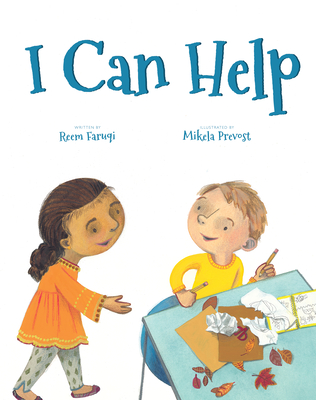
I Can Help by Reem Faruqi

Cover image for I Can Help.

I Can Help by Reem Faruqi, illustrated by Mikela Prevost (9780802855046)

Zahra loves to volunteer to help a boy in her class. Kyle has problems with reading, writing, cutting and gluing. Kyle is great at drawing and other things though. As Zahra helps him, she discovers that he is generous, funny and kind too. Then one day, when Zahra is swinging high on the swings and seeing the new colors of the leaves, she overhears some girls saying mean things about Kyle. She stops swinging and one girl asks her why she volunteers to help Kyle anyway. The next day, the girls stare at Zahra as she is asked to help Kyle cut some paper. Zahra makes a poor choice and stops helping Kyle, telling him to do it himself. Zahra has become a mean girl that she doesn’t even recognize. The next year, at a new school, Zahra has a chance to make different decisions and do better, and that’s just what she does.

The author of Amira’s Picture Day returns with a book based on her own experience as a child. It’s a look at a child who longs to be helpful but allows peer pressure to lead her away from who she sees herself being. The bullying nature is written so accurately, not overblown into something but kept slick and insidious. Zahra’s own response is honest and real, the shame of acting that way and not seeing a way forward. This book could have turned didactic very quickly and nicely shows a child making her own decisions and coming out of it having learned something about herself and who she intends to be.

The illustrations offer a diverse classroom. They use plenty of white space while expanding to larger images at times too. The children’s faces are done very effectively, showing a wide range of emotions.

Sure to create opportunities for discussion, this picture book gives space for children to make mistakes and recover from them. Appropriate for ages 4-7.

Reviewed from copy provided by Eerdmans.

I Can Make a Train Noise by Michael Emberley

Cover image for I Can Make a Train Noise.

I Can Make a Train Noise by Michael Emberley and Marie-Louise Fitzpatrick (9780823444960)

A little girl enters a crowded cafe with her family, insisting that she can make a train noise. As they take off their coats and sit at a table, the little girl continues to state that she can make a train noise, and that she will do it NOW! Jumping down from her chair, her imagination takes over as all of the customers form a line and quickly transform into passengers on a train. The train moves through a city formed from kitchen utensils, ketchup and mustard. It makes its way out in realistic oceanside settings and mountains with prairies. As the train slows to a stop, readers return to the bustling restaurant where everyone is talking about trains now.

This picture book is written in very simple lines, repeating “I can make a train noise” and “Now!” again and again. Using simple punctuation to slow the lines down or speed them up, the rhythm the repeating lines make is captivating and very impactful. This is a picture book that is ideal to share aloud and then share it again with the group joining in with the repeating lines. It’s a book that begs to be done aloud.

The illustrations are a large part of the success of this book. Given the simplicity of the text, they carry the weight of the story and the little girl’s imagination. I love the nod to In the Night Kitchen with the city made of condiments and kitchen gear. The transformation of cafe to train is joyous and fun, with everyone happily going along for the ride together. The speech bubbles in the cafe scenes are very effective and done only in images.

A grand ride on a little girl’s imagination. Appropriate for ages 2-4.

Reviewed from copy provided by Neal Porter Books.

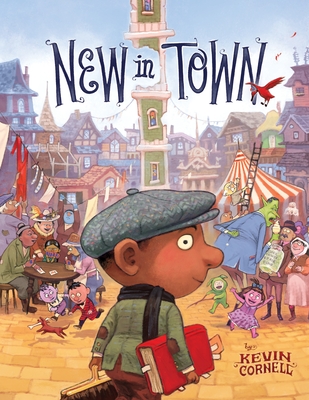
New in Town by Kevin Cornell

Cover image for New in Town.

New in Town by Kevin Cornell (9780374306090)

One morning, the residents of Puddletrunk woke up to discover that their bridge had collapsed. It certainly wasn’t the first time. They were lucky to have Mortimer Gulch, who had built and replaced over 200 bridges for the town. Mr. Gulch said it was the termites again and they’d just all have to donate to replace the bridge again. He was willing to accept jewelry and cash. But the new traveling clock repairman refused to pay, instead saying he would pay by fixing the clock tower for free. So bridge #272 began construction! Everyone worked hard to build it while Mr. Gulch orated, drummed and motivated them. Then they ran out of wood, but the clock repairman had some. When he refused to share his wood with Mr. Gulch, lest it get eaten by termites, readers soon find out exactly what has been happening to the bridges. But the traveling clock repairman just may have understood it all along.

Cornell has created an atmospheric picture book of an isolated town built in a marvelously ramshackle way on a small circle of land surrounded by a pit. Readers will immediately know that Mr. Gulch is a bad guy, but they won’t quite understand how bad until it is revealed that bridges (and clock towers) are simply delicious. The quiet and reserved repairman has a plan of his own that results in a wonderfully satisfying ending, neatly solving the bridge problem in a permanent way.

Cornell’s illustrations are a delight. They play with light and dark, filling with ominous shadows. The ramshackle town is full of small details as are the people in town. The ending works particularly well because of the art, showing the height of the tower, how precarious it looks, and the rather sad wooden bridge that connects them to the world. Even the font used for the book is unusual and interesting, swirling with promise of a fantastic tale.

A great villain, quiet hero and one doozy of a solution come together to make this fantasy picture book pure joy. Appropriate for ages 4-6.

Reviewed from e-galley provided by Farrar, Straus and Giroux.

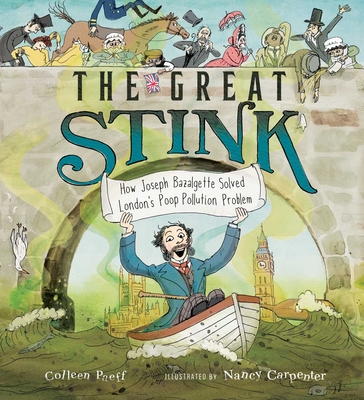
The Great Stink by Colleen Paeff

Cover image for The Great Stink.

The Great Stink: How Joseph Bazalgette Solved London’s Poop Pollution Problem by Colleen Paeff, illustrated by Nancy Carpenter (9781534449299)

It was 1858 and the Thames River in London smelled terrible. The problem was that the river was full of poop. The problem had started in 1500, when the sewers were emptied by men who shoveled them out at night. But the population kept on growing. By 1919, there were many more people in London and flush toilets are growing in popularity, but there is no way to get rid of all of the human feces, so some people connected their homes directly to the sewer, sending it all to the river. Cholera epidemics started killing thousands of people, but cholera is blamed on smelly air rather than polluted water, so they kept happening. In 1856, Bazalgette submits a plan to create large sewer pipes to take the sewage away from the river. His plan is finally approved in 1858 after a very hot summer causes the smell to get even worse.

Told with a merry tone, this book embraces the stink of history and shows how one man can change the lives of so many, rescuing them from disease and death. Paeff packs a lot of history into this picture book, making it all readable and fascinating through her use of historical quotes combined with a focused pared down version of what happened. Her writing is engaging and interesting, offering lots of information without ever overwhelming the story itself.

Carpenter’s art is just as stinky as can be. She captures the sewage entering the Thames, the miasma of stench coming off the river in the heat, and the grossness of dumped chamber pots. Against that unclean setting, a small baby is born and becomes an engineer who creates grand tunnels where the air is clear once again. Add in the macabre face of cholera and you have a book that is hard to look away from.

Fascinating, stinky and delightful. Appropriate for ages 6-9.

Reviewed from e-galley provided by Margaret K. McElderry Books.