Review: Little Cub by Olivier Dunrea

little cub

Little Cub by Olivier Dunrea

The author of the Gossie books returns with this companion book to Old Bear and His Cub that explains the way that Old Bear and Little Cub met.  Little Cub lived all alone near the forest with ono one to take care of him.  He was often hungry and slept alone and cold outside.  Old Bear lived alone too.  He had plenty to eat and a warm place to live, but no one to share it with.  Then one day, Old Bear heard odd noises coming from a pile of rocks.  It was Little Cub, trying to sleep curled into a ball.  It was Old Bear who named him Little Cub and Old Bear who took him home, gave him food, tucked him into a warm bed, and promised to teach him how to fish.  And it was Little Cub who filled up that empty bed so that neither of them had to be alone any more.

This is such a warm story.  Showing the way that Little Cub and Old Bear came together to be a family is honey rich.  Dunrea takes him time showing the parallels between the two bears’ lonely lives.  Though they are different in age, in being able to care for themselves, they are alike at heart and searching for something new. 

Dunrea’s writing is simple but also cheery.  Though it explores a child alone in the cold wilderness, one doesn’t worry because there is a sense of safety throughout.  Children will understand the hunger and chill and also that level of joy that is clear.  A large part of this are the illustrations that show blustery winds but also have the security and solidity of Old Bear right there too.  He is the hope for Little Cub, one that radiates across the pages.

Fans of Dunrea will enjoy this new series and those who read the first in the series will cheer to see Old Bear and Little Cub return.  Appropriate for ages 3-5.

Reviewed from copy received from Philomel.

Review: Betty Bunny Didn’t Do It by Michael B. Kaplan

betty bunny didnt do it

Betty Bunny Didn’t Do It by Michael B. Kaplan, illustrated by Stephane Jorisch

I’m a Betty Bunny fan, since I enjoy protagonists in children’s books who have a feel of being a real kid.  Betty Bunny in this third book in the series breaks a lamp when her siblings refuse to play with her.  When she is asked about it, she blames it on the Tooth Fairy.  Betty Bunny thinks this works so very well that she’s surprised it hadn’t occurred to her to try it before.  But things quickly unravel when her mother asks if she’s telling the truth.  Betty admits to telling an “honest lie” and is sent to her room.  Later, when a vase is broken, everyone in the family automatically blames Betty Bunny, but she really didn’t do it this time! 

Betty Bunny is precocious for a four year old.  I enjoy the way that Kaplan explains what Betty is thinking about her new ideas.  Also, the family dynamics ring very honest with older siblings unwilling to play but all too willing to offer witty advice. 

Jorisch’s illustrations have a great modern vibe to them.  The bunny family is active and they dynamic lives appear clearly on the page.  This has the trademark style of the earlier books with zingy writing and a naughty but quite charming little bunny at the center.

Fans of the earlier books in the series will find more to love here.  This series is not for every reader or family as some will find the naughtiness less funny and more problematic.  Appropriate for ages 4-6.

Reviewed from copy received from Dial Books.

Review: Busy-Busy Little Chick by Janice N. Harrington

busy busy little chick

Busy-Busy Little Chick by Janice N. Harrington, illustrated by Brian Pinkney

Mama Nsoso and her chicks needed a new home.  They spent each night shivering and cold in their dark, damp nest.  So Mama Nsoso said that tomorrow they would start work on their new home.  But the first day, Mama Nsoso found worms to eat and decided to eat rather than build a house.  The family shivered through another night.  The next day there were crickets to eat and no work was done.  Except by Little Chick who set out to gather grasses and mud to create their new home.  His hard work resulted in a fine new home for them, and then he was off finding himself some delicious bugs to eat. 

Harrington writes like a storyteller.  Her words flow beautifully when shared aloud.  She has reworked a classic fable from the Nkundo people of Central Africa and throughout has woven in Lunkundo words from their language.  She has also added lots of sounds to the book, so there are wonderful patterns that emerge as the hen and her chicks move through their day.  She clearly enjoys wordplay and creating rhymes and rhythms, all of which make for a great book to share aloud.

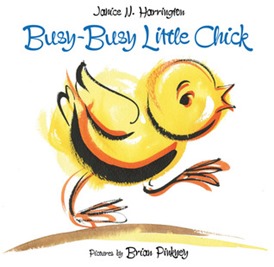
Pinkney’s art is large and bold, filled with warm yellows and oranges.  He has created images of the hen and her little family isolated and floating in cold blues.  They are brilliant orange, evoking the warmth of family and shelter.  His art is simple but filled with moving lines and playfulness with white space. 

A great pick for spring story times, don’t be chicken to share this one.  Appropriate for ages 4-7.

Reviewed from copy received from Farrar, Straus and Giroux.

Review: The Market Bowl by Jim Averbeck

market bowl

The Market Bowl by Jim Averbeck

Mama Cecile taught Yoyo to make bitterleaf stew, the same stew they sold at the market.  But Yoyo thought that the entire process took too long, so she took some shortcuts herself.  Then she snuck her batch of stew along with them to the market.  Mama Cecile warned Yoyo that they must always accept a fair price for their stew, otherwise Brother Coin, the Great Spirit of the Market, would remove his blessing from their bowl.  After selling all of Mama Cecile’s stew, there was still one customer left, so Yoyo pulled out her own stew and tried to sell that.  But she rejected his small offer for her stew.  Thunder rolled and through the next days, no one came to their staff at the market.  Now it was up to Yoyo to fix what she had done.  That would take traveling to see Brother Coin in person.

Set in modern-day Cameroon, this story skillfully blends folk elements as it talks about the culture as well.  The book will make a great read aloud thanks to the ease of the language used and the natural rhythm of the storytelling.  It would also be a great candidate for storytelling for those reasons too.

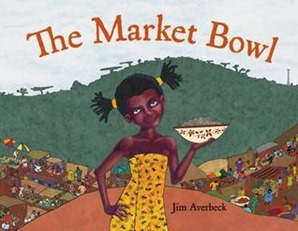
Averbeck’s art has a strong modern edge to it.  He shows the gorgeous textiles that people wear.  Additionally, he uses textures and patterns to create other objects as well, such as the shanty houses and details of interior scenes.

A modern-day folk tale, this is a rich glimpse into Cameroon.  The book ends with a recipe for bitterleaf stew too!  Appropriate for ages 4-6.

Reviewed from copy received from Charlesbridge.

Review: Round Is a Tortilla by Roseanne Greenfield Thong

round is a tortilla

Round Is a Tortilla: A Book of Shapes by Roseanne Greenfield Thong, illustrated by John Parra

Explore shapes with two young members of a Mexican-American family.  The book begins with circles as they are seen in nests, bells, and food.  Readers will also get to find squares, rectangles, triangles, ovals, and stars.  Spanish words are sprinkled throughout the book and engagingly explained within the context.  There is also a glossary at the end of the book to help.  This is an engaging look at shapes with a charming Mexican vibe.

Done in rhyming couplets, the book has a strong lilting rhythm and reads aloud easily.  The writing is strong and never suffers from the structure of the rhymes.  Thong invites us into their home where we are made to feel welcome throughout the book.  It is a warmly written book about shapes that has an additional dimension with the Spanish words.

Parra’s illustrations have a wonderful texture to them, often looking like traditional art and aging painted walls.  They add even more warmth and character to this already rich book.

This is an enjoyable and simple look at shapes and Spanish that invites the reader to learn and to try new words.  Appropriate for ages 2-4.

Reviewed from copy received from Chronicle Books.

Review: The Longest Night by Laurel Snyder

longest night

The Longest Night: A Passover Story by Laurel Snyder, illustrated by Catia Chien

This Passover picture book tells the story of the Exodus from the point of view of a young slave girl.  Readers first get a sense of the harsh environment and difficult lives of the Jewish people: the heat, the hard labor, the slavery.  Then come the plagues, one after another.  Finally there is the Exodus itself, the thrill and fear of fleeing in the darkness.  And finally, the miracle of the sea splitting in two, giving them safe passage away from Egypt. 

Written in rhyme, Snyder has created a book filled with rhythm and a story that moves swiftly along through the different parts of the Exodus.  Her choice of telling the story from the point of view of a child makes the story all the more personal and dramatic. 

Chien’s illustrations are just as dramatic with their deep color palette.  Especially moving are the natural moments, when the little girl finds openness and freedom in the world around her, though she can’t find it personally.  At these moments, the sky is huge and beautiful, but quickly the grit and sand return. 

A powerful and lovely exploration of the Old Testament tale of the Exodus given a fresh and personal aspect.  Appropriate for ages 5-7.

Reviewed from copy received from Schwartz & Wade.

Review: Lucky Ducklings by Eva Moore

lucky ducklings

Lucky Ducklings by Eva Moore, illustrated by Nancy Carpenter

Based on a true story, this book follows the walk of a mother duck and her small ducklings.  They follow her out of the pond, through the grass of the park, and into town.  They ate a bite from the overflowing garbage can and then headed off the curb and over a storm drain.  But while Mama Duck made it over the grate with no problems, her ducklings fell through one by one.  It could have been a sad ending to the story, but it wasn’t!  The people who saw it happened called for help.  It took firemen and someone with a winch on their truck to save all of the ducklings. 

Moore has created a story that has a real appeal.  It is the story of tiny ducklings that at first seems very sweet, then takes a very dangerous turn.  Throughout, she tells the readers that that could have been the end of the story, but it wasn’t.  Using this device, she creates both drama and also the assurance that thing will be alright in the end.  Her writing has repetition that makes it perfect for very young children.  The environmental message is subtle but profound.

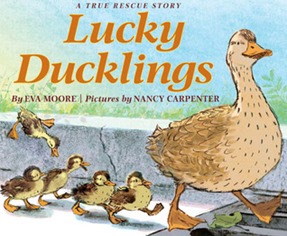
Carpenter’s ducks seem to be drawn with a nod to McCloskey’s Make Way for Ducklings.  The book feels vintage with the small town coming together to save this small family of ducks.  Carpenter celebrates both the natural setting and also the people themselves.  Her use of separated images that form one larger image to name the little ducklings works particularly well. 

Ideal for a duckling story time and perfect for spring, read this one alongside Make Way for Ducklings.  Appropriate for ages 3-5.

Reviewed from copy received from Orchard Books.

Review: The Highway Rat by Julia Donaldson

highway rat

The Highway Rat by Julia Donaldson, illustrated by Axel Scheffler

The creators of The Gruffalo return for an uproarious version of a beloved poem.  Beware, for the Highway Rat is coming and he’s out to steal everyone’s snacks.  He rides along with food dropping out of his saddlebags, accosting poor travelers at sword point, demanding their goodies.  He steals clover from a rabbit who has nothing else, a leaf from some ants, even hay from his own horse.  Eventually though, the Highway Rat meets his match in a juicy-looking duck who directs him into a cave where the echo seems to promise food.  Then the Highway Rat rides no more.

I love a good riff on a traditional poem, and this one is very clever.  Those familiar with The Highwayman by Alfred Noyes will particularly enjoy the play Donaldson makes with its form.  She incorporates familiar phrasing like “And the Highway Rat went riding – riding –riding – riding along the highway.”  Somehow her other words which are quite different from the poem have a similar rhythm and evoke the poem effortlessly.

Scheffler’s illustrations have a wonderful bold quality to them.  The Highway Rat is truly a bad guy and his naughtiness is clearly shown in his actions and his aspect.  His googly-eyed horse is a pleasure, almost always making eye-contact with the reader and sharing the joke of this evil rat riding on his back.  The rich colors of the landscape add a depth to the illustrations that is very welcome.

The tale of an evil highwayman (or rat) makes for a great read.  Add in strong illustrations and the play on a well-known poem, and you have picture book magic.  Appropriate for ages 4-6.

Reviewed from copy received from Arthur A. Levine Books.

Review: Who Put the Cookies in the Cookie Jar? by George Shannon

who put the cookies in the cookie jar

Who Put the Cookies in the Cookie Jar? by George Shannon, illustrated by Julie Paschkis

Lots of hands can take the cookie from the cookie jar, but even more are involved in getting the cookies there in the first place.  There are the hands that mix the dough and put it on the cookie sheet.  Then there are the ones that made the cookie sheet and oven mitts too.  Hands feed and milk the cow that makes the milk. Hands churn the butter.  Hands plant and harvest the wheat.  Hands feed and gather the eggs.  Many hands doing important work, make that cookie arrive in the cookie jar.

This is a great spin on a traditional song.  I’d pair it with the more traditional version in a program to get kids to see it from both sides.  Shannon celebrates all of the hard work that goes into things that we take for granted.  He focuses on their efforts but also on all of us being part of a larger global community that really matters. 

Paschkis’ illustrations have a warm feel to them.  They hearken back to more traditional images yet depict a modern and multicultural world.  Their bright colors really make the book pop and will work well with a large group.

Perfect for a cookie story time, I’d advise having some cookies to share when reading this and other cookie books.  Yum!  Appropriate for ages 2-4.

Reviewed from copy received from Henry Holt & Company.