Review: The Matchbox Diary by Paul Fleischman

matchbox diary

The Matchbox Diary by Paul Fleischman, illustrated by Bagram Ibatoulline

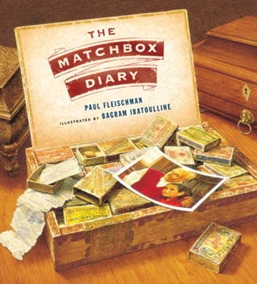
A great-grandfather shares his life’s story with his great-granddaughter who picks out a cigar box filled with matchboxes to find out more about.  He has been collecting matchboxes that are filled with small items documenting his life, a diary of objects.  They tell of his poor childhood in Italy where he’d be given an olive pit to suck on to make him less hungry.  There is a picture of his father who went to work in America and sent money home.  His story then turns into one of an immigrant with a trip to the port and then aboard a large ship.  He tells of arriving at Ellis Island, of the terror of possibly being denied entrance, and the eventual reunion with his father.  The entire family, including the children, worked to earn enough money to survive.  Life became better and he learned to read until he started in the printing industry and opened a bookstore. 

Fleischman writes of the tentative relationship of a young child and her great-grandfather who are just getting to know one another for the first time.  This is a story filled with small gems, treasures of stories that the two of them explore side by side.  The small matchboxes are a wonderful device to add surprise and delight to the story.  Fleischman has created an entire picture book told only in dialogue, making it a pleasure but challenge to read aloud. 

Ibatoulline’s illustrations are precise and detailed.  The matchboxes are shown up close and just opened, as if the reader had been the one exploring them.  The stories are shown in sepia tones with modern day in full color.  They are filled with a beautiful warmth in both cases.

A distinguished picture book, this is a brilliant combination of historical story and vivid illustrations.  Appropriate for ages 6-9.

Reviewed from library copy.
Review: Red Kite, Blue Kite by Ji-li Jiang

red kite blue kite

Red Kite, Blue Kite by Ji-li Jiang, illustrated by Greg Ruth

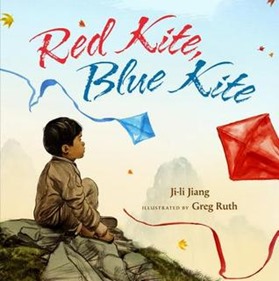
Based on the true story of a family friend, this book tells the story of a father and son separated during the Cultural Revolution in China.  Tai Shan and his father, Baba, loved to fly kites together from the roof of their home in their crowded city.  Then bad times come and the schools are closed.  Baba is sent to a labor camp and Tai Shan is sent to life in a small village with Granny Wang.  Both Tai Shan and his father continue to fly their kites, using them as a signal to one another and a way to maintain contact.  Eventually, Baba is taken further away to another labor camp where they cannot communicate with kites.  All that can be done is to wait until Baba is free again and their kites can soar together once more.

This picture book will be best understood by older children.  There is no need to have a background in Chinese history to understand this book because the story is so universal.  The use of kites as imagery of freedom and connection works particularly well, especially in the ending which is particularly uplifting after the tension and sorrow of the rest of the tale.  Jiang writes in prose that is filled with the emotion of the time.  He writes with deep compassion and doesn’t shy away from the pain that fills Tai Shan’s days separated from his father.

Ruth’s illustrations capture the mood of the story very effectively.  He moves from bright golds and oranges in the city to the dull colors of khaki and earth when the two are separated.  The color scheme is only alleviated by the pop of color from their kites.  When the two are together again, the color begins to return to the landscape.

This is a striking and universal look at families that are torn apart by war and the haunted time they spend apart.  Appropriate for ages 6-9.

Reviewed from library copy.
Review: Exclamation Mark by Amy Krouse Rosenthal

exclamation mark

Exclamation Mark by Amy Krouse Rosenthal and Tom Lichtenheld

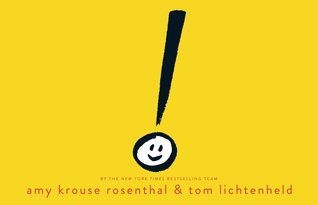
The creators of Duck! Rabbit! return with another book filled with bold but simple illustrations.  This book is about an exclamation point that is just trying to be like every other very stable period around him.  He tries everything to be the same, but it just doesn’t work.  He meets a question mark who is also very different, but he’s really bothered by all of her questions.  So he yells at her to stop!  Then he tries out other exclamations, realizing that he’s suddenly discovered exactly what he’s made for. 

An immensely simple book, I really appreciated the occasional zing of puns that kept it from becoming stale.  The illustrations are done on lined paper giving the entire book a cheery aspect.  The message is not done heavy-handedly, rather it is delivered in a playful and light-hearted way. 

This will be welcomed in classrooms as a witty and jolly way to discuss punctuation.  Expect the exclamation mark kids in the class to find a kindred spirit!  Appropriate for ages 4-6.

Reviewed from copy received from Scholastic.

Review: The World Is Waiting for You by Barbara Kerley

world is waiting for you

The World Is Waiting for You by Barbara Kerley

Another visually gorgeous book from National Geographic, this book ties together what kids do at a young age with what they can become as an adult.  The book invites children to get out into the world and explore.  After all, if you love getting wet, you could become a diver.  Love digging in the mud?  You could be an archeologist.  Love looking at the stars?  Climbing trees?  Digging into deep holes in the ground?  All of these and more are skillfully tied to careers in a book that is less about getting children to buckle down and more about getting them to open up and fly.

Kerley’s prose reads like a poem, each line designed as an invitation to be themselves and get into things that they love.  Even better, those same thrilling things are tied to life as an adult, offering options for turning their passions into careers.  Yet this book does not dwell there, instead it is a cornucopia of ideas, one after another meant to inspire thought and dreaming than to instruct on specific jobs.

As always in National Geographic books, the illustrations are crisp and colorful photographs.  Here readers will see children out in nature, interacting and loving it.  The images are from around the world and are filled with joy and motion.  At the end of the book, details on each image are given.

Bright, colorful and filled with inspiration, this is a career book that children will find thrilling.  Appropriate for ages 4-8.

Reviewed from library copy.

Review: Inside Outside by Lizi Boyd

inside outside

Inside Outside by Lizi Boyd

This lovely wordless book explores the changing seasons in a subtle and engaging way.  The book starts on the inside of a house with a young boy and a little black dog.  The boy is planting seeds in pots while the dog watches and two white mice play.  Through the die cut windows, you can see the snowmen in the yard.  Turn the page and you are outside with those snowmen, the birds eating the seeds.  Turn again and you are inside once more, this time able to glimpse flowering trees out the window.  The plants in the pots are green and growing too.  The boy is hanging pictures on the walls about birds and snowmen melting.  Keep turning and the seasons change, marked by activities, the pictures on the walls, and what you can see through the windows. 

There is a wonderful organic feel to this book, partly thanks to the textured brown paper that serves as the background for all of the images.  That feel is also helped by the color scheme of greens, blues and terra cotta.  The die cuts are used very skillfully throughout, offering glimpses from inside to outside and back again.  The wordless nature of the book makes it a universal story, ideal for being shared with families who may use another language at home. 

Filled with small details that will have children looking back at previous pages when they discover something new, this book is perfect for lingering over on long trips or snuggled in someone’s lap.  Appropriate for ages 2-4.

Reviewed from copy received from Chronicle Books.

Review: Brief Thief by Michael Escoffier

brief thief

Brief Thief by Michael Escoffier, illustrated by Kris Di Giacomo

An import from France, this picture book has a wonderful quirkiness.  It is the story of Leon, a lizard, who is having a lovely morning, eating breakfast, sitting in the sun, and then he has to go to the bathroom.  But after he goes poo, he discovers that he’s out of toilet paper.   He looks around, but only sees prickly leaves and messy grass.  Until he discovers pair of old underpants hanging on a nearby branch.  They are full of holes anyway, so he uses them to wipe and tosses them away.  But that’s when a loud voice, his conscience, starts to talk to him and tells him to clean them up and hang them up to dry.  In the end, his conscience turns out to be something else entirely and the grand twist of the tale adds to the merriment of the book.

Escoffier is a popular author in France and this book marks his debut into the American market.  His humor is spot on for young readers who will adore the idea of what this lizard does for toilet paper.  They will not see the ending coming, since it is fresh and completely surprising.  In the end, the twist will delight readers even more than the original joke. 

Di Giacomo is the illustrator of My Dad Is Big & Strong, BUT… and I am very pleased to see another of her picture books come to English translation.  Her art is a fabulous blend of paint, crayon, fine lines and texture.  She uses blots of color as the leaves, something that is surprising but works very well. 

Share this with all of those children who love something a little naughty in their picture books.  If you share it with a group, you will most likely be asked to read it over again.  Also, expect riotous reactions to the humor.  Appropriate for ages 3-5.

Reviewed from copy received from Enchanted Lion Books.

Review: Engine Number Ten by Rose Ann Woolpert

Engine Number Ten

Engine Number Ten by Rose Ann Woolpert, illustrated by Jaguar Studio Design

This is the story of how granite was quarried over one hundred years ago in California.  First work was done with mules and small wooden carts.  Then little steam trains were used on the narrow tracks, shuttling back and forth with loads of rock.  Steadily, more steam trains were used until they had ten steam trains and one steam shovel working in the quarry.  Then diesel locomotives started to replace the oldest steam engines until just Number Ten was still working.  The other steam trains had been taken apart and sold.  A new diesel engine was purchased for the quarry, pulling huge loads of granite with ease.  Number Ten was sent off to be scrapped.  But then something happened that changed Number Ten’s fate, a rockslide trapped the diesel engine.  There was only one train that could rescue her:  Number Ten!

Woolpert successfully mixes the true story of the Number Ten engine that now is on display at the Railroad Museum in Sacramento with personified engines that eagerly say “Yes, I Will!”  Her writing is refreshingly clear and playful, allowing the momentum of the true story itself to set a brisk pace. 

The illustrations are a mix of vintage photographs and black and white drawings that are often superimposed upon the photos.  This echoes the story being a mix of history and fiction.  The result is clearly historical but also very friendly.

This is the first book in the “Yes, We Will” series which will continue to tell the stories of the machines and people of Graniterock, a business in northern California.  It’s a good pick for young train enthusiasts or those interested in American history.  Appropriate for ages 4-6.

Reviewed from copy received from the author.

Review: Thunderstorm by Arthur Geisert

thunderstorm

Thunderstorm by Arthur Geisert

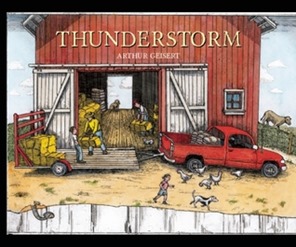
Geisert leaves behind his signature little pigs and instead tells the story of a storm rolling through the Midwest.  Follow the course of a red truck filled with sacks and bales of hay as they race the storm to get unloaded in a variety of places.  As the sky darkens, readers also get a glimpse of animal life both above and below ground.  The wind stirs and then roars, a funnel cloud forms and threatens destruction until the wind lowers and the sky clears and it is time to start cleaning up. 

Geisert tells his story with the only words being timestamps below some of the images.  His art is filled with details that make one linger and wonder.  He changes lighting and feeling with tightness of line and colors.  What is most fascinating about the book is that all of the illustrations fit together into one long illustration without any breaks.  It makes me wish that the book unfolded so that I could see it as one long line, but it is very interesting to look at the book in a new way, viewing it differently on a second reading. 

This is a celebration of the power of nature and the way that light changes through the course of a storm.  Geisert mixes in plenty of action and the tension of a family at risk.  Appropriate for ages 4-7.

Reviewed from copy received from Enchanted Lion Books.

Review: Have You Seen My New Blue Socks?

have you seen my new blue socks

Have You Seen My New Blue Socks? by Eve Bunting, illustrated by Sergio Ruzzier

Duck has lost his new blue socks.  He searches in his box, but they aren’t there.  He asks his friend Fox who hasn’t seen them either.  Perhaps Ox knows where his socks are?  Ox remembers seeing some socks down by the rocks.  But those socks are purple, not blue socks, and they aren’t new either.  Finally, Duck asks a group of peacocks about his socks.  And they do know where his socks are!  It turns out they are in a most surprising place!

Bunting has written a picture book in rhyme that dances along to a jaunty beat.  The rhymes are merrily done, done in a humorous way.  She makes it all look so easy and effortless, but rhyming picture books are some of the most difficult to do well.  Kudos to Bunting for maintaining the joy in simple rhymes.  Her words read aloud well and are also simple enough for beginning readers to tackle.

Ruzzier’s illustrations are the key to young readers spotting the blue socks which are slowly revealed as the book progresses.  Expect eagle-eyed children to figure out the answer even before the adults.  Ruzzier fills Duck’s world with lots of clutter from starfish to soccer balls to underwear.  Done in ink and watercolor, the colors are bright and add to the surreal nature of the story itself.

Socks lost and then found, rhymes and rhythms, and a delight of a read aloud to share, this book has it all!  Appropriate for ages 3-5.

Reviewed from library copy.