Review: Miss Moore Thought Otherwise by Jan Pinborough

miss moore thought otherwise

Miss Moore Thought Otherwise by Jan Pinborough, illustrated by Debbie Atwell

Annie Carroll Moore grew up in Limerick, Maine in a time when girls were not encouraged to be opinionated but she had her own ideas.  Children in that time were also not allowed in libraries, especially not girls, because reading was not seen as important.  Annie had always loved stories and books and though she thought at one time of being a lawyer like her father, she decided to become a librarian.  She studied in New York City, living alone even though others thought it was dangerous.  Miss Moore became a children’s librarian at the Pratt Free Library, with a room designed just for children.  She had new ideas, of course, like letting children take books home and removing the large “SILENCE” signs from the libraries.  As her new ideas took hold, Miss Moore changed library service for children into what we love today.

Pinborough clearly admires Miss Moore and her gumption and willingness to approach problems with new ideas.  Miss Moore’s life work is detailed here but we also get to see to her personal life and the tragedies that marred it.  Perhaps my favorite piece is the ending, where Miss Moore retires in her own special way, on her own terms.  Don’t miss the author’s note with more information about Miss Moore as well as a couple of photographs of the woman herself.

The illustrations by Atwell have the rustic feel of folk art.  It is colorful, vibrant and lends the entire work a playfulness that is entirely appropriate to the subject. 

A celebration of one woman who changed the face of library service to children around the world, this book will be welcomed by librarians and children alike.  Appropriate for ages 6-8.

Reviewed from library copy.

Review: Grandma and the Great Gourd by Chitra Banerjee Divakaruni

grandma and the great gourd

Grandma and the Great Gourd retold by Chitra Banerjee Divakaruni, illustrated by Susy Pilgrim Waters

This picture book is a retelling of a Bengali folktale.  Grandma was invited by her daughter to visit her on the other side of the jungle.  Before Grandma traveled there, she left the responsibility for her garden and home with her two loyal dogs.  On her way across the jungle, Grandma met a series of hungry animals: a fox, a bear and a tiger.  To each, she explained that she is very thin now, but will be plumper when she returns from seeing her daughter, so they let her go.  Grandma had a good time at her daughter’s home, eating lots of food and visiting.  But eventually, she had to return home to her dogs and her garden.  But how was she to get back?  That’s where the giant gourds in her daughter’s garden came in, and you will just have to read the book to find out how.

Divakaruni has taken a traditional folktale and left it wonderfully traditional.  The story reads like an oral tradition, filled with repetition, small descriptions, and a story that just keeps on rolling forward like a gourd.  She includes noises in the story as well, the khash-khash of lizards slithering over dry leaves, the thup-thup-thup of elephants lumbering on forest paths, and the dhip-dhip of her heartbeat. 

Waters’ illustrations are lush and colorful.  She uses texture and pattern to create a jungle.  The colors range from earthy browns to deep oranges and hot pinks.  The cut paper collages have strong clean lines and add a perfect organic feel to the story.

A great choice for library folk tale collections, this is a story that reads aloud well and has just the right mix of repetition, sound and inventiveness.  Appropriate for ages 4-7.

Reviewed from copy received from Roaring Brook Press.

Review: The Passover Lamb by Linda Elovitz Marshall

passover lamb

The Passover Lamb by Linda Elovitz Marshall, illustrated by Tatjana Mai-Wyss

Miriam has been selected to sing the Four Questions at the seder, the special Passover meal, at her grandparent’s house.  She has been practicing over and over again.  When she discovers that Snowball, one of their ewes, is going to have a baby, the family wonders if it will disrupt their Passover plans.  Snowball has her lambs in time, but her third lamb is ignored and she refuses to nurse him.  Miriam is very worried for the little lamb, but also wants to head to the seder and sing her part.  So she comes up with a clever plan to care for the newborn lamb and be able to be with her extended family.  This Passover story is a gentle reminder about compassion and a beautiful introduction to Passover.

Marshall writes with a gentleness that weaves throughout the entire story.  She allows Miriam to really be the center of the story, her family members are important but Miriam is certainly the lead.  She is the one who discovers that the ewe is going to have a baby, bottle feeds the newborn lamb and figures out the solution, all on her own.  This is child-led compassion that comes from a deep and natural place.

Mai-Wyss’ art is done in watercolors. The results are rich and colorful, nicely capturing a small family farm.  Just as with the text, Miriam is often front and center in the illustrations.

A superb book about caring and compassion, this is a strong addition to any public library.  Appropriate for ages 4-6.

Reviewed from copy received from Random House Books for Young Readers.

Review: Snow School by Sandra Markle

snow school

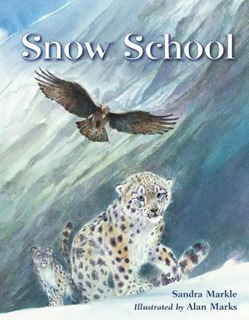
Snow School by Sandra Markle, illustrated by Alan Marks

High in the mountains of Pakistan, two week-old snow leopard cubs snooze in a den waiting for their mother to return.  It’s May and the pair are only a week old.  When the male cub goes outside, he is attacked by a golden eagle and only saved by his mother rescuing him.  As the cubs grow, the practice pouncing one another and then start to eat directly from the game their mother kills.  Their mother teaches them skills they must have to survive in the harsh climate.  They learn to mark their territory, to silently hunt, to be quick, to guard their food, to find shelter when snow comes, and when to retreat.  It is a story of how small cubs grow into strong hunters and how these great and beautiful cats manage to survive in their mountainous and cold habitat.

Markle is the author of over 200 books for children.  In this one she takes on one of the most elusive creatures on earth and shows the strong family bonds and the huge amount of learning these young cats must accomplish to live.  She writes her nonfiction in verse, making it more easily read.  Nicely, as the mother is teaching her cubs, Markle makes sure readers understand the lesson by repeating it neatly at the end of the stanza. 

Marks’ illustrations capture the snow leopards and their beauty and grace.  There are moments of such daring leaps and heart pounding danger that Marks captures with flawless accuracy.  His use of soft watercolors adds to the mystique of these cats and also captures the speed and motion as they hunt. 

Beautiful illustrations and strong text result in a book that will teach children much about the snow leopards and their lives.  Appropriate for ages 7-9.

Reviewed from copy received from Charlesbridge.

Review: The Price of Freedom by Dennis Brindell Fradin

price of freedom

The Price of Freedom: How One Town Stood Up to Slavery by Dennis Brindell Fradin and Judith Bloom Fradin, illustrated by Eric Velasquez

In 1856, John Price and two other slaves escaped to Ohio and freedom.  But the Fugitive Slave Act of 1850 was in effect and even free states were required to allow slave owners to capture escaped slaves anywhere in the United States.  John and his friend Frank spent the winter in Oberlin, Ohio, a hub of Underground Railroad activity.  They decided to stay and not travel to the safety of Canada.  So when a group of slave catchers came to Oberlin specifically hunting for John and Frank, the residents of the city had no legal grounds to help the two men.  When John was captured though, the city rose up against the slave catchers, forcing a showdown that would be one of the defining moments in fueling the Civil War.

Filled with informational facts, this book reads more like a fictional story thanks to its inherent drama.  It begins with John Price’s escape across the ice on stolen horses, continues through the Underground Railroad but the most amazing part is the final showdown, where your heart almost stops with the bravery and daring the Rescuers demonstrate. Fradin offers just the right mix of information and heroism.

Velasquez’s illustrations add to the dramatic feel of the narrative with their deep rich colors, drawn guns and historical details.  There are so many gorgeous night images filled with danger but also with hope.

This is a nonfiction picture book that is sure to inform children about an aspect of slavery that they will not have heard of as well as a tale of what a group of brave citizens can do.  Appropriate for ages 7-9.

Reviewed from library copy.

Review: Polar Bear Morning by Lauren Thompson

polar bear morning

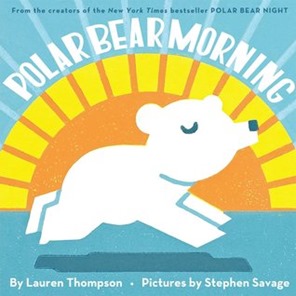
Polar Bear Morning by Lauren Thompson, illustrated by Stephen Savage

Following the picture book Polar Bear Night, this second book continues the story of the little polar bear cub.  The cub wakes up and peeks out at the day and snow outside her warm den.  As she starts to explore, she discovers another little cub out playing too, sliding down a little snow hill.  The two of them immediately start playing together, running towards the sea and eventually jumping into the icy water side by side.  The two little friends end up together on an ice berg surrounded by family, seals and whales.

Perfect for toddlers, this book speaks to the speed at which small children can find playmates and make friends.  As the two polar cubs run together, they pass different arctic animals like seals, walrus, seagulls and whales.  The text is brief and clearly sets the story in the arctic, the cold, the ice and the warmth of friendship.

Savage once again has amazing illustrations that are filled with chunky shapes, deep textures and shading that makes it stand out.  My favorite page in the book has the two small cubs nose to nose, one with a plop of snow on his head. 

A nice morning read aloud, this book be a good fit with bear story times or wintry tales.  Appropriate for ages 1-4.

Reviewed from copy received from Scholastic Press.

Review: Open This Little Book by Jesse Klausmeier

open this little book

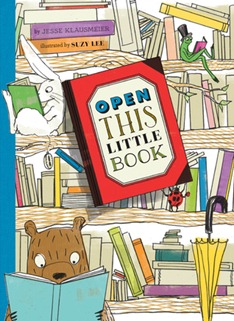
Open This Little Book by Jesse Klausmeier, illustrated by Suzy Lee

Open the full-sized picture book and inside you find a series of nesting books, each smaller than the one before.  The stories in the books also nest with one another.  First the reader opens the Little Red Book and discovers ladybug who is opening the Little Green Book where frog is the character.  On and on it goes, until the story reaches a little twist in the little books.  Then the stories unwind as the books are closed one by one.  It’s impossible to not be charmed by the design and concept.

Debut author, Klausmeier has created a seamless partnership with illustrator Lee.  The book is so much a marriage of their work that one might think it was done entirely by one artist.  The story is simple yet fully engaging.  The problem you may have with little listeners is having them slow down opening the next book in time to read the words on the page.  Lee’s illustrations add to the charm, hearkening back to vintage picture books but still carrying a modern vibe.  The scale of the books is perfection, like opening a Russian nesting doll.

Engaging, interactive and oh so much fun, this book looks at colors, sequence and a love of reading.  Appropriate for ages 3-5.

Reviewed from library copy.

Review: Who Says Women Can’t Be Doctors? by Tanya Lee Stone

who says women cant be doctors

Who Says Women Can’t Be Doctors?: The Story of Elizabeth Blackwell by Tanya Lee Stone, illustrated by Marjorie Priceman

Back in the 1830s, there were no women doctors, only men could have that career.  But also growing up in the 1830s was a young girl who would end up changing that.  Elizabeth Blackwell was not particularly well behaved: she was always exploring, working to toughen herself up, and even carried her brother over her head until he backed down.  Elizabeth had not dreamed of becoming a doctor, but she was inspired when an friend mentioned how much nicer it would have been to be examined by a woman.  When Elizabeth started talking about her new dream, people mocked her and told her it was impossible.  She applied to school after school, until finally the 29th school she applied for said yes!  But Elizabeth would have to face additional challenges in school and beyond as well.  This is the story of a woman who would not take no for an answer and the way that she changed the face of medicine along the way.

Stone has written a very engaging biography of Blackwell.  Much of the story is spent on her childhood and the challenges she faced getting into medical school.  I love the image of a spunky young girl who just wants to explore and demonstrates determination from a very young age.  She is an inspiring figure for youth, someone who discovered her dream and stood by it despite the many obstacles in her way and the mockery she endured.  Stone’s author’s note continues Blackwell’s story and offers a photograph of the real Dr. Blackwell.

Priceman’s illustrations done in gouache and India ink are filled with bright colors.  They bring the past to life, showing the energy of the young Elizabeth Blackwell and incorporating the vistas and buildings of the 1800s.  While they are bright and vibrant, they also serve to make sure that readers are cognizant of the period in which the book takes place.

Blackwell is a real-life heroine that young readers should be aware of.  This bright and welcoming new biography for younger readers is a welcome addition to library collections.  Appropriate for ages 6-9.

Reviewed from copy received from Henry Holt and Co.

Review: When No One Is Watching by Eileen Spinelli

when no one is watching

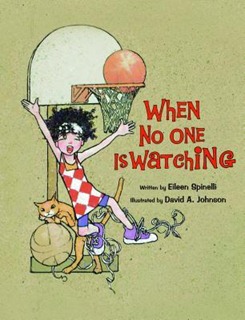
When No One Is Watching by Eileen Spinelli, illustrated by David A. Johnson

With all of the discussion about quiet and introverted children in classrooms right now, this book could not be more timely.  For those of us who were shy as children, you will recognize yourself in these pages.  Told in first person, the young female narrator finds it easy to be herself when no one is watching.  She is able to dance and spin when alone, but finds herself off to one side when her extended family gets together.  Alone she can be brave and imaginative, when on the playground with other kids she leans alone against a wall.  As the book progresses, another child suddenly pops out in the illustrations.  It’s a new best friend, who is quiet and shy too.  Together the two start to not care about who is watching them at all.

Spinelli does a great job of explaining the freedom of being alone, the imaginative play and the activity that happens when a child is comfortable and free.  She contrasts that clearly in her poem, where the girl who had been brave and active is now quiet and unsure.  Happily, Spinelli does not make this way of feeling seem wrong or strange.  Rather, she has created a character who is shy but willing to make friends and starts to naturally progress to being more sure of herself.

Johnson’s illustrations have a marvelous texture to them.  The main character pops on the pages, dressed in bright colors with wild curls and tumbling shoelaces, she is engaging and shining.  The other characters fade into the background, until Loretta, the new best friend appears and is just as bright as the protagonist.  It’s a subtle and successful look at connections between people.

A strong book that looks at shyness in positive and understanding way, this book will be embraced by children looking for someone just like them in the pages of a picture book.  Appropriate for ages 4-6.

Reviewed from copy received from Eerdmans Books for Young Readers.