Review: My Heart Will Not Sit Down by Mara Rockliff

my heart will not sit down

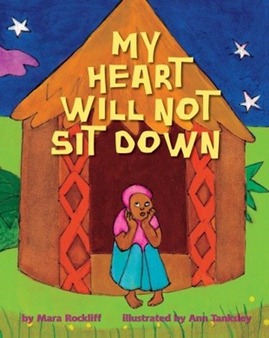
My Heart Will Not Sit Down by Mara Rockliff, illustrated by Ann Tanksley

Inspired by the true story of a village in Cameroon donating $3.77 in 1931 to the city of New York to help feed the hungry during the Great Depression.  In this picture book version of the story, the main character is Kedi, a girl who learns from her American teacher that people in his hometown of New York City were going hungry due to the Depression.  Kedi could not stop thinking of the hungry children in America, even though they lived so far away.  Her heart would not sit down until she did something.  So she talked with the grownups in her village and all of them told her at first that nothing could be done, they had no money to spare.  But then, one by one, all of the adults gave coins to help the hungry children. 

The author’s note at the end of the book, tells more about the Depression and about the donation too.  It explains that even in the Depression, this small amount of money would not have had a large impact.  But for the villagers who sent the funds, it would have been a fortune.  This book is a lesson in following your heart, finding compassion for others, and making an important difference in the world, even if it is just $3.77. Children will easily understand both the sacrifice made by the villagers and the meager amount that was raised.  It makes the story all the more haunting.

Tanksley’s illustrations have a roughness and organic quality that really grounds this story in reality.  Done in watercolor, pen and ink, and oils, they are filled with rich color and show the poverty and the beauty of Cameroon.

Throughout the book, the phrase “my heart would not sit down” is used.  It evokes a yearning, a calling, an inner distress that could only be quieted by doing something to help.  It’s that feeling that we need to cherish in both ourselves and our children.  It would also make a very good discussion book about what makes children’s hearts “not sit down.”

Based on a true story, this book is a call to follow our unquiet hearts.  Appropriate for ages 5-8.

Reviewed from copy received from Alfred A. Knopf.
Review: Mom, It’s My First Day of Kindergarten by Hyewon Yum

mom its my first day

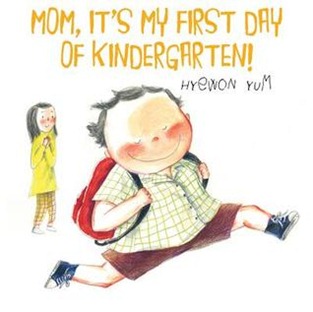
Mom, It’s My First Day of Kindergarten by Hyewon Yum

A little boy is all set for the first day of Kindergarten, eager to start.  His mother, on the other hand, is not quite to eager to see her little boy start school.  The boy runs to school with his mother trailing behind, worried and blue.  His mother frets about how big the school is, that they don’t know anyone there, but the boy is set to head in.  Then in the hall, things change and suddenly it is the boy who is smaller and bluer and more concerned and his mother is glowing and ready for him to start.  This book perfectly captures the mixed emotions of the first day of school for children and parents alike. 

Yum manages in a just a few words to really show the eagerness the boy feels and the reticence of the mother.  The boy is thrilled to be a big boy and head off to school, the mother is obviously seeing him a completely different light.  The book really comes into its own when the change happens and suddenly the mother feels confident and the boy is unsure.  It is that switch, that change that makes the entire book really work well.

Yum’s art also helps capture the emotions of the day.  At first, the boy is much larger than his mother, bright colored and dashing.  The mother is blue, almost wizened and delicate, worn away with worry.  When the change of attitude happens, the mother grows steadily in size and gains color as the boy shrinks to normal size and becomes bluer.  It’s a delight to watch the change come full circle by the end of the book where the day has ended and they are both large and bright.

A perfect pick for families facing their first day of Kindergarten this fall, this book will make a great jumping off place for discussions about the mixed emotions that everyone is sure to be feeling on the big day.  Appropriate for ages 4-6.

Reviewed from copy received from Farrar Straus Giroux.

Review: Happy Like Soccer by Maribeth Boelts

happy like soccer

Happy Like Soccer by Maribeth Boelts, illustrated by Lauren Castillo

Sierra loves to play soccer, especially on the field that is well maintained with a real soccer goal, not two garbage cans next to each other.  But now that she plays on a team, her aunt can’t come to her games because she has to work.  Sierra’s coach tells her he is glad to have her on the team and asks her if there is anything she needs, but Sierra always says no.  When her aunt manages to get time off to attend Sierra’s final game of the series, the game is rained out.  Sierra knows that her aunt can’t get two Saturdays off in a row, can’t ask for two favors so close together.  Sierra has to figure out how to fix this herself, because her aunt just has to see her play at least once this season!

Boelts has written this book poetically, with the lines in stanzas that make it read like a poem.  She also uses phrases that turn it into poetry, repetition and spare but true language.  Her writing has a great lilt to it, pointing to someone who speaks with an accent that makes their own phrasing dance.  It’s beautifully done, fully capturing the love between Sierra and her aunt and the fact that the two of them are a complete family. 

Castillo’s art adds to this feeling of family.  The book is set firmly in an urban environment, one that is escapable by bus but also one that is home.  The illustrations cement that setting.  The thick black lines and bright colors also have a subtlety that is unexpected.

A celebration of a small family, an urban community and sports, this picture book glows with love.  Appropriate for ages 5-7.

Reviewed from library copy.

Review: Don’t Copy Me by Jonathan Allen

dont copy me

Don’t Copy Me by Jonathan Allen

When Little Puffin heads off on a walk all by himself, he is followed by three little gulls who all copy him.  How annoying!  He tried to scare Small Gull, Tiny Gull and Baby Gull away, but they all just repeated what he said to one another.  Little Puffin tried shouting at them and that didn’t work either.  He sat down to think how he could end the game, and all three little gulls sat down too.  Little Puffin tried running and that didn’t work.  So he tried sitting very still so they would get bored.  You will have to try out the book to see whether that worked or not.

Allen is the author of I’m Not Cute! which charmed readers in 2005.  This book gives us a new lead character who is having a great day until he gets teased by the little gulls.  Allen’s writing maximizes the humor of the situation.  I particularly enjoyed the smallest gull and his baby-speak interpretations of what Little Puffin is saying.  Children will get this humor immediately, enjoying both the teasing and the eventual solution.

Allen’s art continues his use of cloud-like feathers and thick black lines.  The expressions are vivid and great fun, with the obvious frustration of Little Puffin growing and growing just as the satisfaction of the little gulls does. 

Grab this one for a bird-themed story time for toddlers!  Appropriate for ages 2-4.

Reviewed from library copy.

Review: A Bus Called Heaven by Bob Graham

bus called heaven

A Bus Called Heaven by Bob Graham

It all started when the bus with a sign that said “heaven” was abandoned on Stella’s street.  Traffic slowed, people gathered, and Stella took her thumb out of her mouth and suggested that the abandoned bus could be “ours.”  So everyone helped move it out of the street and into Stella’s front yard.  It stuck out a bit into the sidewalk and took up the entire yard.  The next morning when Stella looked out her window, things had changed again.  Now there were people sitting on their front wall, children wrestling in the grassy shade under the bus.  The adults began cleaning things up.  When some boys spray painted the side of the bus one night, they were invited back to paint one of Stella’s designs instead.  The bus had become a hub of activity for the entire community.  But then one Saturday morning things changed again, when a tow truck arrived.  What will happen next to the bus called heaven?

Graham creates books that have a special sort of feel to them, a sense of place and community, but that are also infused with a wonder and magic all their own.  Here he takes one abandoned bus and creates that community in our modern world where it is lacking.  This is not a statement about the problems of our society, but rather a look at what it could be if we were only willing. 

The illustrations are done in his signature style that has lots of details, fine lines, and soft colors that manage to be bright too.  He plays with color here, making Stella almost ghostlike in her paleness.  When she gets excited two dots of pink appear, but she does not ever fully become colored like the other characters.  She is a pale but very solid young character.

This is an uplifting read about the little changes that create a community and the little children that can lead us there.  Appropriate for ages 4-6.

Reviewed from library copy.

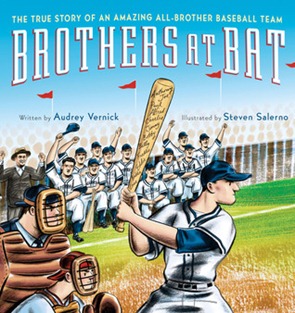
Review: Brothers at Bat by Audrey Vernick

brothers at bat

Brothers at Bat by Audrey Vernick, illustrated by Steven Salerno

In one family from New Jersey, there were 12 baseball-playing brothers: the Acerra brothers.  All of the brothers played high school baseball and their high school had an Acerra on it 22 years in a row!  In 1938, the oldest nine brothers formed their own semi-pro baseball team.  Their father coached the team and they played on dirt fields that were littered in rocks.   Each of the brothers had a different skill set than the others.  Some were slow runners but great players, others posed for the cameras naturally, one was a great pitcher that people still talk about today.  But all of them supported one another.  Then came World War II and the team disbanded as six of the brothers headed off to war.  Happily, all six brothers returned from war.  The brothers played their last game together as a team in 1952.  By that time, they were the longest-playing all-brother baseball team ever.  In 1997, the brothers were honored by the Baseball Hall of Fame.

Vernick shares this story of brothers who played together for most of their lives with a real sense of wonder and amazement at what they achieved.  The story celebrates their strong brotherhood and sense of family as well as the love of baseball.  Vernick offers all sorts of details that really create a vivid picture of the family dynamic and their lives. 

Salerno uses a vintage style for the illustrations that firmly roots this picture book in the time period.  They are colorful and action filled. 

A great non-fiction picture book for baseball fans, brothers, or people who enjoy a little sports with their history.  Appropriate for ages 6-9.

Reviewed from library copy.

Review: John Jensen Feels Different by Henrik Hovland

john jensen feels different

John Jensen Feels Different by Henrik Hovland, illustrated by Torill Kove

John Jensen lives in Norway.  He lives in an apartment, eats cereal for breakfast, brushes his teeth, and takes the bus to work.  But he feels different than everyone else and knows that people are looking at him because he is different.  He notices that no one else wears a bowtie, so he changes and wears a regular one.  But he still feels different.  John Jensen decides that the real problem is his tail, since no one else has a tail like his.  So he ties it up and hides it, but all that results in is not being able to sit comfortably and losing his balance.  In fact, he loses it so badly that he falls and has to go to the doctor.  Thank goodness that Dr. Field turns out to be just what John Jensen needs, a friendly doctor who is also an elephant.

Told in a deadpan voice, this book is pure delight.  John Jensen is obviously different, since he’s an alligator.  But the book never gives that away except in the illustrations.  Instead, it is told as if he is just another Norwegian on the bus.  The tension leading to the realization builds and is only partly fixed by the appearance of the elephant towards the end.  The book ends shortly thereafter with no sudden realization by John Jensen, just an acceptance that he truly is different.  I loved the fact that there was no culminating event at the end, because it made the book really work as a vehicle to talk about all sorts of differences even if you are a human too.

Kove’s illustrations add to the deadpan humor of it all.  There are marvelous touches like Camus’ The Stranger as bedtime reading, and the fact that absolutely no one on the bus is actually looking at John Jensen.  The illustrations are a large part of what really create the strong Norwegian setting that permeates the book. 

Translated from Norwegian, this is a striking picture book in so many ways.  It will be one of those books that children shout at thanks to the deadpan nature and the lack of reveal, and I love sharing those books with kids.  After all, we all feel different and even a bit green and scaly at times.  Appropriate for ages 4-6.

Reviewed from copy received from Eerdmans Books for Young Readers.

Review: Rachel Carson and Her Book That Changed the World by Laurie Lawlor

rachel carson and her book

Rachel Carson and Her Book That Changed the World by Laurie Lawlor, illustrated by Laura Beingessner

This is a biographical picture book about the environmentalist Rachel Carson.  The book covers her childhood, which she spent outside in her family’s woods, orchards and fields.  Her mother loved nature and passed her passion on to her daughter.  Though times were tough and her father struggled to make enough money to support the family, Rachel was able to attend Pennsylvania College for Women in Pittsburgh.  It was during this time that she started to be concerned about the environment. Rachel decided to become a biologist and received her Master’s Degree, becoming one of the few female biologists.  After some time jobless due to the Great Depression, her two skills of science and writing came together in a job for the Bureau of Fisheries writing radio scripts about sea life.  After World War II, Rachel became alarmed at the chemicals being sprayed everywhere.  Though she had been diagnosed with breast cancer, she continued work on Silent Spring which caused such a reaction that new laws were created to protect the environment.  This book tells the story of a woman who was smart, scientifically gifted, and passionate about the natural world she loved so much. 

Lawlor pays real homage to Rachel Carson here.  It is the story of her entire life, from the early days of connecting with nature through her years of study to the final, vital book she wrote.  Hers is an inspirational story of what can be done by someone who is smart and passionate about a subject.  It is also a great story about a woman who defied the conventions and followed her dreams.  Lawlor makes Carson both intensely human but also heroic.

The illustrations are done in a simple style with ink and watercolor.  They celebrate the natural world around Carson with plenty of the greens of the woods and the blues of the waters.  And in each, Carson is observing and making notes.  It’s a glimpse of a woman who is a scientist first and foremost.

This is a celebration of a groundbreaking book by a groundbreaking woman.  Appropriate for ages 5-8. 

Reviewed from library copy.

Review: Jimmy the Greatest by Jairo Buitrago

jimmy the greatest

Jimmy the Greatest by Jairo Buitrago, illustrated by Rafael Yockteng

Jimmy lives in a small village in Latin America where there is nothing but a small church and a little gym.  Thanks to that little gym, Jimmy and the other children in town spend their time learning to box.  Since Jimmy didn’t have much else to do, he started to train.  He wanted to become a famous boxer and get his mother the icebox she needed.  It all changed though when his trainer, Don Apolinar, gave Jimmy a box of clippings and books about Mohammad Ali.  Jimmy started reading all about Ali, started wearing his glasses, and even shadowboxed while continuing to read.  Jimmy learned about respect and dignity from Ali, creating his own sayings from Ali quotes.  He grew into a great boxer.  When Don Apolinar left the village for a larger city, Jimmy stayed behind and kept up the gym and opened a library.

This picture book took my breath away with its ending.  As Don Apolinar headed to the bus to leave town, I assumed that Jimmy was joining him or following close behind.  Instead, Jimmy stays where he is and continues to pass on the training he received and share his inspiration and learning with others.  It is a tribute to those who stay in their home communities and make a difference.  Jimmy learned a lot, let his dreams flow, and still stayed, not because he felt trapped or stuck, but because he wanted to. 

Yockteng’s illustrations are filled with warm, yellow light.  They display the barren environment around the village, the lack of things to do, and yet they also show a community of bright-colored shacks and friendly people.  There is a beauty to the barren landscape and certainly a beauty to the people themselves.

Highly recommended, this book pays homage to the local hero, the person who stays and makes a difference.  It’s one character that is often missing in children’s picture books and it’s great to see such a wonderful tribute.  Appropriate for ages 4-7.

Reviewed from library copy.