Review: Bird Talk by Lita Judge

bird talk

Bird Talk: What Birds Are Saying and Why by Lita Judge

Incredible displays of feathers, bright-colors and complex songs are all ways that birds communicate and try to find a mate.  Some birds puff and strut, others have large wattles, and still others drum on a branch with a stick.  Once birds have found that mate, they communicate their pairing to others using dances, clattering bills, or by providing food for one another.  When eggs and baby birds arrive, the parents use flashing wing colors, trickery or pretending to be wounded to lead predators away from their young.  The parents teach their babies to eat, fly and more with clucks, demonstrations, and plenty of talk.  Celebrate the birds that live around your house as well as exotic birds that have amazing ways of communicating.

Judge has written a very detailed but also very readable book about birds.  It has a wide range of species that are all intriguing in the way they communicate with one another.  This makes the book engaging and great fun to read.  At the end of the book are even more facts about the birds, that share their habitat and range.   Judge’s illustrations have a wonderful playfulness to them, but also display the beauty of the birds with accuracy and skill. 

A great pick for children’s nonfiction collections, this is an inviting book about wildlife that will give new and intriguing information to young nature lovers.  Appropriate for ages 8-10.

Reviewed from copy received from Roaring Brook Press.

Review: A Path of Stars by Anne Sibley O’Brien

path of stars

A Path of Stars by Anne Sibley O’Brien

Dara has a close relationship with her grandmother, Lok Yeay, who tells her stories about life in Cambodia when she and her brother were growing up.  She remembers Cambodia as a place of beauty, filled with moon and star light.  Lok Yeay also shared her darker memories of the soldiers coming and hiding in the jungle until they could make their way to Thailand.  But when the phone call came and Lok Yeay found out that her brother had died, she stopped telling stories.  In fact, she stopped getting out of bed entirely and stopped eating.  The entire family was worried.  Dara went to the garden and picked a rose and a ripe tomato.  Then she put them on a tray along with a photograph of Lok Yeay’s brother and went into the darkness of her grandmother’s room.  They shared the tomato and prayed for her brother, and Dara shared a story of the future and going back to visit Cambodia.

Commissioned by the Maine Humanities Council, this book reflects the story of a family that survived the Killing Fields in Cambodia and came to Maine afterwards.  According to her author’s note, O’Brien did extensive research not only about Cambodia’s history but also about its culture and environment.  As a reader, it is clear that she took Cambodia into her heart and showed its beauty.  O’Brien focuses on the intergenerational relationships in the family, demonstrating the importance of the grandparent in the Cambodian culture.  Additionally, the book is about war, families torn apart, and grieving. 

The art in the book is done in oil paints and oil crayon.  It has a wonderful jewel-tone and great depth and richness.  The illustrations focus on the family relationship, none of them showing the atrocities of war at all. 

This is a strong picture book that looks at the Cambodian Americans and the violent history that they fled from.  Appropriate for ages 7-9.

Reviewed from copy received from Charlesbridge.

Review: I Too Am America by Langston Hughes

i too am america

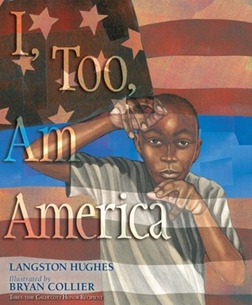
I, Too, Am America by Langston Hughes, illustrated by Bryan Collier

Collier marries the famous poem by Hughes with the story of the African-American Pullman porters, who served the wealthy white patrons aboard trains.  The poem speaks to the dream of freedom and equality that we are moving towards but have not yet attained in America.  It tells of servants sent to eat in the kitchen but also that in the future that will change and no one will again be sent to eat separately.  Collier’s illustrations depict the real work of the Pullman porters and the rhythm of the train seems to appear in Hughes’ poem too.  These men who worked in a racist world long after slavery was abolished are a fitting match to this strong poem that sings.

Hughes was able to write with such spare poetry, that it gives a strong vehicle for illustrations.  Collier built an incredible story around those lines, one of porters and a small boy who has new chances in the modern world.  He wraps his illustrations in the flag, playing with stars and stripes and the blue of the open sky throughout the book.  There is a gravity, a seriousness to his work that is truly fine.  It lifts up to the level of the poem, creating a harmony that is very special.

This is an extraordinary picture book about freedom, African Americans, and the struggle that still goes on every day for equality.  Appropriate for ages 7-10.

Reviewed from library copy.

Review: Under the Baobab Tree by Julie Stiegemeyer

under the baobab tree

Under the Baobab Tree by Julie Stiegemeyer, illustrated by E. B. Lewis

Brother and sister, Moyo and Japera, travel to a neighboring village to gather under the baobab tree, the tree of life.  Different people gather under the baobab at different times.  Sometimes the market wagon is there selling pots, pans and cloths.  Other times, the elders are gathered there talking.  Sometimes it’s a storyteller sharing stories.  As the children walk to the tree, they see all sorts of wildlife like weaver birds, gazelle, and a termite mound.  The siblings reach the baobab tree and more and more people join them, along with the minister and his Bible for church under the tree.

The setting of this book is clear from the very moment you open it.  For some people, from reading the title.  The setting stays true throughout the story, as details about Africa are woven into the story.  The children pass all sorts of creatures as they travel.  The different people under the baobab tree are shared in detail as well.  Clues about what will happen under the tree today are also shared in the text, so religion is tied nicely throughout as well.

Lewis’ art really make this book appealing.  He uses soft lines and almost gauzy colors to tell the story.  The watercolors seem to shimmer in the heat of Africa.  At times there is clarity in the images and great detail, other times the reader is moved further back and the scene itself is captured in its vastness and heat.

A picture book that embraces religion with a gentle touch, this book is a heartfelt welcome to Africa.  Appropriate for ages 4-6.

Reviewed from library copy.

Review: Ocean Sunlight by Molly Bang

ocean sunlight

Ocean Sunlight: How Tiny Plants Feed the Seas by Molly Bang and Penny Chisholm

Following her Living Sunlight book, this continues the story of how the sun makes life on earth possible.  Here, the focus is on the ocean and the role that sunlight plays even in the darkest depths of the sea.  The story starts with photosynthesis and food chains on dry land, then moves to the water.  Bang asks where the green plants in the ocean are except for the seaweed.  Then she shows the tiny phytoplankton that make up the plants of the sea.  The food chain is shown and the book then turns to the darkness of the deep and how the food chain works even in blackness.  It is beautiful science. 

Bang successfully combines poetry and science in this enticing picture book. Her tone is inviting, inquisitive and filled with wonder at the amazing things that happen due to our sun.  The book is written from the point of view of the sun itself and how its energy reaches everywhere on earth.  It is a celebration of the sun and of the oceans themselves too.

Chisholm’s art ranges from the glow of the yellow sun to the black deep of the ocean.  Everywhere, even in the darkness, you can see the energy of the sun.  When the phytoplankton are displayed, Chisholm shows them up close in all of their wonderful detail.  Then the energy of the sun dances above the waves in yellow dots.  The entire book sings with energy and light.

This book is a tribute to science and nature.  It’s a readable and very understandable look at the complex systems that make our lives possible.  Appropriate for ages 5-8.

Reviewed from library copy.

Review: When I Was Small by Sara O’Leary

WhenIWasSmall_cover

When I Was Small by Sara O’Leary, illustrated by Julie Morstad

Henry asks his parents what they were like when they were small.  The book starts out normally enough with his mother explaining that she was called Dot because her full name, Dorothea, was too big for her.  But then things get creative!  Dot was so small she wore the same shoes as her doll.  She swam in the birdbath.  She jumped rope with a piece of yarn.  Her bed was a mitten.  Her father built her a doll house, and she lived in it.  At the end of this story from his mother, the two of them agree that one of the reasons that his mother looked forward to growing up was to share stories with a child of her own. 

O’Leary writes with a quiet joy that infuses the entire book.  There is a gentle playfulness throughout and children will immediately know that this is a story being told and not the truth.  Morstad’s illustrations have a delicacy to them that works particularly well with the more tall tale parts of the story.  The illustrations have a sweetness to them that make me think of the old Golden Books.  They are never saccharine thanks to their whimsy.

This is the third in the series about Henry, but the first one that I have read.  The first book in the series won the 2007 Marilyn Baillie Picture Book Award in Canada, so that one is definitely worth seeking out too.  Appropriate for ages 3-5.

Reviewed from pdf received from Simply Read Books.

You can also view the trailer below:

Review: Baby Bear Sees Blue by Ashley Wolff

baby bear sees blue

Baby Bear Sees Blue by Ashley Wolff

Baby Bear wakes up next to his mother in the den.  Sunlight peeks into the den, warming him and Baby Bear sees yellow.  At the entrance to the den, the oak tree waves its leaves at him, and he sees green.  The jays in the trees are blue.  The trout in the stream is brown.  The scent of the strawberries leads him to discover red.  The tickle of a butterfly on his fur shows him orange.  The storm clouds are gray, but then they leave behind a rainbow.  Finally, at the end of his day, Baby Bear sees nothing but black.

Wolff has created a lush and rich picture book that truly celebrates colors in very natural way.  All of the elements of color seem unforced and honest.  She embraces cadences that roll off of the tongue, giving this book a wonderful rhythm.  The patterns create a book that will be loved by toddlers who will enjoy exploring colors alongside Baby Bear. 

What makes this book really work are the illustrations that are linoleum block prints painted by hand with watercolor.  This creates a combination of strong black line and foundation and then colors that have light and glow on the page. 

A top pick for color concepts, this book is a work of art that has plenty of toddler appeal.  Appropriate for ages 2-4.

Reviewed from library copy.

Review: I’ll Save You Bobo! by Eileen & Marc Rosenthal

ill save you bobo

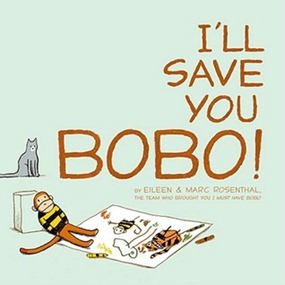
I’ll Save You Bobo! by Eileen & Marc Rosenthal

Willy and Bobo return for their second book, following I Must Have Bobo!  Willy is trying to read a book with Bobo, his stuffed monkey, but Earl the cat keeps trying to steal Bobo away.  The rivalry established in the first book continues here as Willy starts to write his own story instead of reading one.  It is all about him and Bobo at first, with them in the jungle with plenty of snakes and living in a tent.  But again, Earl keeps on sneaking in and trying to take Bobo away.  So Willy adds Earl to the story, changing it to one of revenge!  In the end, Earl though is the one who takes a tiny bit of revenge.

Reading the first book is fairly critical here, since it explains the strained relationship between Willy and Earl.  The mood carries from one book to the next seamlessly and makes for great fun. Those new to the series though may not understand what Earl is trying to do.  This is a book that shows a kid who has real feelings, does not get sweeter as the book goes on, and one knows that this is not the end of his rivalry with the cat.  That adds to my enjoyment of the book, since Willy seems so much like a real child, rather than a picture book example of one.

This book also shows the creative process and will get children interested in writing their own picture books whether they have lots of snakes in jungles or not.  It’s a delight of creativity that is anchored well by the illustrations which have a frenzy and vibrancy that matches the story well.

Get this into the hands of fans of the first book, or hand them to children as a pair.  Appropriate for ages 3-5.

Reviewed from library copy.

Review: Let’s Hear It for Almigal by Wendy Kupfer

almigal

Let’s Hear It for Almigal by Wendy Kupfer, illustrated by Tammie Lyon

Almigal wears hearing aids in her favorite cotton-candy pink.  She has friends who all different in a variety of ways.  Some wear glasses, others are twins, some speak Spanish, and one of her friends also wears hearing aids, but hers are purple.  Almigal is happy most of the time, until she finds out that she can’t hear everything, things like her friends talking, bird chirps, or songs in ballet class.  Worst of all, when she is ready for bed, she can’t hear her parents say goodnight.  So her doctor recommends that Almigal get a cochlear implant.  She has to have an operation and is able to pick out a bright pink implant just like her hearing aids.  She has to work to learn to hear with the implant and be careful with them, but it works really well.  The best part of all, is that she can hear her parents say goodnight.

Kupfer is the mother of a child born with hearing loss.  She discovered the lack of books with children who have hearing loss and hearing aids and created this picture book.  As a new author, she has managed to create a very readable and focused story.  While it is the story of a girl getting her cochlear implant, it is also about the diversity around us and that everyone has something different about them.  Lyon’s illustrations have a charm to them that adds to the appeal of the book.  They are filled with bright colors and done in a very inviting way. 

An issue-oriented book that will have appeal to children with hearing loss and those without.  Appropriate for ages 4-6.

Reviewed from copy received from Raab Associates, Inc.