Review: Step Gently Out by Helen Frost

step gently out

Step Gently Out by Helen Frost, illustrated by Rick Lieder

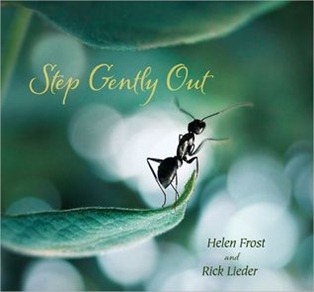
This picture book celebrates looking closely at the small things in the world around us.  Through a poem that focuses on the insects that you can notice if you slow down and take the time, Frost quietly reminds us all that there is another world beside our own that we often ignore.  Ants are climbing up stems, honeybees buzz past, crickets leap and spiders spin webs.  Children will get to see these insects up close, larger than life in the gorgeous photography that accompanies the poem.  It’s a perfect invitation to take a closer look.

Focusing on the more common insects in our gardens, the poem celebrates the ants, bees and moths that surround us.  Frost speaks about them very poetically, bathed in golden light or shining with stardust. 

Her gentle poem pairs beautifully with the artistic photography that features close ups of the insects in the poem.  The images are stunning and lovely, each focusing closely on an insect.  The morning dew image alone is a breathtaking photograph, but there is one after another that are exceptional.

Combining nature and poetry, this book celebrates both.  It also inspires mindfulness and a slower pace, so that children can make discoveries like this of their own.  Appropriate for ages 4-7.

Reviewed from library copy.
Review: Just Behave Pablo Picasso! by Jonah Winter

JUST BEHAVE, PABLO PICASSO!

Just Behave, Pablo Picasso! by Jonah Winter, illustrated by Kevin Hawkes

Pablo Picasso started out painting just like everyone else, but when he started to paint his moods in colors, things started to change.  The gallery owners wanted more pictures in just the same style, and suddenly Picasso became wealthy and well know.  But Picasso was not interested in painting the same rose colored paintings again and again.  Instead, he becomes inspired by African masks and does a new painting that breaks all of the rules.  When it is unveiled, the reaction is strongly negative and it is called “ugly” by the critics.  When the entire world starts doubting him, Picasso works even harder, coming out with another painting that is the birth of modernism.  This book displays the strength needed to stay true to yourself all through the lens of the incredible Pablo Picasso.

Winter has not written a conventional picture book biography here.  Instead, he plays with the format.  He uses comic book techniques like BLAM! and has pages that range from just a sentence or two to ones that are lengthier and provide more information and insight into Picasso.  This biography is less about the details of his life and much more about his art and its inspiration and evolving style.  We learn nothing of his family, but much about his process and his drive.

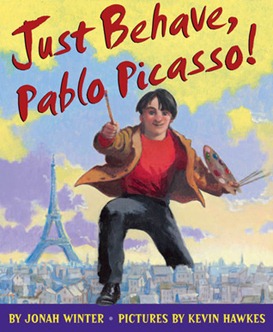
Hawkes’ illustrations carry that same playful feeling forward.  He toys with perspective, enjoys depicting the close quarters in Paris with see-through walls.  It takes a certain amount of playfulness to take on a book about Picasso and not imitate his style in the illustrations.  Hawkes’ style remains true to himself, underlining the overall message of the book by doing so.

A creative and fun picture book biography about a vibrant and rebellious artist, this book should find a place in children’s nonfiction collections.  Appropriate for ages 6-8.

Reviewed from library copy.

Review: Mooshka, a Quilt Story by Julie Paschkis

mooshka

Mooshka, a Quilt Story by Julie Paschkis

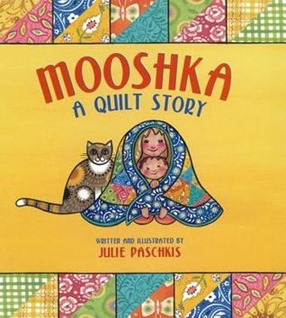
Karla loved her quilt that her grandmother had made for her from scraps.   Karla had named the quilt Mooshka.  Mooshka kept her warm at night and smelled just right.  But the most special thing that Mooska could do was talk.  Mooshka would wish Karla sweet dreams and in the morning invite her to pancakes.  If Karla couldn’t sleep at night, Mooshka would tell her the story of any patch on the quilt.  There were playful stories from tablecloth scraps, romantic stories from a bandana, exciting stories from a red scrap.  When baby Hannah moved into Karla’s room, Karla was upset.  She tried to get Mooshka to soothe her with a story, but Mooshka would not speak.  Then when Hannah woke up crying and could not be settled, Karla found that Mooshka might be able to share stories with other people too.

Paschkis has created a book that speaks to the power of story and family.  There is a wonderful spirit of discovery and sharing throughout the book as family stories are shared.  The book has a circular feel, coming to a satisfying close that makes the circle complete.  This sense of place, history and story brings a richness to the book.

What is most distinctive about the book is its art.  Done in ink and gouache, each page is bordered in patchwork, giving the entire book a warm and cozy feel.  The patterns also offer a lot of color, making a feast for the eyes as each page is turned. 

A warm book about quilts, family and stories, this book is ideal for reading under your own quilt and sharing your family stories there.  Appropriate for ages 4-6.

Reviewed from copy received from Peachtree Publishers.

Review: What We Wear by Maya Ajmera

what we wear

What We Wear: Dressing Up around the World by Maya Ajmera, Elise Hofer Derstine, and Cynthia Pon

This bright, colorful picture book shows cultural apparel from around the world.  The book revels in the unique colors, structure, beading and design.  Filled with images of children with smiling faces wearing their unique clothing, the book does contain some simple information on the clothes.  They are grouped in categories like dance and play, school clothing, and celebrating who we are.  The simple structure and basic information makes the book more appropriate for preschoolers than elementary students.

Because of the simplicity of the text, this book’s quality rests solely with the clarity of its images and the way they are presented.  Happily, the book has photographs of children of a variety of races, dressed in gorgeous colors and clothing.  They are shown on pages of equally bright colors that really add spice to the design. 

A very friendly look at costumes throughout the world, this book is a solid addition to preschool nonfiction collections.  It reminded me of looking through my mother’s Unicef calendars as a child.  Appropriate for ages 3-5.

Reviewed from copy received from Charlesbridge Publishing. 

Review: Green by Laura Vaccaro Seeger

green

Green by Laura Vaccaro Seeger

Wow.  That could be my entire review, just WOW.

Let me try to do better than that though.  Seeger looks at the different sorts of green that surround us.  There is sea green, shown with a turtle gliding through not only green but purples, reds, oranges and yellows too.  Lime green, pea green, faded green and fern green.  There are odd sorts of green too like wacky green, slow green and even no green at all.  The book is written simply with only a couple of words per page, making the focus of the book the illustrations.  And what illustrations they are.  This is my pick for the Caldecott winner so far this year. 

The illustrations are paintings that are done with plenty of thick paint, the brushstrokes visible making the pictures tactile.  They have a great depth of color and maintain a playful lightness that speaks to the young audience.  Turn the first page and you will be astonished to find die cuts in the page, done so smoothly and carefully that they don’t ever look like holes in the page until the page is turned. 

The book is a delight of surprises, new perspectives, and just speaks to everything that this format can be for children.  It is an unrivaled success as a concept book.  Appropriate for ages 2-4.

Reviewed from copy received from Roaring Brook Press.

Review: Words Set Me Free by Lesa Cline-Ransome

words set me free

Words Set Me Free: The Story of Young Frederick Douglass by Lesa Cline-Ransome, illustrated by James E. Ransome

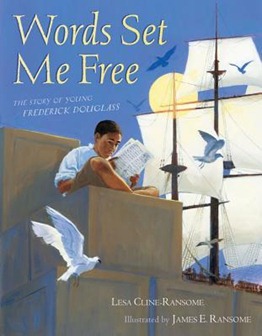
This picture book tells the story of Frederick Bailey, who would grow up to become the great Frederick Douglass.  His biography is also the story of the power of the written word and the ability to read.  Born a slave, Frederick was separated from his mother early in life and sent to live with his Grandmamma.  His mother would walk 12 miles at night to see him while he slept.  At age 8, Frederick was sent to work for another master in Baltimore.  It was there that he first learned his letters, until his mistress was told to stop teaching him as it would make him unfit to be a slave.  Daring white children to write better than him, Frederick continued to learn to read.  Returned to his home, Frederick taught the other slaves to read too, eventually writing his own way free from slavery.

A glimpse at an amazing mind and leader, this book takes us back to his childhood.  It is a testament to the damage and horrors of slavery, as readers see Frederick taken away from one person after another in his life.  It is also a celebration of the human spirit and the power of writing to change a life.  Cline-Ransome’s writing is exemplary.  She tells the story with wonderful detail, rich with meaning, and plenty of depth.  The book has more words than most picture books, but the story being told needs those words to shine best.

The illustrations are also rich.  There is such an aching feel to the image of the slave mother visiting Frederick that it is a portrait in heartbreak.  Other illustrations capture emotions beautifully as well.  The soaring nature of Frederick hidden up high and reading a newspaper rises against a purple-blue sky. 

The author and illustrator have created a wonderfully cohesive work with soaring prose and powerful illustrations.  Appropriate for ages 7-10.

Reviewed from library copy.

Review: Looking at Lincoln by Maira Kalman

looking at lincoln

Looking at Lincoln by Maira Kalman

Take a fresh and radiant look at our 16th president, Abraham Lincoln in this new picture book.  A young girl is motivated to find out more about President Lincoln after spotting someone in the park who reminded her of him.  She discovers many interesting facts, some of them well known like him being born in a small log cabin and other more obscure like his love of vanilla cake.  This is a personal look at a president, allowing us to see what his road to greatness was and how it ended in tragedy. 

Kalman takes a very modern look at history here.  A large part of its modern feel is the art in the book which is bright and blazing.  She uses color with abandon, with pinks, yellows, reds and greens adding color to simple illustrations.  Her paintings range from individual objects of importance to entire scenes from history.  The diversity of the images also adds a sense of playfulness to the work that is welcome.

Her writing carries through that same light touch, making the facts all the more interesting.  As she tells the story of Lincoln’s life, she is also telling the sad story of slavery and Civil War.  Somehow her illustrations and the tone she employs here keeps the book moving and never lets it bog down into too many words. 

A colorful, fascinating look at the life of our 16th President.  This book is appropriate for ages 7-9.

Reviewed from copy received from Nancy Paulsen Books.

Review: How Many Jelly Beans? by Andrea Menotti

how many jelly beans

How Many Jelly Beans? by Andrea Menotti, illustrated by Yancey Labat

Released in April 2012.

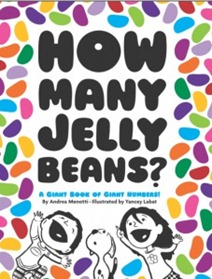
I cannot count how many dismal number and math books I have read over the years.  I’m lucky enough to have a mathematical kid, but finding books that he would enjoy was painful.  Many math books are a lot more about concept than about being fun to read.  Well, not this one!  This one winningly mixes math with candy, so that even non-mathematical kids will give it a try.  Aiden and Emma are just like most siblings, they are trying to get more than each other.  So when Emma asks for 10 jelly beans, Aiden asks for 20!  And the number just keep climbing from there.  Soon, they are up to 500 jelly beans, which may be way too many to eat.  But how about 1000 or 5000 or 10,000 in a year?  The jelly beans get smaller and smaller until the final number of 1 million is reached only be an enormous fold-out page. 

This visual sweet treat will get children able to truly visualize what the difference between thousands, tens of thousands, hundreds of thousands and a million are.  The art by Labat done in black and white with only the jelly beans for tantalizing color really works.  The focus is on the candy and the number.  Menotti nicely inserts division into the conversation too, when the children debate how many jelly beans they could eat in a year. 

I can see this over-sized book inspiring lots of counting, adding, dividing and multiplying in families, or it is also a very sweet book to share with your number-loving kid.  Appropriate for ages 5-7. 

An aside just for librarians, please don’t put this in the remoteness of the nonfiction section with your math books.  Let it enjoy being taken home as a yummy picture book with a jelly bean and math center.

Reviewed from copy received from Chronicle Books.

Review: Z Is for Moose by Kelly Bingham

z is for moose

Z Is for Moose by Kelly Bingham, illustrated by Paul O. Zelinsky

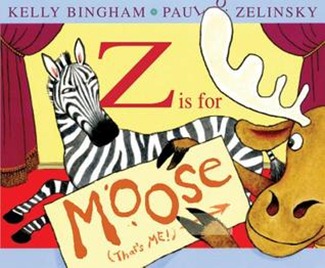
If you are looking for an alphabet book with more than a bit of nonsense, this is the one for you!  I happen to be a huge fan of alphabet books that play around, add humor and have plenty of twists.  If you are looking for a straight-forward ABC book, the title alone should be enough to have you looking elsewhere.  For those of you as silly as I am, continue on!  Zebra is in charge of the ABCs happening in the right order on stage.  Unfortunately, Moose doesn’t want to wait his turn.  He enters on D, knocking Duck away, messes up Elephant’s entrance too, gets his head in the way for Hat, pops out of the pocket for Kangaroo, and continues to be silly for Lollipop too.  But the insult truly comes when they decide to go with M is for… Mouse.  Now Moose is upset and rampages through P and Q, drawing scribbles on R and S.  Zebra tries to stop him, but ends up messing things up himself until the happy ending at Z. 

Bingham’s writing is filled with asides from the different animals.  The book is extremely funny, the pacing is brilliant, and the twists are unexpected.  There is a great tension built up as the letter M approaches, and then with the twist, it is pure genius. 

Zelinsky’s illustrations add to the mad gaiety of the book.  Moose is obnoxious but also charming, his emotions clear on his face.  The reaction of Moose as M passes him by is delightful, the rampage of destruction is great fun, and his scribbling is clever. 

It is clear that this is a book that was pure fun to create, since that is apparent on every page.  Impossible to read without laughing and grinning, this is an alphabet book that is sure to delight.  Appropriate for ages 4-6.

Reviewed from library copy.