Review: Moonlight by Helen V. Griffith

moonlight

Moonlight by Helen V. Griffith, illustrated by Laura Dronzek

Rabbit waits for the moon to appear out of the cloudy skies, but leaves a bit too soon to see the moon emerge.  The moon shines its buttery light into space and onto the earth.  It covers the mountains, the trees, enters the water, and even enters Rabbit’s burrow, making his dreams fill with the light.  He wakes up, leaves his burrow and dances in the field with the butter of the moon on his head.  

This picture book is a poetic look at moonlight as butter, continuing the metaphor throughout the book.  While some may quibble about moonlight being as yellow and thick as butter, there are nights where the light is so yellow that it almost has a weight.  Those full moon nights are buttery and rich, filled with that light that is so very different than sunlight.  Griffith embraces the metaphor entirely, enriching moonlight with her buttery idea. 

Dronzek’s illustrations really make the metaphor work in the book.  Readers can see the butter of the light as it coats the entire forest.  They can see it coat Rabbit and his dreams, along with the flowers, grass and the entire world.  She has chosen her yellow with care, selecting a color that skims between butter and moonlight. 

A bedtime book that embraces butter, this book could be used to teach about metaphor or could be used with even very small children as a solid bedtime read.  Expect hunger for buttery pancakes in the morning!  Appropriate for ages 2-4.

Reviewed from library copy. 

Review: The Boy Who Harnessed the Wind by William Kamkwamba

boy who harnessed the wind

The Boy Who Harnessed the Wind by William Kamkwamba and Bryan Mealer, illustrated by Elizabeth Zunon

This picture book version of the nonfiction book manages to translate the story of William Kamkwamba with clarity and inspiration.  When a drought hit his village in Malawi in 2001 and 2002, 14-year-old William and his family were in real danger of starving.  William had always through about machines and even after he was forced to leave school due to the drought, he kept reading books about them.  He thought about what could be done with a windmill in his village, bringing light and water.  So he hunted through the junk yard and found pieces to use.  Built entirely out of scraps, his first windmill and its electric wind brought electricity to the valley.   The afterword gives more details about William’s story and how it took him longer years to bring his dream of pumping water to fruition. This inspirational story speaks to the inventor, the doer, and the dreamer in all of us.

The writing here is lovely.  The imagery is impressive, such as comparing the windmill to a “clumsy giraffe” and giving William’s sorrow at having to leave school a physical sense: “alone with the monster in his belly and the lump in his throat.”  The book carefully captures what life in Malawi was like and what little could be done to make a difference before transforming into a book where dreams create change.  

Zunon’s illustrations are exquisite.  They are a captivating mix of painting and collage.  Filled with texture, the textiles of the clothing come to life and the objects have weight and feel.  The most impressive are the faces of the people, filled with light.  The faces become the place your eyes go first, making the message of the book just that much stronger in a subtle but powerful way.

A luminous picture book version of a compelling real-life story, this book should inspire others to not only dream but to make those dreams happen.  Appropriate for ages 7-10.

Reviewed from copy received from Dial Books for Young Readers.

Gideon by Olivier Dunrea

gideon gideon and otto

Gideon by Olivier Dunrea

Gideon & Otto by Olivier Dunrea

Gideon is the newest fowl in Dunrea’s farmland.  He is a gosling who loves to play, hates to nap, and has a favorite toy, an octopus named Otto.  In the book bearing just his name, Gideon is hard at play and refusing to listen to his mother call him for his nap.  He just keeps racing on to the next thing to play with.  Readers who are paying close attention will notice that he starts slowing down towards the end of the book, just before he falls asleep all on his own.  In Gideon & Otto, Gideon is once again hard at play on land and in the water.  Otto participates happily, listening when books are read aloud, hiding in the leaves, and even bobbing in the water.  When Gideon sets Otto aside to play more, he instructs Otto to stay there.  But in the midst of playing, Otto gets knocked down and then disappears.  Gideon is about to give up when Otto appears again.  Filled with appeal, these books are jolly additions to Dunrea’s menagerie.

Toddlers and their parents will immediately recognize moments out of their own days here.  From being too busy to nap to losing a beloved toy, these moments are what create the tapestry of young lives.  Told with a wonderful humor, zinging with speed and action, these books beg to be shared.  In fact, when I was curled up to read them to myself, my 10-year-old appeared and insisted that he be read them aloud.  There is such charm to just the covers and even more inside the pages.  These are small books that are very rich.

Perfect for busy toddlers who need some time to slow down a bit.  Appropriate for ages 2-4, or for 10-year-olds who need a cuddle too.

Reviewed from library copies.

Review: A Leaf Can Be… by Laura Purdie Salas

11505

A Leaf Can Be… by Laura Purdie Salas, illustrated by Violeta Dabija

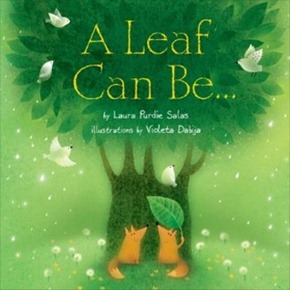
Explore leaves throughout the seasons in this work of poetry.  The book focuses less on the science of leaves and much more on their impact, their dance on the wind, the shade they spill, and the color they give.  Told in verse that will work very well with young children, this book captures the wonder of nature.  

This is a dance of a book with rhymes and rhythms that really sparkle.  Much of the book is done in two-word lines that encapsulate one aspect of leaves, “sun taker” and “food maker,” and then in the autumn, “pile grower” and “hill glow-er.” 

Dabija’s art is jewel-toned and dynamic.  Her work is infused with merriment and joy.  She uses layers and transparency to great effect, capturing the beauty of nature.  One particularly striking page is her “frost catcher” where the layers of her work shine and the details are luminous. 

A great book to use in a unit about trees, this is also a book that invites exploring a poem.  Exquisite writing is well matched with rich art in this book.  Appropriate for ages 3-6.

Reviewed from library copy.

Review: Zoo Girl by Rebecca Elliott

zoo girl

Zoo Girl by Rebecca Elliott (Link to InfoSoup)

Told in just a few words per page, this book tells the story of a little girl who doesn’t have a family.  At the orphanage she is lonely and has no friends.  Then the children visit the zoo and suddenly the little girl feels at home.  She is left behind at the zoo and the animals discover her.  They befriend her and she lives with them for awhile until the zookeepers discover her curled up with the tigers.  The little girl does not want to go, and the book ends with a happy ending where the little girl is adopted by the zookeeper couple.  The story is a simple one, told in only a few words, but the sense of belonging and being wanted remains a powerful message.

Elliott’s story is really told in the illustrations rather than the words.  Her art is a rich mix of texture, patterns, drawing and photographs.  The rather simply drawn characters and animals live in a world made dazzling.  Even the air itself seems to have its own feeling and shape.  The elephant has wonderful wrinkles, the tiger has plush fur, and the penguin’s feathers are swirled. 

Also, in the orphanage, the mood is not grim.  It is specifically this little girl who does not have friends and feels alone.  The other children are merry and playing with one another.  That changes the message quite a bit too.

Perfect for toddlers because of its brevity, this book is a very friendly way to talk about adoption.  Appropriate for ages 2-4.

Reviewed from library copy.
Review: Sweet Dreams by Rose A. Lewis

sweet dreams

Sweet Dreams by Rose A. Lewis, illustrated by Jen Corace

This quiet bedtime book is the perfect antidote to a busy day.  Starting with a mother carrying her daughter up the stairs, the mood is set for a sleepy bedtime.  The book moves from that child to the moon and then a sleeping baby bear, a soaking wet tiny mouse, and birds in a nest.  Butterflies sleep as moths take wing into the night.  Crickets start to sing and other nocturnal animals appear.  Then the sun returns and a quiet morning begins with animals starting to rise and eat.  The book returns to the bedroom and the child now curled in bed, her walls opening to reveal the wonder of night beyond.

Lewis’ writing is poetry, she conveys the quiet mood beautifully without the book ever becoming dull.  Instead it is filled with quiet wonder at the change that happens when darkness falls, the beauty that emerges.  She captures moments that invite cuddling up cozily, creating a dreamy glowing world.

Corace’s illustrations help with this as well.  Her art here is done with pen, ink and watercolor.  She uses delicate lines and deep colors to create this nighttime world.  They are filled with moonflowers, a gently smiling moon, and animals that are not anthropomorphized at all. 

This book is a joy to read and will be a pleasure to share with your little sleepyhead.  Appropriate for ages 4-6.

Reviewed from copy received from Abrams Books.

Review: One Cool Friend by Toni Buzzeo

one cool friend

One Cool Friend by Toni Buzzeo, illustrated by David Small

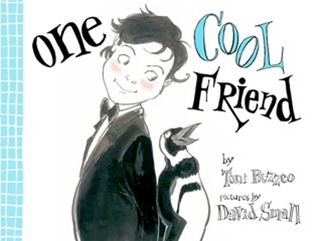
Elliot was a very proper boy, dressed in his tuxedo and bow tie.  When his father asked if he wanted to go to the aquarium one day, he went along despite worries about loud kids.  When they got to the aquarium, his father sat down to read and sent Elliot off to have some fun.  Elliot went past the jellyfish, the saltwater display, and the hands-on tide pool and discovered the penguins!  He immediately connected with the birds and then asked his father if he could have one.  His father glanced at a poster for plush penguins and agreed.  But Elliot did not have a plush penguin in mind.  Instead, he brought home a real penguin.  Once back home, Elliot wasted no time in creating a perfect penguin habitat.  But after days of happy living, what in the world would his father say when he discovered the penguin?

This book has its own wonderful feel.  From the dapper lad in the lead role to his couch-loving, slow-moving father, it has the feel of a classic book but also one that is delightfully modern as well.  Buzzeo’s writing is fresh and funny, creating a book that is both inviting and compelling.  It also has great twists throughout where you never know what will happen next.  In other words, it’s a stellar read.

Small’s art is what provides a large part of the feel of the book.  His tuxedo wearing kid, the splash of green that is the father, and the busts of other colors throughout.  The use of primarily blacks and whites to tell the story pays homage to its subject and also gives it the marvelous stylized feel that works so well.

The great librarian character at one point doesn’t hurt the book one smidge either!  This is a dapper, dazzling read that is creative, funny and a delight.  Appropriate for ages 4-6.

Reviewed from copy received from Dial Books for Young Readers.

Review: Secrets of the Garden by Kathleen Zoehfeld

secrets of the garden

Secrets of the Garden: Food Chains and the Food Web in Our Backyard by Kathleen Weidner Zoehfeld, illustrated by Priscilla Lamont

Alice loves it when spring arrives and they can start planting the garden.  Her dad gets the soil ready for planting and then she and her brother start putting the seeds in.  It seems like a long time before the seeds finally sprout.  Then other seedlings are transplanted from pots and potatoes are sown.  Lettuce and radishes are ready to eat first, and Alice spots a rabbit munching on them too.  She also thinks a mouse might be eating the fallen corn.  Hawks hunt in the garden and there are plenty of insects too.  Autumn nears and harvest begins, and the food cycle of the garden is complete for another year.  Throughout the book, the chickens offer commentary about the cycle itself with information about herbivores and carnivores, compost, worms and much more. 

This is an outstanding example an information book for children.  The chickens give the book a lighter tone, even though they are the ones offering the hard science.  The story celebrates gardening, the food cycle, and having a place connects one with nature.  Zoehfeld’s writing is breezy and cheerful, setting just the right tone of exploration, wonder and science.

Lamont’s illustrations add to the delight.  They have a similar feel to Michael Rosen’s with the friendly characters.  The colors tend towards the subtler side, inviting close inspection and learning.

This is a choice book for units on the food cycle or for children looking for information that they will enjoy learning.  Appropriate for ages 5-8.

Reviewed from copy received from Alfred A. Knopf.

Review: Little Bird by Germano Zullo

little bird

Little Bird by Germano Zullo, illustrated by Albertine

Released April 1, 2012.

Winner of the 2011 Prix Sorcieres for illustration, the French Caldecott medal, this book is an impressive example of the magic of illustration and only a few select words.  A man drives his red truck up to the edge of a cliff and opens the back, releasing several amazing birds.  When he glances into the truck, he sees one bird left behind.  The man tries to tell the bird where to head and that it should fly, but the bird just looks at him.  The two sit together and the man shares his sandwich with the little bird.  The man shows the bird again where to head and how to fly, landing on his face.  The bird spreads its wings and flies away, joining the other birds the man had let go.  The man watches the bird fly off, heads back into his truck and drives off.  What seems like the end of the story is actually just the beginning.

Zullo has chosen his words carefully, letting the story really be told via the illustrations.  The words offer a touch of guidance to the depth of the work, the deeper meaning of the simple story.  They speak to the importance of noticing small things and how those small things are the true treasures in life.  It’s a message that will speak to children and adults alike, in very different ways.

Albertine’s art is wonderfully bright and filled with playful moments.  From the sunny yellow ground, the robin’s egg blue sky and the red truck, there is plenty of zing in these pictures.  As the story is told in the illustrations, the relationship between bird and man is also shown just in pictures.  The looks, the moments of connection, the departure, all add up to moments that lead to the magical conclusion.

An impressive picture book that is modern, fresh and will have readers looking for tiny treasures in their lives too.  Appropriate for ages 5-adult.

Reviewed from copy received from Enchanted Lion Books.