Review: Into the Outdoors by Susan Gal

into the outdoors

Into the Outdoors by Susan Gal

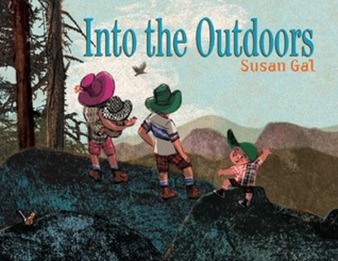
Learn your prepositions in the fresh air with this book that takes us up into the mountains and down into the forest.  A family heads out on a camping trip.  Along the way they go over a bridge and under the trees.  Once they reach the woods, they head out on a hike, following a trail around the lake, across a stream, and between some large rocks.  They return to their campsite and the fire, where the animals they saw on their hike have followed them back.  The entire book is playful and fun.

Gal has managed to structure a fine little story out of her prepositional phrases.  The family moves through their day, exploring the natural world.  While the book would be of use with prepositions and prepositional phrases, it is also a gem of a short read all on its own. 

Gal’s illustrations lift this book up, giving it a modern freshness that is not without whimsy.  From the very friendly and approachable animals, to the grin of the baby riding in its sling, this book has a merry and jaunty feel that one gets outdoors.

An enjoyable prepositional outdoor hike, this cheerful title will be embraced as a learning tool but also as a great bedtime read.  Appropriate for ages 3-5.

Reviewed from copy received from Alfred A. Knopf.
Review: Extra Yarn by Mac Barnett

extra-yarn-cover

Extra Yarn by Mac Barnett, illustrated by Jon Klassen

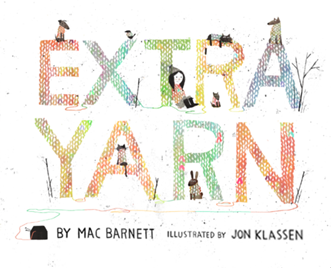
In the bleakness of winter when the town was all white from snow and black from chimney soot, Annabelle found a box that contained yarn of every color.  She knit herself a sweater and still had more yarn, so she knit a sweater for her dog too.  There was still yarn, so she started knitting sweaters for everyone or hats for those who didn’t want sweaters.  Still there was more yarn, so she knit sweaters for all of the animals around.  She still had not run out of yarn, so she started knitting for objects that don’t wear sweaters, covering houses and mail boxes with yarn.  That’s when Annabelle attracted the attention of a vain archduke who wanted the unending box of yarn for himself.  When she refused to sell it to him at any price, he stole it from her.  But we all know the rules about magic things, and soon the box was back in Annabelle’s hands.

This book is filled with magic and not just in the form of the unending yarn.  Barnett’s storyline is a combination of gentle storytelling and subtle humor.  It manages to be both fresh and also pay homage to traditional tales. 

Klassen’s art has the starkness of his previous book, I Want My Hat Back, but the brightness of the yarn adds an entirely new dimension.  It glows in all of its color and texture against the rest of the illustrations, bringing not only color but also a robust life into the images.  His use of digitally scanned textures to create the knit effect is ingenious. 

A delight of a picture book that references the traditional while creating something completely new and magical.  Appropriate for ages 3-5.

Reviewed from library copy.

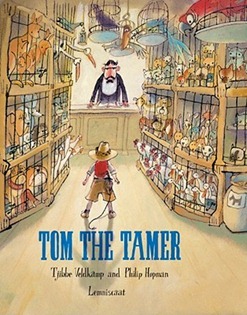
Review: Tom the Tamer by Tjibbe Veldkamp

tom the tamer

Tom the Tamer by Tjibbe Veldkamp, illustrated by Philip Hopman

Tom may be able to train snails to jump on a trampoline and squirrels to swing from trapezes in the trees, but he can’t convince his father to go outdoors.  His dad is too frightened of all of the animals out there.  So Tom sets out with a plan to bring the animals in to his father.  He starts by heading to the local pet store and buying a polar bear.  He trains the polar bear in the park and by that evening, the polar bear is pretending to be their new furry white chair in the house.  Tom’s father loves the new chair and never notices that it is actually a polar bear.  The next day, Tom heads out and gets even more animals from the pet store, training them all to act like different pieces of furniture.  Soon the entire living room is filled with animals, and Tom’s father loves all of the new “furniture” too.  But what will happen when he finds out that Tom got all of these new things at the pet store?

Veldkamp has created a broad comedy that stretches the imagination in a most wonderful way.  It also takes the parent/child relationship and merrily turns it on its head.  Tom is a very creative young man, seeing the world in his own unique way and definitely not in the way that his father does. 

Hopman’s illustrations add to the fun, from the crowded shelves of the pet store to the graceful curve and smile of a polar bear chair.  The illustrations have a certain wildness but also a friendly style that makes sure that everyone knows this is pure fun.

An exuberant book that is full of zany fun, this Dutch import would be a great addition to an animal story time.  Appropriate for ages 4-6.

Reviewed from copy received from Lemniscaat.

Review: And Then It’s Spring by Julie Fogliano

and then its spring

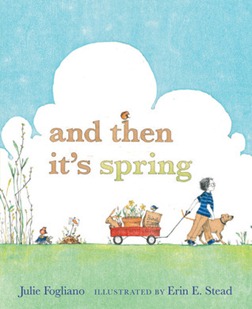
And Then It’s Spring by Julie Fogliano, illustrated by Erin E. Stead

This enchanting book starts with the brown of late winter.  It’s the brown that you have to plant seeds into in the hopes of green coming soon.  But then you have to wait for rain, hope that the birds didn’t eat the seeds, realize that the bears may have stomped too close to the seeds because they can’t read signs, and then you have to wait some more.  It stays brown, but even the brown starts to change and seem more hopeful and humming.  Then you wait some more, and then one day, if you are patient and keep caring for your newly planted seeds, you wake up to green!

Oh how I love this book!  In her poetic prose, Fogliano captures the patience of gardening, the drudgery of late winter, and the hope that must be invested in order to see seeds spring to life.  I had expected the birds eating the seeds, but the stomping bears led me to realize that this was more playful a book than I had originally expected, something I love to have happen in the middle of a picture book!  

Add to this the illustrations of Caldecott winner Stead and you have such a winning book.  Her art has a delicacy that is perfect for the whispers of early spring.  The boy in the story is thin, wear glasses, and by the time spring finally comes has created quite a garden with birdfeeders, signs, and plenty of lumps of dirt.  By far my favorite part comes at the end, where the garden does not burst into flowers but remains weedy and lumpy, but green.  Perfection.

Doing a spring story time soon?  Get your hands on this book!  Ideal for classes planting a garden or all of us longing for the green to return.  Appropriate for ages 3-6.

Reviewed from copy received from Roaring Brook Press.

Study Shows Decline in Nature in Picture Books

A recent study by Dr. J. Allen Williams, Jr., a sociologist at the University of Nebraska-Lincoln took a look at Caldecott Award books between 1938 and 2008.  They specifically looked at images in the books and whether they depicted nature, indoor settings, or a combination of human and natural settings like a playground.  They looked at over 8000 images in 296 books.

Due to the increased interest in the environment, one of the possibilities was that more nature would be in the award winning books in more recent times.  Another possibility, and the one that turned out to be true, was that because of our isolation from the natural world in the modern day, there would be fewer images of nature.

The study showed significant declines in illustrations of nature in the picture books.  Now, those of us who know children’s books can come up with many examples of incredible books that focus on the environment, and before I read more about the study that was exactly what I was starting to do.  This study shows though that the books that are being selected as the best picture books of the year are not those about nature.  An interesting trend that.

What is your take on this?  Do you agree with the trend?  Wonder at whether it reflects the full picture book world? 

Review: Hugs from Pearl by Paul Schmid

hugs from pearl

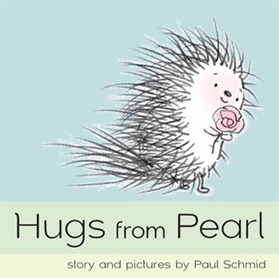
Hugs from Pearl by Paul Schmid

Pearl is a very friendly little porcupine, and one of her favorite things to do is give everyone hugs.  But porcupines are prickly and Pearl’s hugs hurt!  At first Pearl tried keeping Band-Aids handy after hugs, but she didn’t like to make her friends say “Ouch!”  Then she tried pin cushions on her quills, but that took way too long and she couldn’t reach them all.  Pearl tried a long hot bath, but her quills refused to soften.   Pearl decided that she just couldn’t give hugs any more.  But then she got inspiration on her way home from school when she saw some bees buzzing happily among the thorny roses.  Could Pearl have figured out the trick to pain-free hugs from a porcupine?

Schmid has created a story that is simply told and can be read solely as a book about a little porcupine, but it is also a story that could be used for discussions about what each of us has that is prickly and hurts other people and how we can solve it.  The story has a touch of heartache and a real sweetness to it that never becomes sickly sweet or overbearing, instead it has a great freshness to it.

The art is equally fresh with its charming mix of pale greens and pinks.  Pearl herself glows with her pale pink blush, popping on each page compared to the other animals.  Her facial expressions manage to convey deep emotions even though they are just a few lines on the page.  The simplicity in both the text and the illustrations make the book very enticing.

This book is a shining example that adorable, sweet books can also be stirring and warm.  Appropriate for ages 2-4.

Reviewed from library copy.

Review: A Boy Called Dickens by Deborah Hopkinson

boy called dickens

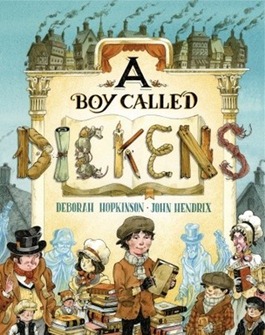
A Boy Called Dickens by Deborah Hopkinson, illustrated by John Hendrix

Enter the world of Charles Dickens’ childhood in this picture book.  The fog and cold of London will enfold you, along with the smoking chimneys and the dankness of the Thames.  Twelve-year-old Dickens worked in Warren’s blacking factory, wrapping bottles of blacking for sale.  He entertained the boy next to him with his stories when they could get away with it.  Dickens worked ten hour days and when work is finally completed, he headed home to his tiny attic room where he lived alone.  His family was in the debtors’ prison with only Dickens bringing in any money at all.  When his father and family is released from prison, Dickens’ life changes and he is finally allowed to go to school.  This book celebrates the 200th anniversary of Dickens’ birth in a way that will resonate with children.

Hopkinson’s story begins with an invitation into London and into understanding the world at that time better.  It is actually like entering a novel by the great writer.  Readers will chase after the fast-moving Dickens until they figure out where he is headed.  There is an element of play and fun from the get-go, even though the subject here is very serious. 

Hendrix’s illustrations show the gritty world that Dickens grew up in.  Yet all is not fog and work, there is the beauty of story, the world of imagination.  It’s an impressive mix of historical accuracy and a more whimsical take on creativity. 

Picture book biographies of historical figures can be tricky, since so much information needs to be shared.  Here the balance of story telling and imagery is deftly done, creating a book that is noteworthy.  Appropriate for ages 6-9.

Reviewed from library copy.

Review: Crouching Tiger by Ying Chang Compestine

crouching tiger

Crouching Tiger by Ying Chang Compestine, illustrated by Yan Nascimbene

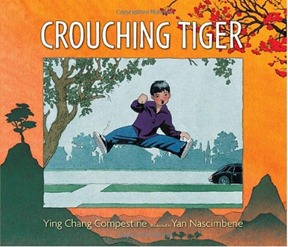
Vinson is fascinated when his grandfather arrives from China and practices tai chi in the backyard.  When Vinson finds out it’s a martial art, he thinks it might be like kung fu but soon learns it is not.  His grandfather begins to teach him the basic movements of tai chi but it is slow and requires a lot of patience.  When Vinson is offered a place in the Chinese New Year parade, he’s not sure he wants to even participate.  However, when he and his grandfather get to China Town, he discovers that his grandfather has been saying wonderful things about him and that everyone is very pleased to meet him.  Even more importantly, the respect everyone shows his gentle, quiet grandfather changes his view of martial arts and the man himself.

This book is perfect for Chinese New Year, since that holiday is celebrated in the story.  The growth of the main character is well developed, especially for a picture book.  The quiet grace of tai chi is shown throughout the book, including the overall tone of the story itself. 

The illustrations also reflect that quiet simplicity with their expanses of watercolor and fine lines.  The illustrations are modern-feeling and capture the excitement of the New Year and the movement of martial arts with great energy. 

This winning title is a dynamic but also introspective look at the Chinese New Year and tai chi.  Appropriate for ages 4-6.

Reviewed from library copy. 

Also reviewed by BookDragon.

Review: Caveman, A.B.C. Story by Janee Trasler

caveman

Caveman, A.B.C. Story by Janee Trasler

Take a prehistoric trip through the alphabet in this funny picture book!  This book tells the story of a caveman’s adventures solely through pictures and a few alphabetical words.  It starts with an acorn that both the caveman and a squirrel are after.  They are scared by a bear into a cave where a dinosaur was living.  A bit later, the caveman makes friends with an odd little creature who had been trapped in some ice.  Unfortunately, the big green dinosaur appears again and chases them around, forcing them to leap onto vines and swing away.  But the book can’t end before one final uproarious slapstick moment which leads all the way too the Zzzz at the end.

This story is told only in 26 words, so that means that the illustrations are what really make this book work so well.  Filled with a zany cartoon style, the pictures are action-filled and great fun.  The huge green dinosaur may pursue the caveman in the book, but readers will notice the rounded teeth and the big smile long before the caveman does.

A fast-paced and funny alphabet book that will do well with young dinosaur fans.  Appropriate for ages 2-4.

Reviewed from library copy.

Also reviewed on Jen Robinson’s Book Page.